Erin McKinstry, Alaska's Energy Desk - Sitka
Special rate could help some rural Southeast communities afford heat pumps

An air-to-air heat pump can provide a more efficient alternative for heating a home, particularly in regions of Alaska with less dramatic temperature swings like Southeast. Because they run off of electricity, they can also reduce greenhouse gas emissions in communities that use renewable alternatives like hydropower or solar. (Erin McKinstry/KCAW)

Many Southeast Alaska homeowners are converting to electric heat pumps as a way to reduce reliance on fossil fuels and improve air quality. But in some of Southeast’s smallest communities, the high cost of electricity makes operating them unaffordable. A recent study found that offering a special rate for heat pumps in the Kupreanof Island village of Kake and other remote communities could help the consumer, the electric utility and the environment.

Kake resident Adam Davis decided to convert to a heat pump about four years ago. Before that, he was using a pellet stove, but barging in fuel was getting expensive.

When Tlingit-Haida Regional Housing Authority offered to install a heat pump for free as part of a pilot program, it piqued his curiosity.

“I was willing to be a guinea pig to see whether or not they were viable here,” he said.

Davis doesn’t have any complaints about his air source heat pump. The devices can work like an air conditioner, using electricity to move hot air outside during the summer. But unlike an air conditioner, they can also move warm air into the home to provide heat in the winter. They also provide added benefits like air filtration, compared to wood and oil heating, which can reduce indoor and outdoor air quality.

Davis said maintaining and operating the heat pump is also a lot easier than the pellet stove, and he’s only seen a slight increase in his electricity bill. Even with that increase, he thinks he’s saved money not having to buy the pellets for his stove.

But that wouldn’t be the case if it was his only source of heat, especially when temperatures drop below freezing. He also has propane and oil heaters for his nearly 2000-square-foot home.

“I see them as a great, you know, complementary type of heat source. Not as a primary heat source just because of the wide swings in our temperature here,” he said. “I don’t think you can rely on them in the coldest of months.”

Davis is one of six Kake residents to benefit from the program so far, including a few of his neighbors. He said they installed heat pumps as their only source of heat and their electric bills skyrocketed, minimizing or eliminating savings from not having to buy heating fuel.

Like many rural Alaska communities, the cost of electricity in Kake is high: 1.5 times the state average and 2.5 times the national. And that’s when you factor in something called Power Cost Equalization, a state program that subsidizes rural energy costs. In Kake, any usage over 500 kilowatt hours a month is about double the cost because it isn’t covered by the program. And the added electrical demand of heat pumps can easily push a household over that threshold.

That’s one of the reasons the Inside Passage Electrical Cooperative or IPEC worked with the Alaska Center for Energy and Power to study whether a lower rate for heat pump users might be a good fit for Kake and the four other communities they serve.

“I do understand that people are having a hard time, you know, those who have heat pumps are having a hard time paying the extra amount on their electric bill every month,” IPEC CEO Jodi Mitchell said. “And so some of them are really struggling with that.”

She said it’s expensive to provide electricity to the remote communities IPEC serves because they each have their own infrastructure, like diesel generators or hydroelectric dams. And IPEC has way less customers to carry the burden of those fixed costs than in a city. As customers cut back on electrical use and introduce energy efficiency measures to try and save money, it can actually make rates per kilowatt hour go up because the utility still needs a minimum amount of money coming in to keep things running.

“People always say IPEC has to be more efficient, and IPEC’s customers need to be more efficient. It doesn’t work that way because of the economies of scale factor,” Mitchell said. “The more we sell the cheaper it is for everybody. That’s it in a nutshell.”

Introducing a special rate for heat pumps could encourage more customers to use them, and the money they’d normally spend on imported fuels would go toward electricity instead. And even though IPEC would absorb the cost of the special rate, the study shows that it’s still worth it financially because it would help them sell more power.

The study also shows that, with the special rate, consumers would save money on heating in the long run, even if they have to cover the cost of the heat pump and installation. But with the program Davis benefited from, that could come for free.

And finally, in places like Kake where renewable hydropower is in play, heat pumps are a win for the environment because they replace non-renewable fossil fuels with clean energy.

Mitchell is excited about the findings, but also recognizes their limitations. IPEC doesn’t want to overload their microgrids either. They’ll likely have to limit the number of residents who can benefit from the special rate, which would apply to any usage over 500 kWh a month.

“So we’re trying to find this sweet spot: how many can we allow, assuming that our system was using a peak demand from like January? If we added this much more burden on our electric system, would we have to start up another generator? And that’s what we want to avoid,” Mitchell said.

The study put that sweet spot at about a quarter of Kake households installing heat pumps.

Gary Williams is a former executive director of Kake’s tribal government, the Organized Village of Kake. He’s been working on a grant-funded project to study heat pumps and electric vehicles to help Kake address energy issues, and hopes IPEC will implement the special rate.

“Because without that rate for heat pumps and EVs, it quite frankly, probably wouldn’t be practical,” he said.

He said looking to alternative solutions to address the high cost of energy in Kake is imperative. It doesn’t just impact households; it has a broader effect on the entire economic development of the town.

“Time after time, we’re faced with the high cost of electricity just making it impractical and unfeasible for anyone to develop new businesses,” Williams said.

IPEC plans to hold a meeting with its members in early June to discuss the special rate for heat pump users. If implemented, customers would apply on a first-come, first-served basis.

Sitka fish and game committee speaks out about climate change

Members of the Sitka Advisory Committee expressed concern that climate change is impacting habitat for fish and game resources that commercial, sport and subsistence users rely on. (Photo by Erin McKinstry/KCAW)

Sitka’s local fish and game advisory committee is speaking out again about climate change and its impacts on commercial, sport and subsistence activities.

When the group met on Wednesday, they signed off on a letter to other advisory committees around Alaska urging them to take action. Last November, the group unanimously passed a climate emergency resolution, and in February, they were part of an effort that unsuccessfully petitioned the city assembly to do the same.

The city has since formed a task force to address climate change locally.

Member Stacey Wayne who holds the shellfish seat, said at the meeting that part of the Sitka advisory committee’s job is to advise others on wildlife conservation and use, including matters related to habitat.

“We’re fighting as user groups to have fish to fish, and our seasons are collapsing and our stocks are collapsing, and all of these are related to climate change,” Wayne said. “And so our job is to preserve opportunities to fish and hunt for the community.”

Support for the letter was almost unanimous, but member Luke Bastian, who holds the guide seat, did have some concerns.

“I think there’s unforeseen consequences there, and I don’t know if it actually gains us anything,” he said.

Wayne and others disagreed, saying that calling on other advisory committees to take action could have a tangible impact.

“Maybe with many voices pressuring local governments to become louder in support of stopping climate change and taking actions at the local level, there can be an impact to help preserve and protect the habitat for the species that we’re supposed to be protecting,” she said.

The committee also signed off on a letter opposing the decision to reverse the Roadless Rule in the Tongass National Forest and filled or renewed positions on the trapping, processing, alternate and sport fishing seats.

Residents free entangled humpback whale near Southeast Alaska community

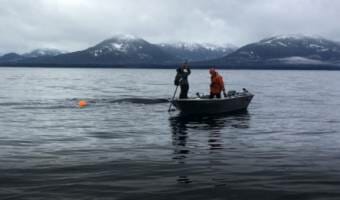
Tenakee resident Gordon Chew holds a GoPro in the water to gather footage of a nearly 40-foot humpback whale entangled in Tenakee Inlet, while resident Steve Lewis carefully maneuvers the skiff. (Photo by Rachel Myron/NOAA permit #18786-04)

It was the middle of the night on the day before Thanksgiving when a gut-wrenching sound awoke residents in the Chichagof Island town of Tenakee Springs.

“It was a pretty sad and mournful and awful sound,” resident Wendy Stern said.

Resident Steve Lewis described it as a plaintive cry for help.

“It was just this sort of whistling and groaning,” Lewis said.

Neither of them actually heard the noises until later in the day when the sound carried closer to their homes. But they were among the first to respond to its source — a 40-foot humpback whale caught in tanner crab pot gear that, resident Gordon Chew said, came from Kodiak around 630 miles away.
“People were very shaken up after losing a lot of sleep and listening to a bellowing humpback whale all night,” Chew said. He awoke to calls from those distressed residents.

Large whale entanglements are fairly rare in Alaska. Only around 10 are spotted each year, and most whales shed the marine debris or fishing gear on their own. But once or twice a year, human intervention is required to save a whale’s life.

As Chew, Lewis and Stern would soon learn, this was one of those times. All three are part of a network of volunteers trained by NOAA to respond to whale entanglements.

As soon as they got the go-ahead from the National Oceanic and Atmospheric Administration, Chew and Lewis headed out in a skiff to collect footage while Stern followed in a support boat. An orange buoy marked the spot where the animal was now frozen in place. Slowly, Chew lowered a waterproof video camera on a long pole into the water.

“It had an anchor on the tail, lines going forward, a buoy in its mouth, another buoy at its tail. And it really could barely move,” Stern said. “It was awful to see an animal all bound up like that.”

“We could hear it breathing and it was labored, the way it was pinched and folded in half,” Chew said.

Then, they relayed the photos and footage to people like large whale entanglement specialist Sadie Wright at NOAA.

“It was amazing that people were willing to give up their holiday preparations in order to get this animal free,” Wright said. “We were able to work with those folks in Tenakee to evaluate the photos and the video, come up with a safe and deliberate plan to do these disentanglement tactics from a distance to keep people safe,” Wright said.

That’s because disentangling a whale is dangerous. Both Chew and Lewis have had extensive training, have access to specialized tools and assisted with multiple entanglements over the years. And they consulted with NOAA every step of the way.

Chew said even some of the most experienced responders have been killed.

“You know a 40-ton animal can do an awful lot of damage. A pectoral fin can weigh 900 pounds, just the fin off the side of the animal. So I mean if it comes down on you or your boat, it would be very very bad,” Chew said.

By the time they were ready to try to cut the whale free, it was Thanksgiving morning. Two more boats joined them. A long, careful dance began. What Stern described as an agonizingly slow process.

“Everyone thinks of maybe some kind of YouTube video where you go out and there’s these heroes and maybe they’re in wet suits and they go down and they cut off the gear and the whale jumps in the air and there’s a rainbow,” Stern said. “It’s just not that way.”

First, they cut the whale free from the heavy crab pot weighing it down. Then, they followed the whale as it began to swim, hoping it would shed the remaining gear. Chew made several unsuccessful attempts to cut it away.

“I wish I could’ve done more. And I just tried and tried and tried,” he said. “And it was one of the most challenging things I’ve ever done, and I just stayed focused on trying to be successful.”

Finally, as the daylight waned and the whale approached the rougher waters of Chatham Strait, they cut a buoy off the base of its tail. It took a dive and disappeared, just in time for Thanksgiving dinner.

“Helping a big animal like that is a wonderful way to spend Thanksgiving,” Lewis said. “We were really happy to be able to spend our day doing something really good for the world or at least for that whale.”

But like most real-life stories, this one doesn’t have a definitive happy ending. The whale was still trailing some lines and had a buoy stuck in its mouth. NOAA experts said it’s highly likely that the powerful animal will shake the remaining gear. But unless someone spots the 16-year-old humpback again, who’s since been photo-identified as a known Southeast Alaska whale, they won’t know for sure.

“It would be nice to know the end of the story. It’s part of the part for me that’s kind of hard,” Stern said. “I wish I knew what ultimately happens to this whale.”

But maybe, just maybe, one of Tenakee’s many whale-loving mariners will deliver that happy ending soon.

New Gunnuk Creek hydro plant reduces Kake’s reliance on diesel

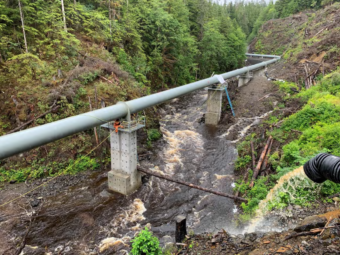
IPEC built a penstock along Gunnuk Creek to carry water from an existing water supply dam to the newly-constructed powerhouse, almost a half mile away. It will also provide water to the newly revived Gunnuk Creek hatchery. (Photo provided by Jodi Mitchell/IPEC)

A new hydroelectric plant in Kake means the Kupreanof Island village will no longer have to rely solely on diesel generators for its electricity. The multi-million dollar Gunnuk Creek hydro project came online earlier this fall, and its proponents hope it will lower the cost of energy and bring the remote community one step closer to energy independence.
Residents of Kake have been experiencing intermittent power outages this fall as the Gunnuk Creek plant comes online. That’s all part of normal growing pains, says Jodi Mitchell, the CEO and General Manager of the Inside Passage Electric Cooperative, or IPEC. The nonprofit provides electricity to a handful of Southeast Alaska towns.

“When you build a new generation project in a remote village, you don’t just turn it on like you just plug in a new appliance,” Mitchell said. “You have to do a lot of adjustments and tweaking, basically to optimize the hydro output and minimize the diesel output.”

Aside from a small solar project, Kake relies on diesel generators for electricity. Since the Gunnuk Creek hydro project was turned on in September, it’s saved the town 2,500 gallons of diesel fuel. IPEC will still rely on diesel generators during dry times and as a backup source of electricity. But Mitchell said that at a minimum, the plant will cut diesel consumption in half over time. And hopefully that will translate to a reduction in rates.

“The less fuel we have to consume, that’s the savings that gets passed onto the customer,” she said.

A quest for more affordable energy is at the heart of Kake’s exploration of renewables like solar, biomass heating and now hydro. The cost of living in rural Alaska is high, and residential electricity rates in Kake are more than double the national average.

“We’re paying too much for electricity and heating,” president of Kake’s tribal government, the Organized Village of Kake, Joel Jackson, said. He and other community leaders worked with IPEC during the project’s planning stages. “There’s no silver bullet that will sustain us off the grid. But I think using a couple different things as we move forward will lessen the cost of living here.”

Whether this new plant will translate to lower rates is complicated for a variety of reasons. For one, IPEC’s rates are based on sales. The more electricity they sell, the lower their rates are, so if enough residents implement energy saving measures like installing LED lighting or energy-efficient appliances, their rates may actually go up. Also, because IPEC serves multiple communities, any savings from the hydro would be distributed throughout the region.

An aerial view of the Gunnuk Creek hydro penstock (Photo provided by Jodi Mitchell/IPEC).

And residential customers benefit from something called power cost equalization, a state subsidy that helps offset the cost of energy. As IPEC’s costs go down, so do the state subsidies. But that program doesn’t include schools, businesses and churches, Mitchell says, so that could translate to lower prices for goods and services.

“The goal there is if we can reduce rates to those entities, they can provide more jobs. It will spur economic development in our communities,” Mitchell said.

IPEC paid for the bulk of the nearly $9 million project with state and federal grant funds. The dam was already in place, built by the Army Corps of Engineers in 2007 to help secure Kake’s water supply. IPEC constructed a penstock and a powerhouse, and Jackson expressed concern about the possible impact of this new construction on the salmon runs in Gunnuk Creek.

“There’s always negative sides to things and of course, you know, it’s a fish stream, so I hope that don’t disturb the fish return in there,” he said.

The Alaska Department of Fish and Game conducted site visits as part of Gunnuk Creek’s permitting process, and their reports show limited-to-no impact on fish runs. Gunnuk Creek also supports a hatchery, and manager Ryan Schuman said the hydro plant will help them by providing additional sources of power and clean water.

“We have been working cooperatively with them throughout their project to provide help whenever we can,” he said. “On the other side of the coin, they have helped us with a great many things as we’ve been working to get our project up and online.”

IPEC’s Mitchell said the Gunnuk Creek project initially faced a healthy dose of skepticism in Kake, especially from people who still support a cross-island intertie to Petersburg’s electrical grid. And she says that could still happen in the future, but she doesn’t think the nearly $70 million for the project will be available anytime soon because state and federal grant funds for renewable energy are harder to come by than in the past.

“I don’t see that there’s anything in the works that’s going to make the intertie project any easier or cheaper at this point,” she said.

Gunnuk Creek is one of around 20 hydro projects across Southeast Alaska.  It’s IPEC’s third hydroelectric project, and there’s a fourth in the works in Angoon.

Warming rivers are melting Arctic sea ice, new study shows

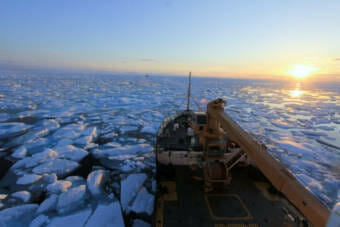
(Photo provided by Lisa Hatland/USCG)

Warming rivers play an increasingly important role in melting sea ice and rising air temperatures in the Arctic, according to a new study published Nov. 6 in the journal Science Advances.

Using complex modeling techniques, a team of international researchers found that heat from rivers melted as much as 10% of Arctic sea ice between 1980 and 2015.

University of Alaska Fairbanks researcher Igor Polyakov is one of the study’s authors.

“Because of increase of surface area temperature over continents, the riverine water becomes warmer. This warmth is carried by river water into the Arctic,” he said.

The warmer river water then flows beneath sea ice, causing it to melt. That triggers a cycle where newly open ocean absorbs heat from the atmosphere, warming the ocean temperature even more and melting sea ice further.

“What we showed is that this positive feedback mechanism almost doubles the effect of original heat carried by rivers. So it’s multiplication of causes and effect in this system,” Polyakov said.

The Arctic is warming at almost twice the rate of the global average, and the impact of climate change there is well-documented. But the impact of river heat on sea ice loss and ocean and atmospheric temperatures is not. Polyakov said their research identified a previously overlooked piece.

“Our study is just one element of a big puzzle of Arctic or global climate change, but it’s an important element,” he said. “It creates a more complete, more interesting picture of multi-disciplinary changes in the Arctic in general.”

The effect is especially pronounced in places with larger rivers like Siberia and Canada’s Mackenzie River, but smaller rivers in Alaska play a role, too.

Tongass Roadless Rule exemption leaves subsistence users feeling left behind

The Tongass National Forest is the largest temperate rainforest in the country. With exceptions, the Clinton-era Roadless Rule restricted road building and industrial activity in around 55% of the national forest. Advocates for its repeal said it posed unnecessary hurdles to development projects, like logging, mining and renewable energy (Photo by Erin McKinstry/KCAW)

The announcement on Wednesday that the Trump administration will lift protections against development in the Tongass National Forest sparked strong reactions. For many Southeast Alaskans who rely on the Tongass for food, the news is personal.

On a rare sunny afternoon in the Tongass, Chuck Miller showed me a spot near the water where his grandmother would often take him. He pointed out where they’d collect salmonberries, blueberries and huckleberries, giving Tlingit names for each.

“And then my grandmother would show me some of the plants we could use for medicinal purposes,” Miller said.

He eats many of the same foods as his ancestors. He hunts seal, collects seaweed, and fishes for salmon.

“I like to use the word Tlingit soul food,” Miller said. “It makes you feel good on the inside.”

He said he’s not political, and he doesn’t know all the ins and outs of what a full exemption of the Roadless Rule means for the Tongass National Forest, which is bigger in land area than the entire state of West Virginia. But anything that could threaten his subsistence way of life makes him nervous.

“If they allowed roads into certain areas where it affects our harvesting, I’m not a big fan of that,” he said. “You’re gonna get more population, more pollution and then some things might get overharvested.”

Chuck Miller poses for a photo near where he and his grandmother used to collect berries and medicinal plants. “Our Tlingit people have been eating food off the land since time immemorial. It’s a very important part of our culture,” Miller said. (Photo by Erin McKinstry/KCAW)

Miller isn’t alone. At a U.S. Forest Service hearing in Sitka last fall, commenters advocated unanimously to keep protections for the Tongass in place. Subsistence users and environmentalists worry that opening more than nine million acres of the Tongass to potential development for logging or mining could disrupt vital habitat for the species many depend on like Sitka black-tailed deer and salmon.

Eric Jordan is a Sitka-based commercial fisherman, but he feeds his family salmon too. He recalls what clear-cut logging did to salmon streams and wildlife habitat in the last century.

“Around Southeast, the people who live here understand how damaging that was to our ecology, and they do not want it reintroduced,” Jordan said.

The immediate return of industrial-scale timber operations to Southeast isn’t likely, mostly for economic reasons. But that doesn’t ease Don Hernandez’s worries. He lives in Point Baker on Prince of Wales Island, and like many of his neighbors, a significant portion of what he eats is hunted, fished or gathered.

“Ten years down the line, depending on what pressures may come from industry, once the long-term protections are eliminated, we could see a push to have more large-scale clear-cutting on the Tongass again,” he said.

He chairs the Southeast Alaska Regional Subsistence Advisory Council, which advises the federal board on important hunting and trapping decisions on federal lands.

The Forest Service’s final environmental impact statement states that the full exemption of the Roadless Rule in the Tongass will have “minimal adverse and beneficial effects” on subsistence users. It posits that increasing road access could open up hunting and fishing areas to those who don’t have boats and spread subsistence use over a larger area, rather than concentrating it in more accessible places.

But Hernandez said he thinks the costs far outweigh the benefits.

“When you spend the amount of money that it takes to build a road in Southeast Alaska, you have to extract a lot of timber to justify building those roads. So it’s not just a small impact,” he said. “And yes it does provide access for subsistence users and people use the roads. But, over time, all the negative impacts from the road building and clear-cutting, it takes a toll.”

Proponents of the changes say they’ll allow for more economic development opportunities like mining, communications and renewable energy projects. But for many people who live in and around the nation’s largest temperate rainforest, it’s all about the long view.

Take Allysia Witherspoon. She, her husband and their two children live in Sitka and rely on hunting and fishing for a good portion of their household needs. She says they’re nervous about what the decision to roll back protections for the Tongass will mean long term for subsistence resources — especially after the lion’s share of Alaskans implored the federal government to keep the Roadless Rule in place.

“It’s kind of alarming that no matter what research has been provided and all the comments of all the people who live here that they would try to do the exact opposite,” Witherspoon said.

Wednesday’s decision to overturn Clinton-era protections for 55% of the Tongass could be challenged in court. Congress could also get involved or a future administration could start the years-long process of reinstating the Roadless Rule in Southeast Alaska.

Editor’s note: This story was produced as part of a collaboration between KCAW and Alaska’s Energy Desk. Erin McKinstry is a Report for America Corps member.

Site notifications
Update notification options
Subscribe to notifications