
Erin McKinstry, Alaska's Energy Desk - Sitka
In a quest for cheaper energy, Kake turns to biomass heating

Sawdust and wood scraps at Mud Bay Lumber Company in Haines. Haines is one of dozens of communities around Alaska that have looked into biomass technology. (Photo provided by Clay Good/REAP)

Alaskans spend nearly 60% more on energy than the national average, and in some rural communities, that number is much higher. The Kupreanof Island village of Kake is trying to bring down the high cost of energy by transitioning to renewables. They’ve looked at solar, wind, hydro and now biomass heating, an old technology with a new design.

When Gary Williams retired after 30 years as executive director of Kake’s Tribe, the Organized Village of Kake, he decided to turn his attention to energy.

“The cost of energy here is high, so if we can come up with some more affordable energy, it’s always a good thing to pursue,” he said.

He worked on a successful solar project and helped conduct feasibility studies for wind energy. And now, he’s working to replace the tens of thousands of gallons of non-renewable heating oil used to heat the town’s school and other large facilities with a renewable and readily available resource: wood.

“We’ve got a fuel supply that’s literally in our backyard. We’re in the middle of the Tongass,” Williams said. “So it would reduce the need for imported fuels and also at the same time as we harvested our local fuels, it would create jobs and put money into our local economy.”

Burning wood to stay warm is an ancient technology, but the system Williams and other energy stakeholders in Kake are hoping to implement is high-tech. Special sensors and multiple chambers mean it burns hot and efficiently. The impact on air quality is the same or less than a system that uses heating oil.

It’s called a biomass district heating system.

“Biomass means a lot of things,” said Clay Good, who works for the Renewable Energy Alaska Project. He’s been involved with several of Kake’s renewable energy projects. “It can mean food waste or fish waste or anything that’s biological, any carbonaceous material that can be utilized for some kind of energy source.”

In this case, it means wood that’s leftover from thinning of second growth forests or from timber operations.

“It’s not a big leap to think, well, if that’s just left there, it’s gonna be burned. Let’s use that material,” Good said. “We’ll just grind it up into chips and feed it into our industrial boiler here.”

If Kake’s system becomes a reality, it could heat the school, senior center, health center, community center and other public buildings while saving the community nearly $100,000 a year on energy costs.

And Kake’s not the only community looking into biomass. Dozens of places around the state are already using it. The interior town of Tok also uses their system to produce electricity through steam for their school. Local school district Superintendent Scott MacManus said it’s saved them money and created jobs since they first implemented it a decade ago.

“Besides just a couple jobs running the plant, we are able to hire counselors that we didn’t have before and for a while we had a music program,” MacManus said. “It was because of the funding that we were able to save with the school.”

He admits there were challenges, like finding people knowledgeable enough to work on the technology or convincing community members that it was a good idea. And, he said, it’s not the right fit for everyone.

“One of the things about renewable and sustainable energy is that it’s got to be specific to where you are. You have to look at what’s available locally,” he said.

But Gary Williams thinks it is the right technology for Kake. And one more step toward energy independence, energy affordability and sustainability.

Besides making this work for our community today, we want to make sure we leave a good world for our grandchildren too,” Williams said.

Kake was awarded a USDA grant to design their biomass system. They received the design plans back earlier this summer. Now they just have to find the funding to build it.

In a down market, Alaska fishermen avert disaster by feeding families in need

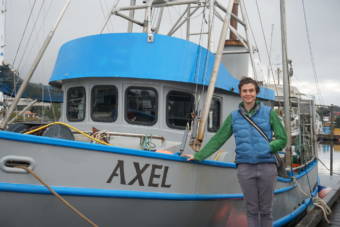
Sitka fisherman Jacquie Foss stands in front of her and her husband’s troller, the Axel. The boat is tied up for the winter in Eliason Harbor after a challenging season. (Erin McKinstry/KCAW)

It’s been a hard season for small fishermen in many parts of Alaska because of economic losses caused by the COVID-19 pandemic. But a seafood donation program started by a Sitka organization is helping bring some stability to fishermen and consumers during an uncertain time.

It started to drizzle as I stepped off the dock at Sitka’s Eliason Harbor and followed Jacquie Foss onto her and her husband’s grey and blue fishing boat, the Axel.

“You land your fish here, you clean here and you ice and store them in these totes before you put them down in the hold,” she said.

Living and working aboard the 40-foot troller is a tight squeeze when Foss, her husband and their two kids are all aboard. For most of the season, it’s just Foss’s husband and one crew member trolling Southeast waters for lingcod, coho and king salmon, while Foss runs the business shoreside. This was their ninth season commercial fishing and it wasn’t an easy one, mostly because of the pandemic.

“So we’re low volume, high quality and so typically, restaurant markets, a lot of the fish goes out whole and fresh. So, with the collapse of the restaurant industry, there was no market,” Foss said.

They also worried that even if they could sell their fish, they wouldn’t be able to get it processed if facilities closed down because of coronavirus outbreaks. And the pandemic disrupted Asian markets, a relationship that was already strained because of tariffs and counter-tariffs between the U.S. and China.

At the start of the season, the price for lingcod was half of what it was last year. Foss didn’t know if they’d be able to operate.

“When you’re starting out with unknown markets, unknown volume, unsure if you’re going to be able to sell your fish anywhere, there was a lot of anxiety early on,” Foss said.

But they did operate thanks to a seafood donation program started by Linda Behnken at the Alaska Longline Fishermen’s Association or ALFA and the Alaska Sustainable Fisheries Trust.

“I very quickly heard about people who were struggling here in town and that catalyzed us to start talking to local fishermen, local processors, about how we as commercial fishermen could help meet that local need,” Behnken said.

NormallyALFA is a membership organization that advocates for sustainable fisheries and small fishermen. They also run Alaskans Own, a community-supported fishery that sells seafood boxes to people around the country.

But Behnken and her partners decided to branch out to meet the local need brought on by the pandemic. They used grant funds from Catch Together to supplement the price of lingcod, so Sitka fishermen like Foss and her husband could start their season with some security. Then, they created a market for the seafood by delivering it to families who were struggling to make ends meet because of the pandemic.

“The pandemic really created a lot of need around Alaska and around the country from loss of jobs,” she said. “It’s just a particularly difficult time for people and then to be able to have really good quality food coming from Alaska’s healthy oceans. It’s just really special to be able to provide that and make those connections.”

Soon, Behnken started getting calls from other communities asking her to expand. With the help of outside funders and organizations, they delivered seafood to military families in Alaska and to Tribal communities in the Pacific Northwest.

Justin Zuelner is the head of The Wave, the foundation that helped distribute the seafood in the Pacific Northwest.

“We must support sustainable fisheries, to keep that economy going, because if we were not able to survive this, then we don’t have sustainable fisheries in the future,” he said. “That is such a critical investment.”

Then came the news about poor salmon runs. Southeast Alaska had the worst commercial fishing season for salmon in 44 years, and sockeye runs in Chignik Bay on the Alaska Peninsula failed altogether. The program brought salmon from Bristol Bay — where the salmon season was strong — to Chignik. And most recently, they partnered with Sealaska to bring nearly 50,000 pounds of sockeye to Tribal households in several remote Southeast Alaska communities.

Tiadola Silva helps process the 8,000 lbs. of donated sockeye that the Angoon Community Association received at the end of September. (Photo by Carol Martin / Courtesy of Tiadola Silva)

Tiadola Silva works for Angoon’s Tribe, the Angoon Community Association. She helped organize the salmon donation for her community.

“Fish was very scarce this summer, so just receiving this 8,000 pounds from these organizations was just a very generous opportunity for us, enough food supply for our winter,” Silva said.

Normally, the community delivers excess salmon they’ve caught to elders. But this year, there wasn’t much extra to go around. That was partly because of low runs and because the local gas station had to shut down several times due to active coronavirus cases in the community. Without gas, people couldn’t get out on the water.

“You know, salmon migration patterns are not gonna wait for you, you just have to go out when the time is right,” she said.

The donation was personal too. Silva was worried she wasn’t going to have enough salmon to make sockeye dry fish this year, but now she will.

“I’m excited for this week because I know that there’s gonna be a bunch of smokehouses running and that’s my favorite smell in the world is just the smokehouse smell,” Silva said.

The program will continue distributions through the winter in Sitka. Behnken said if they get support from the USDA and other funders, they can expand and continue connecting fishermen with communities in need.

Site notifications
Update notification options
Subscribe to notifications