Archives for:

"Roadless Rule"

For Tongass projects, critics say environmental rollback could cut the public out of the process

This clear-cut in the Tongass National Forest on Kupreanof Island north of Petersburg is visible from the air in 2014.
A clear-cut in the Tongass National Forest on Kupreanof Island in 2014. (Photo by Ed Schoenfeld/CoastAlaska)

Gov. Mike Dunleavy recently praised President Donald Trump’s decision to make changes to bedrock environmental policy. Proponents say the changes streamline a burdensome regulatory process that hampers development on federal lands. In the Tongass National Forest, they come at a time when sweeping management changes were already underway. 

Natalie Dawson, the executive director at Audubon Alaska, compares the changes to the National Environmental Policy Act to a late-night text.

“It used to be like the morning text message where it was thoughtful and you had a night to sleep on it. And you thought about your actions and what you may or may not want to say. And now, we can kind of go with heat of the moment decision making.”

Changes include removing the requirement to analyze cumulative impacts, like climate change, for new projects to take place on federal lands.

Dawson thinks another impact of the late-night text version of NEPA will be less public engagement. She says public input was a founding principle of the NEPA framework. Now, that’s being degraded.

This is all happening when the Tongass — the nation’s largest national forest — was already going through some controversial management changes. It’s slated to be totally exempted from the federal Roadless Rule, which could open up more access to logging. Under old NEPA, that public process was already fraught, with critics claiming the U.S. Forest Service didn’t listen to the public or tribal governments’ feedback to keep those protections in place. 

Under new NEPA, Dawson says getting a word in on future projects will be a lot harder. One change is that only substantive comments will be accepted. This means that expressing general concerns about logging near deer or salmon habitat isn’t going to cut it. 

“There was this phrase called, ‘to the fullest extent possible encourage and facilitate public involvement,’” Dawson said. “So ‘to the fullest extent possible.’ That language is now gone.”

“You may not have the time to sit down with all the maps and documents and provide a site-specific analysis of the federal agency action, and yet you are an incredibly important stakeholder in this process,” she said.

In the last few years, public meetings held throughout Southeast Alaska to discuss changes to the Roadless Rule were well attended. Dawson says that in the future, it’s not clear if public meetings with federal agencies will even take place. Before, meetings were held when there was substantial interest or controversy. Now, public meetings will only occur “when appropriate.” She says it’s also unclear who among the various federal agencies will make that determination. The same goes for decisions about whether a project is significant enough to trigger a full environmental review. 

Dawson thinks the region recently saw a preview of what these changes could mean. The largest proposed timber sale in the Tongass in decades wasn’t allowed to move forward because it violated NEPA. Dawson says that project might not have the same barriers in another go-round. 

Tessa Axelson, executive director of the Alaska Forest Association, says the ruling on that sale was a setback for the timber industry, and she thinks streamlining NEPA will be a good thing.

“I don’t see anything necessarily that is going to result in the loss of public input into the process,” Axelson said.

The timber industry group has long pushed for changes to NEPA. Axelson says under the old version, projects could be held up for many years — making it difficult for struggling operators to bid on federal timber sales and plan for a predictable supply.

“What we want is a process that is responsive to the law and also ensures that the professionals, that agencies are held to a standard for producing things timely and in such a way that is not so burdensome to small business operators,” Axelson said.

Still, Axelson doesn’t think an exemption to the Roadless Rule in the Tongass and revisions to NEPA will do enough to ensure a better outlook for Alaska’s timber industry. It’ll be up to federal agencies to plan enough timber sales that actually come together. 

In the meantime, all of this could change in November. President Trump’s NEPA revisions can be undone by a new presidential administration. 

With a Roadless Rule decision pending, tribal governments petition for new process

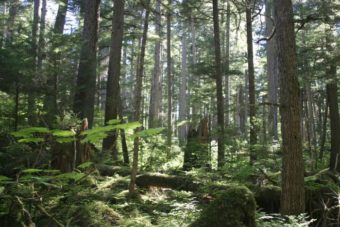
Tongass National Forest
Part of the Tongass National Forest on Douglas Island pictured in 2004. (Creative Commons photo by Henry Hartley)

Nine tribal governments in Southeast Alaska submitted a petition to the United States Department of Agriculture on Tuesday, asking for another rule making process for the Tongass National Forest. 

The federal agency is close to announcing what’s likely to be a full exemption of the Roadless Rule in the Tongass, which the state has long requested. 

But there’s been discord between the Department of Agriculture and tribal governments, who’ve repeatedly stated Roadless Rule protections should stay in place. In an unreleased federal report, 96% of the public said they disagreed with changes to the Roadless Rule, too. An exemption would make it easier for new roads to be built in the forest — opening up access to logging. 

Joel Jackson, the President of the Organized Village of Kake, was one of the leaders who signed the petition. He’s concerned about damage to fishing and hunting areas, and he said Kake’s concerns have felt ignored by the federal agency. 

“They seem to minimize our way of life,” Jackson said.

The petition outlines the creation of a Traditional Homelands Conservation Rule to protect important areas for Tlingit, Haida and Tsimshian peoples. 

In 2018, the State of Alaska petitioned the U.S. government for the Roadless Rule exemption in the Tongass. Tribal governments were supposed to be playing an integral role in that process, but have been critical of how the federal agency has handled things — saying that deadlines were rushed and that a meeting was scheduled during the chaos of the coronavirus pandemic, making it difficult to attend. 

The petition asks the Department of Agriculture to create a new, more robust consultation process. Marina Anderson, the Tribal Vice President of Kasaan, says that would bring in more science to help guide the process. 

“That best available science includes Traditional Ecological Knowledge,” Anderson said.

It’s unclear how long the Department of Agriculture has to respond to the tribal governments’ petition. The agency accepted former Gov. Bill Walker’s petition to reexamine the Roadless Rule after four months

Invited to ‘virtual consultations’ to talk Roadless Rule, tribal governments feel distanced

xx
Because of COVID-19, Marina Anderson is working from her home, which is an old logging camp float house. She says it can sometimes take half an afternoon to download a zip file. (Photo courtesy of Marina Anderson)

The Trump Administration is still on track to make a final decision this summer on a federal rule that prevents road building in the Tongass National Forest. It could open up more access to logging. But tribal governments across Southeast Alaska say the entire process has been fraught, and while everything else seems to have slowed down because of COVID-19, federal officials are moving ahead quickly with their plans.

Marina Anderson, the Vice President of the Organized Village of Kasaan on Prince of Wales Island, says she’s felt rushed for the entire two years this most recent Roadless Rule discussion has played out. Technology issues have been a major hindrance.

When the U.S. Forest Service held its first public meeting on Prince of Wales Island in 2018, Anderson didn’t find out until the eleventh hour.

“We finally got our mail, and I opened it up, and I showed it to our administrator at the time, and she looked at me with big eyes,” Anderson said. “And she’s like, ‘get in the car we gotta go!'” 

Kasaan’s internet was spotty at best so the tribal government relied on an actual mailbox to stay connected. Anderson had to hurry to make the meeting — a two hour drive away. 

Kasaan is supposed to be providing important feedback on the Roadless Rule decision to top federal officials. Like the State of Alaska, it’s a cooperating agency. But unlike the state, it’s recommendations haven’t made it into the final draft, which is now under consideration in Washington D.C. 

Kasaan wants the Roadless Rule to stay in place. However, the Tongass National Forest could be totally exempted from the federal rule. And that’s at odds with the requests from several tribal governments across the region, who rely on the forest for food. Anderson worries history could repeat itself, and this could lead to more logging — damaging deer habitat and salmon streams on the island. 

“It’s been taken advantage of for so long,” she said.

Now, a final Roadless Rule decision is just weeks or months away. There’s also a global pandemic going on. 

Anderson says this is not a good time for the U.S. Forest Service to hold a government consultation meeting. But the agency scheduled one with tribal governments anyway. 

“To try to host a video conference consultation is completely inappropriate during a pandemic when everyone is trying to take care of their own,” she said.

Anderson is currently working from home — in an old float house where she lives, a remnant leftover from the industrial logging days.

Our conversation breaks up several times on both of our ends during the voice-only Zoom call for this story. And it’s one of the reasons the Organized Village of Kasaan asked to have a meeting with federal officials postponed: It’s hard to communicate the enormity of something between dropped sentences and long pauses. 

But in the end, the U.S. Forest Service meeting wasn’t rescheduled. It happened over the phone in late April. Anderson says not everyone showed up which was sad. In total, nine tribal governments have requested the feds hit pause on the Roadless Rule decision while the pandemic unfolds. 

Don Hernandez from the Alaska Regional Subsistence Advisory Council has asked for that, too. 

“They’re listening to us, but they’re not hearing what we have to say,” Hernandez said. “Because what we have to say has already been discounted from the start.”

Recently, a records request obtained by Southeast Alaska Conservation Council showed an unreleased federal report, detailing 96% percent of the people who weighed-in want to keep the Roadless Rule in place.

Kasaan’s Tribal Vice President says she’d like to see more acknowledgement of that reflected in the final decision making. But the whole process, including a push for a meeting during a global pandemic, has felt disrespectful. 

“I want them to say, ‘we heard you voice your opinion,'” Anderson said. “‘We heard all your comments. They were impactful. Keep coming to the table when we have proposals so your voice can be heard again.'”

In a written statement, the U.S. Forest Service said it was “aware” of the tribes’ request to pause working on the Roadless Rule because of COVID-19. But the agency is still moving ahead. “No delay has been announced.”

USDA opens investigation into why Forest Service grant was given to Alaska to work on Roadless Rule

Tongass National Forest
Part of the Tongass National Forest on Douglas Island pictured in 2004. (Creative Commons photo by Henry Hartley)

The federal Office of the Inspector General is opening an investigation into how the U.S. Forest Service granted millions of dollars to the State of Alaska to work on a Roadless Rule decision in the Tongass National Forest.

In November, two Democractic members of Congress requested the investigation after Alaska’s Energy Desk obtained documents showing the state used some of the money to pay a timber industry group for additional industry perspective.

Sen. Debbie Stabenow of Michigan and Rep. Raúl Grijalva of Arizona questioned if the funds were misused. The money came from a modified federal grant typically used to prevent wildfires.

The state spent the money in a variety of ways, but it drew criticism from tribal governments and environmental groups for offering some of the funds to the Alaska Forest Association — at a time when a major decision is being made that could impact logging in the nation’s largest national forest.

Governor Mike Dunleavy has sharply denied any misuse of funds.

Corri Feige, Alaska Department of Resources Commissioner, reiterated that in a statement, which also says the state hasn’t received notification of the investigation yet, but will work cooperatively with the inspector, trusting that the inquiry is fair. 

The Office of Inspector General will determine if the Forest Service had the proper authority to award the $2 million grant to the state and confirm whether other stakeholders knew about it or not.

Editor’s note: This story has been updated.

Donald Trump Jr. is headed to Juneau for a hunting trip — and you could join him

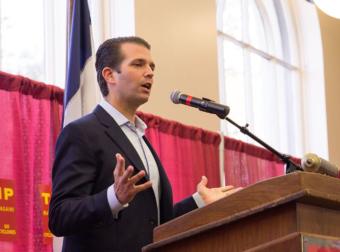
Donald Trump Jr. speaks into a microphone at a podium.
Donald Trump Jr. at a campaign rally at Iowa State University, Nov. 1, 2016. (Creative Commons photo by Max Goldberg)

Donald Trump Jr. and his son will be embarking on a weeklong hunt for Sitka black-tailed deer and ducks in Southeast Alaska — and a spot to join them was auctioned off to the highest bidder.

For one Juneau-based guide, it’s a way to teach his guests about the importance of the Tongass National Forest at a crucial time.

Keegan McCarthy owns Coastal Alaska Adventures, a business that guides visitors on yacht-based hunts.

He’s also developing a new program that will help kids learn the subsistence values he grew up with. A big part of that revolves around Sitka black-tailed deer.

“That’s what my family subsided on,” he said. “Growing up in Juneau, all we ate was Sitka black-tailed deer, and still do to this day. That’s what my family eats. So (I am) sharing that message and the importance of that resource with the young hunters.”

McCarthy is well-connected in the guided hunt scene. In fact, he spoke on a cell phone where he was attending the Safari Club International convention in Reno, Nevada.

McCarthy auctioned off the Alaska hunt there and online. It’ll help fund his new youth program.

And he tapped a famous acquaintance to come along: Donald Trump Jr.

A Sitka black tailed deer in June 2014.
A Sitka black-tailed deer. (Creative Commons photo by Kenneth Cole Schneider)

“As a hunter, I do personally believe that his morals and ethics are excellent in the hunting world,” McCarthy said.

Trump has been criticized by the Humane Society for his hunting practices. Photos of him posing next to a dead elephant in 2012 caused a stir among animal rights groups.

But McCarthy stresses Trump is conservation-minded. And the deer on this hunt aren’t being shot for just trophies. The meat will be served on board the yacht, taken home or donated.

“You know, like farm to table type concepts,” McCarthy said. “We stress the importance of how we eat what we harvest.”

But McCarthy has another thing he wants to teach Donald Trump Jr. and his guests about a subsistence lifestyle in Southeast Alaska: He thinks it’s largely dependent on protecting habitat in the Tongass National Forest.

McCarthy is outspoken in his opposition to changes to the Roadless Rule in the Tongass, which could increase logging. The Trump administration has been pushing for that.

But McCarthy said it’s not a secret that he would like to see an end to massive timber sales in the national forest. He’s spoken to Trump about it before, and that conversation will continue when he visits in November.

“Hopefully, if anything, we can bend a sympathetic ear towards getting somebody potentially as influential as he is out there to really see what we’re doing,” McCarthy said. “And see how important the Tongass National Forest is. So I do think this can be beneficial if done right.”

The auction closed on Saturday — the final day of the Safari Club International convention. It sold for $150,000.

This story has been updated.

Activists take to social media as comment period for Roadless Rule draws to a close

The final deadline for public comments on a proposal to exempt the Tongass National Forest from the Roadless Rule is Tuesday, Dec. 17.

As the deadline loomed, environmental groups increasingly tried to get the word out to encourage people to weigh-in.

Those conversations have taken place in physical spaces and also — increasingly — online.

Mary Catharine Martin works for Salmon State, an environmental advocacy group that works to protect waterways for salmon.

She pulls up Salmon State’s Instagram feed to show some of their recent efforts. She says the videos the group created with its partners about the Tongass has had a big reach.


In a video called Breathe, a Tlingit woman and a Yup’ik woman dressed in regalia talk about the cultural and environmental significance of the nation’s largest national forest. Salmon and eagles make an appearance.

Then the pacing of the video speeds up as chainsaws and falling trees blink on the screen.

Martin estimates the video has been viewed on Instagram by more than 32,000 people, and her group is still adding up the numbers.

She says the goal isn’t just to get people to watch and share the content.

“The main purpose of all of this, besides informing people about what’s going on and the different ways the Tongass is valuable as an intact Forest, is get people to comment,” Martin said.

In February, the U.S. Forest Service documented over 140,000 comments on a draft version of changes to the Roadless Rule in the Tongass.

Most of the comments suggested keeping the rule in place. But in November, Dept. of Agriculture Secretary Sonny Perdue announced that — despite all those comments — the agency would recommend the Tongass be completely exempted from the Roadless Rule.

During this final comment period that started in October, 220,000 people had weighed in, according to the U.S. Forest Service.

Over the weekend, Audubon Alaska helped host a webinar to guide people through the process of crafting their comments. The instructors for the video appear to be in their homes. They include activists and a tribal government leader.

One hundred and fifty people watched on Facebook live. Another 150 people have streamed it again since then.

Natalie Dawson, Audubon Alaska’s Executive Director, says environmental groups have been making a special effort this go-round to bolster the numbers.

“I mean there’s definitely been a bigger social media push for this … then there has for other issues on the Tongass,” Dawson said. “100 percent hands down.”

Dawson says people have asked her if official public comments really matter. After all, the last comment period didn’t sway a top federal official from seeking a full rollback of the Roadless Rule in the Tongass.

But Dawson thinks it does carry weight.

“If the agency chooses to ignore the public and the public has made substantive comments then that’s grounds to pursue litigation and lawsuits,” Dawson said.

At a church in Juneau, the Southeast Alaska Conservation Council took a different approach.

In addition to the group’s social media outreach, Executive Director Meredith Trainor says they wanted to invite people to draft comments, on the eve of the deadline, over bowls of salmon chowder.

“It’s also important to feel together to feel a part of something bigger and see each other and make eye contact,” Trainor said.

The U.S. Forest is taking public comments on the Roadless Rule decision until midnight Dec. 17, 2019 Alaska time.

The agency is expected to make its final decision on how the Roadless Rule applies to the Tongass in 2020.

Site notifications
Update notification options
Subscribe to notifications