Archives for:

"Roadless Rule"

Dunleavy defends the use of a federal grant used for Roadless Rule decision

The Ketchikan headquarters of Alcan Forest Products and Alaska Forest Association. (Photo by Elizabeth Jenkins/Alaska's Energy Desk)
The Ketchikan headquarters of the Alaska Forest Association. (Photo by Elizabeth Jenkins/Alaska’s Energy Desk)

The Dunleavy administration is defending how it spent federal grant funds as it was working with the U.S. Department of Agriculture to consider a rollback of the Roadless Rule in the Tongass.

On Nov. 18, two Democratic members of Congress requested an investigation into why some of the grant funds were used to pay an Alaska timber industry group for additional input while an important federal rule — one that could open up areas to logging — was being examined.

But the state maintains it spent the money appropriately.

The money was given to the state of Alaska by the USDA in 2018, after the state got a “yes” on a longstanding ask to reexamine — and possibly exempt — the Tongass National Forest from the Roadless Rule.

It received the money as a cooperating agency on the decision.

The state used more than $200,000 of that federal grant money, typically designated for fire prevention, to pay an industry group for more perspective on economic timber sales.
On Monday, Sen. Debbie Stabenow, D-Mich., and Rep. Raúl Grijalva, D-Ariz., requested an investigation, seeking more details about “potential misuse” of those federal funds.

In their request, they said the Tongass is “essential to addressing the climate crisis. It is critical that we ensure this taxpayer funded grant was properly awarded and used.”

“We see no misuse of funds,” said Gov. Mike Dunleavy on a phone call from Florida, where he’s attending the annual Republican Governors Association meeting.

Like the state, the Organized Village of Kake was also a cooperating agency providing important feedback on the Roadless Rule decision. Tribal government President Joel Jackson opposes large-scale logging in the Tongass.

From the grant money the state received, the Organized Village of Kake got some travel funds to be able to participate. Jackson estimates it was a few thousand dollars.

Still, he said, they struggled with limited staffing to be able to make meaningful comments.

He said whether the money was administered and divided up legally or not isn’t the entire point.

“We don’t view the process as being fair,” Jackson said.

Ben Stevens, the governor’s chief of staff, reiterated there’s no evidence to support the claim that funds were misused.

“There’s none,” Stevens said. “And so whether it’s fair or not doesn’t — we don’t understand what that means. If there’s anybody, any another entity, that could have done that economic analysis, we’d be happy to hear who it is and have them come forward.”

The entity is the Alaska Forest Association, a timber industry group.

Alaska’s Energy Desk obtained documents through state and federal records requests that show how some of the $2 million given to the state was spent.

Funds were used to help facilitate a conversation about the Roadless Rule.

Former Gov. Bill Walker appointed a diverse group of stakeholders. The committee came up with a menu of six options for the Tongass to be considered by Agriculture secretary, Sonny Perdue.

Later, the Alaska Forest Association was offered contracts to add additional industry perspective: analyzing the six alternatives and providing an economic analysis of the timber.

The group has received over $200,000, so far, from the grant.

A press release from the state Department of Natural Resources says it hasn’t billed the U.S. Forest Service for the work yet. It could still use the state match for that.

Stevens said it makes sense the Alaska Forest Association would do this work.

“They’re the ones that know the value of the timber industry there,” Stevens said.

The request for an investigation into how the federal funds were spent is set against the backdrop of the Forest Service now seeking a full exemption of the Roadless Rule in the Tongass.

The decision has been met with some skepticism in the public Forest Service meetings throughout Southeast Alaska. People have questioned the agency about the state’s influence in the process, largely drawing on a Washington Post report that suggested — at Dunleavy’s urging — President Donald Trump directed the secretary of Agriculture to select the full exemption.

Dunleavy said he has talked with the president about the Tongass.

“So any conversations I’ve had with the president and asking questions, if he’s asked questions about the Tongass forest, ‘How can we help Alaska?’ etc., my response was to get it back to being operated as a national forest,” Dunleavy said. “The Roadless Rule doesn’t necessarily help that forest act like a national forest. It makes it act more like a preserve or a national park.”

The USDA Office of the Inspector General has 60 days, upon notice of the request, to issue a response about whether it will be pursuing the investigation that the two members of Congress have asked for.

As for the Organized Village of Kake, they sent an email to the Forest Service recently saying they no longer want to be a cooperating agency.

The Forest Service declined to comment for this story.

Why was fire prevention funding used on the Roadless Rule process in Alaska? Congress members want to know.

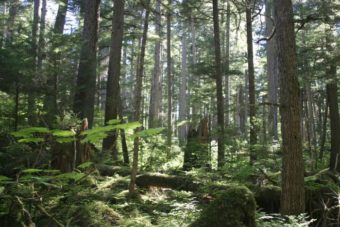
Lena Loop trail near Juneau in the Tongass National Forest.
Lena Loop trail near Juneau in the Tongass National Forest. (Creative Commons photo by Gillfoto)

A United States senator from Michigan and a representative from Arizona want an investigation into why federal dollars — typically used to prevent wildfires — were given to the state of Alaska to work on the Roadless Rule.

On Monday, Sen. Debbie Stabenow and Rep. Raúl Grijalva sent a request to the U.S. Department of Agriculture inspector general, asking for more transparency into how the federal grant was awarded and how the state is spending the money.

In September, records requests obtained by Alaska’s Energy Desk showed the USDA gave the Alaska Division of Forestry $2 million.

That money was used for the state to act as a cooperating agency in the rulemaking process regarding how the Roadless Rule should apply to the Tongass National Forest. But the state also paid a timber industry group more than $200,000 from those funds to provide additional input.

Other cooperating agencies, such as tribal governments, didn’t receive any money.

Currently, the Trump Administration is seeking a rollback of the Roadless Rule in the Tongass, which could increase access to logging.

Stabenow, a ranking member of the U.S. Senate Committee on Agriculture, Nutrition and Forestry, is concerned about climate change and said in the letter that the Tongass is “essential to addressing the climate crisis.”

Forest Service kicks off Roadless Rule discussion in Juneau

Conor Lendrum, of the Southeast Alaska Conservation Council, listens to a presentation on the Roadless Rule on Monday, Nov. 4, 2019, in Juneau. (Photo by Rashah McChesney/Alaska’s Energy Desk)

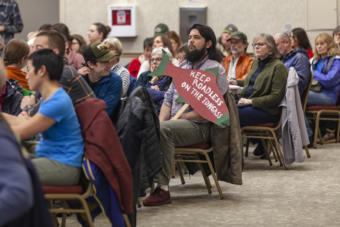
The U.S. Forest Service kicked off a series of public meetings Monday, Nov. 4, in Juneau to discuss why it is seeking a full exemption to the Roadless Rule in the Tongass National Forest.

The federal agency explained it didn’t anticipate big changes in the Tongass as a result of the exemption. But some in the crowd weren’t convinced.

People who attended the meeting had a lot of questions for the Forest Service: especially, questions about why verbal comments weren’t being documented at the meeting and questions about why a previous comment period, where most of the public told the agency they wanted to keep Roadless Rule in place, was ignored.

Chris French, who works at the Forest Service’s D.C. office, told the audience of a few hundred people their feedback was still influencing the final decision.

“I hear you,” French said. “And that is certainly something, as we look at those comments that have come in, and we think we need to shift, we certainly can.”

The Clinton-era Roadless Rule makes it difficult to build new roads through national lands. But state officials and Alaska’s congressional delegation have long maintained there’s not enough access to valuable stands of timber or energy and mining opportunities in the region.

In October, the Forest Service announced it was moving ahead with the full exemption. Tribal governments, tourism operators and environmental groups have expressed concern about the impact this change could have on deer and salmon habitat.

That’s why gillnetter Sommers Cole wanted to be here. He fishes in “waters that are fed by terrestrial habitat,” and he’s concerned that “terrestrial habitat” could be damaged by logging and affect salmon streams. The Forest Service explained to Cole that a full Roadless Rule exemption in the Tongass would have virtually no impact on fisheries.

But Cole’s not sure.

“I’ll never claim to speak for other fisherman,” he said. “But I do know it’s on a lot of people’s radar.”

The Forest Service was supposed to be considering a suite of options for the Tongass that allowed road building to varying degrees.

But over the summer, the Washington Post reported Gov. Dunleavy had the ear of the President. And at Dunleavy’s urging, President Trump directed the Forest Service to choose the full exemption.

Murray Walsh is OK with that. He doesn’t like the Roadless Rule because he thinks it impedes business. And he thinks exempting the Tongass from the Roadless Rule is a step in the right direction.

“You have a governor of a state who wants a full exemption and has asked for it and will keep asking for it,” he said.

Richard Peterson is the president of the Central Council Tlingit and Haida Indian Tribes of Alaska, a tribal government that’s a cooperating agency with the state on the Roadless Rule decision.  He also thinks Alaskans should have a say in how the Tongass in managed. But he doesn’t think that’s what’s currently playing out.

“I’m really frustrated,” he said. “The process has been abbreviated.”

Recently, six tribal governments in the region sent a unifying letter to the Forest Service opposing a full rollback of the Roadless Rule.

“People here who have been born here have 10,000 years of descendancy from this forest,” he said. “We matter just as much as the timber and anything else. And so we should be the ones in Alaska that decide what happens in Alaska.”

On Tuesday, Nov. 5, the Forest Service will hold another public meeting in Ketchikan. Here’s a roundup of all the meetings happening across Southeast Alaska. Public comments will be accepted until Dec. 17.

A new inventory of old growth trees could be coming. Will it be too late?

xx
The Ketchikan headquarters of Alcan Forest Products and Alaska Forest Association. (Photo by Elizabeth Jenkins/Alaska’s Energy Desk)

The Trump Administration is seeking a full exemption from the Roadless Rule in the Tongass National Forest.

Public comments found most people want to keep the federal rule in place. But state officials have been pushing hard to exempt Alaska — in part to help the state’s declining timber industry.

But one logging company says the industry is facing other challenges: Chinese tariffs. So they aren’t counting on a new inventory of trees just yet.

For Eric Nichols, head of Alcan Forest Products, times are hard.

In his Ketchikan office, he said calls to fix broken logging equipment can start rolling in at the crack of dawn.

Nichols oversees logging camps in remote locations, sometimes only accessible by boat or a small plane. Last year, the timber industry in Alaska employed just over 300 people. Nichols supplies paychecks for 50 of them. He said those jobs are important.

Still, it’s not always easy doing business.

“It’s a challenge up here,” Nichols said. “Especially a challenge because it’s government ownership on all the lands, and it’s an expensive place to operate.”

But that’s not Nichols only headache.

He now has to pay a tariff to export logs to his biggest customer: China. Over the summer, President Donald Trump’s trade war with the country escalated, and Alcan Forest Products’ tariff on spruce doubled.

“The 20% (tariff) hit us outta the blue,” Nichols said. “I really expected those guys to resolve their differences and solve this.”

At nearly 17 million acres, the Tongass National Forest engulfs most of Southeast Alaska. It’s part of the largest intact temperate rainforest on Earth.

The proposed exemption from the Roadless Rule means prohibitions on logging could be removed for millions of acres of old growth trees in the region.

Nichols said being able to log more valuable old growth trees in the Tongass would give him some flexibility to ride out the current global market. But he expects this change to the Roadless Rule could be litigated for years. And he’s not not sure if he can wait.

“We’re in our 60s, most of the people in this industry is,” Nichols said. “You gotta decide … is there a next generation coming or not?”

The U.S. Forest Service is holding public meetings across Southeast Alaska to discuss the proposed exemption to the Roadless Rule. A final decision is expected next year.

A version of this story first appeared on NPR’s “Morning Edition.”

Forest Service substantially weighed the ‘state’s preferences’ in Roadless Rule decision

Tongass National Forest
Part of the Tongass National Forest on Douglas Island pictured in 2004. (Creative Commons photo by Henry Hartley)

On Friday, the U.S. Forest Service explained its decision to seek an exemption from the Roadless Rule for the Tongass National Forest. The agency published the information in the federal register.

The Forest Service acknowledged it gave “substantial weight to the state’s policy preferences” to be exempted from the federal rule. The agency also said this change would allow more “flexibility” in how the nation’s largest national forest is managed.

Austin Williams, an attorney with Trout Unlimited, doesn’t think that justification makes sense.

“What flexibility is going to mean … is that the Forest Service is going to have flexibility to plan timber sales in new areas that it has previously had off limits,” Williams said.

A change in the federal rule could open up over 9 million acres in the nation’s largest national forest. Though the federal agency says those lands “would not be scheduled or expected to be subject to timber harvests.”

The Forest Service could not be reached in time to provide additional comments.

In 2018, former Gov. Bill Walker signed off on a petition, asking for the Alaska exemption.

It’s something Gov. Mike Dunleavy has also pushed hard for. The Washington Post reported a conversation between Gov. Dunleavy and President Donald Trump in August encouraged the administration to lean toward granting Alaska a full exemption.

Tribal governments have expressed concern over the impact the exemption would have on hunting and fishing in the region. According to the Forest Service’s own summary of comments, most of the public said they wanted to keep the Roadless Rule in place.

The Forest Service is accepting public comments on the draft plan starting Oct. 19, 2019 until Dec. 17, 2019. A final decision is expected by 2020.

Tourism advocates say proposed Roadless Rule exemption threatens industry’s growth

The remains of a Tongass clear-cut and logging road north of Ketchikan, pictured here in 2014, are visible from the air.
The remains of a Tongass clear-cut and logging road north of Ketchikan, pictured here in 2014, are visible from the air. (Photo by Ed Schoenfeld/CoastAlaska)

News confirming that the U.S. Department of Agriculture plans to fully exempt the Tongass National Forest from the Roadless Rule came as a disappointment to members of Alaska’s visitor industry Tuesday.

But tourism operators say they plan to continue pushing back against further development in the Tongass that they feel threaten their industry.

Rumors began circling in August that President Donald Trump had directed the U.S. Forest Service to draft a full exemption of the Roadless Rule for Alaska. That’s despite the fact that a majority of the public input received during last year’s comment period opposed allowing road development in remote parts of the Tongass.

Many of those comments came from members of the growing Southeast visitor industry. According to Raincoast Data, an economic analysis firm, it’s now the largest private sector industry in the region.

Tourism jobs outnumber timber industry jobs by more than 20-to-1. And tour operators say allowing more logging and land development in the Tongass directly threatens their businesses.

“People aren’t coming to Alaska to see clear cut forests and mines and pipelines and oil rigs,” said Lee Hart, founder of the Alaska Outdoor Alliance. “They’re coming to see the magnificent public lands and waters and glaciers and wildlife that we have here.”

Hart attended last week’s Alaska Travel Industry Association convention in Juneau, where she and other tourism operators from Southeast and other regions of the state urged the organization’s board to push back against an exemption from the Roadless Rule.

“Our landscapes are just the thing people around the world dream of coming to,” Hart said this week. “So why can’t we get more investment and positive attention to that type of development and not try to exclude it?”

Many people, including Hart, said during last week’s board meeting that they felt like their involvement in the public process had been thrown out. The board declined to take any specific action at the time.

In an email, ATIA spokesperson Julie Jessen said the organization would not comment, but its executive committee will be meeting later this week to discuss the issue.

Dan Kirkwood runs Pack Creek Bear Tours, a wildlife viewing company in Juneau. He also works on Forest Service issues with other tour operators through a Juneau Economic Development Council working group.

He said that prioritizing resource development over tourism will lead to more competition among tour operators.

“This shrinks the pie for everybody. I think the way in which this decision was made has caused a lot of angst,” Kirkwood said.

He hopes business owners will continue speaking up on behalf of their industry.

“We need to stand up for having incredible scenery, wild places, outstanding wildlife, and we need to stand up and demand that the Forest Service takes us seriously as an economic opportunity,” he said.

The public comment period for the draft proposal ends Dec. 17.

Clarification: This story has been updated to more accurately reflect Dan Kirkwood’s position on tourism’s role in the Tongass.

Site notifications
Update notification options
Subscribe to notifications