Elizabeth Jenkins, Alaska's Energy Desk - Juneau

Two of Alaska’s biggest exports are caught up in the US-China trade dispute

salmon-displayed-in-a-seafood-restaurant-in-china (Photo C/O Sea Grant)_
Salmon displayed in a seafood restaurant in China. (Photo courtesy Alaska Sea Grant)

As President Donald Trump’s trade dispute with China continues to drag out, some of Alaska’s biggest exports expect to be hit with even steeper tariffs than they’ve seen in recent months.

Now the timber and seafood industries are trying to figure out how to do business as the pressure mounts.

The Alaska Seafood Marketing Institute is always on the lookout for innovative ways to create demand for the state’s catch. Sometimes that includes sending salmon to influencers on Instagram.

Other times, it’s strategizing how to get more of the product into the global market. Jeremy Woodrow, a director at the organization, said that’s what they’ve always done.

“But the urgency is probably greater than it has been in recent years,” he said.

That’s because some types of fish caught in Alaska could be 25% more expensive when the product is sent to the markets in China — a country that buys about a quarter of the state’s seafood by value.

Earlier this week, China’s Ministry of Finance announced it would be increasing tariffs — a move prompted by Trump’s latest wave of tariffs imposed on Chinese goods.

The tariff increase cuts both ways. Processed seafood that’s exported back to the U.S. could be subject to a 25% tariff imposed on China.

President Donald Trump speaks to more than 100 Airmen, Sailors, Soldiers, Marines and Coast Guardsmen at Joint Base Elmendorf-Richardson, Alaska, Feb. 28, 2019. The president was at the base to meet with service members after returning from a summit in Hanoi, Vietnam. His plane refueled before continuing to Joint Base Andrews, Maryland.
President Donald Trump speaks to more than 100 Airmen, Sailors, Soldiers, Marines and Coast Guardsmen at Joint Base Elmendorf-Richardson, Alaska, Feb. 28, 2019. (Public domain photo by Staff Sgt. Curt Beach/U.S. Air Force)

Woodrow said that’s created some uncertainty for Alaska’s seafood industry.

“When a product is now subject to increased tariffs, that makes that product more expensive to consumers,” Woodrow said.

And those consumers might just go for a cheaper alternative to Alaska’s wild-caught fish. But Woodrow said the industry is already thinking about some workarounds. Right now, Alaska seafood is processed and sold in China. That’s where the tariffs stack up.

But having the fish processed in Poland could be a way to avoid that.

So Woodrow doesn’t think it’s all doom and gloom.

“There is reason to be concerned,” Woodrow said. “However, I don’t think the sky is falling yet.”

But the situation is very different for Eric Nichols at Alcan Forest Products in Ketchikan.

“We don’t have many options to put that log in another marketplace,” Nichols said. “And so we’re very dependent upon what happens with that Chinese market.”

Nichols will be on the hook for a 20% tariff for spruce trees shipped to his biggest customer: China.

His company sends mostly barges of young-growth trees harvested from Southeast Alaska to the country, and he said that’s the problem: He doesn’t have enough high-value product to help ride out the volatility.

“When we don’t have the access to old-growth anymore, then we don’t have those diversity of markets,” Nichols said. “So if we have one interruption like these tariffs, then it puts you in a situation where you got to decide whether you’re going to be able to stay in business or not.”

That’s a big concern among Southeast Alaska’s small, struggling timber industry.

A few efforts underway could result in more old-growth trees being harvested in the region. But in the meantime, Nichols is trying to get by now, and he said this trade dispute is making it harder.

Still, he’s not ready to stop his operations just yet.

“You want me to lay off everybody?” he asked. “I have bank payments. I have equipment payments. I have employees that depend on us for a very regular paycheck.”

The tariffs increase on U.S. exports could take effect June 1 if a deal between the White House and China isn’t reached.

Conservation groups sue over Prince of Wales Island project

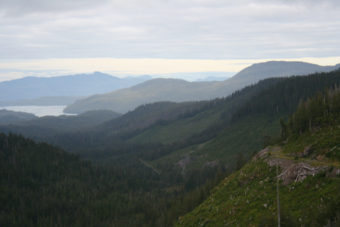
Clearcuts and old-growth forests are part of the view of Indian Valley on Prince of Wales Island.
Indian Valley on Prince of Wales Island. (Creative Commons photo by Nick Bonzey)

Eight conservation groups filed a lawsuit against the U.S. Forest Service in federal district court last week over the controversial sale of thousands of acres of trees on Prince of Wales Island.

In March, the Forest Service signed off on the final environmental review for what could be the largest logging operation in more than a decade in a national forest.
But the agency has maintained the project is intended for more than just timber, saying it will fulfill a variety of objectives, like stream restorations and the construction of new hiking trails and public use cabins.

The plaintiffs say that the Forest Service hasn’t provided a detailed map of the areas that could be logged and therefore can’t adequately assess the environmental impact of the project for the public to weigh in.

Tom Waldo, an attorney at Earthjustice, says the project shouldn’t be allowed to move forward.

“This is a brazen attempt by the Forest Service to rewrite the rules for timber sales,” Waldo said. “And it comes at the expense of a vast amount of habitat on Prince of Wales Island, that’s important for wildlife and for people and communities.”

Historically, large-scale industrial logging has taken place on the island. It’s where Alaska’s last mid-sized sawmill resides.

The Forest Service is expected to offer a timber sale in the area this summer.

A page on the agency’s website with more details about the project appeared to be down Tuesday. But the page has since been restored.

This story has been updated as new information has become available. 

As the Lower 48 continues to dry out, Alaska could get wetter

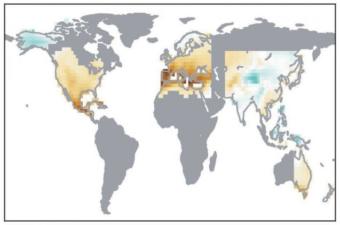
Regions projected to become drier or wetter as the world warms. More intense browns mean more aridity; greens, more moisture. (Gray areas lack sufficient data so far.) A new study shows that observations going back to 1900 confirm projections are largely on target. (Adapted from Marvel et al., Nature, 2019)
Regions projected to become drier or wetter as the world warms. More intense browns mean more aridity; greens, more moisture. A new study shows that observations going back to 1900 confirm projections are largely on target. (Adapted from Marvel et al., Nature, 2019)

This past winter, parts of Southeast Alaska experienced severe drought. It forced some communities to switch over from hydroelectricity to diesel. But a new study published in the journal Nature suggests that’s probably not a preview of what’s to come in Alaska.
Scientists are getting a better handle on the leading causes of global drought and where the future is headed.

Jason Smerdon is a paleoclimatologist at the Lamont-Doherty Earth Observatory of Columbia University. It’s a job title that befuddles some strangers.

“A paleoclimatologist is anyone who studies the climate of the past,” Smerdon said.

He’s interested in the past because it holds significant clues about the global weather events we’re experiencing now.

He combed through tree ring records from a thousand different sites all around the world, including Alaska. Some of the records were 2,000 years old, while others were from the turn of the century.

He created a kind of timeline, with wetter or dryer years reflected in the width of the tree rings.

Smerdon compares the climate model to listening to a rock song, where a trombone represents human-caused carbon emissions.

“We can’t quite hear it with all the other instruments when it’s playing really quietly,” Smerdon said. “But as it gets louder and louder and more punctuated, we can really pick it out more robustly.”

The other instruments are different variables: solar energy, volcanoes, naturally occurring green house gasses. But it’s the trombone that scientists have observed blaring through the noise.

“The drying regions and the wetting regions that are identified in this pattern become a map for the future, as we think about a much warmer world with much higher levels of greenhouse gasses in atmosphere,” Smerdon said.

Smerdon says, for the most part, the data points to the likelihood of some drier places becoming drier and wetter places becoming wetter.

And yes, Southeast Alaska has been experiencing a drought recently, but Smerdon doesn’t think that’s necessarily the new norm.

“So the expectation is for precipitation to increase in Alaska by 10-20% under business as usual scenarios,” he said.

That’s by the end of this century — if nothing changes. Smerdon says a loss of sea ice in the Arctic is one of the things that could contribute to these warmer, wetter conditions.

He cautions while that might sound like music to some hydroelectric companies’ ears, it could mean Alaska can expect more seasonal variability, and less snowpack which some reservoirs rely on.

New legislation introduced in Congress aims to strengthen Roadless Rule

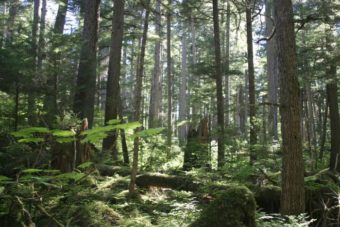
Tongass National Forest
Part of the Tongass National Forest on Douglas Island pictured in 2004. (Creative Commons photo by Henry Hartley)

A few states are in the process of challenging a federal rule that makes it difficult to build new roads through national lands, called the Roadless Rule.

In Alaska, the debate centers on the Tongass National Forest, where Republican Sen. Lisa Murkowski says more access is needed to timber, energy and mining opportunities.

But on Thursday, U.S. Sen. Maria Cantwell, D-Wash., and Rep. Ruben Gallego, D-Ariz., introduced legislation which could eliminate the possibility of an Alaska-specific exemption to the Roadless Rule.

Under the Roadless Area Conservation Act, the U.S. Department of Agriculture wouldn’t have the authority to grant that exemption.

Right now, the agency is on track to release a draft environmental impact statement this summer, including various options for road-building in the Tongass. An official decision is expected by 2020.

It’s unclear how the new legislation will interfere with those plans. It still has to pass both the House and the Senate, where Murkowski chairs the Senate Committee on Energy and Natural Resources.

Before, some teens in crisis had to leave their families in Juneau to get help. That’s changing.

xx
The youth crisis stabilization room at Bartlett Regional Hospital has been adapted for patient safety. It’s able to serve minors, ages 8-17. The new building will have some of the same features, as well as therapeutic design elements. (Photo by Elizabeth Jenkins/KTOO)

Since January, Southeast Alaska’s largest hospital has quietly rolled out a new program to close a big gap in behavioral health services for minors.

So far, 13 young people in the midst of a crisis — like a suicide attempt — have been able to receive care. It’s addressing a growing need so patients can stabilize a little closer to home.

Bradley Grigg used to work at the emergency department at Bartlett Regional Hospital, and he saw dozens of patients come through the door.

But he wasn’t treating them for an injury, like a broken leg. He did mental health assessments when parents would come in with their child asking for help.

“My frustration in working in those scenarios was talking with the family, building a quick rapport with the family … only to find out, we can’t help you here,” he said.

The hospital does have in-patient mental health services for adults.

But up until recently, there was nowhere in the region for a minor to stay after a mental health crisis, stabilize, see a psychiatrist and receive ongoing care. The closest place in Alaska was Anchorage.

Grigg says behavioral health specialists in the community recognized it was a problem. Children would sometimes be separated from their parents, which can delay the healing process for everyone.

“Right now, we’re really stuck,” Grigg said. “When a family comes in here, they usually come in here at the time when they cannot handle it anymore.”

That was Erik and Melissa McCormick’s experience with their oldest son.

xx
Speier McCormick (Photo courtesy of the McCormick family)

“Speier Malone McCormick was his full name,” Melissa McCormick said.

The McCormicks remember Speier as an inquisitive kid who enjoyed going on hikes with the family. He played guitar and wrote his own songs. His music tastes were eclectic. He liked Metallica and the Beatles.

“He really liked Elton John,” Erik McCormick said.

But the McCormicks became increasingly concerned about Speier’s behavior around the time he was in 6th grade.

He was a pitcher on a junior league baseball team.

“He would come home and he would be very upset that they lost the game,” Melissa McCormick said. “And we we would explain to him, it’s just a game. But he would take it really hard. He would go hit his head against the wall. ‘I didn’t pitch well enough.'”

Erik McCormick says they thought he was just being a perfectionist.

“He just to needs to learn,” he said. “But we probably underestimated all that was going on in his brain. We didn’t know.”

Speier was later diagnosed with bipolar and borderline personality disorders: treatable mental health conditions.

But at 15, he tried to kill himself. That’s when the McCormicks first tried to navigate a confusing mental health system which made it nearly impossible to keep their son close to home.

Melissa says after Speier was taken to the emergency room in Juneau, “it was like boom, boom, boom and he was gone.”

Speier was flown to a hospital in Anchorage outfitted to help suicidal teens. Then, he was admitted to a youth mental health treatment facility in Palmer for about six months. His parents were able to visit him there and Speier eventually returned home.

When he was 16, the family went through it all over again — after another suicide attempt.

Melissa says in both instances, she would’ve liked to slow down and reflect on the best options for Speier and the family.

“You know, worked on a plan together,” Melissa McCormick said. “Instead of me on the internet at 3 o’clock in the morning trying to figure out what am I going to do with my son? And how am I going to get him out of town, and how am I going to explain this to his siblings?”

The McCormicks felt like they’d exhausted all the mental health services available. So Speier was sent to another treatment program in the Lower 48 while most of the family remained in Alaska.

A little over a year ago, Speier died by suicide.

Bradley Grigg, the counselor who did mental health assessments at the hospital, didn’t treat Speier. But he did know him.

“I was a baseball coach. It’s a small community,” Grigg said.

Grigg is now the Chief Behavioral Health Officer at Bartlett, which is doing things differently than how it’s been done in the past, due to a $2 million dollar grant from the state.

For instance, when a family arrives with a child experiencing a mental health crisis, they aren’t immediately confronted with a flight to Anchorage. Instead, they can receive care at Bartlett’s new youth stabilization room.

Grigg points out the safety features which have been adapted to minimize self-harm.

But it’s more than the redesign of one room. Next year, Bartlett is constructing an entire building that can serve up to four adults and four kids, which they hope to be able to flex based on need.

Grigg says it’s a chance to hit pause for up to week or longer. Patients can meet with a psychiatrist and come up with a treatment plan.

“And as often as possible with the family,” Grigg said. “Because don’t view this as, ‘Oh, we have a kid here who’s having a crisis.’ We view it as a family crisis.

Grigg acknowledges there’s still more work to be done to address the huge need for more mental health services in Alaska.

But for now, he’s able to tell families with kids something he couldn’t before: Yes, we can help you here.

If you or someone you know needs help, call Careline at 1-877-266-HELP (4357), a 24/7 Alaska resource that can provide support, information, and local resources.

Site notifications
Update notification options
Subscribe to notifications