Elizabeth Jenkins, Alaska's Energy Desk - Juneau

In Anchorage, emotionally preparing students for the scary prospect of climate change

xx
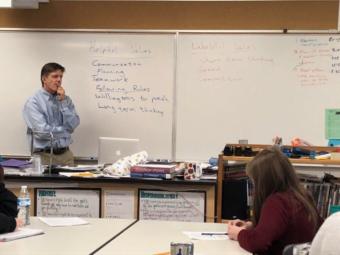
Bryan Smith has a PhD in chemical engineering. He says he always liked teaching in graduate school. So when it came time to move back to Anchorage, he decided to make it his career. (Photo by Elizabeth Jenkins/Alaska’s Energy Desk)

The Alaska Department of Education and Early Development is in the process of revamping its science standards. It hopes to have a draft released by March. But for the past 13 years, teachers have been working with a curriculum that gives little guidance on how to explain the science behind one of Alaska’s most pressing problems: climate change.

This week, we’re going inside two Alaska classrooms to learn how teachers and students are navigating these difficult conversations.

Bryan Smith is the kind of teacher who goes by his first name in his classroom at Polaris K-12 School in Anchorage. You could call his teaching style eclectic.

Today, his class of high school students are learning about resource extraction by competing to grab Goldfish crackers off of a row of tables. Snatch too many goldfish and you deplete the fishery.

“As soon as I saw people taking more than three fish, I knew it was over for me,” Kadi LeBlanc, a ninth-grader, says with a laugh.

She says not everyone is playing fair. But she understands the point.

“If people are greedy and take more than an ecosystem can handle, by the end no one be able to use that resource,” LeBlanc said. “It’ll be gone.”

Later, the class brainstorms helpful values for solving the problem. They list things like communication, planning and following rules or regulations.

It sounds like students are having a good time. But Bryan acknowledges these are tough things to talk about, especially in a resource-dependent state.

“I’ve got this Upton Sinclair quote above my door: ‘It’s difficult to get a man to understand something when his salary depends on his not understanding it.'”

That quote alludes to the tightrope discussions Bryan has to have with his students. Some of their parents are employed by the oil and gas industry. Bryan says it can be a sensitive topic; the business that’s feeding some families is also contributing to an increase in carbon emissions.

So there are the social complexities of teaching about climate change in an oil state, and then there are the emotional ones.

“One of the reasons why I suspect other teachers might not want to jump into this, besides it being a political hot topic … it’s heavy and it’s a real downer,” Bryan says.

Bryan says the future can appear increasingly uncertain, dangerous and even scary for kids.

He describes it as taking an unblinking look into the void. Alaska is warming twice as fast as the global average temperature.

So the students in his classroom are given a choice.

And this is where Bryan takes another page from one of the great contemporary works: “The Matrix.”

He uses an iconic scene from the dystopian sci-fi thriller in class. In the movie, Morpheus tells the protagonist Neo that there’s no turning back.

“You take the blue pill, the story ends, you wake up in your bed and believe whatever you want to believe,” Morpheus explains. “You take the red pill, you stay in wonderland, and I show you how deep the rabbit hole goes.”

Bryan says he has had one student tell a counselor, “I don’t want want to take this class.”

Of course, Bryan’s not presenting his class of middle and high school students with real pharmaceuticals. It’s a metaphor. Take the blue pill and drop the elective science class. Or, take the red pill and learn more about the leading causes of climate change and its effects.

Bryan believes the student who opted out felt like the subject was just too much to handle, and he says that’s OK. He wants his classroom to be intellectually and emotionally prepared for the things they’re about to hear.

“The projections are grim,” Bryan says. “That’s why in the past couple of decades scientists have started speaking out publicly.”

Bryan admits he’s struggled to explain this to his own kids, who are 11 and 14 years old. He feels conflicted, like he’s stealing away a piece of their childhood by telling them the truth.

The concern is somewhat valid. The state’s former Department of Health and Social Services commissioner even put out a report warning about increased anxiety and depression as Alaskans grapple with a changing environment.

Some of Bryan’s younger students have asked him to dial it back.

“They were kids, and they just wanted to go play on the swings and that’s fine,” he said.

But like Morpheus and Neo in “The Matrix,” if a student is ready, Bryan wants to them have all the information: Climate change is happening. The future, as projected, looks pretty bleak. Our carbon emissions are a major contributing factor.

But he assures them there are things they can do. The antidote to despair is action, he says.

Still, Bryan has received some push back from at least one of the teens in his class.

It was for an assignment where he asked students to engage in some kind of activity, applying their values to what they learned. So a student made a flyer for an Anchorage neighborhood.

“The gist of it was climate change wasn’t happening,” Bryan says.

But he didn’t fail that student because he completed the assignment and applied his values to the task. Unlike carbon emissions, beliefs can be harder to measure.

“Some people you won’t be able to reach,” Bryan says.

But that was one isolated event over the course of seven years of teaching about climate change.

Bryan says most of his students know it’s occurring, and they genuinely want to do something about it.

What’s the biggest takeaway he wants his classroom to leave with? After a pause, he says he wants them to feel empowered to take some action, whatever that means to them, and then stop thinking about the rabbit hole. Go out and enjoy the sunshine.

In Sitka, a teacher wants her classroom to know who’s responsible for climate change

xx
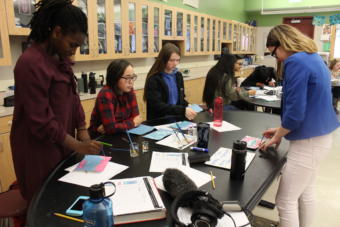
Chohla Moll’s science class gets lots of hands-on experience. Recently, they got to swim in the ocean in wet suits. (Photo by Elizabeth Jenkins/Alaska’s Energy Desk)

The Alaska Department of Education and Early Development is in the process of revamping its science standards. It hopes to have a draft released by March. But for the past 13 years, teachers have been working with a curriculum that gives little guidance on how to explain the science behind one of Alaska’s most pressing problems: climate change.

Some school districts don’t elaborate on the cause at all. While others are using a growing national model, which makes it clear: Humans are largely to blame.

This week, we’re going inside two Alaska classrooms to learn how teachers and students are navigating these difficult conversations.

Chohla Moll’s classroom at Mt. Edgecumbe High School has an ocean view, and today the proximity to seawater will come in handy.

As the teens settle into their desks, Moll asks them a question.

“So how many of you guys are fisherman (or) fisherwomen?”

Hands shoot up in the air. It’s about half of the class.

The 400-plus students who attend Mt. Edgecumbe, a public boarding school, represent communities from all across the state. Preference is given to those who apply from rural Alaska.

Moll knows how to tap into something that unites all her students when she’s teaching about climate change.

“So what critters at home are going to be affected?” she asks.

Moll has the class make a list of food they like to eat. On a whiteboard, a teenager from Tununak writes clams, walrus and beluga whale.

And Moll has her students consider something else: The ecosystem of these cherished food sources is being disrupted by human activity.

To demonstrate that point, Moll passes around a glass of seawater collected from outside.

The students take turns blowing into it with straws, adding carbon dioxide with their breath.

Thanks to a pH indicator, the classroom can see the chemistry of the water changing right before their eyes. The color transforms from emerald to a light green, indicating the water is becoming increasingly acidic — and that’s exactly what’s happening to the ocean, with the burning of fossil fuels.

Over time, ocean acidification can dissolve the shells of crabs and clams, important marine species that animals and people — and this classroom — like to eat.

Not all teachers in Alaska are this straightforward about how humans are contributing to the problem.

Despite the overwhelming scientific consensus, climate change is still treated as a controversial topic in some places.

Moll says that’s misleading.

“When we come into science, we’re not talking about things that we believe in,” Moll says. “We’re talking about things that we have evidence to back up.”

This is the kind of thinking you’d expect from a daughter raised by two science teachers.

Moll jokes she was initially reluctant to get into the family business. She wanted to do scientific field work, not teach about it. But she missed having conversations.

“And I’m a talker. So I kind of succumbed,” she says with a laugh.

Moll has been talking to students at Mt. Edgecumbe about climate change for 12 years.

Chohla Moll is a nominee for the 2018 Alaska Teacher of the Year. She’s a high school science teacher at Mt. Edgecumbe School in Sitka. (Photo by Wesley Early, Alaska Public Media – Anchorage)
Chohla Moll was a nominee for the 2018 Alaska Teacher of the Year. (Photo by Wesley Early/Alaska Public Media)

Back when she was a student herself in the late 1990s, she says climate change wasn’t part of the curriculum. She learned about the effects of warming from conversations around the dinner table.

Of course, scientists know more now. Predictions with climate modeling have gotten better. We’re starting to see the consequences play out in real time. Last year was one of Alaska’s five warmest on record.

But some public schools still haven’t thawed to the idea of teaching about it.

“There’s really very solid evidence that shows it’s human-driven,” Moll says. “But I still think that, especially in a state that is very supported by fossil fuels, it’s still a fine line that people feel like they have to walk.”

Moll feels empowered to walk that line because her school district is using growing national science standards, where humanity’s contribution to climate change is clearly spelled out. Next Generation Science Standards are more detailed than the ones currently outlined by the state.

Moll even keeps a laminated copy taped to her desk.

“It says it right there: ‘human impact,'” Moll says, gesturing to the standards. “So I feel pretty comfortable about what I’m doing in my classes with my students.”

Moll says she feels like her school district has her back. But she understands why teachers from other districts might be nervous explaining the topic.

For example, the Juneau School District adopted these same national standards last year. But it wouldn’t commit to taking a hard line on climate change attribution. It advised teachers to stick to the line “climate change is happening” and allow students to form their own opinions.

And this tension has played out in other states. As states’ departments of education update their science standards, the language surrounding subjects like climate change or evolution gets edited out or watered down.

Soon, Alaska’s Department of Education will release a draft of its updated science standards. It’s considering modeling those after the national standards that are explicit about climate change. Gov. Michael Dunleavy’s administration is currently reviewing the material.

Moll hopes the new state standards make it clear: Yes, humans are contributing to the problem, and teachers can have these tough conversations.

It’s a talk Moll thinks classrooms in Alaska are ready to hear.

“I really feel like the youth right now, they really want to do something,” Moll says. “They really want their future to be not what’s predicted. And I think science teachers, and teachers in general, can help them kind of formulate that future and change that future. Because it’s their problem.”

Back in class, Moll’s students pick out paint brushes. For today’s final activity, she wants them to paint a picture, reflecting on how environmental change will affect their hometown.

Sixteen-year-old Stephanie Eakin is from Kotzebue. She’s painting a picture of the ocean. Eakin loves to fish, and she says the changes at her doorstep are definitely on her mind.

“Snow is coming later in the year than normal now. The cold, cold weather is coming pretty late,” Eakin says.

But she’s learning what her family is experiencing can be explained by science. She says that makes it easier to understand.

“You start to realize that it’s not just words on the news,” Eakin says. “Like, they’re telling the truth, and you need to start paying attention to it more.”

Eakin thinks that’s the best way to teach kids, maybe even adults: by talking about those lived experiences.

Site notifications
Update notification options
Subscribe to notifications