In this newscast:
- Absentee voting update
- Oil prices are up. So, why hasn’t Alaska’s economy recovered the recession?
- The end of the Alaska Federation of Natives Conference
In this newscast:

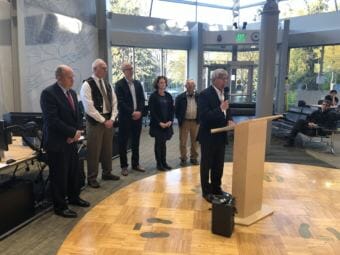
A team appointed by Governor Bill Walker collaborated all summer to produce a comprehensive policy to address climate change. Their directive was to act bold. And on Wednesday, the group formally handed over the plan.
But the work has only just started. It will be up to state agencies and elected officials to prioritize what’s there.
The state of Alaska recognizes that climate change is happening. And rather than wait around for outside help, the 37-page document outlines the prospect of local solutions to mitigate the damage. For instance: set targets for reducing greenhouse gas emissions, invest in a diverse economy less reliant on fossil fuels and educate the public about the impacts of warming.
At the press conference in Anchorage, Governor Walker acknowledged there have been cutbacks to climate change programs at the federal-level.
“There has been a change in that regard,” Walker said. “We don’t change what we do because somebody else changes what they do. So that didn’t change. If anything, it perhaps might have escalated it a bit.”
The Walker administration did go ahead and greenlight dozens of the team’s suggestions spread out across various state agencies.
Most of that focuses on developing a framework to address the climate change challenges that are already here and the ones that are still to come.
The climate action plan also includes the possibility of Alaska supporting some kind of national carbon pricing legislation, while also investigating a state carbon tax.
When asked about that, Governor Walker wouldn’t commit to endorsing it.
“I have said, and I remain, that I’m not interested in anything that’s going to raise [or] increase the cost of energy to Alaskans.” Walker said.
Walker said continuing to utilize the Climate Action Leadership Team comprised of stakeholders around the state was important, and he was confident no matter what happens in the November election, whoever was in charge would see the benefit of continuing that work.
The team is still appointed for the next two years. But that could change with an administrative order from a governor.

The timber industry in Southeast Alaska has blamed a decline in business on fewer federal timber sales. And now, it risks being penalized by one of its biggest customers.
Tariffs will be placed on trees shipped to China: a response to President Donald Trump’s latest wave of tariffs on Chinese goods.

Eric Nichols says about 80 percent of the trees his Ketchikan-based company harvests in Southeast Alaska goes to China. Alcan Forest Products sells mostly young growth. Spruce trees make up a big part of that, and last week it got 10 percent more expensive to send that timber abroad. The tariff on hemlock went up 5 percent.
Nichols figured the Chinese tariffs were coming. To stay competitive with the global markets, his company is going to have to eat that cost — at a loss of millions of dollars.
It’s a blow in a series of blows, Nichols says. Already, the supply of timber is way down.
“Got no timber coming from the state or the forest service — that’s going to put me out of business. And I got a tariff that’s probably going to put me out of business,” Nichols said. “So which level of worry do I want to worry about first here?”
A big concern, he says, is that the tariff could increase to 25 percent.
The Trump administration has threatened to raise tariffs on Chinese products by early next year. And Nichols worries that China will retaliate with the same, which he says could be the death of Alcan Forest Products.
“How do I make business decisions for today when I don’t know what the tariff level is going to be in January?” Nichols said. “So, it’s almost impossible to run your business beyond a day-to-day basis with the threats of tariffs out there with the products that you sell.”
His company helps employ about 30 people.
As of this morning, Nichols was on his way to a remote logging camp in Southeast Alaska, and he says he hopes this trade war gets resolved soon.

In many parts of Alaska it’s not uncommon to see a black bear lumbering through a neighborhood, especially in the summer or fall. The animals are crafty at getting into trash if it’s not secured. But this season, it seems like more bears have been spotted around Juneau scavenging for food, and scientists think they know why.
Melissa Griffiths used to have an outdoor camera for security. But after buying a house on Douglas Island, her motivation for around-the-clock surveillance changed.
“We when we moved here, we decided we would make it a nature cam, and it’s been very effective,” she said. “This year, we’ve seen a lot of bear activity, some porcupines, some deer.”
Griffiths lives in a subdivision on a hillside. Her backyard leads into a huge expanse of forest. And this has become the scene of a familiar visitor.
She pulls her out her cell phone to show me footage of a chubby black bear.
“He comes down from the left of the playhouse in search of trash,” she describes.
This isn’t speculative. The bear reappears later in the video carrying what looks like a small plastic bag of garbage in its mouth.
“It’s not the first time it’s happened where we’ve seen a bear, could be a different bear, taking a bag of trash up the hill,” she said.
Griffiths emphatically states: this is not her trash. She reckons it’s from somewhere else in the neighborhood. Still, she’s had to clean the mess up on several occasions. Her partner even broke two wooden spoons banging on a pan, trying scare the bears away.
Griffiths wanted to get the word out about securing garbage.
“So, for the Douglas Island block party, I got this wild idea that I should make a trash bear cake,” she said.
The red velvet cake was shaped like a bear sitting on top of a dumpster. There were even little replicas of Rainier beer cans made out of fondant strewn about.

Griffiths doesn’t remember catching any bears on the camera last summer. But this year, she’s spotted them in the yard at least 20 times. And she reported the uptick to the Alaska Department of Fish and Game.
Carl Koch is one of the management biologists who reviews that information.
“Could be anything from ‘I saw a bear walking down the street’ to ‘There’s a bear ripping into my garbage or my chickens or my garage’,” Koch said.
Last year, Fish and Game and the Juneau Police Department received roughly 470 calls about bear activity. By the end of August this year, they had already fielded more than 600.
“This is the busiest year that I’m aware of since I worked here,” he said.
But how unusual is all of the bear activity? Every summer, it seems like there’s a story of a city bear getting into trouble: a bear walks into a bar, a bear gets a mayonnaise jar stuck on its head, a bear falls through a skylight onto a child’s birthday party.
But this year seems to be different. For starters, Koch says, biologists think more cubs may have been born in the spring, due to the mild winter.
So, there are possibly more bears and less natural food.
“A lot of the fish runs were poor and anecdotally, from what I’ve seen out in the woods, it seems like the berry run is low this year,” Koch said.
Bears typically eat salmon to fatten up for hibernation.
Dave Harris, a biologist with Fish and Game, says pink salmon will return to “any little trickle.” But they’re on a two-year cycle.
“We’re in a situation where our even-year pink salmon returns have become very depressed,” Harris said.
Harris says low pink returns are happening north of Petersburg up through the Inside Passage.
The last even year, 2016, was declared by Governor Bill Walker as a fisheries disaster. This year, commercial fleets in Southeast Alaska have reported catching half of that.
“This is about the worst I’ve seen,” Harris said.
Harris says fisheries biologists aren’t entirely sure what’s happening. One study points to even-year pink salmon being less genetically adaptable to changing ocean conditions, like warmer water, than the salmon that spawn in odd years.
On his survey flights, Harris has noticed more bears clustering around streams, almost like they’re competing.
“There’s just a lot less food now available in this poor return of pink salmon for the bears, so they’re looking for other things,” Harris said.
Sometimes those other things take the form of the stinky garbage sitting out on the curb.
Next year, biologists predict odd year pink salmon returns will be good. But in the meantime, the bear sightings could ramp up as they make that final push to find enough food before winter.

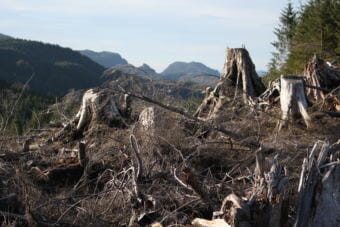
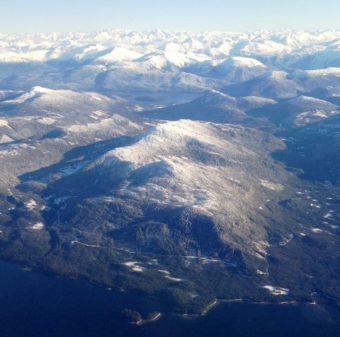
The U.S. Forest Service is on a tour through Southeast Alaska and Anchorage to talk about the prospect of building new roads in wilder parts of the Tongass National Forest. The controversial initiative, which was announced in August, is up against a November deadline. That’s when the state hopes to have a proposal ready for environmental analysis.
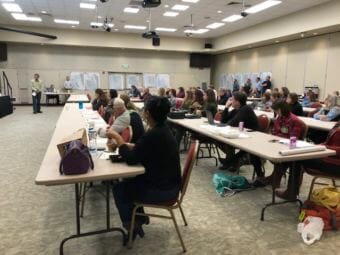
On Thursday, Sept. 13, the forest service held its first public meeting in Juneau.
The forest service wasn’t taking any formal public comment from the crowd of more than 50 people. Instead, there were maps stuck to walls with blue tape to spur discussion.
After some presentations from the forest service, the floor was opened up for a roughly 40-minute Q&A.
In 2016, a forest service plan for the Tongass included moving away from old growth logging.
It was created with years of community input from people on both sides of aisle, including conversation groups and the timber industry.
Meredith Trainor, the director of the Southeast Alaska Conservation Council, wondered how the possibility of new road building in the Tongass would alter previous plans like the one from 2016.
The prospect of new road building wasn’t on the table then. It’s not for most national forests in the United States.
Alaska has been fighting this for decades, and this latest attempt to green light new roads in the Tongass could potentially change that earlier management decision.
Some in the audience questioned whether that seemed like a good idea.
“It’s a guaranteed slippery slope,” said Bart Koehler. He says he pretty much came out of retirement to make that point.
He used to work for the Southeast Alaska Conservation Council during the heyday of large scale industrial logging.
During his career, he says he saw some positive changes in the way the Tongass was managed, the Roadless Rule being one of them.
Koehler says he’s upset with how the forest service is conducting its current reevaluation.
“This meeting format is a bunch of B.S. — just a pile of bear scat,” Koehler said. “You come, you’re interested and you want to say something and none of these conversations are being recorded.”
Koehler did get his questions in, though, and he’s going to submit a written comment by Oct. 15 when the deadline closes.
A lot of people attending the Juneau meeting wore green stickers that said, “Keep roadless in the Tongass.” Eric Nichols from Alcan Forest Products in Ketchikan wasn’t one of them.
“I’ve been up looking at timber in other places so Juneau was a stopover because of the plane schedule,” Nichols said.
Nichols acknowledged there didn’t seem to be much representation from industry in the room. But he says these issues extend beyond Juneau, to small communities where people are still employed by logging. It’s estimated there are few hundred timber jobs left.
However, Nichols doesn’t think that will be the case for long — if there isn’t easier access to trees.
“We’ve lost the balance. The balance is totally off the scale,” Nichols said. “We’ve got everything in protection for conversation, but very little for what’s going to generate economic activities.”
The next forest service meeting on road building in the Tongass will be in Ketchikan on Sep. 17. The governor’s office still needs to appoint an advisory committee to help inform the decision.

Governor Bill Walker’s administration is looking for Alaskans to serve on an advisory committee that will shape the future of the Tongass National Forest.
In August, the U.S. Forest Service announced it would be considering building new roads in the wilder parts of the Tongass. This is different from the federal legislation most states have to follow.
The committee will discuss which areas in the Tongass could have new roads. Alaska’s congressional delegation has said having enough access to timber and mining opportunities is a priority.
The governor’s office says it’s seeking applications for a “diverse” panel of up to 13 people, including Alaska Native regional corporations and tribes, local governments and environmental groups as well as interests from tourism, mining, energy, timber and fishing.
Meredith Trainor, from the Southeast Alaska Conservation Council, says her organization is still deciding whether they’ll apply.
“Of course, I think any environmental group that’s paying attention to these issues is going consider putting their hat in the ring to be able to be at the table,” Trainor said.
Trainor is skeptical the governor’s office will be able to select a balanced committee to oversee the future of road building in the Tongass, since it was the state that asked for an Alaska Roadless Rule exemption in the first place.
But a spokesperson for the Alaska Division of Forestry says the agency is committed to bringing a broad range of objective people together.
It’s expected the group will be appointed in the next two weeks.