Alaska Made

Alaska Made: This Sitka inventor wants to ease the sore backs of baggage handlers everywhere

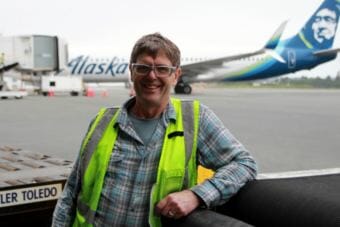
Tim Fulton on the ramp at the Sitka Rocky Gutierrez Airport after the first “full-turn” test of his portable baggage conveyor. After a 30-year career working in aircraft bellies, Fulton has a litany of injuries — including two shoulder surgeries — common among his colleagues on the ramp. (Photo by Robert Woolsey/KCAW)

The job of loading baggage on airplanes is hard, but it doesn’t have to be injurious to the men and women who do the job.

In Sitka, a baggage handler — or “ramper,” as they’re known in the airline business — has designed and built a piece of equipment he hopes revolutionizes the way commercial aircraft are loaded, sparing rampers like himself a lot of physical aches and pains.

As part of the CoastAlaska series “Alaska Made,” a Sitka aviation entrepreneur behind Ramper Innovations.

On an overcast summer day, ramper Tim Fulton waits for the arrival of Alaska Airlines Flight 53 at the Sitka Rocky Gutierrez Airport.

Tim Fulton (right) and his work partner Craig Langenfeld load the 102-pound TISABAS onto the belt loader, in anticipation of the arrival of Alaska Flight 53. (Photo by Robert Woolsey/KCAW)

Flight 53 circles low over Sitka Sound and touches down, trailing ribbons of mist from its wingtips. The Boeing 737-800 pulls up to the gate, and Fulton and his coworker, Craig Langefield, climb up the belt loader into the belly of the beast.

Watching rampers work brings to mind country singer Dave Carroll’s YouTube video, “United Breaks Guitars.” Carroll penned the song after United Airlines refused to compensate him for the damage incurred by his guitar while in transit. After the video went viral, United offered Carroll flight vouchers, but he declined to accept them.

But to a ramper, your bag — your clothing, your fish, your tools, or even your Taylor guitar — is just weight. Weight that has to be pushed (or tossed) and stacked onto a pile that begins far from the doorway — by two people working on their knees.

Flight 53 carries a relatively light load in the aft belly: only 2,300 pounds. There is a lot more at risk here than guitars.

“Forward-bending is challenging on the spine. Twisting is challenging on the spine, and lifting is challenging,” said physical therapist Eric Speck. “When you combine all three you have the perfect storm of forces for the low back.”

Speck has treated a lot of rampers in over two decades at his Sitka practice. He thinks Fulton’s device will be a game-changer for the teams that load airplanes.

“It changes the person who first receives the bag on their knees,” said Speck, “having to accelerate it down the plane, which is a huge twisting moment on the low back, rotating and sending it down the plane. And now he just has to place it there, and the belt is going to take it down. That’s a very big difference.”

Working out of his garage — a fully-equipped machine shop, actually — Fulton has designed and built “TISABAS,” short for “TIm SAves BAckS.” The invention is a lightweight, collapsible conveyor belt that can take the heaviest bag you could ever pack. To be precise, Fulton said it’s designed to hold 150 pounds per square foot.

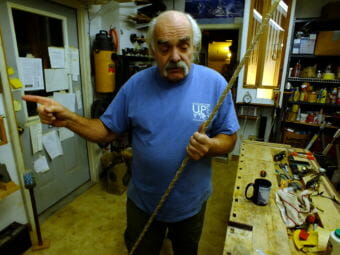
Fulton troubleshoots a TISABAS prototype in his garage shop. A local aluminum fabricator made the frames for the conveyor, and many of the smaller parts Fulton picked up at the local hardware and automotive store. He tried outsourcing some components to China, but was disappointed. “Their stuff was junk,” he said. “With the right parts and the right people, we could make this anywhere in Alaska.” (Photo by Robert Woolsey/KCAW)

A conveyor belt is nothing new, but the TISABAS conveyor folds up in sections — like an accordion — to fit inside a plane’s belly doors. And then it extends or retracts, depending on whether the task is loading or unloading. Each time Fulton lowers one of the sections of TISABAS into position, the belt in that section automatically starts. And when he raises it, the belt stops. A switch reverses the belt’s direction.

Fulton has already built and sold rollers used by Alaska Airlines to load fish boxes into their planes, but regular luggage was a struggle. He said it was like “pushing them on a rutted road.”

“And I got to the point where (there were) probably 20 prototypes into a roller that would do this job, and it just wasn’t meeting the force reduction that I was looking for,” Fulton said. “And that’s when I came up with the idea of a folding belted system.”

Back at the airport, the first full trial of TISABAS has been brilliant. Fulton and Langenfeld turned around luggage in the aft belly just a little faster than their colleagues forward — but Fulton, with two shoulder surgeries and a painful hip, said his back is doing just fine.

But how do the other rampers feel?  One ramper who hadn’t seen the trial was concerned that TISABAS — or similar technology — would cost jobs on the ramp, and that airlines might adopt it to cut costs, rather than to save backs.  Another third-year ramper, Evan Sutton, was more upbeat. “It went well,” he said. “I felt like they had a good rhythm, and they kept up with the belt (loader). That’s all we really wanted.”

An airline may assign a third person to load in the aft belly of longer aircraft, like the Boeing 737-900, but these rampers say that most of the time there are only two.

Ramper Bob Weaver has suffered injuries to his elbow and shoulder in the past. He sees promise in TISABAS.

“I was impressed. This was the first time I’ve seen it in action, and it worked a lot better than I expected,” Weaver said.

He added that an alternate way to mitigate rampers’ injuries would be for passengers to pack lighter.

“People bring too much stuff,” Weaver said. “You don’t need high heels in Alaska.”

The brain behind TISABAS is the electronic control system: Only the belts that are horizontal on the aircraft’s floor turn on during loading. When they’re folded up they stop automatically. Fulton says he interviewed about a dozen engineering firms before settling on a company in Boise, Idaho, to design the motors and switches. (Photo by Robert Woolsey/KCAW)

Fulton’s new company, Ramper Innovations, hopes to sell TISABAS for around $40,000 each — about 20 percent of the cost of his closest competitor. Fulton has already begun conversations over possible licensing deals. Ramper Innovations was one of five businesses chosen by the aviation business accelerator AeroInnovate for its Class of 2018.

“I got this,” says Fulton after the successful trial. “I’ve got proof of concept.” The next step: connecting with investors. (Photo by Robert Woolsey/KCAW)

What happened inside the belly of Flight 53 has been a long time coming.

“Right now, my thought is, ‘I got this,'” Fulton said. “I’ve got the proof of concept. Get some investors, help me take it to the next stage. This one is basically all mine. I know it. I know what has to be fixed. I got this.”

And his distribution plan is simple: He’ll load TISABAS as cargo — collect to airports all over the world — in the belly of planes just like the Boeing 737-900.

Alaska Made: A new rule makes this easy-to-build gadget a required kit for the tackle box

“Rockfish Recompression” — it’s a song and a soon-to-be required Southeast Alaska fishing regulation. As part of CoastAlaska’s “Alaska Made” series, here’s an easy-to-build gadget that’s a simple solution and good fishing karma.

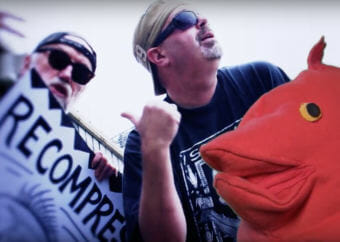
Ketchikan-based band Ratfish Wranglers has a rap all about rockfish recompression.

Rockfish live in deep water. When they’re caught and brought to the surface, they can’t swim back down on their own.

“So they float on the surface, generally, until an eagle picks them up,” said band member and fisherman Brian Curtis.

He doesn’t fish to feed eagles. So he built a simple gadget.

This simple device can help save rockfish that have to be thrown back. Ketchikan musician and fisherman Brian Curtis makes them, and sells them at gigs. (Photo by Leila Kheiry/KRBD)

“This is a rockfish recompressing device,” he said, holding up a hook attached to a line and a weight.

And what is a rockfish recompression device?

“It will take a rockfish from the surface suffering from barotrauma back down to the depths (from) where it came, and recompress him in so doing,” Curtis said.

Barotrauma is damage caused by a quick change in pressure. Rockfish have a swim bladder that’s filled with gas, and that helps them stay in deep water.

“When a non-pelagic rockfish is brought to the surface, the gas in the swim bladder expands, resulting in pressure-related injury referred to as barotrauma,” explained Kelly Reppert, a biologist for the Alaska Department of Fish and Game. “This includes bulging eyes, a protruding stomach and other unseen internal injuries.”

Starting in 2020, fishers in Southeast will be required to return unwanted rockfish to deep water.

“All anglers fishing from a vessel that are releasing rockfish will be required to have in possession — and (will be required to) use — a deep-water release device,” Reppert said.

Charter fishing boats must have and use recompression devices already. The new rule expands the requirement.

There are a number of deep-water release devices that meet that requirement. But Curtis thinks his is probably the simplest.

“You can find all of these materials in the average tackle box,” he said.

Those materials are: A barbless hook and 20-ounce weight attached to a fishing reel on a sawed-off rod. That’s it.

He keeps it on his boat, ready to use. If he reels in a rockfish he doesn’t want — or can’t keep because he’s reached the bag limit — he puts the barbless hook on its lower jaw and throws it back head-first.

“You don’t backlash or anything at that point,” he said. “And it goes all the way to the bottom, dragging the rockfish headfirst by the barbless hook. By the time it gets to the bottom, all you really have to do is reel up, and now the hook is pulling out. You don’t have to jerk, just reel up.”

Brian Curtis is a fisherman and a member of Ketchikan band the Ratfish Wranglers. They sing about rockfish recompression, and Curtis makes a simple device to accomplish that soon-to-be-required task. (Photo by Leila Kheiry/KRBD)

Those instructions, and other options, are detailed in the Ratfish Wranglers’ rap.

“I like to think that every time we sing that song and we talk about it a little bit, we actually save the lives of little fishies,” said band member Ray Troll.

He said the song and accompanying music video were commissioned by the National Oceanic and Atmospheric Administration. There are two version of the YouTube video. The short version is just the song.

One is longer and walks people through the steps,” Troll said. “By the end, you will be a barotrauma specialist.”

Curtis has sold his recompression kits at Ratfish Wranglers’ shows.

“They were popular,” Curtis said. “I wanted people to see how simple they were: ‘Oh, I could make that.’ Yes, you can make that.”

Recompression will earn fishermen some karma points, Curtis said. And pretty soon in Southeast, it also will be the law.

Alaska Made: Tonkin cane, silver spoons and the ultimate fly rod

Jon Lyman says you could bend a bamboo fly rod almost double on itself and it still won't break.
Jon Lyman says you could bend a bamboo fly rod almost double on itself and it still won’t break. (Photo by Matt Miller/KTOO)

Entrepreneurs are always searching for ways to grow their business. But some businesses may simply be a one-person operation producing handcrafted items, and they don’t need any growth.

As part of CoastAlaska’s “Alaska Made” series, this is the story of how one Juneau man’s early childhood passion for fishing became a small business.

Jon Lyman claims fly fishing is the world’s oldest sport, going back centuries. But he says it’s less about killing fish and more about the connection to nature.

“I think (Henry David) Thoreau said it: Some men fish all their lives without knowing it’s not the fish they’re after,” Lyman recalled. (Editor’s note: That quotation, while commonly attributed to Thoreau, may have been misattributed.)

Lyman remembers being 10 years old and getting frustrated feeding his entire can of worms to an elusive trout in a Connecticut stream. Everything changed when he borrowed something he’d never seen before.

“These long, willowy sticks. And flies! And I was just entranced,” Lyman recalled.

“There I am trying to come up with worms,” he said. “They handed me a piece of leader with an Adams (dry fly) on it and said, ‘Try this on the end of your line. Betcha catch that fish. Just be real quiet.’”

He was surprised at what happened next.

“Damned if that fish didn’t come up and take that fly!” Lyman laughed. “Ever since then it’s been, ‘Katy, bar the door!’”

Now retired from building houses and as an education officer for the Alaska Department of Fish and Game, Lyman jokes he spends “eight hours a day, 10 days a week” in his woodshop, incorporating skills from both jobs into making bamboo fly rods.

Cross-section of two-inch diameter piece of Tonkin bamboo shows the dark power fibers that gives the cane its strength. (Photo by Matt Miller)
Cross-section of two-inch diameter piece of Tonkin bamboo shows the dark power fibers that gives the cane its strength. (Photo by Matt Miller/KTOO)

Lyman uses a species of bamboo only found in one area of China. He showed me a cross-section of a scrap piece of unprocessed cane that he had recently discarded outside his woodshop.

“See all the little black dots?” Lyman pointed out. “Well, this is big heavy cane.”

Making a fly rod out of bamboo cane is a long, meticulous process that includes 600 steps and 60 hours of work.

“Those black dots are the power fibers that are tubes that run the length of the entire column,” Lyman explained. “Those tubes are like carbon fibers. They give you the power in the rod. They concentrate in Tonkin bamboo out towards the skin, towards the outside of it.”

Lyman splits the bamboo cane into very long, but very thin three-sided strips. Then, he uses a razor sharp wood planer to trim the strips into a gradual taper. Frequent checking with a micrometer ensures that he’s accurate down to ten-thousandths of an inch.

“If your taper is not exact, if you aren’t holding the plane dead level, then your taper gets skewed one side or the other, and it doesn’t give you the same degree of power in the rod,” Lyman said. “Things get twisted and the cast won’t go right.”

Rough cut batches of three-sided bamboo strips wait for more planing and gluing.
Rough-cut batches of three-sided bamboo strips wait for more planing and gluing. (Photo by Matt Miller/KTOO)

The tapered strips are glued together and wrapped in string in a mechanical binder that sounds like an old sewing machine. Next, they’ll be hung in his own fabricated dryer and dehumidifier for at least a month.

Then he’ll paint, varnish and hang again before dressing with line guides, silk thread and exotic wood for the reel seat, like bloodwood or a 2,500-year-old English yew struck by lightning.

“It’s one of the reasons why it takes six months to build a rod,” Lyman said. “Not only do you have all the labor, but the adhesives have to dry, the varnish has to dry for three months before you move or wiggle the rod. It just takes a long time.”

The end result is a strong and flexible rod that is better and more responsive than mass-produced fiberglass or graphite rods.

This antique silver spoon with its unique design will someday become a decorative reel cup or rod butt for one of Jon Lyman's bamboo fly fishing rods. (Photo by Matt Miller/KTOO)
This antique silver spoon with its unique design will someday become a decorative reel cup or rod butt for one of Jon Lyman’s bamboo fly fishing rods. (Photo by Matt Miller/KTOO)

“I have to be real gentle with it,” Lyman said as he hunched over a metal lathe that is spinning a portion of a sterling silver spoon.

Lyman adds a distinctive touch by reworking spoons with unique designs that he’s scrounged from antique stores and pawn shops.

“So now I got a buffalo on the end of my reel cup. Repurposing old silver that everybody says is junk. That will be the end cap that is holding the reel,” Lyman explained as he held up the piece of silver for me to see. “Isn’t he beautiful? Just a gorgeous buffalo.”

After carefully picking out spoon designs that tell a story, the rods become usable art and family heirlooms that can be passed down from generation to generation.

“The family, the father, the mother, the children, the grandchildren were all there (in a Juneau restaurant) when they bought that rod,” Lyman said. “Now that rod is part of their Alaska story. The entire family for generations in the future will have that rod to remind them of this time. And that’s why I do it.”

The rod even comes with a warranty.

“I offer a lifetime guarantee,” Lyman laughed. “My lifetime, not yours!”

Jon Lyman describes how to make a bamboo fly fishing rod in his Juneau woodshop.
Jon Lyman describes how to make a bamboo fly fishing rod in his Juneau woodshop. (Photo by Matt Miller/KTOO)

But Lyman’s rods are not cheap. They sell for at least $1,200 dollars and up.

And he worries the trade war with China will add to his material expenses. For example, it usually takes months and $600 to get good, mature Tonkin bamboo cane shipped over from China. He now expects that will double.

“And it’s going to cost because this is an agricultural product from China, and the tariff is going to hit it,” Lyman said.

Lyman has a website and displays his rods in Colorado ski shops or Juneau restaurants. But he really doesn’t need marketing to bring in more orders, since he can only produce a dozen rods a year.

“I still fish several times a year with it,” Lyman said as he grabbed one of rods and led me out to a small lawn adjacent to a busy downtown street.

He side-cast a few times with one of his rods, precisely landing the line at his intended target underneath a tree.

A silver spoon with the image of goddess Minerva on a Hawaiian background serves as a reel cup on one of Jon Lyman's handcrafted bamboo fly rods.
A silver spoon with the image of goddess Minerva on a Hawaiian background serves as a reel cup on one of Jon Lyman’s handcrafted bamboo fly rods. (Photo by Matt Miller/KTOO)

“Here, just feel this,” Lyman offered. “Let’s put down a modest amount of line here.”

Lyman let me try casting with his rod.

“Now don’t be afraid to bend the rod,” he encouraged. “That sucker, you can bend it in half! Hammer it! Don’t wave the flag! Bang! Bang! There you go!”

For a fleeting instant, as I pulled back and watched the line loop above and back behind me, I paused for a few beats then heard the distinctive whoosh sound as I loaded the rod and pushed hard forward on the cast. I was in the moment.

I was already thinking about visiting my favorite stream again. Which may be just what Thoreau was talking about.

Alaska Made: Sea otter pelts are highly prized, tightly regulated

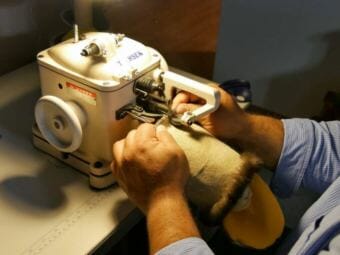
Petersburg resident Will Ware sews a pair of sea otter mittens in his living room. (Photo by Angela Denning/KFSK)

Alaska is one of the few places with a legal sea otter fur trade. The species is listed as endangered in some areas, but in Southeast Alaska they’re booming.

As part of CoastAlaska’s “Alaska Made” series, here’s a closer look at the tight restrictions on who can work with the prized pelts and how.

Sea otter is the densest fur in the world, with upwards of one million hairs per square inch — downy hairs that can take to the air when cut.

Will Ware of Petersburg is sewing, hunched over a sewing machine in his living room. His sleeves are rolled up, and he’s meticulously sewing a pair of seal skin mittens. They have three inches of sea otter fur at the top.

Ware’s been hunting sea otters for about eight years, often with his sons. The fur is tanned in the nearby village Kake. He tries to use every inch: The pelts can run up to $200 each.

“They’re expensive to get tanned. If you’re buying the hides, they’re expensive to buy,” Ware said, who is is Tlingit from the Taakdeintaan Clan. “Our people — our clan — were known for hundreds and hundreds of years as the harvesters of sea otter.”

There’s no harvest limit for Alaska Natives. Ware bags about 30 to 40 sea otters per year to make a variety of items, like hats, mittens, scarves and teddy bears. It’s not a huge moneymaker; he’s got a full-time job. But he also owns a gallery in Petersburg and sells his work online.

Will Ware, left, and Derek Lopez display the pelt of a sea otter at the Petersburg Indian Association office in 2011. (Photo by Ed Schoenfeld/CoastAlaska)

About 90 percent of the world’s sea otters live in Alaska. They were nearly wiped out in the early 20th century by the fur trade. In the 1960s, about 400 animals were brought from the Aleutians to repopulate Southeast. And it worked.

Now fishermen often complain there are too many. The sea otters eat up the shellfish — crab and sea urchins — that fishermen catch commercially. Sea otters can weigh 100 pounds and eat a quarter of their body weight in a day.

Ware says they’re tough, smart and, “They’re absolutely adorable when you see them. You know, they’re cute. They just happen to carry and wrap themselves up in the best fur in the world.”

But the modern sea otter trade is slow-going. Across town, there’s a workshop happening to teach people how to sew the hides — by hand. Half a dozen students sit around a table covered in brown sea otter pelts.

Marcus Gho is the instructor brought to town by the Sealaska Heritage Institute in Juneau. He helps a student smear a thin layer of glue over a seam.

Marcus Gho instructs Jeanette Strickland (left) and Pauline Young on how to sew with sea otter pelts in a Sealaska Heritage Institute workshop in Petersburg. (Photo by Angela Denning/KFSK)

“Some things turn out better when they’re sewn by hand,” Gho said. “Like these pill box hats. I always sew them by hand.”

Federal regulations prevent mass production of sea otters. One must be at least one-fourth Alaska Native to possess tanned, unmodified skins. Sea otter products can’t be produced by people working together. It has to been done by individual craftsmen.

Classes like these are the exception.

But jumping through regulatory hoops is worth it for Gho. He hunts up to 40 sea otters a year and says it’s not about money.

Guylynn Etcher and Marcus Gho work wear pill box hats made of sea otter during a sea otter skin sewing class in Petersburg. (Photo by Angela Denning/KFSK)

“When I sew and work with my sea otter fur or seal fur or any marine mammal fur, I feel a stronger connection to my ancestors,” Gho said. “And I’m grateful for the opportunity that I have to let other people have part of that connection too.”

If this class is any indication, Alaska Natives will continue the craft. And there should be plenty of sea otters to provide the materials.

Sea otter fur is the densest in the world with up to one million hairs per square inch. (Photo by Angela Denning/KFSK)

The population in Southeast is growing steadily. Several years ago a survey estimated almost 26,000 animals. Scientists estimate a growth rate that could put the current population over 40,000. But the data is old, and the U.S. Fish and Wildlife Service is gearing up for an updated survey in the next year.

Alaska Made: There’s only one Christmas tree farm in Alaska. It’s on Kodiak, and it’s thriving.

xx
The Dorman Tree Farm now places small trees in a greenhouse to insulate them from the cold until they’re big enough to be transplanted outside. (Photo courtesy of Celeste Dorman)

Look around Christmas tree lots in town, and you’ll likely spot trees once rooted in the Lower 48. The trees are shipped up by the thousands during the holiday season. Varieties like Douglas fir can have a hard time growing in the state. As part of the CoastAlaska series “Alaska Made,” here’s the story of the one place to buy non-native species — grown in Alaska.

Todd Dorman moved to Kodiak in the 1970s after his family bought a cattle ranch. But his father dreamed of starting another venture.

“He looked around here and saw the native trees around here, and he said, ‘I think this would be a good place to grow Christmas trees.’ Or, they would grow here, anyhow, he thought.”

Dorman’s dad held on to the idea. He saw a niche for a Christmas tree farm, which is an unusual sight in Kodiak and most of the state.

Many of the favorite commercial decorative species don’t grow naturally this far north. It’s outside their typical ranges. Of course, native trees like Sitka spruce are just fine for decking the halls. But the needles can shed quickly, and the spindly branches aren’t to everyone’s liking.

So, in 2006, Dorman and his dad decided to embark on their long-talked-about experiment. They bought 500 small fir, pine and spruce trees from a nursery down south.

Dorman said they tried to manage expectations.

“The typical way that a farmer does something: It’s just kind of, (let’s) see what happens,” Dorman said. “So we just ordered some trees and worked up some ground and planted them out there and saw what happened.”

In the summer, the little trees looked like they were flourishing in the Kodiak soil.

“But after the first winter, it just looked like a desert,” Dorman said. “It didn’t look like anything was alive. So, it wasn’t very encouraging at all.”

The climate in Alaska is warming twice as fast as the rest of the U.S. Tree species that were once thought to thrive in lower latitudes are starting to migrate farther north.

But Dorman said the weather in Kodiak has felt unpredictable. His dad didn’t lose hope after that first harsh winter, when the little trees resembled little more than twigs sticking out of the ground.

“Out of all these bad trees, he’d find one that looked good,” Dorman said. “And (he’d) say, ‘Hey, look at this!’”

That optimism paid off. Dorman said it wasn’t a total wipeout. Most of the trees survived.

xx
Todd and Celeste Dorman at their tree farm in Kodiak. (Photo courtesy of Celeste Dorman)

The next year, the family planted 1,000 more trees. And the following year, even more.

Dorman’s father died about four years ago. But he was alive to see the tree farm make its first sale around 2012.

“I remember the very first one we sold. I’d been looking at this thing for seven years, I think,” Dorman said. “So when someone came along and wanted to buy it, I was a little freaked out.”

He remembers it was a standout Fraser fir. Noticeably, the most beautiful one on the farm. It quickly caught the attention of a father and son who borrowed a saw to cut it down.

Dorman said it’s hard to describe the feeling of letting that first tree go.

“It didn’t take long to get over it,” Dorman said. “But I was thinking, ‘OK, this is the point.'”

He hoped more trees would grow as lush and sturdy as that one, and they have. There are now two-and-a-half acres of Christmas trees on the Dorman farm.

Site notifications
Update notification options
Subscribe to notifications