
A sample of marijuana hash oil in the Alaska House Judiciary Committee, March 6, 2015. Law enforcement officials were holding a “show and tell” about drugs and associated paraphernalia. (Photo by Skip Gray/360 North)
The Juneau Assembly outlawed certain marijuana refining methods for personal use Monday night in a 5-3 vote.
Using methods based on butane and propane are not permitted. The concern is that flammable gases used to make hash oil could cause fires or explosions.
Approved methods include water-, alcohol- and food-based extraction, which could create marijuana infused butter, olive oil or liquor.
On Feb. 23, the Juneau Planning Commission will consider two North Douglas property owners’ commercial grow application. The commission is the gatekeeper for the conditional use permit they need to operate.
Sea lions sit on a buoy in front of Angoon, May 31, 2014. (Creative Commons photo by James Brooks)
The City of Angoon believes high levels of mercury have been discovered in subsistence food caught near Hawk Inlet and that Hecla’s Greens Creek Mine could be responsible.
Angoon’s tribal government is asking for changes with the monitoring and processing of mine waste. Albert Howard, the city’s mayor and tribal president, said dead crab initiated the concern.
Last year, a seal was harvested at Hawk Point and brought back to the village to share. Howard said a sample of the tissue was sent to a lab to be inspected.
“And the lab results came back and it’s one of the highest levels of mercury seen in the state of Alaska since the seal sample program has taken place,” Howard said.
Howard said the Friends of Admiralty Island also found elevated toxic metals in seaweed, clams, mussels, shrimp, cockles and crab. It’s such a concern that Angoon has warned tribal members not to collect traditional foods in the area.
Howard said he would like to see the city and the mine work together to clean up the water.
“I understand that the mine is important to a lot of people for jobs and revenue into the City and Borough of Juneau, but there’s also a responsibility to the community health. And what I meant by that is the city council and the tribal council understand the importance of the community’s health and our children,” Howard said.
Greens Creek spokesperson Mike Satre said the mine reports a sample on an annual basis.
“We meet all the permitted conditions that are put on us by the state for the discharge of our water into Hawk Inlet,” Satre said.
While the reports are annual, Satre said they’re based on continuous monitoring and sampling of the discharge water, supplemented by quarterly bio-monitoring and additional sampling of seawater and sediment.
Angoon has requested that Lt. Gov. Byron Mallott and Alaska’s Department of Health and Social Services look into the matter.
Editor’s note: Comments by Greens Creek mine spokesperson Mike Satre about annual reporting have been expanded and clarified.
The City and Borough of Juneau has named candidates for two top positions: city manager and chief housing officer.
Rorie Watt and Fred Parady are in the running for city manager. Watt is a long-time Juneau resident and the director of engineering and public works. Parady is the deputy commissioner for the Alaska Department of Commerce, Community and Economic Development.
City Manager Kim Kiefer plans to step down April 30. She’s held the position for four years. The Juneau Assembly hopes to fill the job before Kiefer leaves so there’s some overlap.
For Juneau’s new housing officer, Scott Ciambor and Jeff Watson are the candidates. The position was created to help with housing development in the community.
Ciambor and Watson gave presentations at Juneau Assembly Chambers Thursday night. Similar presentations for the city manager candidates are scheduled for Tuesday, Feb. 9 — starting at 5 p.m.
Editor’s Note: scheduling for the presentations has been updated.
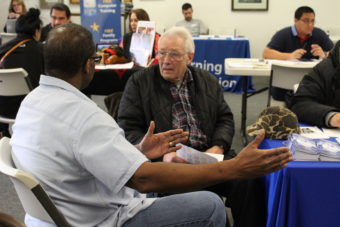
A Wal-Mart employee talks to a Juneau Job Center staffer during a Jan. 29 job fair. (Photo by Elizabeth Jenkins/KTOO)
Wal-Mart says it’s trying to do right by its soon-to-be-laid-off employees in Juneau. For example, it’s flying in trainers to help with job skills. But it’s also been strictly sticking to a corporate policy that left some outgoing employees in the dark about a state-organized job fair held specifically for its employees.
About a minute’s walk from Wal-Mart, a small room at Gruening Park has been transformed into a mini job fair. Up to 168 Juneau Wal-Mart employees could lose their jobs this week, so the state organized the Jan. 29 job fair to help.
“We’ve got TSA, Fred Meyer, Verizon, AT&T, Home Depot, and IGA,” said Ray Brogdon, an employee at the state’s unemployment office.
He says the hope is that Wal-Mart associates can find new jobs before they have to step into his office.
And at about an hour into the event, prospects look good. Some Wal-Mart associates who walked through the door already landed a job interview. But for one of Juneau’s largest employers to be shutting down…
“It’s a little slow right now but we’re looking at probably around 12 o’clock, until we’re done here until 2 p.m., that it should start picking up and hopefully be able to assist everyone that comes in,” Brogdon said.
In the afternoon, it does pick up. And Wal-Mart associate, Bradford Rich, goes from booth to booth to speak to the stores hiring. He found out about the job fair the same way he discovered Wal-Mart was closing: he read about it on Facebook.
“And some other my coworkers had seen it, and we all talked about it. I didn’t realize it was specifically put on for us until I read the whole shebang,” Rich said.
Wal-Mart announced it was closing 154 of its stores in the U.S. in January–potentially laying off 10,000 employees. And Juneau was on that list.
Rich, who’s worked at Wal-Mart for two years, says the news hit him hard.
“Best way to describe it as a family member died. It’s that kind of feeling of loss,” Rich said. “I’m full grown and when I went to work for them I had planned on working there until I retired. And like I said, we didn’t know until that Friday that they were closing down so it was like a death in the family.”
So he says he was excited when he heard the Department of Labor was organizing the jobs event. Rich is a manager at Wal-Mart’s deli. And he wants to find something similar at one of the other stores in town.
But, working his shift at Wal-Mart, he couldn’t find any information that the job fair was even happening.
“They would not allow us to have any job fair. They are going to give us a class on resumes and that’s going to be done at the store. But they will not support the Department of Labor to come into the store,” Rich said.
“Yes, I had heard that,” said Heidi Drygas, the head of the state Department of Labor. “I had heard they had requested that we not be on the premises.”
She says it’s not uncommon for the state to organize this type of response in communities facing mass layoffs. In Bethel, when the Swanson’s grocery store shut down, displacing 80 employees, the Department of Labor stepped in to help with job relocation.
“Typically, employers welcome that sort of interaction with a state agency tasked with reemploying workers so not sure why there was that… I don’t want to say resistance, just decision on behalf of Wal-Mart management,” Drygas said.
A Tlingit-Haida Regional Housing Authority staffer assists a Wal-Mart associate at the job fair. (Photo by Elizabeth Jenkins/KTOO)
Wal-Mart’s corporate spokesperson says there’s a company policy that forbids outside groups from engaging in any demonstration and soliciting or distributing literature at their stores. That includes the state’s job fair flyers. But Wal-Mart is flying in development trainers to help employees with resumes.
Lisa Mielke, the statewide rapid response coordinator, said she wasn’t at the meeting between Wal-Mart and the Department of Labor. The Juneau Job Center was, but officials declined to comment for this story. And Mielke says she’s not sure why the job center wouldn’t talk.
“We have Wal-Marts through Alaska and they’re a big employer that hire lots of people,” Mielke said. “And so we have a good working relationship with them.”
Wal-Mart has 12 other stores in Alaska.
Mielke says the Department of Labor did everything it could to get the word out about the job fair. Staff placed flyers in bus stops, convenience stores — even inside Safeway and Fred Meyer.
Still, one Wal-Mart associate I spoke with didn’t know it was happening, and she missed it.
In all, about 20 Wal-Mart employees scored new jobs from attending the job fair. Magesty Tauay was one of them.
“Well, I like to socialize with people. I like to get along with people. I make friends easily. I don’t have to get used to them,” said Tauay. “I just walk up and said, ‘Hey, I’m Magesty. Nice meeting. You have a wonderful day.’”
She says Fred Meyer and Home Depot offered her a job. And she needs it, because she sends money back to her family in American Somoa.
“Every paycheck I have, if I have that much, I send my parents money. But if they do really need it, I don’t care about myself or anything. All I care about is my parents,” she said.
And she says she heard about the job fair at a meeting that morning at Wal-Mart.
But Bradford Rich says he wishes Wal-Mart would have done more to promote the event.
“I would have appreciated it if they had done that. I just want to thank the people that did this here. ‘Cause at least we did have something to go to,” Rich said.
The Department of Labor plans to hold another job fair for Wal-Mart’s employees after the store closes this week.
The Juneau Wal-Mart was previously a K-Mart store. (Photo by Elizabeth Jenkins/KTOO)
The Alaska Department of Labor and Workforce Development is hosting a job fair Friday for Wal-Mart employees who are being laid off.
IGA, Safeway, Fred Meyer and Home Depot will be there to discuss job prospects. Juneau’s Wal-Mart employs about 180 people.
Lisa Mielke, the statewide rapid response coordinator, said there will be information on how to file for unemployment, Medicaid and public assistance. The job fair is happening close to Wal-Mart.
“The reason we held it at Gruening Park was so it would be close in vicinity so that people could come during their breaks and lunches so we’re hoping to get as many as we can and we’re hoping we can hand out a lot of information,” said Mielke.
Mielke said people should bring resumes.
“Or if they don’t have a resume, just kind of bring a list of jobs they’ve had in the past, some other skill sets, and just be prepared to have a mini-interview,” she said.
The job fair is being held tomorrow from 10 a.m. to 2 p.m. Mielke said another job fair is being planned.
Earlier this month, the store announced it was shuttering its Juneau branch—along with 154 other stores nationwide. The Juneau Wal-Mart is expected to close next week.
John Ross gets his hair cut by Marti Fred from Shear Design. (Photo by Elizabeth Jenkins/KTOO)
Alaska now has a more localized way of looking at homelessness data. Instead of gathering information that reflects the state as a whole, some municipalities can see their own data that gets reported to the feds. That could mean more funding for housing in some communities.
John Ross hasn’t had a haircut in a while. His hair is black with wisps of gray feathering from the temples. He says he wants something polished — just nothing high and tight.
“I was in the service, I’ve had everything cut off. I don’t want that again,” Ross said.
He’s waiting with three other people at the Zach Gordon Youth Center. A salon called Shear Design is volunteering staff for the day, and so far, they’ve been busy nonstop giving people cuts.
Ross has been sleeping at the Glory Hole on-and-off for about four years. In the summer, he works at Taku Smokeries.
“Soon as they open up the campground, I’ll go back there, and I’ll be going back and forth to Taku working and having a place to stay,” he said.
He works the most during salmon season, even doing double shifts. But in the winter, when there’s little seafood coming in, he goes back to being unemployed.
“It’s rough right now so this is really good timing for me. I really do appreciate it. That’s why I like to give something in appreciation of what they’re doing for me.”
He gives away tiny dream catchers, the kind you can hang on a rearview mirror. He made one last year for the woman who cut his hair. At that point, he hadn’t had it cut in seven months.
“And I was really shaggy so I really appreciated it at the time and it’s whole different person who came out of here,” Ross said. “And I was looking for work and a couple of weeks later I did get some work and it’s kind of nice to look good before and when you’re looking, gives you confidence, gives you better chances.”
Just across the parking lot, more than 200 people experiencing homelessness filtered through the Juneau Arts and Culture Center. Booths line the walls of the old gymnasium. You can sign up for Medicaid, have your blood pressure taken, or pick up a pair of socks and gloves.
But first, you have talk to Jackie Triplette, or one of the other volunteers, to take a survey.
“I take you through it question by question. Gender, race, whether it’s an adult or an adult with children,” she said.
There are also some very personal questions on it, like “Have you been a victim of domestic violence or sexual assault?”
“And some people want to talk more and discuss things which is fine,” she said. “It’s nice to meet these people and understand their issues. I think more people would understand what’s happening to these people if they came and volunteered to do this.”
This is Triplette’s second year volunteering to do this. Project Homeless Connect has been going on for five. Triplette says when people sit down with her, she tries to explain why the survey is important.
“We’re really collecting data so that we know how the community can help our homeless population,” she said.
Every year across the United States, that data gets collected and important policy and funding decisions are made by analyzing it.
“This year we’re working with our administrator to make sure that we break it down by communities,” said Scott Ciambor, the chair of the Alaska Coalition on Housing and Homelessness.
Ciambor says, for many years, the state complied with just the federal requirements. Alaska was broken down into two categories: Anchorage and the rest of the state. Now communities doing the survey can have access to that data, which could help with getting funding for housing — especially permanent supportive housing.
“It’s a game changer,” Ciambor said. “When you’re trying to plan and advocate for resources, the first question is well, what do you have? … So it’s definitely giving communities a tool to address their circumstances for people who are experiencing homelessness.”
John Ross is finishing up his haircut. He’s probably had about an inch cut off. And it looks great. Most of the feathery white has been snipped away.
Before he leaves, he hands the barber a gift — the small dreamcatcher. And heads to the bathroom to check out his new look.
“It’s perfect. The length, everything. I feel better about going, even though I got the job at Taku, it’s still good to look good when you start a job. So I’m happy,” Ross said.
Down the line, he hopes to qualify for other jobs with the vocational training he learned about at today’s event. The results of the survey should be completed sometime in May.
Close
Update notification options
Subscribe to notifications
Subscribe
Get notifications about news related to the topics you care about. You can unsubscribe anytime.