Elizabeth Jenkins, Alaska's Energy Desk - Juneau
Conservation group says Obama should be tougher on Tongass

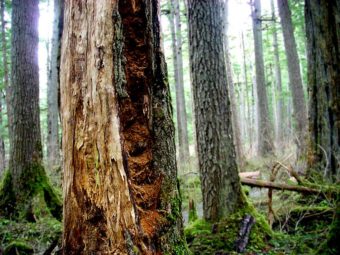
Tongass National Forest
Part of the Tongass National Forest in April 2008. (Creative Commons photo by Xa’at)

A federal proposal to make Southeast Alaska’s logging industry sustainable while preserving old growth in the Tongass National Forest does too little, too slowly, according to one conservation group. The Oregon-based Geos Institute says the Tongass National Forest draft plan is out of step with a global agreement to reduce climate change.

President Barack Obama visited Alaska in September to see the effects of climate change firsthand. Then, a few months later, the U.S. joined about 195 nations in signing the Paris Climate Change Agreement. The president has made reducing carbon emissions a talking point during his time in office.

“But his administration puts forth a plan that’s not ambitious enough,” said Dominick DellaSala, a scientist at the Geos Institute. What he’s referring to is the draft timber plan for the Tongass, which is open for public comment until February.

In a nutshell, the federal plan outlines dramatically reducing old growth logging while ensuring a sustainable supply of young growth trees. The problem, DellaSala said, is the plan isn’t aggressive enough.

“Those acres of trees over time being cut down would be equivalent to 4 million additional cars on Alaska roads every year,” DellaSala said.

That estimate is over a hundred years. The Geos Institute has been crunching the numbers with Forest Service data. DellaSala believes the transition from old to young growth logging could be done in five years, rather than 16. That’s what the plan is proposing.

DellaSala says trees soak up carbon dioxide from the atmosphere like a sponge. Essentially, a big stick of carbon.

“Now unfortunately, when a tree does fall in a forest and if it’s done by logging, you’re going to lose about 80 percent of that stored carbon,” DellaSala said.

Eventually, when it decomposes, it goes up into the atmosphere as greenhouse gas. And with old growth trees, DellaSala says you get more carbon.

With the Paris Climate Change Agreement, leaders came up with guidelines to slow global warming. They pledged to protect forests, like the Tongass.

“So it’s absolutely critical to everyone’s future that we keep those temperatures below that 4 degree Fahrenheit tipping point that most scientists believe that all hell will break loose in terms of climate change,” DellaSala said.

Owen Graham isn’t concerned with the Paris Climate Change Agreement. He’s the executive director at the Alaska Forest Association, a timber industry group.

“You know, I don’t really give a damn about the Paris, what they did over there with climate change,” Graham said.

Graham thinks the Tongass draft plan already transitions to young growth trees too soon. Any sooner could be devastating.

“That’ll put the local sawmills out of business. And it seems kind of pointless. It’s just cutting the trees early and exporting them,” he said.

Graham said most mills in the area can’t process the less valuable product. So the trees would likely be shipped overseas or down south, resulting in the loss of hundreds of regional jobs.

“The industry that we’ve had in Southeast Alaska has never been a big industry despite what you hear from some of the environmental groups,” Graham said. “We’ve never been a big industry and we’ve never had a significant impact on anything, let alone global warming.”

Dominick DellaSala said the goal of his report isn’t to reduce jobs. It’s to find alternatives.

“I think we need to demonstrate that with a pilot study that these young trees can be processed locally. They can add jobs and they can have value to them,” DellaSala said.

Forest Service reps said they need more time to review DellaSala’s report before commenting. But DellaSala says the clock is ticking. The president is wrapping up his term.

“This is not a legacy gift to Alaskans when we still have this much old growth on the table,” DellaSala said.

How much old growth is on the table? According to the plan, more than 43,000 acres by about the year 2117. That sounds like a lot. But it’s about a quarter of a percentage point of the entire Tongass.

The Forest Service is holding an open house on Jan. 19 to discuss the draft plan on the Tongass. It starts at 5 p.m. at the Juneau Ranger District conference room. Public comment ends Feb. 22.

Filing for new Juneau mayor opens Friday

(Photo by Lisa Phu/KTOO)

The filing period for Juneau’s new mayor opens Friday. To be considered, candidates must be a Juneau resident for at least 30 days before the election, be qualified to vote in Alaska, and be at least 18 years old. Felons are not permitted.

Candidates have until Jan. 25 to apply. The special election is March 15.
Mary Becker has been serving as Juneau’s mayor since Greg  Fisk’s death in November. The assembly decided in December to hold a special election for a new mayor. Earlier this week, Barbara Sheinberg was appointed to fill Becker’s vacant District 1 seat.

Becker will return to that position after the election.

Update: Barbara Sheinberg appointed to Juneau Assembly

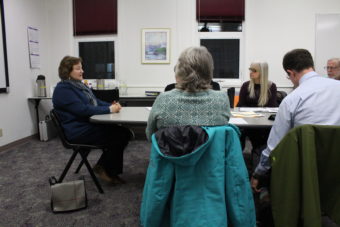
Barbara Sheinberg answers the Juneau Assembly's questions at her interview for the District 1 seat. (Photo by Elizabeth Jenkins/KTOO)
Barbara Sheinberg answers the Juneau Assembly’s questions at her interview for the District 1 seat. (Photo by Elizabeth Jenkins/KTOO)

Update | Jan. 12, 2016 9:39 am 

The Juneau Assembly appointed Barbara Sheinberg to fill the vacant District 1 seat. She is the owner and principal of Sheinberg Associates, a community and strategic planning consulting business. Her firm worked with the McDowell Group recently to prepare the Juneau Economic Plan. She says she’s also familiar with municipal budgets, including Juneau’s, through her work forecasting revenues for local governments.

Sheinberg was on the Planning Commission for five years and currently sits on the city’s Board of Equalization.

Original story | Jan. 11, 2016 7:48 pm 

The Juneau Assembly plans to announce Tuesday morning its pick to fill the vacant District 1 seat for two months.

In a meeting on Monday, assembly members interviewed Albert Clough, Douglas Mertz, Arnold Liebelt and Barbara Sheinberg. A fifth applicant, Cheryl Jebe, withdrew on Monday due to medical reasons.

Each person received 10 minutes to pitch why they would be the best fit. Assembly members asked about Juneau’s biosolids issue and whether they would consider running for assembly again.

Only Liebelt and Sheinberg said possibly. Albert Clough and Douglas Mertz said no.

The District 1 seat belonged to the former deputy mayor, Mary Becker, who assumed Mayor Greg Fisk’s position when he died in November.

Juneau voters will elect a new mayor on March 15, and Becker will return to her District 1 seat.

Why Capital City Fire/Rescue is jumping into freezing water

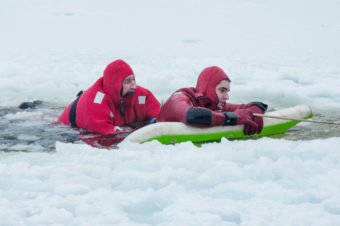
Capital City Fire & Rescue demonstrate how to get out of the water after falling through ice. (Photo by Greg Culley)
Capital City Fire/Rescue members demonstrate how to get out of the water after falling through ice in 2014. (Photo by Greg Culley)

This weekend, guests to the Mendenhall Glacier Visitor Center can see a safety demonstration on ice.
Laurie Craig, a forest service naturalist, said people fall through Mendenhall Lake every weekend hiking near the glacier. Typically, the frigid water only comes up to their knees, but Craig said it’s good to be prepared for the worst.

Members of Capital City Fire/Rescue will chainsaw a hole into a pond near the visitor center.

“And then they will get one of their suited up experts to go in as a victim and demonstrate how to get out,” Craig said.”This pond is 30 feet deep so they can’t just stand up and walk out of it.”

Craig said there will also be a demonstration on how to rescue a dog.

“They will not use a real dog. They will use a stuffed dog,” Craig said. “One of the reasons that’s important is often it’s the pets that go through the ice. And the owners rush out to save them and they go in as well.”

The visitor center didn’t have a demonstration last year. The ice wasn’t firm enough, due to the warm temperature.

This year’s ice safety training takes place at 1:30 Saturday afternoon at the Mendenhall Glacier Visitor Center.

Eaglecrest to participate in what might be world’s largest ski and snowboard lesson

Eaglecrest Ski Area is participating in an effort Friday to set the Guinness World Record for largest multi-venue ski and snowboard lesson.

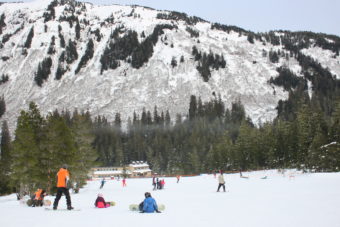
Twenty instructors will be on-hand to help as many as 100 beginner-level riders glide down the Porcupine run.
Charlie Herrington, Eaglecrest’s Marketing and Events Coordinator, said riders who have signed up were asked to be there by 8 a.m.

“At 10 a.m. sharp, bam! The lesson starts,” Herrington said. “Across the whole nation, everyone’s lesson has to be following the same guidelines. It’s going to be pretty chaotic at first getting everyone going and then once the lesson gets going, I’m sure everyone’s going to be fine.”

As many as a hundred other ski resorts across the nation will participate.

Seventy people have signed up for the $10 lesson since noon on Thursday. Registration is now closed, but the public is invited to witness the spectacle.

Juneau considers options for dealing with its #2 problem

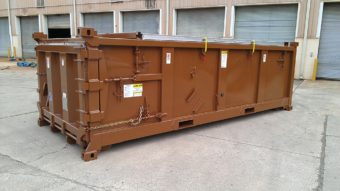
One of the city's watertight shipping containers it uses to transport sewage sludge. (Photo courtesy CBJ Public Works Department)
One of the city’s watertight shipping containers it uses to transport sewage sludge. (Photo courtesy of CBJ Public Works Department)

About 7,000 tons of the capital city’s human waste is barged to Oregon every year, costing the City and Borough of Juneau about $2 million. The Juneau Utility Advisory Board released new recommendations Monday on how CBJ should continue to deal with the sludge.

City engineer Rorie Watt said the advisory board met several times over the past year to discuss solutions.

“What the utility board essentially found is that indeed that they agree the dryer is our best option,” he said.

Watt said the dryer is kind of like a big oven. It turns the waste into pellets which can then be used for topsoil, revegetation or road projects.

The upfront cost would be more than $16 million. The dryer would be located at the Mendenhall Wastewater Treatment Plant.

“If we built the dryer, and depending on fuel prices, operating the dryer is probably only around $800,000 a year,” Watt said.

The life span of the dryer is about 20 years. Another option is to contract with a private company that would bury the waste on land in South Douglas. Bicknell and Backfill, Inc. are proposing barging the city’s waste to 100 acres of remote land.

That would cost about $1.8 million per year. While it’s more than the dryer option, upfront costs are less. The company is asking for a 10-year contract with an option to cancel after five years.

At a meeting Monday, Juneau Assembly member, Debbie White said she wanted to hear more about the company’s plans.

“I started out with this thinking I wanted the dryer,” White said. “But the fact is, I like the idea of getting some time for technology to catch up to where we’re at.”

The dryer option would take about 18 months to get off the ground. With permitting, it’s unknown when the private company could be operational. The assembly asked the Utility Advisory Board to bring back more information for their next meeting.

Editor’s note: We’ve updated information on how long the projects would take to get started. 

Site notifications
Update notification options
Subscribe to notifications