Elizabeth Jenkins, Alaska's Energy Desk - Juneau
‘We’re not going to hide our family members or be ashamed’

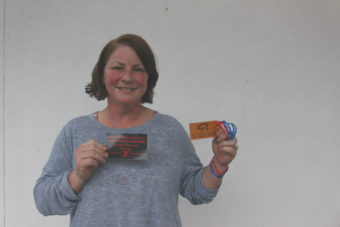
Michele Stuart is organizing the Stop Heroin Start, Talking Event. (Photo by Elizabeth Jenkins)
Michele Morgan is organizing the Stop Heroin Start, Start Talking event. (Photo by Elizabeth Jenkins/KTOO)

There are two different Juneau events this weekend to raise awareness about heroin addiction. This year, seven people have died in deaths involving heroin. The community is banding together to talk about what’s happening to their neighbors and family.

Michele Morgan said she wasn’t aware of an opioid problem in Juneau. The realization happened gradually.

When it came time for her teen-aged son to have his wisdom teeth pulled, she asked if he would tell his friends.

“And he said, ‘No, mom. Don’t tell anyone.’ He said, ‘Mom, because they’ll come to our house. They’ll know I have oxycodone,” Morgan said.

That was about nine years ago. Oxycodone, like heroin, is an opioid. It elicits the same effect on the brain. If you look at the recent drug seizures in Juneau, heroin is gradually increasing.

Morgan, the director of the Juneau Softball Association, said she noticed a shift in 2014. That’s when one of the young players died of an overdose.

“No one talked about it, except through the grapevine,” she said. “We have a benefit tournament we do for our players for those who have passed. So we did a plaque for that kid. And six months later we lost another kid to the same, to heroin.”

Then another. Breyner Haffner, in his mid-twenties. “Like one of my children,” Morgan said.

He used to play on her softball team.

“And I came home and I was mad and I was scared. And so I went on my computer and I ordered some stickers and some magnets,” Morgan said. “Anything I could get to make me feel like I was getting the word out.”

The stickers say, “Heroin will kill you and your friends, please don’t start.” That snowballed into the grassroots initiative: Stop Heroin, Start Talking.

The Juneau police noticed a trend last year in heroin-involved deaths and they’re tracking it now. During the next few months, they’ll be releasing videos of users speaking about their struggles with addiction.

The people appear in silhouette. Their voices are altered.

INFORMATION RELEASESubject: Stop Heroin Start Talking-Part 4 Date: 11-2-15From: Lt. Kris SellThe Juneau Police Department, as part of a six month anti-heroin initiative, will be introducing the public to several former and current heroin addicts throughout November. While JPD continues to work many heroin importation cases, like many other police departments, JPD knows going after only the heroin supply without addressing heroin demand does not give the community the results everyone wants. In order to address heroin demand the questions of why people started using heroin and why they keep using heroin must be answered for the community to have an effective prevention and treatment strategy. One person interviewed by JPD was nearly an overdose death at one point but was saved by Capital City Fire and Rescue. That person continues to use heroin. It is difficult for a non-addict to understand why someone would make that choice. The answer seems to be that the addict’s desire for the heroin high becomes so strong even an addict’s child cannot compete.

Posted by Juneau Police Department on Monday, November 2, 2015

Morgan said the hope with her initiative is education but also to remove the stigma attached to losing a loved one.

Then there’s policy change, like Senate Bill 23. It allows a medication called Naloxone to be distributed at trained agencies or sold over-the-counter at pharmacies.

“And Naloxone under the brand name Narcan stops the heroin overdose or the opiate overdose. Is it a cure for addiction? No, but it could save lives,” she said.

The Senate has already passed the bill, sponsored by Sen. Johnny Ellis. It now needs to pass the House. And as the legislative session gets underway, Morgan said she’ll be focusing her energy promoting it.

Overall, she said she wants to inform the community that having addiction isn’t a character flaw. It’s a health crisis. One that can be addressed.

“We’re coming out,” she said. “We’re not going to hide our family members or be ashamed, we’re going to kick heroin’s butt, and we’re going to do that as a group.”

Before she leaves, she hands over a Stop Heroin, Start Talking bracelet. Morgan said she’s giving them out to everyone she meets.

On Saturday, Stop Heroin, Start Talking is holding a 5:30 p.m. event at Rockwell. It features hip-hop performances and karaoke. There’s a $5 suggested donation.

On Sunday at 3 p.m., Community of Compassion meets @360 for a conversation about heroin addiction.

Juneau Assembly adopts marijuana zoning

medical marijuana grow operation
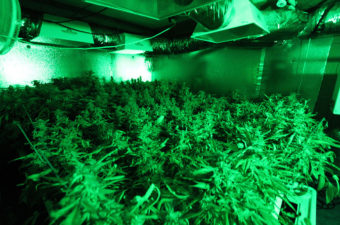
Flowering cannabis plants under green light in an air-conditioned, indoor hydroponic grow operation in Oakland, Calif. (Creative Commons photo by Rusty Blazenhoff)

The Juneau Assembly has established zoning for marijuana cultivation, processing and retail.

Pot entrepreneurs will be able to grow their crop in some low-density neighborhoods, outside the city’s urban service boundary. That includes parts of North Douglas, Thane and out the road.
Margo Waring, who lives on North Douglas, testified that she was concerned about the scale of commercial grow operations.

“We’re not looking at your backyard raised veggie bed. This is an indoor industrial activity,” Waring said.

Grow facilities, in the designated D1 areas, are limited to under 500 square feet or about the size of a two-car garage. Residents will be able to voice concerns with the city on a case-by-case basis if issues come up.

Assemblymember Debbie White said by establishing zoning, existing marijuana businesses can come into the light. Pot entrepreneurs will be able to apply for conditional use permits by the end of the year.

“The fact is, then we get to tax for sales,” White said. “And if you think cultivation is not already happening in residential areas, the fact is it’s already there.”

The assembly also enacted a 1,000-foot buffer for marijuana processing facilities around registered neighborhood associations in rural reserve areas.

Retailers will be able to set up shop in parts of downtown, Lemon Creek and by the Juneau airport. Also, in rural reserve areas, which is basically everything off of the road system, plus parts of North Douglas and out the road.

The state is proposing a 500-foot buffer around all schools, youth centers, and churches.

Juneau Assembly stays the course on Gastineau demolition

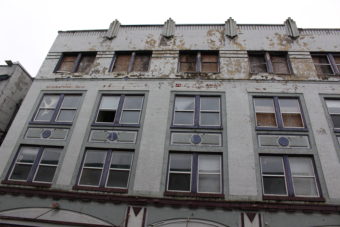
A Seattle developer is considering renovating the historic building and turning into it subsidizerd and market-rate housing. (Photo by Elizabeth Jenkins)
The burned out Gastineau Apartments are still slated to be demolished after a developer attempted an eleventh-hour save. (Photo by Elizabeth Jenkins)

The crumbling Gastineau Apartments are still slated to be torn down. The Juneau Assembly voted 2-6 on Monday not to change course, after a Seattle developer presented an alternate plan.
Private Public Partnership LLC and local company, Coogan Alaska Construction, have entered into a last-minute purchasing agreement with Gastineau’s owner. But haven’t bought the building yet. The group originally intended to turn the building into affordable housing.

Construction attorney, Garth Schlemlein, said that plan changed after meeting with city officials and realizing their sense of urgency.

“And that’s why we have morphed away from the affordable housing and the time that would take to pull that together to a more right-of-tackle straightforward deal that we will know within 30 days what it’s going to take us to do what we’re planning,” Schlemlein said.

City engineer, Rorie Watt, said it would cost the city $50,000 to delay the demolition, which was already contracted to CBC Construction.

Schlemlein and his partners presented the assembly with an option to salvage Gastineau into a turn-key shell. After the rehab, the city could purchase the building. But several downtown business owners testified in opposition.

Colleen Goldrich, of Annie Kaill’s, said she’d experienced the negative effects being located next to an empty building.

“I just worry that we’ll end up in the same position that we’re in now with a nice looking shell that will then degrade and there will be no improvement, and the opportunities we have right now may go away,” Goldrich said.

The city budgeted $1.8 million for the project which it hopes to recoup from the owners, James Barrett and his mother.

Assemblymember Loren Jones said he was tired of the owners jerking him around.

“As far as I’m concerned, we proceed with the demolition order,” Jones said. “Whoever buys that property buys that demolition order. If we lose the $1.8 because it stays a hole in the ground, I guess that’s the price we pay.”

The city needs to send the notice to proceed to CBC construction for the demolition deal to be finalized.

A look back as Juneau Assembly considers Gastineau reboot

Will Muldoon lost almost everything in the fire. He escaped with just his dog and a pair of EXTRATUFS. (Photo by Elizabeth Jenkins)

The burned out Gastineau Apartments are supposed to be demolished in April, but a last-minute deal could restore the downtown dwelling. Three years after the fire, the owner has a purchase agreement with a Seattle developer. It’s on Monday’s Assembly agenda.
Will Muldoon lived at the Gastineau Apartments for about five years. He says the street was always bustling with activity: bars letting out after last call, the occasional smell of acetone from the nail salon below.

And he says sure, sometimes it could be uncomfortable.

“Part of living downtown is one time, I stepped out the shower and my neighbor saw me so I had to go over and say ‘I’m sorry’ to them. But it’s part of the fun of living downtown in such close quarters,” Muldoon said.

That neighbor was working at the doll museum across the street. Still, he says he loved living in Gastineau in a small one bedroom.

Muldoon paid around $950 a month for rent. He worked two jobs. The location gave him the flexibility to walk to work in the day, then come home and do information technology work at night.

“It was kinda neat,” Muldoon said. “My life was pretty localized and I liked it that way.”

Then three years ago this month, his life changed. Clanging fire alarms woke him up, but he rolled back over and went to sleep.

“The way Beck was knocking, Officer Beck was knocking, I could tell it wasn’t just like a ‘hey, let’s chat kinda thing.’ It wasn’t no ‘hello, I’m trying to sell something.’ Or anything like that,” he said.

Capital City Fire and Rescue spent the night of Nov. 5 fighting a blaze at the Gastineau Apartments in downtown Juneau. The building was a total loss.
Capital City Fire and Rescue spent the night of Nov. 5 fighting a blaze at the Gastineau Apartments in downtown Juneau. (Photo by Heather Bryant/KTOO) Firefighters battle blaze downtown

Muldoon escaped with a pair of XTRATUFS and his dog. Even the clothes on his back had to be thrown away from smoke damage. But all of the other tenants, minus one pet cat, made it out.

Gastineau’s owner, James Barrett, repeatedly missed city deadlines for repairs or demolition. And the building caught fire again. It’s been a huge eyesore, even declared a safety concern. So the city put together a bid package for Gastineau to be torn down.

The contract was supposed to be finalized with CBC Construction at the end of last month.

“Well, the Barrett family has now relinquished control of the property to us,” said Jim Hurley, a Seattle-based consultant.

The city is holding the notice to proceed for the demolition.

Private Public Partnership LLC and a local company, Coogan Alaska Construction, want to renovate the apartments. Not tear them down. The group has entered into a purchasing agreement with the Barretts. But haven’t bought the building yet. The Barretts couldn’t be reached for comment.

“We have a plan that could involve a construction cycle that could be completed in 18 months. If we had cooperation with the city,” Hurley said.

The Assembly would first have to cancel the bid it awarded to CBC Construction.

Hurley says it’s still in the development stage, but there are tentative plans to turn the apartments back into market-rate or subsidized housing. Of course, this would take longer than just tearing it down.

A Seattle developer is considering renovating the historic building and turning into it subsidizerd and market-rate housing. (Photo by Elizabeth Jenkins)
A Seattle developer is considering renovating the historic building and turning it into housing. (Photo by Elizabeth Jenkins)

“Here’s the thing, I don’t know much about the history in terms of the politics of it,” Hurley said. “What I do know is there’s not much risk for the taxpayers to listen to what we have to say.”

But he says there are risks with the demolition. The city hoped to recoup over a million dollars from the Barretts; after demolition, Hurley estimates the land is only worth about $200,000.

“We’re fresh now and can bring our vision of an alternate plan to the city. And they can have an apples-and-oranges plan to what’s on the table,” Hurley said.

For Muldoon, the fire that destroyed his apartment seems like a lifetime ago.

“My life has changed. Now I live out in the valley, I have a state job and help raising kids and all these things,” Muldoon said.

He lost most of his possessions but says he was able to bounce-back with the help of his family and community.

Seeing the twinkle in his eye when he talks about living downtown, I have to ask if he would move back into the Gastineau Apartments if it was renovated.

“I would, I would,” he said enthusiastically. “I’ve got a really nice setup in the valley right now. But it would be hard not to. I had a lot of fun living there. It had a 100-year-old history. So I’m kinda excited to see if they can do the restoration, what Gastineau 2.0 will mean.”

The assembly will be discussing that possibility with the developers.

Full disclosure, Will Muldoon is a member of KTOO’s Board of Directors.

How 3D printing helps preserve and return sacred Tlingit objects

This Tlingit rattle was scanned and 3D printed with the beads inside. (Photo by Elizabeth Jenkins/KTOO)
This Tlingit rattle was scanned and 3D printed with the same size beads inside. (Photo by Elizabeth Jenkins/KTOO)

The Smithsonian is using 3D printing and scanning technology to preserve and repatriate Hoonah Indian Association items.
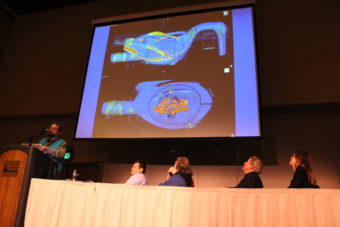
But because they’re culturally sensitive objects, being able to make infinite copies isn’t necessarily a good thing. At last week’s Sharing Our Knowledge” clan conference in Juneau, participants learned how tribal members are adapting the new technology.

A group of people crowd around a small table in the back of the conference room at Centennial Hall. The 3D printed objects are carefully laid out. They’re gray and beige. Most are not painted yet.

Eric Hollinger and Robert Starbard put the replicas away. KTOO obtained permission to photograph the objects. (Photo by Elizabeth Jenkins/KTOO)
Eric Hollinger and Robert Starbard put away the replicas. Photography can be a sensitive subject when it comes to shamanic objects. These were photographed with permission. (Photo by Elizabeth Jenkins/KTOO)

Although these items are replicas, we are advised we can look but can’t touch. Robert Starbard, the tribal administrator for the Hoonah Indian Association, handles the copies with gloves.

The original items are yéik: objects that have a spirit embedded in them.

Eric Hollinger, a repatriation case officer at the Smithsonian, said traditionally they would have been left at the above-ground grave houses of Tlingit shamans.

“Some shamanic objects have actually been passed on from multiple shaman. They may be hundreds of years old before they were removed and sold into museums illegally,” Hollinger said. “And that’s what happened with these objects.”

After a repatriation request, the ownership was transferred back to the Hoonah Indian Association in 2013. But the items remain in the Smithsonian.

“They’re on a five-year loan to us while we explore this project together and CT scan it, but they own and control everything about ‘em,” Hollinger said.

That’s right. A CT scan, like the medical machine that shows the inside of your body. Except, this scan creates 3D digital renderings that can be printed or studied.

In 2005, the National Museum of Modern History repatriated a killer whale hat belonging to the Tlingit  Dakl’aweidí. With the clan’s permission, the hat was recreated. It’s now used for educational purposes and in the museum’s exhibition.

Robert Starbard said, during the panel, that most of Hoonah’s cultural items were lost in a fire in 1944.

“In one of the few places that we had access to some of these cultural objects, that were otherwise stolen from us, were in the museums,” Starbard said.

https://www.youtube.com/watch?v=P7MndvEcUcQ

He said the partnership with the Smithsonian provides two things: copies of the items in case something happens, and educational opportunities.

“Where we could take these objects and with our elders and our youth actually start sharing some of the stories and some of the histories and some of the techniques that went with them,” Starbard said.

Throughout the process, Starbard has been consulting with the elders and will continue to do so about the items’ sensitive nature.

He said it’s never easy to take a new technology and start using it for something that’s culturally and historically significant to the clans.

“And so there is a level of suspicion, there’s a level of distrust, and there is an apprehension to move forward, which is why we’re doing it in an incremental, very slow process.”

The Hoonah Indian Association is involved in another repatriation claim with the University of Pennsylvania. So far, Starbard said the college hasn’t been receptive. But he hopes the partnership with the Smithsonian can serve as an example.

“Even if they are replicas for display or in the case of UPenn they’re sitting in the backrooms, perhaps we’d be able to move that relationship off of the standoff that we have now,” Starbard said.

Tlingit artists in Hoonah will be painting the items and milling their own paddles and masks from the scans.

Radio host showcases two-hour block of Filipino culture

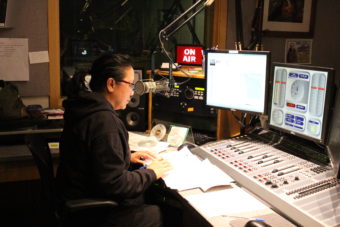
Genny Del Rosario balances work life and being a KRNN volunteer. She's also the president of the League of Women Voters. (Photo by Elizabeth Jenkins/KTOO)
Genny Del Rosario balances work, life and being a KRNN volunteer DJ. She’s also the president of the League of Women Voters. (Photo by Elizabeth Jenkins/KTOO)

October is Filipino American History Month. In Alaska, that’s more than 26,000 people. One Juneau DJ is finding ways to connect others with their culture on the airwaves.

In the two years that Genny Del Rosario has been hosting her show “Good Evening My Friends,” she’s only been absent once. And that was because her car wouldn’t start.

In the summer, she closes her Filipino food shack early to make it here in time. The winter months, she said, are the hardest. It’s dark, the roads are slick with ice and it’s cold.

“But I have to be here, you know. It doesn’t matter. It’s like I have my alarm for this show, 9 o’clock. Even if I’m lying down. I say 30 minutes before, I come over now,” she said. “Sometimes I’m rushing in the car, ‘Ah, I gotta go!'”

During the breaks, she reads in Tagalog. The root language of the the Philippines has multiple dialects. Del Rosario can speak five.

“My father’s dialect which is Ilocano. Then I can speak Cebuano from Cebu. And then I can speak Chavacano which is from my birth city Zamboanga,” Del Rosario said.

She reads public service announcements, Filipino recipes, newsletters, even birthdays. In the summer, she fills the gaps with stories from cruise visitors. Usually, other Filipinos who work on the ships.

She started the show because she felt like her community wasn’t being represented.

“It’s a shame that we’re the second largest minority and we don’t have a show to showcase our tradition.”

Some of the music Del Rosario plays is from her youth.

“Anthony Castelo is one singer when I was in college, we used to scream like the Beatles when he goes to a certain town where we are. … He’s so handsome,” she said. “It’s like Justin Bieber or Joe Jonas. Anthony Costello was like that before.”

https://www.youtube.com/watch?v=n8xkMqhxBe4

When she visits her family in the Philippines, she brings CDs back. In Juneau, she said it’s impossible to find the music. iTunes and Spotify don’t have a great selection.

And like the food, she said the songs from home can trigger memories. Good Evening My Friends is for people who immigrated to the states. But also for their kids who might not have grown up speaking Tagalog.

“I hope that they listen, the teenagers. Because it’s good to know your mother’s or father’s language. I missed it out with my children. I just wished before that I could have taught them to speak Tagalog,” she said. “They told me every time they go home to the Philippines, they say, ‘Mom, why didn’t you teach us to speak Tagalog? Even give us a dictionary?’ I thought they weren’t interested but they were.”

Del Rosario came to the U.S. on a Rotary International scholarship. And traveled around the country as an ambassador for the Philippines in the 80s.

She went back, determined to return to the United States.

“It was like my eyes was open. And I was already 29 so I was ready to do adventure, adventure in the United States. My mom said, ‘Aren’t you scared?’ ‘No, ma. I’m 29 years old. What’s going to go wrong?’”

She met her now-ex husband, settled in Vegas. She was able to stay in the country with a green card and thought she’d remain there forever. Then the marriage split up and she needed a fresh start.

“I came to Juneau with just two suitcases. It was difficult for me for the first six months,” she said. “I was like a homeless person living from one friend’s to another friend’s house. I should have gone back to Vegas but I wouldn’t want to. I said I’m here, I will start.”

Eventually, she opened a daycare. That led to the funds to open Manila Bay Cafe with her sibling.

“We bought that store and it’s been there for six years. I used the store’s income to send my children to college.”

Del Rosario is visiting the Philippines in December. And she said it’s not easy to find a sub for the show. So far, her attempts to recruit someone who speaks Tagalog have failed. But that doesn’t mean she’s giving up.

When she does return home, she’ll collect more music for Good Evening My Friends and mourn with family. Recently, a sister passed away.

“Even though when my sister died three weeks ago. I don’t feel like coming but I said the show must go on. And you know, my sister would be proud. My family would be proud.”

KRNN is KTOO’s sister station. You can listen to Good Evening My Friends on Tuesday nights at 9.

Site notifications
Update notification options
Subscribe to notifications