Elizabeth Jenkins, Alaska's Energy Desk - Juneau
Totem poles slated for Douglas mark ‘A Time for Healing’

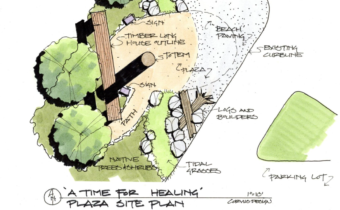
A tentative design of the Native plaza at Savikko park. (Photo courtesy of Corvus Design)

Savikko Park and Gastineau Elementary School will be the future sites of two totem poles. Plans include interpretive signs in Tlingit and English, explaining the history of the original people of Juneau and Douglas: the Aakʼw Ḵwáan and Tʼaaḵu Ḵwáan. Technology also plays a part in telling the story.

In 1956, the site of the Douglas Indian Cemetery was paved over near the elementary school. The Douglas Indian village was burned in 1962 to make way for a new harbor. Signs near Savikko Park explain the history of the Treadwell Mine, but there’s nothing about the area’s Native people.

Now there’s a project to change that. It’s called A Time for Healing: A Gaawooya Yei Shtoosneixhji.

John Morris remembers the spot where his house once stood. (Photo by Elizabeth Jenkins/KTOO)

The Goldbelt Heritage Foundation was awarded over a million dollars from the U.S. Department of Health and Human Services.

John Morris of the Tʼaaḵu Ḵwáan saw his village destroyed back in 1962.

“In my lifetime, I have not seen a Native totem pole placed in Douglas, so that’s really good news,” he said.

Morris, a tribal leader in the Douglas Indian Association, is on the design team for the totems. As the final plans come together, he says he doesn’t want the poles to reflect anything negative. It’s not what the poles are historically intended to do.

“My vision of the totem pole is going to be more of a welcome totem pole with the crest figures of the Tʼaaḵu Ḵwáan Yanyeidí people, which is of the Eagle-Wolf design.”

He says the poles could include other Native people in the area, like the Aakʼw Ḵwáan  and Wooshkeetaan.

The other part of the grant helps fund exhibits at the Juneau-Douglas Museum. The carving of the totems will be documented through photos and videos. Later, an $18,000 touch-table can provide museum-goers with an interactive experience.

“For example, if it were a map of the Douglas Indian Village you could touch a portion of it and it zooms into part of the screen. So it’s however you program it,” said Richard Steele, a grant writer at Goldbelt Heritage Foundation.

He’s been working with Jane Lindsay, the museum’s director, on how technology could play a role.

Lindsay came up with idea of the touch-table after seeing something similar at the Haines Library. And she’s excited the stories of the Aakʼw Ḵwáan and Tʼaaḵu Ḵwáan will be featured in a permanent exhibit.

“You know, we’re looking at some pretty important history in Douglas and for the Douglas Indian Village and for all of the local Native people here that we really need to talk about,” Lindsay said.

The totem poles are slated to go up in 2017. The touch-table is planned for 2018. A Time for Healing culminates in a community-wide celebration later that year.

Juneau organizer hosts discussion on addiction, recent deaths

Juneau has suffered six heroin-related deaths this year. The public is invited to share stories about addiction and discuss solutions at Wednesday night’s Community of Compassion gathering.
Grace Elliott, the event’s organizer, said the losses hit home. A family friend died of an overdose recently. He was dancing at her daughter’s wedding just weeks before.

“What we want is a space that people can gather in, that it’s a safe space for people to talk about their own experience, how they’re affected by this,” Elliott said. “A lot of the people who are coming already are family and friends of people who have died recently. A lot of these people are in their 20s.”

The Juneau Police Department is conducting a six-month anti-heroin initiative to help answer questions about why users start and why it’s so difficult to kick.

Police typically don’t send out press releases about heroin deaths. However, they released one on Oct. 5 after Robert James Hanson died in his family home. Hanson’s mother gave specific permission because she was distressed about the large number of overdoses in the capital city.

Grace Elliott said by talking, she hopes addiction can be de-stigmatized.

“So that we can have a realistic view of what the condition is in our community and then, thus be able to address it,” Elliott said.

Community of Compassion runs from 5 to 8 p.m. @360 in KTOO.

What Medicaid expansion means for this Juneau family

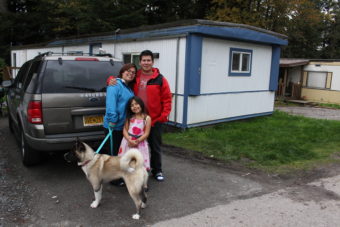
James Refeurzo and his family outside their family home. (Photo by Elizabeth Jenkins/KTOO)
James Refuerzo and his family outside their home. (Photo by Elizabeth Jenkins/KTOO)

Medicaid expansion has been available to Alaskans for over a month, and 93 people in the capital city have enrolled. 263 in all of Southeast. It’s providing coverage for the uninsured. But it’s also offering increased care for those who qualify with Indian Health Service.

For one Juneau man, that means having options to treat alcohol addiction.
James Refuerzo says he fell on hard times when he was in his 20s, and he’s still paying for it now. Back then, he didn’t think he had a drinking problem.

“Maybe one time I’d overdo it. Then all a’sudden I find myself doing something I totally wouldn’t be doing if I was sober,” he said. “With my addiction sometimes I’d drink eight or 10 beers and make a dumb decision and say, ‘Hey I think I can drive.”

After his third DUI, he was locked up at Lemon Creek Correctional Center. Refuerzo is the father of three small kids. He spent two years away serving his sentence and had a revelation.

“Realizing, hey, this has got to stop. ‘Cause the next time I get in trouble, I’m automatically going to be in jail for five years,” Refuerzo said. “And I don’t want to do that and with my kids, something had to change and that’s when I went to Rainforest.”

He knew SEARHC was another option. That’s the tribal health care organization serving Alaska Natives in Southeast. Refuerzo is Tlingit from the Wooshkeetaan Clan. So most of his medical needs are covered. But Juneau SEARHC only offers limited outpatient care for substance abuse treatment.

“It’s tough just to ask for help but then when you ask for it and to be told to wait, it’s a little bit tougher.”

At Rainforest Recovery Center, he says he was able to fill out a form and come back that same day. The center has a sliding-scale payment policy. There’s an overnight treatment program. Refuerzo opted to do outpatient. And he says things got better. He was meeting with a counselor regularly and talking about his problems.

“When I got my job and everything I didn’t qualify for the sliding scale and I was paying 100 percent,” he said.

Refuerzo only works part-time and owes Rainforest over $1,300.

“It’s gone to collections now. I just got another letter saying this one is going to go to collections, too. It’s like I got to take care of it later on in life when I start making more money and decide to start fixing my credit,” he said.

So he stopped going Rainforest. Then he heard he qualified for Medicaid, which pays for treatment.

Bettyann Boyd, Refuerzo’s girlfriend, helped him sign up. She works at SEARHC and has been covered by Indian Health Service and Medicaid for a long as she can remember. Medicaid covers travel expenses for medical reasons and specialized care. Giving her family more opportunities.

“Just the choice, the choice to have a different option to go to a private clinic, a private dental. If you’re not feeling comfortable with the IHS services,” Boyd said.

And she’s glad those choices could extend to her boyfriend, Refuerzo. She’s proud of the work he’s done on himself. She’s going to counseling, too.

“We’re doing really good and we been doing really good. Who knew we’d be able to live in this trailer and have a trailer and own it,” she said. “Everything just keeps going up higher and higher.”

Refuerzo hasn’t heard back yet if he’s been approved for Medicaid. Some people who’ve signed up have had to wait. But after Nov. 1 new applicants will get an instant response from the Health Care Exchange that could speed up the process.

When his enrollment card does come, Refuerzo says it’ll feel good to slip it in his wallet.

“For once I’ll feel like I’ve got something in my life that means something material wise. … I’ve never carried an insurance card before. And each time I’ve been asked, I’ve never had insurance number in my life,” he said. “And it’s going to be nice knowing that I got Medicaid and I’m not just stuck seeing one person because that’s the only person I can see. I can seek out other opinions, other options.”

He’s four months sober. But he says it’ll be nice to know he can get help when he needs it.

‘Assimilation’ playwright flips the script on Native history


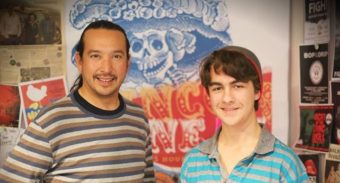
Assimilation Playwright Jack Dalton and actor Tendal Mann. (Photo by Annie Bartholomew/KTOO)
“Assimilation” playwright Jack Dalton and actor Tendal Mann. (Photo by Annie Bartholomew/KTOO)

In a dystopian future, Western civilization has crumbled and indigenous people are in control. That’s the premise of Jack Dalton’s play “Assimilation,” now touring Alaska. It flips the history of boarding schools with whites violently assimilated into Native culture.

A tyrannical character know as Elder pinches a student by the ear and leads him to his desk.

“With each time that you choose to speak your dirty language, your punishment will increase,” she tells him. 

In the course of the play, the boys are beaten, verbally abused and stripped of their identity.

Whites are forced to assimilate into Yup’ik culture. It’s horrific treatment but it also really happened, which playwright Jack Dalton says is the point.

“Being Yu’pik myself, I have had a lot of conversations with people who ask ‘Why are Native people still having problems?’” Dalton said. “And my answer is usually well, when you look at all the traumas that’s happened over several generations, you can imagine it’s really hard to heal from those traumas.”

Assimilation premiered in Anchorage in 2010 with 12 sold-out performances. And this past spring, it was selected for a staged readings at Emory University.

Dalton said he didn’t do any historical research on Alaska Native boarding schools. He drew inspiration from the stories his family told him about their own experiences.

“So I was actually worried that maybe I was too close to the subject and I might be making it harsher than it really was but my dramaturge, Michael Evenden from Emory University, went and did the research and said you only cover about 25 percent of what happened. There’s so much more,” Dalton said.

In the play, a boys screams out in pain as Elder strikes him with a stick.

“I do not care how good your Yup’ik is!” she lectures.

Louise Leonard, the actress who plays Elder, attended one of the boarding schools when she was kid and remembers being punished for speaking her Native language of Cup’ik.

“I am so glad that this is going to be on because we never really talked about those days,” Leonard said.

Dalton cast Leonard after meeting her at a state fair.

He says, traditionally, not talking about the “bad things” was a survival mechanism.

But it’s one that can be dangerous. Each performance of Assimilation is followed by a community discussion.

However, Dalton said he has wondered if some of the material could be offensive–particularly the racial slurs targeted toward whites.

“Every single person I talked to said, ‘How could I possibly be offended by what’s in the play when you realize that every one of those things and every one of those slurs is something that’s happened to Native people and other minorities?’”

By flipping the roles, Dalton says he hopes Natives won’t feel triggered by the violence. And non-Natives can empathize with what happened.

Assimilation’s Kickstarter recently raised over $15,000 to pay the actors and cover touring costs. The play premieres in Juneau on Friday at The University of Alaska Southeast’s Egan Library. The performance is free and starts at 7 p.m.

Editor’s note: the location of the premiere performance has been corrected. 

Another Juneau resident dies from heroin

The Juneau Police Department says it’s the sixth heroin-related death this year. James Robert Hanson, 48, was discovered by his brother in the family home. In a news release, the police department said it appears Hanson overdosed while the family was in another room.
Juneau police typically don’t release information about in-home, unsuspicious deaths, but Hanson’s mother gave specific permission. She was distressed over the large number of heroin deaths in the capital city.

The family believes Hanson relapsed. The police department is continuing to investigate the death and has requested an autopsy by the State Medical Examiner.

Theology school calls off Native art sale amid investigation

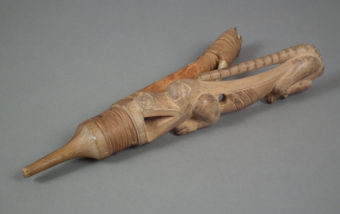
This Tlingit halibut hook with a wolf spirit was slated for auction. (Photo courtesy of Karen Kramer/Peabody Essex Museum)

A Massachusetts college that planned to liquidate its Native art collection has called it off. The pieces are from 52 tribes, including Tlingit and Haida items that might be sacred. Now the country’s oldest theology school could get dinged with penalties as feds investigate.

Over the summer, the Andover Newton Theological School, or ANTS, quietly decided it would sell 80 pieces of Native art from their collection. But their plans didn’t stay quiet for long. The museum that’s housed the collection since the 1940s alerted hundreds of tribal leaders.

Sealaska Heritage Institute was one of the organizations contacted because the school intended to auction off a Tlingit halibut hook, an item that SHI President Rosita Worl says is sacred.

“The halibut hook has spiritual dimensions to it and in this particular case, we have a halibut hook with a wolf,” she said.

Worl believes the school also has a Southeast shamanic doll. If a college or museum receives federal funds, then federal law dictates that certain items in their collection are subject to repatriation.

So, how did Andover Newton wind up with such a vast collection of Alaska Native, Native American and Hawaiian art?

“It was through their own missionaries going out into the field and collecting objects. Like, I tell the story over and over again … they collected our sins,” Worl said.

What those missionaries considered “sins” could fetch the college a million dollars now if the legality of the sale hadn’t come into question.

Peabody Essex Museum President Dan Monroe says the school was confused from the jump. It didn’t file an inventory or summary providing tribes with information. And the college assumed the museum could cherry-pick what was subject to the law, but only tribes have say in that.

“No other party can make those identifications,” Monroe said.

Even so, the school claims that information came from Peabody Essex. Monroe lets out a big laugh before responding.

“OK. Number one: we could never tell them what objects in their collection are subject to NAGPRA. … Because we have no standing in the law and we perfectly well understand that,” Monroe said.

NAGPRA is the Native American Graves Protection and Repatriation Act.

In 2009, Monroe says the Onondaga Nation asked the school to give back a wampum belt. The school denied the request. As a private college, it thought it wasn’t subject to the law. But here’s the problem with that: some students pay their tuition with Stafford loans, which are funded by the government.

This tunic was repatriated from a museum in 2007. Although it's of Southeast origin, the tribe is unknown. (Photo by Elizabeth Jenkins/KTOO)
This tunic was repatriated from a museum in 2007. Although it’s of Southeast origin, the tribe is unknown. (Photo by Elizabeth Jenkins/KTOO)

“If the institution receives federal financial assistance, whether directly or indirectly, that would be receipt of federal funds,” said David Tarler.

Tarler works at the NAGPRA office in Washington, D.C. He said the school is being investigated, and in this case penalties can range from $5,000 for each failure to comply up to about $21,000, or .25 percent of the school’s annual budget — whichever is less. Then there are aggravating circumstances, like previously denying a tribe’s claim.

Monroe says he’s still not sure if the college gets it.

“On the plus side, they’ve made the commitment not to sell objects; they’ve made a commitment to comply with  NAGPRA and those are admirable and very positive decisions on their part,” he said. “Regardless of the means of how they arrived at them.”

Martin Copenhaver, the school’s president, said he was too busy to comment but forwarded a letter that said “we will proceed to repatriate artifacts … if feasible and appropriate ways can be found to do so.”  

“I mean, that sent up a red flag to me,” Worl said. “When I read that, ‘if feasible and appropriate.’ What does that mean? It should be if it complies with the law. Who makes that determination? If it’s feasible?”

Aside from the law, she says there’s a larger underlying issue the school doesn’t seem to understand about the collection.

“They keep referring to them as artifacts and they’re not artifacts. They’re at.oow. They’re living things to us; they’re spiritual things to us,” Worl said.

Andover Newton Theological School did recently reach out to the Onondaga about the wampum belt, Worl said. But Southeast tribes are still waiting.

Clarification: we’ve reworded details about how the school may be fined.

Site notifications
Update notification options
Subscribe to notifications