
Elizabeth Jenkins, Alaska's Energy Desk - Juneau
Angoon and Kasaan receive federal water and sewage grants

So-called honey buckets are used in rural Alaska villages where plumbing is not available. (Creative Commons photo by CambridgeBayWeather)

When President Obama visited Alaska last week, he announced plans to improve rural water systems in the state. Most of the Department of Agriculture’s more than $16 million in grants were offered to remote interior villages. But two were offered to places in Southeast.

The sewage and water conditions in some Alaska villages have been compared to third world countries. As many as 30 use honey buckets.

In Southeast, the situation isn’t as extreme but there’s still room for improvement. Kasaan and Angoon have outdated systems and the grants will help fund engineering studies to get projects rolling.

“You know, everyone goes to the bathroom. It’s just going to ensure that our system is good for another 20 to 30 years,” said Albert Kookesh III, the grants manager for the City of Angoon.

The feds awarded the city more than $52,000. The state added another $17,000.

Kookesh said, at one point, the town’s septic tank was leaking three times more sewage into Chatham Strait than the state permits.

“You know Chatham Strait is a pretty big strait and it’s basically the main marine travel that passes right in front of Angoon,” he said. “So we wanted to make sure we weren’t leaking anything out into the environment and what we gather for subsistence uses is contaminant free.”

He said they were able to come up with a Band-Aid fix. But the grant will help with the design of a new system. The City of Angoon plans to start construction to replace the tank next October.

In the village of Kasaan, waste is pumped into the bay. Timothy Willis, a water plant operator, says a corroded pipe has caused problems.

“We get ocean water flowing back into our sewer system which then causes some overflowing of stuff you don’t want overflowing in the street,” Willis said.

He says it’s not an ideal system. However, it’s one regularly seen in small, Southeast villages. People know not to fish and gather by the bay. The sewage isn’t treated.

“It’s mostly decomposed. It’s not like chunks of poop floating around. It’s more bacterial stuff getting in the water,” he said.

The more than $37,000 rural water grant and state match could help. There are plans to do a preliminary environmental and engineering report. But Willis says the grant money alone won’t be enough to finish the project.

“Not to scoff. We’re very appreciative with what we get. But it’s a smaller amount of money,” Willis said. “It’ll help towards a match towards a larger sum of money later that will help with the actual project of replacing the line and equipment.”

Willis estimates about 25 percent of residents are still on honey buckets. He says there are some loose plans to redesign  Kasaan’s septic system. But for now, it’s about keeping the sewage off the street.

Donation sheds light on Alaska Natives’ civil rights history

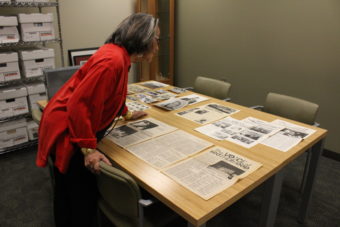
Rosita Worl marvels over the donated collection in the William Paul Archives. (Photo by Elizabeth Jenkins/KTOO)

A recently donated collection of letters, essays, photographs and newspapers is shedding new light on the history of Alaska Native civil rights. One particularly controversial figure in the documents spent half a century advancing Alaska Native causes. He’s the namesake of Sealaska Heritage Institute’s new William Paul Archives.

SHI President Rosita Worl stands over a table of photographs of ancestors in regalia, Alaska Native Brotherhood meetings and less formal gatherings–relaxing around a table for dinner.

“Here look at this. ANB people and traditional leaders. Ooo, I see my grandmother over there!” she exclaims.

The collection spans from the 1940s all the way to the 70s and was donated by brothers Ray and Cy Peck. The sons of Cyrus Peck Senior, who published the newspaper Voice of the Brotherhood.

“Remember at this point and time we don’t have social media. We don’t even have TV,” she said. “So the newspaper print is really important in terms of educating people about what was going on, coalescing people into political action.”

Some of the photos were taken by Ray Peck. He remembers his father giving him a Polaroid camera when he was a teen and asking him to take pictures of the Alaska Native Brotherhood.

“I used a Polaroid ‘cause I could always tell and take another one right away. And they were black and white and they’d turn out perfectly for printing,” said Peck.

At the time, he didn’t know he was capturing history. He would paste the photos on the freshly typed sheets from his dad’s typewriter and run them off to the printer at The Juneau Empire. After his dad passed away, he found boxes full of old newspapers and letters and thought, “Get ‘em to a safe place instead of sitting in my house. And maybe people will get some information out of it.”

Peck turned over the boxes to the William Paul Archives in the Walter Soboleff Building. He donated correspondence between his dad and Paul, who was an important but sometimes divisive leader in the brotherhood.

A letter dated March, 1 1949 from William Paul to Cyrus Peck Senior. (Photo by Elizabeth Jenkins/KTOO)
A letter dated March, 1 1949, from William Paul to Cyrus Peck Senior. (Photo by Elizabeth Jenkins/KTOO)

“He had progressive ideas and he stepped on a lot of feet,” said Peck.

You might not know attorney William Paul by name. But you’re probably familiar with some of stuff he did: fighting for voting rights and the Alaska Native Claims Settlement Act.

Rosita Worl calls him the father of land claims.

“He really brought it to the forefront,” she said.

A Tlingit, Paul was the first Native elected to office when Alaska was a territory, and he was a leader in the Alaska Native Brotherhood. The organization formed in 1912 to combat segregation and racism. Paul was later instrumental in this.

Worl knew him. She says he was a mentor growing up but recognizes he was also controversial.

“Both within the Native community and the non-Native community. The non-Native community thought he was arrogant and brash.”

She even calls some of his political activity unethical.

In the 1920s, a historian says Paul became politically powerful by helping Alaska Natives vote — for exactly whom he wanted them to vote for. He prepared cardboard cutouts that covered ballots and left only his picks. With the cutouts, literacy wasn’t a barrier.

He was also accused of taking campaign donations from salmon canneries, an industry whose unsustainable practices he vilified. Worl says tactics like this might be part of the reason he’s not more well known. Still, he’s an important figure.

“Here you have an indigenous population taking the laws of the oppressor to protect themselves,” she said.

William L. Paul Sr. (left) with Walter Soboleff, M. Quinto and Ray Peck on a boat. (Photo courtesy of Sealaska Heritage)
William L. Paul Sr. (left) with Walter Soboleff, M. Quinto and Ray Peck on a boat. (Photo courtesy of Sealaska Heritage Institute)

Worl reads a letter to Cyrus Peck Senior from Paul dated March 1, 1949.

“I should begin ‘The storm has broken,'” the letter about Native boarding schools and education begins. “… From there we went on and considered the entire problem of Indian education and what we consider to be the policy of the Indian office.”

With the newly acquired materials, Worl hopes scholars and individuals can piece together a complex narrative of Alaska Native Civil Rights.

“More often when you read histories, Native people are seen as passive recipients of Western culture, they aren’t viewed as the active individuals in pursuing these rights,” she said. “With these documents, we’re able to demonstrate that. We’re able to portray history from our perspective.”

Worl encourages the public to donate items as they find them. Ray Peck says he may have a few more boxes to rummage through back home.

Recalled cucumbers may still be on grocery store shelves in Alaska

Packaging of the cucumbers. (Photo courtesy Alaska Department of Health & Social Services)

There have been 10 confirmed cases of salmonella infection from Limited Edition brand pole cucumbers, the Alaska Department of Health and Social Services reported Friday.
Fresh Produce, a company based in San Diego initiated a voluntary recall. The cucumbers, packed by Rancho Don Juanito in Mexico, may still be for sale throughout the state.

Symptoms from salmonella poisoning can include diarrhea, fever and abdominal cramps. Health care providers should call the Alaska Section of Epidemiology at 907-269-8000 or 800-478-0084 after hours to report suspected cases.

Dust settles on state’s new Douglas offices, but employee concerns haven’t gone quiet

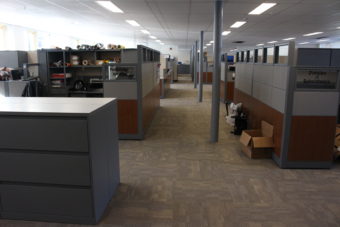
The state's newly renovated offices in Douglas follow the state's universal space standards. Note the angled ceiling. (Photo by Elizabeth Jenkins/KTOO)
The state’s newly renovated offices in Douglas follow the universal space standards. Note the angled ceiling. (Photo by Elizabeth Jenkins/KTOO)

After a class action grievance, a regime change, a year of renovations and buying hundreds of $8,000 workstations, state employees are finally moving into their new offices in Douglas. Although the dust has settled, concerns over the new layout have not gone quiet.
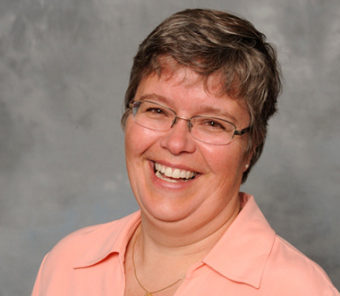
Brian Frenette is the regional supervisor for sport fish. He recently moved back into the renovated building and likes how the new space is flooded with light. Gone are tall cubicle partitions and dark hallways.

“Certainly is a lot brighter, there’s no question,” he said.

But there are some design choices Frenette says employees find puzzling, like how the ceiling bows toward the middle.

“Lower in the center, higher on the walls and I don’t know what that is for. Other than to maybe give the impression that more light is being drawn to the center of the building.”

He said people think it’s a mistake but it’s intentional.

“I don’t understand it. Some people look at it awhile and say it’s making me nauseous. After a while you just get used to it.”

Some changes employees may not get used to. As a supervisor, Frenette gets his own office but most won’t.

The building has been redesigned for universal space standards, a cost and space saving plan implemented by then-Gov. Sean Parnell. Some work stations were whittled down to about half the square footage. Each cost the state more than $8,000.

“Well there were a number of concerns our members had. Reduced space for them to work, less privacy,” said Jim Duncan, the executive director of the Alaska State Employees Association.

The union filed a class action grievance over the state office layout about two years ago, citing safety and health concerns for its members. But eventually reached an understanding with the Walker administration.

“The arbitration is still in place, we are just not moving it forward,” said Duncan. “We had an agreement, an understanding from the administration that they would complete the projects that were underway under the previous administration.”

The exterior of the state's newly renovated Douglas Island Office Building. (Photo by Elizabeth Jenkins/KTOO)
The exterior of the state’s newly renovated Douglas Island Office Building. (Photo by Elizabeth Jenkins/KTOO)

The changes have already happened in Anchorage’s Atwood Building and a floor of Juneau’s State Office Building. Douglas now has 32 vacant spaces.

Andy Mills, a spokesperson, says the Walker-Mallott administration is evaluating if new standards are worth it. And he realizes if it continues, it could affect him.

“The space standards would actually entail me not having an office,” Mills said. “I certainly think that when you’re looking at difficult budget times, I think most folks understand you want to look at everything possible when it’s a decision between programs, people or space. But at the same time you need to be fair and respectful to the employees.”

He said some of the sacrifices, he wouldn’t mind. His floor of the state office building has outdated furniture and a tiny break room with no seating.

“If you came and saw it, it’s a fairly small room. It’s the size of a closet.”

The renovated offices, on the other hand, come with roomier break rooms and updated kitchen appliances. It’s designed to increase collaboration. But Mills says “universal space standards” does sound a bit drab.

“It sounds like it’s a gray box that might be uninviting. But the customizability of the systems furniture when folks get a chance to look at it is probably a little more versatile what they would have first thought,” Mills said.

With the push of a button, Brian Frenette demonstrates how he can raise his desk to work in a standing or sitting position.

He said the new layout has bit of learning curve. The front counter is intermingled with Wildlife Conservation and Sport Fish to provide easier access for the public. The Department of Corrections moves in this week.

But for some employees, he said there have been concerns.

I think what most people will probably tell you what they’re having to give up is separation–from their coworkers in order to get work done and not be disturbed,” he said. “Whether or not that comes to light as being a big issue or a small issue we’ll see as time goes.”

Frenette says they’re looking at white noise machines as a possible solution. The state has no immediate plans to roll out more universal space standards offices.

Search begins for new Juneau city manager

Kim Kiefer
Kim Kiefer is the outgoing city manager. (Photo courtesy City and Borough of Juneau)

A subcommittee of three Juneau Assembly members is leading the search for the next city manager. Mayor Merrill Sanford appointed Mary Becker, Karen Crane and Jerry Nankervis to whittle down the candidate pool to about 10 applicants.
“This is the most important thing that we do right here, hiring the city manager,” said Mayor Sanford. “And you are all invited to be a part of this subcommittee at any of their meetings.”

The mayor said subcommittee meetings would be public unless personnel issues were discussed.

“There’s no reason this hiring process isn’t 98 percent transparent and in the open,” he said.

It hasn’t been decided whether outside HR headhunters should be brought in to help. The assembly remarked on the success of Juneau staff facilitating a previous city attorney search.

Geographic preference is also up in the air. Assembly member Karen Crane said she’d like to look broadly.

“At least statewide but not discount anybody Outside that sees the application and applies,” she said. “That doesn’t mean we don’t end up hiring locally if someone is there but what it does mean is it shortens the process.”

Some assembly members said they’d like to see a candidate selected before the holiday season is in full swing.

Current City Manager Kim Kiefer is retiring at the end of the year.

New Hoonah hydro project could help local businesses

(Photo by Elizabeth Jenkins)
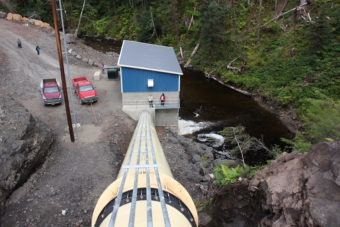
Water flows down the tube and spins a turbine that creates electricity. (Photo by Elizabeth Jenkins/KTOO)

Alaska’s newest hydro power project has been generating electricity since the beginning of August, but it only recently had its ribbon cutting ceremony.

At the Gartina Falls hydro project, curious locals and lawmakers gathered to see how Hoonah will cut its diesel use by 30 percent. For years, diesel was the only option to power the village.

Paul Berkshire, the engineer, points to a structure near the falls that looks like a dilapidated log cabin.

“This is the original attempt to build hydropower here. As near as I can tell, somewhere around 1926,” he said.

The remnants of an old hydro project. (Photo by Elizabeth Jenkins/KTOO)
The remnants of an old hydro energy project. (Photo by Elizabeth Jenkins/KTOO)

Unfortunately, that plan didn’t work but a $10.5 million grant–mostly from the state–made it possible to get the new project up and running. It’s already saved 3,600 gallons of diesel and is expected to save up to 100,000 in a year.

“Basically if you can get anything to spin, you can produce electricity from it.”

On one side of the falls is a stagnant pool that creates pressure. The water flows down a long tube and turns a turbine, similar to a water wheel, and electricity is generated.

The developer is the Inside Passage Electric Cooperative, which supplies energy to small Southeast communities: Angoon, Klukwan, Kake, the Chilkat Valley and Hoonah.

Jodi Mitchell, the  cooperative’s CEO, says when she started working there in 1993, the price of diesel was about 79 cents a gallon.

“Over my career at IPEC, we’ve seen prices go as high as $4.25 a gallon and that’s a wholesale bulk rate that we pay,” says Mitchell.

It’s now close to $3 a gallon but most residents don’t pay for it all in their monthly energy bill. A state program called power cost equalization tries to subsidize rural rates down to urban rates.

“The businesses in the community don’t qualify for that. Because the power cost equalization only pays for residential accounts … and that leads to a whole host of problems,” Mitchell says.

The project was supported by the City of Hoonah, Sealaska Corporation, Huna Totem Corportion, and the Hoonah Indian Association. (Photo by Elizabeth Jenkins/KTOO)
The project was supported by the City of Hoonah, Sealaska Corp., Huna Totem Corp. and the Hoonah Indian Association. (Photo by Elizabeth Jenkins/KTOO)

Mitchell says you can see this reflected in the price for milk or a loaf of bread in Alaska’s remote communities and the high costs of energy could deter economic growth.

Ken Skaflestad, the mayor of Hoonah, says the community has become comfortable with diesel.

“We know a lot about it. We’re very experienced in it,” he says.

The village of 750 has investor interest from outside. There’s a new microbrewery in town and a cruise ship dock under construction could bring in more tourists.

“For people who would love the lifestyle here but don’t dare take the risk due to the high cost of electricity, they now know they have support, that they have people behind them that know of their struggle and respond to it,” Skaflestad says.

Jodi Mitchell says for local businesses paying for electricity, the 30 percent could be huge. She hopes with the state’s budget crunch, projects like this will continue to be prioritized and funded.

“I am so proud of what we were able to accomplish here in Hoonah, and I’d hate to see that stop,” Mitchell says.

She says it might take longer for Gartina Falls to offset the price of electricity for Hoonah residents. A sister hydro project is planned for Water Supply Creek.

Site notifications
Update notification options
Subscribe to notifications