
Elizabeth Jenkins, Alaska's Energy Desk - Juneau

Suspect arrested in Juneau man’s assault

C Scott Fry is the voice behind KRNN’s “Fry’s the Limit” on Saturdays. (Photo by Scott Burton/KRNN)

The Juneau Police Department confirmed in a press release Thursday that an arrest has been made in the assault of a 50 year-old Juneau man.

The victim, C Scott Fry, was found unconscious and badly beaten on Front Street on Saturday morning. Fry is a musician and employee at the Alaskan Hotel & Bar. He was discovered by a JPD officer bleeding from the face and didn’t appear to have a pulse.

CPR was administered by the officer. He was transported to Bartlett Regional Hospital and later, Harborview Medical Center in Seattle. The hospital described his condition as “stable.”

Darrin D. Austin, 31, was charged with second degree assault. JPD describes the investigation as “ongoing.”

State on the hook for millions in leave payouts if layoffs occur

The state is liable for paying tens of millions of dollars in leave time to state employees if a government shutdown occurs next month. Two unions have negotiated for members to retain their leave if that happens. But the largest union of state employees is holding out.

The Alaska State Employees Association has about 8,000 members. Amanda Thomas is one of them. She works for the Department of Administration and knew the layoffs were coming. Her family put away money as buffer.

“Truthfully, I was probably doing OK with it, up until the point that I came to the realization that the leave was going to be cashed out,” Thomas says.

She says some state employees have an entire year saved up. But Thomas has almost two months of leave, roughly a $10,000 payout.

“It’s unexpected income that we don’t need at this point. ‘Cause as I said, we’ve already saved,” she says.

To the feds, that’s income. That would force Thomas’ family into a higher tax bracket than if she took a long vacation.

This didn’t sit well with her. Two smaller unions, Confidential Employees Association and Alaska Public Employees Association, already signed a letter of agreement with the state, allowing employees to retain their leave if layoffs occur. So she called her union to see it would sign one, too.

“Basically I was told that it would happen in the best interest of the membership, and I don’t know that I agree with that,” she says.

Jim Duncan, the executive director of ASEA, says the union isn’t currently considering signing a letter. Duncan was an Alaska legislator for 24 years. He says ASEA is working day and night to get a fully funded budget, including the 2.5 percent cost of living pay increase promised to its members.

“So the bottom line, in the final analysis, our members’ interest are going to be protected when all the decision making is through,” Duncan says.

As of Wednesday evening, if the legislature doesn’t pass a budget in time, the state will have to pay out tens of millions of dollars in leave to ASEA and other union members. Duncan says it’s not a bargaining chip.

“I’m not bargaining with members’ future,” he says. “I’m just working with the legislature to do what they should be doing and to, one: get a budget passed and secondly: honor the commitments to our union members as well as other union members.”

The state will cash out comp time but not flex hours. After 10 years of employment, Amanda Thomas could come back to zero leave. No sick days, no vacation time–nothing.

“In my conversations with my coworkers most of us are pretty disturbed by the fact that, when we come back to work, when that does occur, we will be starting over at square one,” she says.

To avoid being taxed for her leave payout, Thomas says she’s considering putting the money into her retirement. Her upcoming family trip to Australia may have to wait.

Juneau SEARHC opens its doors to non-Natives seeking mental health services

Pyper Powell straightens a picture at SEARHC's new location for behavoiral health services. (Photo by Elizabeth Jenkins/KTOO)
Pyper Powell straightens a picture at SEARHC’s new behavioral health location. (Photo by Elizabeth Jenkins/KTOO)

About 15 new patients are scheduled for behavioral health services at a tribal health consortium in Southeast Alaska. SEARHC recently its practice in Juneau to offer services to non-Native people.

It’s estimated that more than 4,700 people in Juneau suffer from a mental health condition. But if you’re seeking counseling from a private practice, you might have to wait.

“Services in our community are limited and access to them is limited. We just thought it was time to open our doors and make ourselves available to others,” says Pyper Powell, a behavioral health clinician at SEARHC.

She says she’s heard of patients being waitlisted up to a month or longer. So when the behavioral health division moved into a larger building in Juneau, it seemed like the perfect time to expand. Before, the service was only available to Alaska Natives and American Indians.

“And now we’re able to serve anybody that wants to walk through the door.”

That includes non-Natives with health insurance, Medicare and Medicaid coverage. She says they’re working on a sliding scale option for people without insurance. SEARHC is the tribal health care organization serving Alaska Natives in Southeast. It’s funded with federal dollars from the Indian Health Service and grants.

The organization has seen both Native and non-Native people in Sitka for decades.

“We know that it can work,” she says. “We know that it does work and that is a great support for the community.”

Powell hopes, with more people in Juneau, they will be able to expand group therapy.

A therapy room that encourages play for SEARHC's younger patients. (Photo by Elizabeth Jenkins/KTOO)
A therapy room that encourages play for SEARHC’s younger patients. (Photo by Elizabeth Jenkins/KTOO)

“You have a chance to work out your problems in a safe confidential environment with people who maybe remind you of somebody and can give you great feedback rather than jumping in full bore,” she says.

Groups include mental health support and chemical dependency. Some offer art therapy or mindfulness exercises. There’s one for grief management that uses Tlingit storytelling and drumming.

SEARHC’s vice president, Leatha Merculieff, says it’s mutually beneficial to include non-Natives. She’s Aleut from St. Paul Island.

“From an Alaska Native perspective, any type of expansion, it’s great for us as Alaska Native people because it adds additional resources to our services. That’s how we expand,” she says.

SEARHC will also accept patients for one-on-one counseling, but another community behavioral health provider says there’s no need. They already provide similar services without a wait.

“I don’t think we fully realized that there is a perception that so many people didn’t have immediate access to behavioral health services,” says Pamela Watts, the executive director at the Juneau Alliance for Mental Health.

JAMHI provides counseling, among other services, and offers a sliding scale policy for its uninsured clients. Watts says SEARHC is “duplicating” what’s already available.

“When duplication occurs that can draw resources away or clientele away from organizations that are well established,” she says.

SEARHC’s revenue is 20 times larger than JAMHI’s. But something both providers agree on is the lack of psychiatric care in Juneau — particularly for kids. Pyper Powell says that’s one thing SEARHC’s new patients may not receive right away. Alaska Native children already have about a four month wait for that.

“One of the things that we need to make sure that we do is honor the beneficiaries, the Alaska Natives, who would like to receive service as priority when there is a waitlist,” she says.

Powell says there are no immediate plans to hire more staff. SEARHC will reassess in the next few months.


Tracking state layoff notices from the mailroom to the mailbox

Jeremy Duncan runs letters through a postage machine  at the State Office Building. (Photo by Elizabeth Jenkins)
Jeremy Duncan runs letters through a postage machine at the State Office Building. (Photo by Elizabeth Jenkins/KTOO)

A lot of unhappy letters are arriving this week at state workers’ homes, following the announcement of mass layoffs if the legislature can’t pass a budget by July 1.
In the State Office Building’s mailroom, it’s almost the end of the day. Jeremy Duncan and a co-worker are running letters through a postage machine. He’s been a mail courier for about 12 years. And he knows one of those white envelopes might be his.

Alaska Government Shutdown

For more about Alaska’s possible government shutdown and layoffs, visit the 360 North government shutdown page.

“Layoff notifications. I’m sure I have one in there, too,” he says.

There’s a clock ticking closer to 3 p.m. on the wall. That’s the time the mail goes out.

“We’re waiting for a stay of execution type of phone call, huh?” he says. “That’s what it feels like.”

The phone call doesn’t come and, at 3 o’clock, several boxes are loaded onto a cart and wheeled to the mail truck.

In total, the state spent over $6,000 on sending the layoff notices–something they were contractually obligated to do. About 3,000 went to Anchorage, 1,100 to Fairbanks, and 3,000 to other places. About 2,500 were sent in Juneau. And it’s all because legislators haven’t agreed yet on a fully funded budget.

The layoff letters were the last to be loaded on the mail truck. (Photo by Elizabeth Jenkins)
The layoff letters were the last to be loaded on the mail truck. (Photo by Elizabeth Jenkins/KTOO)

At Switzer Village, Cierra Kendrick opens her mailbox with a key.

“I’ve got what appears to the layoff notices for me and my partner and a couple of pieces of junk mail,” she says. “I just really hoped they would figure it out before it got this far.”

She works for the Alaska Department of Commerce and her partner works for the Department of Transportation. She had a meeting at work and knew the letters were being sent. She’s heard some of her neighbors are avoiding the mail.

“They just don’t want to. They’d rather wait until  we hear something. They send someone to check the mail so they don’t have to see the letter,” she says.

If the legislature fails to pass a budget in time, a small number of workers could still come back. But there are a lot of unknowns and layoff details vary by department and division. The one thing that is sure, the government will be operating with less funding next year.

Kendrick says it’s been a stressful and confusing time for her family.

“Am I going to have insurance come August, depending on what they do? I have two high-needs kids that rely heavily on our insurance and we can’t afford to go without it,” she says.

State workers last day of work could be July 1. Their health insurance will last through the end of the month. After that, they won’t be covered. Summer was supposed be a special time for Kendrick and her partner.

“We are planning our wedding in July and that’s kind of been put on the back burner because those are expensive.”

Thankfully, they have already bought her partner’s dress, but they’re still trying to figure out how to pay for everything else.

“We’re budgeting for it but there’s only so much you can do. We may have to reevaluate and downsize,” she says.

Cierra Kendrick just received disappointing mail: a layoff notice from her state job. (Photo by Elizabeth Jenkins)
Cierra Kendrick just received disappointing mail: a layoff notice from her state job. (Photo by Elizabeth Jenkins/KTOO)

The day-to-day expenses, Kendrick says, would be difficult to manage if they lose their pay. They also have two car payments. There are expenses like cable and internet.

“We may shut it off to save the 150 bucks,” she says.

The legislature’s budget negotiations are still ongoing. Kendrick says she’s tired of lawmakers waffling.

“It’s a game of chicken is all it is,” she says. “It’s ridiculous that a group of adults is playing a game like this. To them, there is no consequence. But it’s a make or break situation for a lot of people.”

For now, all her family can do is wait until a budget is passed or isn’t.

“It all depends on what pretty little pieces of paper we get in the mail and when they happen to get here,” she says.

Kendrick says she’s currently looking for other employment.

Troy Quinn named new Juneau Symphony conductor

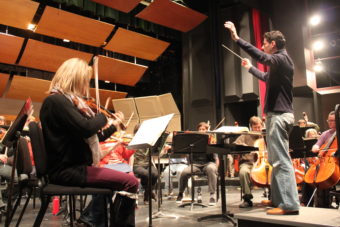
Conductor Troy Quinn leads the Juneau Symphony during rehearsal at the Juneau-Douglas High School auditorium. (Photo by Lisa Phu/KTOO)

The Juneau Symphony has named Troy Quinn its newest conductor. While Quinn has an advanced degree in conducting, he’s also game to bring pop culture to the orchestra.
Quinn has sung backup for The Rolling Stones and has even been on the popular TV show “Glee.” Growing up in Connecticut, he says he was influenced by his parents’ taste in music, everything from Barry Manilow to Motown.

“And my brother and I would do a little show with combs as microphones, set up in the living room and perform for our friends,” he says.

Quinn lives in Los Angeles and plans to split his time between there and Juneau. He says as a kid he loved learning new songs, but his background is different from most of his colleagues.

“I didn’t start taking formal training in music and formal lessons until I was in college,” he says. “That’s kind of a well-kept secret.”

He calls his piano playing skills “proficient” and has been a longtime member of the choir but he didn’t think of music as a viable career. That is, until a professor at Providence College called on him to conduct in class.

“And I had no idea what I was doing but I was just feeling the music,” he says. “You know, I’m of the belief conducting is innate. You either have it or you don’t.”

Quinn had it and his career took off from there. He would go on to earn a doctorate in conducting at the University of California’s Thornton School of Music. Juneau Symphony board President Bev Smith says Quinn’s charisma stood out on stage.

“I just love watching his hands and his graceful way he conducted. He was very engaging with everyone that he met,” she says.

In that performance, Quinn conducted the orchestra without a score — no sheet music to guide him, only the feel. Executive Director Sara Radke Brown says that’s something the audience remembers.

“Not only was it impressive, but it allowed him to be expressive,” she says. “And he may not do that for every concert. He was certainly able to make a more impactful connection with them for that reason.”

New Juneau Symphony Conductor Troy Quinn. (Photo courtesy Troy Quinn)

After the last conductor, Kyle Wiley Pickett, left for a new job, the Juneau Symphony received about 70 applications for the position. Three of those were selected to perform their own concert in Juneau, including Quinn. Radke Brown says they were looking for a conductor who could appeal to a diverse audience.

“So many people say that classical music is dying,” she says. “Opera is dying, orchestras are dying. I think people like Troy are going to remind people that it’s still alive and there’s a lot to offer.”

At 31, Quinn says he’s comfortable navigating social media, like Facebook, to bring new appreciation to the music.

“Because I think that’s what’s going to reach new audiences so that’s vital to the survival of orchestras in the 21st century and beyond,” he says.

He hopes to introduce a new audience to the symphony by taking an interdisciplinary approach. In the classical world, there’s a movement to shake things up.

“The music of Led Zeppelin in an orchestral setting,” he says. “You know, that’s all great because people come in and we offer them a Beethoven symphony as well and that’s how they may get involved.”

Quinn says he’s interested in incorporating film clips or having dancers perform to the symphony’s music. Whenever possible, he wants the arts community in Juneau to be a part of that.

And if his iTunes playlist is any indication, what he’ll bring is eclectic.

“Beethoven five is on my iPod, Usher and Alicia Keys. It’s all music, it’s all good. We just need a common denominator so people can be exposed to the classics,” he says.

Quinn starts the new season as conductor with the Juneau symphony in October.

Front page banner photo by Olivia Zhang.

Juneau to become third city in Alaska to shelter high-risk homeless

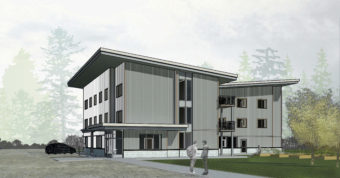
This concept drawing by MRV Architects shows the proposed Housing First project in Juneau. The facility would be built in Lemon Creek on land contributed by Tlingit-Haida Regional Housing Authority.

Juneau will become the third city in Alaska to offer permanent supportive housing to the high-risk, chronically homeless. Those are the people who have been on the streets the longest, and may suffer from addiction or mental health issues.

The Glory Hole offers three meals a day and connects homeless people with services to look for work and find housing. Up to 43 people can sleep in the shelter’s beds, but a deal breaker to staying overnight is being intoxicated. You have to pass a breathalyzer with a blood alcohol level under 0.10.

Trevor Kellar is the outreach coordinator and housing specialist at the shelter. He says he doesn’t like telling people they can’t stay.

“It can be a bummer to kick folks out, especially in the winter asking them to leave when it’s really cold is just so hard to do. But we just try to hold a line of this is what we are, this is how we serve, these are our sobriety requirements,” he says.

Juneau is estimated to have nearly 600 homeless people. Forty of those are considered high-risk, and thus the hardest to house. That’s about to change for some. The Glory Hole just received a grant from the Alaska Housing Finance Corporation to build a Housing First project.

Mariya Lovischuk, The Glory Hole’s executive director, says before you can address substance abuse or mental health issues, you need to put the person in housing.

“You need to give the person no strings attached housing in order for the person to stabilize,” she says.

(Graph by Scott Ciambor/ Alaska Mental Health Board)

The grant includes $3 million dollars in capital funding as well as $1.2 million for operational costs for the next three years. Tlingit-Haida Regional Housing Authority is contributing land in Lemon Creek where the project will be built. Lovischuk says there were a lot of obstacles to overcome to get the 32-bed facility to this point. One of them was her initial aversion to the idea.

“When I first heard about the concept I thought this is such a ridiculous idea this will never work and I’m philosophically actually opposed to it,” Lovischuk says.

She also thought it would enable residents to drink, so Lovischuk visited some of Housing First facilities in Seattle to find out for herself.

“It really took seeing how it works to realize when someone is in constant crisis and has been on the street for 12 years. You can’t just expect them to go to rehab,” Lovischuk says. “A lot of those people have been to rehab many, many times and they’re trying.”

After that, Lovischuk noticed patterns of behavior around The Glory Hole. For instance, she says a sober guest, fresh out of rehab would say, ‘Oh, I’m really excited I’m not going to drink anymore!'”

Then the inevitable stress of living in a shelter would cause them to relapse.

“’Oh, this person moved my stuff. Oh, my phone got stolen,’ and seeing that mounting and mounting, and then seeing that excitement about having a good life after rehab disappear — it was really heartbreaking,” she says.

Rainforest Recovery Center emergency vehicles patrol downtown Juneau several times a day looking for chronic inebriates. The program has a room where people can sleep off their intoxication, but the service is costly. In a two-month span, one client racked up over $33 thousand dollars in expenses that included trips to the emergency room.

Lovischuk hopes the Housing First facility will cut down these costs. The units will be more like apartments — everyone will have their own.

“So it’s definitely not going to be a shelter,” she says. “Nobody has to have annoying roommates. It’s going to be like people’s own little home.”

The Juneau Housing First Collaborative is looking for additional funding for the $7 million project, but Lovischuk says they would like to start breaking ground this summer. Once built, it will be funded by a combination of grants, donations and residents paying a small portion of their income for rent. The City and Borough of Juneau committed $1.5 million to the project in January.

Site notifications
Update notification options
Subscribe to notifications