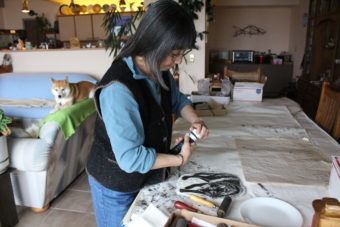
Elizabeth Jenkins, Alaska's Energy Desk - Juneau

The sharing economy: Juneau’s first co-working space open for business

Juneau’s first co-working space recently opened its doors downtown. It’s called The Boardroom but the modern decor and open layout feel far from corporate.

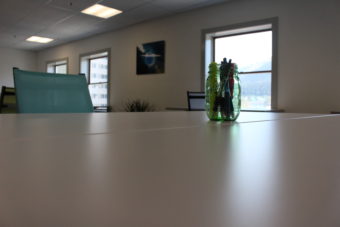
Inside the shared work space, 20 chairs are configured into different formations. Some are clustered around white tables. Others are rolled under stand-alone desks. It kind of looks like the office in an Ikea catalog.

The Boardroom has enough work stations for 20 people. (photo by Elizabeth Jenkins/KTOO)

“We’re going for that sleek modern yet fun look so we have green glass mason jars, green chairs, blue chairs,” Ray Friedlander says, the community manager at The Boardroom.

Since its soft launch this month, she says the company has had three people show interest: a civil engineer, a PR contractor, and an ice cream shop owner.

“I guess the space brings together lines of work that you don’t see in the mainstream or you don’t think about when saying, ‘what do I want to be when I grow up?’ because you’re getting to meet people who think outside of the office box,” she says.

A day pass to the Board Room is $25. Full membership costs $300 a month. Computers aren’t provided but there’s Wi-Fi access, printers and fax machines—even a Keurig coffee maker.

The company is targeting clientele from various backgrounds. Entrepreneurs and cruise ship travelers to busy stay-at-home moms. Pretty much anyone who wants to get away from their regular work environment or doesn’t want to commit to an office lease.

“I would want to work here. If I was tired of sitting in really uncomfortable, wooden wobbly coffee shop chairs or the couch in my living room. Coming here would be a total upgrade,” she says.

The company started in Anchorage about two years ago and was founded by Brit Szymoniak and a business partner.

“We were watching a lot of our bright friends leave Alaska to head out to large cities. And we wanted to do something that would help keep them local and attract young talent and we starting looking at different options and one of the things we came across was this big boom in co-working,” Szymoniak says.

Since its launch, the Anchorage branch has gained about 100 members. Szymoniak says last year 7,000 people came through its door. She’s hoping to find some of the same momentum among professionals here.

“Juneau also has this great energy. It’s really in the process of growing and building. There’s a lot of new young, businesses popping up downtown and young people moving back into the community,” she says.

Brian Holst agrees. He’s the executive director for the Juneau Economic Development Council. He says the addition of co-workspace is meeting a need in the community. It’s part of the trend towards a sharing economy.

“It is people moving away from owning everything for themselves and sharing resources,” he says.

For example, the vacation rental company Airbnb has 38 listings in Juneau which are usually spare rooms.

Ray Friedlander sends an email at her desk at The Boardroom. (photo by Elizabeth Jenkins/KTOO)

“We do know that’s a national trend and there’s no reason to believe that it’s not happening to some degree here in Juneau,” he says.

Holst says Zipcar has also expressed an interest in coming to Juneau. It’s become a popular option for people who don’t want the full-time burden of owning a vehicle.

Back at The Boardroom, Ray Friedlander is the only person in the office. But she hopes with word-of-mouth more people will join soon. An open house is planned for early next month.

“I’ve been told Juneau has a flier culture. I came from Sitka. So fliers are another way in a small Alaskan town to get the word out,” she says.

The Boardroom says it’s interested in spreading to other cities in Alaska, like Sitka and Bethel.

Editor’s note: The Boardroom is located on the third floor of the Senate Mall building. 

GCI services interrupted in Juneau

GCI Antenna
GCI Antenna. (Creative Commons photo by Sir Mildred Pierce)

Telecommunications provider GCI experienced an outage this morning in downtown Juneau with one of their fiber cables.

“This morning we had a contractor working at 12th and Glacier. They inadvertently pulled down an aerial fiber can. When they pulled the can down, they managed to dislocate a couple of fiber cables,” says Warren Russell, the vice president for GCI in Southeast.

A can is the name for the single collection point for various fiber cables. Cell phone reception in Juneau may have been impacted.

“It’s not the whole network, it’s just certain sites may be down. So you may experience short gap areas as you drive through town,” he says.

Other services interrupted were Video on Demand, PBS and 360 North. Russell says the issue should be fixed now.

Juneau Police Department remembers fallen officers

The Juneau Police Department places a wreath on the grave of Officer Richard Adair (photo by Elizabeth Jenkins/KTOO)
The Juneau Police Department places a wreath on the grave of Officer Richard Adair. (Photo by Elizabeth Jenkins/KTOO)

Around 25 people gathered at Evergreen Cemetery this afternoon to remember local law enforcement officers killed in the line of duty.
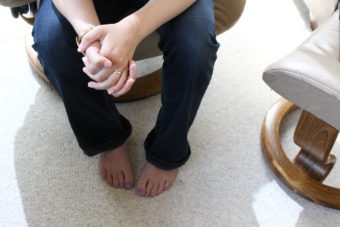
“We have four from Juneau Police Department that were were killed. We also honor the troopers and the other police officers in other jurisdictions, like Hoonah. We’re here to place a wreath and remember their service and their sacrifice,” said Chief Bryce Johnson with the Juneau Police Department.

The earliest recorded police death in Juneau happened in 1964 when Chief of Detectives Donald Dull was accidentally shot by a court bailiff. In 1979, Officer Richard Adair and Officer Jimmy Kennedy were both ambushed by gunfire and died from their injuries. Officer Karl Reishus died in 1992 after trying to save two firefighters during a training accident.

IMG_5436At today’s ceremony, a wreath of flowers was placed on the grave site of Officer Richard Adair. Some of his family still live in Juneau. Lt. Kris Sell says coming together for Alaska’s Police Memorial Week is a way to remember the fallen officers but also reflect.

“There’s only one degree of separation between the fallen officers and those who walk the streets,” she says.

Another ceremony will be held tonight at 5:30 p.m. at Dzantik’i Heeni Middle School.

Marijuana use on the rise for Alaska’s pregnant women

About one in 14 Alaska women are using marijuana while pregnant and that number appears to be going up. That’s based on the state’s pregnancy risk monitoring survey which is a randomized mail and phone questionnaire hundreds of new moms complete a year.

The survey offers a glimpse into the lives of Alaska women who consume pot while pregnant. For instance, we know that these women tend to be younger, under 24. Kathy Perham-Hester coordinates the survey.

“It would tend to be an Alaska Native woman versus women of other races. There’s a higher proportion of women who have had at least part of their prenatal care paid for by Medicaid. So they might be lower income,” she says.

The data also points to where these women live.

“Proportionally more in the northern region of the state and the southeast region of the state,” Perham-Hester says.

PRAMS, or the Pregnancy Risk Assessment Monitoring System, has been surveying women in Alaska since the 1990s. Forty other states also have similar programs. It’s funded by the Centers for Disease Control and Prevention. The latest data is from 2002 to 2011. Over that span, the percentage of women who consumed pot during pregnancy more than doubled. But one question it didn’t include was “Why?”

“You know, we did not ask any question like that. So no, I’d have to say I’m not aware of that,” she says.

Juneau mom, 26, smoked pot about two times a week when she was pregnant. She’s married with a baby boy.

“Everybody comments on his alertness and how he just smiles and laughs. He’s only two months old but he’s very smart. I mean sure, everybody says that about their baby,” she says.

We’re withholding her name because she fears she could lose her job this summer working in the tourism industry. She says she didn’t experience any nausea while she was expecting. But she did have painful cramps.

“So I would smoke to get rid of those ’cause you can’t really take any other medication for it, which worked for me because I could go swimming or I could go on walk,” she says.

Juneau mom is 26, married and has a two month old baby boy. (photo by Elizabeth Jenkins/KTOO)
Juneau mom is 26, married and has a two-month-old baby boy. (Photo by Elizabeth Jenkins/KTOO)

She says she didn’t really start smoking pot until she was in college. And now smoking it recreationally is more conducive to her lifestyle.

“I enjoy marijuana a lot more than alcohol. Like, don’t get me wrong, a cold beer on a great sunny day like today is amazing. Especially if you can be on top of a mountain. Nothing beats that. But I’m kind of done binge drinking and partying hard on the weekends,” she says.

Instead, Juneau mom likes to do yoga — high. She’s interested in living a “healthy lifestyle” and doesn’t smoke tobacco. She pays for private health insurance and enjoys spending time outdoors. She says before getting pregnant, she used cannabis medically to soothe her fibromyalgia.

“Smoking marijuana like, really helped me get over that hump because I didn’t have to be on Xanax and Cymbalta all those crazy mind-altering drugs. So that’s kind of when I really started,” she says.

But smoking pot prenatally wasn’t a decision she says she came to lightly. She did her own online research. The Alaska Department of Health and Social Services recently issued a fact sheet on marijuana use during pregnancy and breastfeeding, outlining some of the risks.

“Well, there’s a lot that we don’t know about marijuana in terms of harms or possible benefits. But right now I think the data points to harms,” says Dr. Jay Butler, the chief medical officer for the department.

He says THC, the active ingredient in marijuana, can enter the bloodstream of a developing fetus or nursing infant.

“There are a number of epidemiological studies that suggest that exposure to marijuana early in life, particularly heavy use, may affect brain development and intellect. Is it proof of causation? Not necessarily. But I think the data are strong enough there’s reason to be concerned,” he says.

“So to me the data wasn’t really solid. It didn’t provide enough evidence to really go with that,” says Juneau mom.

She says before she made the decision to smoke pot while pregnant, she needed advice from one more person.

“Before I made the choice to do it, I asked my mom. And she actually admitted that she did while she was pregnant with me and my siblings. So that kind of made it a little bit more OK after the other research I had done. I could talk to her about it and she told me her experience. And I was like, ‘Well, I came out normal.’ At least, I think. So it can’t be terrible,” she says.

If a medical expert feels like a child has been born drug-effected, an investigation can be launched by the Office of Children’s Services. Juneau mom thinks that’s why more women don’t talk about it, they’re afraid.

“You hid when you smoked or you kept it private. So why would you ever want to speak about it to someone who might blow the whistle on you?” she says.

Since she started breastfeeding, she says she’s stopped smoking pot regularly for now. The Alaska Department of Health and Social Services says, with changing attitudes toward marijuana, there are concerns the number of women smoking pot while pregnant could continue going up.

Tidal Echoes: Capturing Southeast culture in print

The latest edition of the University of Alaska Southeast literary journal Tidal Echoes was recently released. It takes a year to curate all of the work that goes into the book, which showcases poets, fiction writers, and artists. There’s only one requirement for submission: you have to be a full-time resident of Southeast.

Emily Wall flips through 114 matte pages of the freshly published journal.

“That’s a photograph, that’s 3-D art made out of an egg carton,” she says.

Wall is faculty advisor for Tidal Echoes, now in its eighth year. The journal is edited by UAS students. It accepts work from all over Southeast Alaska, from Lemon Creek Correctional Center to Metlakatla. Wall says there are no themes. It’s more about creating a platform for local artists and writers.

“So I really like that for down south audiences, it’s a way to distinguish us as a region. This is a very particular and different aspect of the state,” Wall says.

There are other literary journals in Alaska. Some accept submissions from out-of-state, but none are regionally specific. In this edition of Tidal Echoes, the featured writer and artist are both from Juneau. The cover has Fumi Matsumoto’s artwork on it, a collection of used tea bags stamped with ravens.

“It’s a happy cover. You know what I mean? Someone said that, too. All the ravens look like they’re having a good time,” she says.

Matsumoto is a found artist who’s lived in Alaska for almost 30 years. You might look at an empty milk carton or the dying leaves of a house plant and see trash. Matsumoto thinks of something else.

“The image of a wolf popped out of the pile of leaves. It’s almost like a puzzle. Then looking for the right leaf to make the ear. That’s what I like to do, if I find something and you look at it for a while, a piece of driftwood or whatever, what kind of images come out when you’re staring at it,” Matsumoto says.

There was the time she noticed the glint of a pile of Mountain Dew cans.

“I don’t drink it. I just have the cans and I thought, ‘Wow the colors are really nice.’ You’ve got the greens and reds,” she says.

She realized the colorful aluminum looked like the feathers of her bird, Pogo.

“Very parrot like. So I just made parrots out of those,” she says.

Matsumoto is Japanese-American and uses different Eastern techniques in her art: origami, kirigami or paper-cutting. Also, sumi-e, which is ink brush painting. Some of her work is playful, like the Mountain Dew Parrots. Other pieces tell the story of her family history, like Minidoka Interlude.

“It’s a very subtle photo of a Japanese woman in a kimono and that’s my mom,” she says.

The photograph is encased in a square metal cage.

“There’s a gold button, barbed wire, and a scroll that has the name of some of the Japanese internees there,” Matsumoto says.

Minidoka refers to the Idaho internment camp that Japanese Americans were sent to during World War II. Matsumoto’s father and other relatives were sent to a different camp. At the time, the U.S. government feared another attack like Pearl Harbor. But little evidence was ever uncovered to support theories of espionage.

“It’s just that we looked like the enemy. You know? I don’t know if we hadn’t looked like Japanese people, I doubt we would have been rounded up and stuck in camps,” she says.

Matsumoto says she didn’t learn about her family’s past until she was older.

“That was the thing. Most Japanese Americans were basically wanting to put it behind them. It was very shameful to be accused of being a spy or un-loyal because they weren’t,” Matsumoto says.

Her father later left the internment camp for the U.S. Army and went on to be a highly decorated war hero. Matsumoto says she hopes making artwork like this will help create a dialogue.

“Then perhaps people will become aware and sensitive to what happened and that it won’t happen again,” she says.

You can see Fumi Matsumoto’s work in the latest edition of Tidal Echoes, along with other pieces from Southeast artists and writers.

Copies can be purchased at UAS or Hearthside Books.

Path to graduation: one student’s journey to UAS alum

(photo by Elizabeth Jenkins/KTOO)
(Photo by Elizabeth Jenkins/KTOO)

This past weekend, 693 students received diplomas from University of Alaska Southeast campuses. Sunday was the Juneau campus’s 44th commencement ceremony. Graduation is often a time for celebration, and it should be because getting through college can be hard. There are exams to ace, late night study sessions and pressure over what comes next.

Rebecca Salsman guides a class of pre-teen students through a ballet routine at Tafy dance studio in Lemon Creek. She just arrived here from her other job, working as a daycare teacher. And if that wasn’t enough, she’s also a graduating senior.

“I think the most difficult thing has been trying to figure out how to balance it. Like, I’ve had days where I would go to class, I was taking 21 credits at a time a semester and so I would be in class every evening or every morning. And then I would go and work my full-time job. Then go to a class for another few hours. Then go teach one dance class here or there,” Salsman says.

Even the little things, like grabbing lunch or finding time for friends has been a challenge.

“Or when am I going to get my half hour of ‘me’ time in the day? You take them for granted before you get into college,” she says.

A self-described “ambitious home school kid,” Salsman started taking classes at UAS when she was just 14. She’s now 24 and receiving a degree in English with an emphasis in creative writing.

“I always knew I was kind of good at it like throughout school and stuff and high school. It was never my niche until I figured out how much fun it could be college,” she says.

Rebecca Salsman gets ready to teach class (photo by Elizabeth Jenkins/KTOO)
Rebecca Salsman gets ready to teach class. (Photo by Elizabeth Jenkins/KTOO)

This past year, she spent a lot of time editing the UAS literary journal, Tidal Echoes.

“And I would do that, odds and ends, when the kids were napping. On my lunch breaks when I had to. At midnight if I had to just to get things done,” she says.

Throughout her time in school, when things got really hectic, she’s had moments of I just can’t do this anymore.

“Oh yeah, I’ve hit those points a couple of times in my college career,” she says.

For the first three years, Salsman paid for her tuition with scholarships.

(photo by Elizabeth Jenkins/KTOO)
(Photo by Elizabeth Jenkins/KTOO)

“Then the fat hit the fan and I had to start paying for ‘em. I was considered too old and had been there too long to keep receiving as many scholarships. That was a challenge of having to hit the reality of paying student loans and working and trying to figure out how to manage life,” she says.

She got through it and now she’s graduating from UAS. Being a senior, she says you get a lot of unsolicited advice.

“Go back to school and get a masters degree. Become a teacher because that’s the only thing you can do with an English degree.”

But for now, she says she doesn’t mind where she’s at.

“I’m totally okay with continuing to work 7 a.m. to 8 p.m. ‘til I pay off my student loans and then go back to school for masters,” she says.

Salsman says she’ll use her English degree in other areas of her life, like telling stories through movement and dance.

Editor’s note: This story has been corrected to acknowledge several UAS graduation ceremonies across different campuses. An earlier version overstated Juneau diploma figures by incorporating all UAS campuses.

Site notifications
Update notification options
Subscribe to notifications