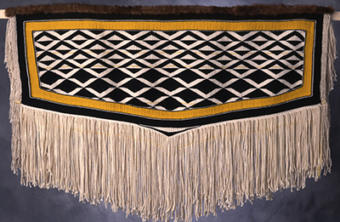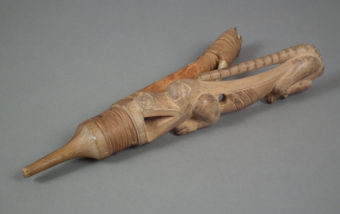
The Sealaska Heritage Institute acquired a Chilkat robe believed to be a funerary object in 2015. (Photo by Elizabeth Jenkins/KTOO)
Five sacred Tlingit items could be returned to Central Council Tlingit and Haida Indian Tribes of Alaska.
A notice published in the federal register on Monday stated the items were “acquired” by William P. Palmer III and given to the University of Maine in 1982. The items now reside in the university’s museum.
They include a shaman’s pipe and mask and other items placed near grave sites or associated with death ceremonies.
Under federal law, such cultural or sacred objects belong to Indigenous descendants and can be removed from museums for repatriation. Central Council members visited the museum in Maine in 2018 to make the determination.
One of the items that could be headed back to Alaska is a Tlingit Raven grave totem, which records indicate once hung in the Elks Lodge in Juneau.
The transfer of the objects to Central Council will take place after August 5 if no other descendants make a claim.
Clarissa Rizal is an artist who specialized in the design and creation of Tlingit regalia and art, including Chilkat and Ravenstail robes and weavings. (Photo by Tripp J Crouse/KTOO)
Neiman Marcus is one of the clothing retailers that’s seen a decline in sales because of the coronavirus. The company filed for bankruptcy in early May — just weeks after it was sued by Sealaska Heritage Institute.
The company was selling a so-called “Ravenstail knitted coat” on its website, which the Institute alleges is a copy of a notable Alaska Native weaver’s design.

Lily Hope remembers seeing her mother’s piece hanging at an art show at the Heard Museum in Phoenix. The robe was called “Discovering the Angles of an Electrified Heart,” and it won first place.
Hope’s mom, Clarissa Rizal, died in 2016, and Hope’s family later had some of that work copyrighted. Not long after that, Hope got a message from some friends. They sent links to multiple websites, including Neiman Marcus. The company was selling a very similar-looking garment to the piece her mother wove.
Hope’s immediate thought was “What are they thinking? What makes someone think that’s OK?”
“Discovering the Angles of an Electrified Heart” by Clarissa Rizal. (Photo courtesy of Rizal’s heirs and Sealaska Heritage Institute)
Ravenstail weaving has been practiced by Tlingit, Haida and Tsimshian people for hundreds of years. Rizal has been credited as an important influence on reviving the tradition. Hope was taught to weave by her mother and is now a weaver herself.
The “Ravenstail knitted coat” — retailing for more than $2,500 dollars — features the same bold geometric patterns seen in Northwest Coast weaving. Hope says she also recognized flourishes that were distinctly her mother’s. As the website links to the coat kept filling up her inbox, she wasn’t sure what to do.
“With each one of them, I was like ‘yep, I’ve seen it’,” Hope said. “And then I was like ‘I wonder if there would be something to do about it?'”
The “Ravenstail knitted coat” sold at Neiman Marcus. (Photo by Brian Wallace, courtesy of Sealaska Heritage Institute)
Hope met on the phone with Sealaska Heritage Institute in Juneau, and she says they decided to take a stand.
“It doesn’t feel good as an Indigenous artist to think that the work I make could be mass produced,” Hope said.
Sealaska Heritage Institute sued Neiman Marcus in the spring for alleged copyright infringement and violating the Indian Arts and Crafts Act — a law that ensures products marketed as Native American or Native Alaskan are authentic.
President Rosita Worl called it “one of the most blatant examples of cultural appropriation” she’d ever seen. The case is thought to be the first time in the U.S. a business has been sued for copying a traditional Indigenous pattern. Though, it’s far from the first time there’s been concern over the issue.
The Italian clothing company that makes the “Ravenstail knitted coat” is described as “paying homage to Native American iconography.”
“It doesn’t work that way because you’ve taken their property,” said Jacob Adams, Sealaska Heritage Institute’s lawyer on the case. “You’ve stolen it and that’s the end of the discussion.”
He says copyright law does allow for inspiration.
“What is not allowed is copying,” he said.
And he thinks that’s what’s happening with the “Ravenstail knitted coat” and other Indigenous patterns and cultural property, which have been used to sell products.
“This isn’t a call to end all external use of these patterns,” Adams said. “It’s a call to do things appropriately.”
Adams thinks there is an example of a corporation doing things appropriately: Walt Disney Animation Studios.
The song “Vuelie” is in the opening of the princess saga “Frozen” and its sequel “Frozen 2.” It’s composed of Sámi chants. For the first film, Disney was accused of whitewashing Indigenous Sámi culture. For the second film, the company entered into a legal contract with Sámi leaders.
Adams says that’s an important distinction. This isn’t some kind of soft law thing. It’s not passive, like asking for permission: It’s something you must do — recognizing Indigenous groups have the right to say, “no.”
“Even if we want to do things appropriately sometimes it’s difficult to know how. So, just starting at that basic principle of recognizing these rights, it gives us a roadmap of how to properly engage,” Adams said.
Adams wants the Sealaska Heritage Institute lawsuit to further that discussion. He says the Neiman Marcus bankruptcy has complicated things, but the case is still moving forward.
Sealaska Heritage Institute’s President, Rosita Worl, didn’t want to comment verbally on the ongoing case but added in writing:
“My hopes are that businesses will develop policies and practices to respect the cultural and intellectual property of Indigenous Peoples, and that they would be open to opportunities to collaborate with Indigenous Peoples.”
Elizabeth Hope holding up the Chilkat Protector Mask at a ceremony. (Photo by Sydney Akagi. Photo courtesy of Lily Hope.)
A Chilkat mask woven to document the coronavirus pandemic has been donated to Sealaska Heritage Institute in Juneau.
Famed weaver, Lily Hope, created a similar mask as part of an online art competition in April. It took her 60 hours to weave the mask, which was later acquired by the Burke Museum in Seattle.
The mask fits similar to those worn in public to protect people from contracting COVID-19. But it was woven using an intricate technique practiced by Indigenous people living along the Northwest Coast for hundreds of years. In an earlier interview, Hope explained her intent to create a lasting piece of art that reflects on tradition.

“When the person goes out, if they are a carrier, they are essentially protecting their whole community (by wearing a mask) from being sick,” Hope said. “And that’s foundational to the Tlingit, Haida, Tsimshian peoples. … My aunt says it best: ‘The mask serves to record that we took care of each other during this time.'”
Hope told the Institute she wanted to donate the mask to express gratitude for the organization’s continued support of her art.
The mask, called Chilkat Protector, was donated at a ceremony at Sealaska Heritage Institute, where Hope and weaver, Ricky Tagaban, also unveiled a commissioned Chilkat robe.
The Bravo Eugenia as seen from Douglas Island. (Photo by Elizabeth Jenkins/KTOO)
There are no cruise ships in Juneau so far this summer, but recently a giant vessel owned by a Texas billionaire pulled into port — a private cruise ship of sorts.
Travelers who fly into Alaska have to follow state mandates, like submitting a COVID-19 test. But what about visitors who arrive by boat or luxury yacht? Juneau’s harbor master Matt Creswell says they’re on the hook to follow those rules, too.
Creswell recently became the harbor master at the City and Borough of Juneau docks and harbors.
“It’s been interesting, I took over as the harbor master in early March when all of this began and was looking forward to a busy cruise ship season, and my role quickly changed,” Creswell said.
He’s now in charge of making sure travelers who arrive by boat from outside of Alaska are abiding by the state’s travel mandates. That usually starts with some kind of check-in when they arrive in port. Passengers can agree to take a COVID-19 test. But Creswell says there are other ways to fulfill the mandate.
“It’s not necessarily receiving a COVID-19 test. It’s the travel declaration form,” Creswell said. “And that’s where the traveler has the option to say they have tested 72 hours prior to and will follow guidelines upon arrival in Alaska.”
Or, he says if passengers have been on board a ship for two weeks without disembarking, that counts as self-quarantine. Of course, that shouldn’t be too hard with access to amenities like a floating spa.
But what about the 357-foot Bravo Eugenia tied up in a private dock in downtown Juneau? That boat belongs to Jerry Jones, the owner of the Dallas Cowboys. Creswell couldn’t comment who was on board the ship. However, he said the passengers complied with state mandates.
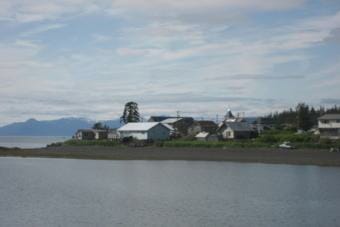
Kake photographed in 2012. (Department of Commerce, Community and Economic Development; Division of Community and Regional Affairs’ Community Photo Library.)
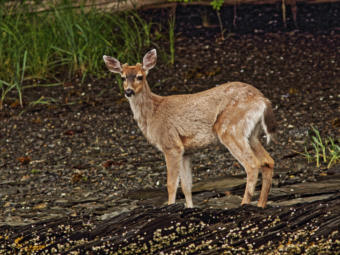
The federal subsistence board approved a special hunting request on Monday that permits the Organized Village of Kake to harvest deer or moose out of season.
The tribal government expressed concern at the beginning of the COVID-19 pandemic that grocery store shelves weren’t fully stocked with items like meat. Kake’s Tribal President also added he was worried about the health of village Elders.
Dave Schmid is the regional forester at the U.S. Forest Service Alaska region. He voted to approve the measure, which passed 7 to 1.
“I would say given the level of food insecurity that you heard from here facing this community, approving this special action — it’s the right thing to do,” he said.
Schmid said that he didn’t foresee any conservation issues related to wildlife population numbers in the vicinity of Kake.
The federal subsistence board has been handling multiple requests across the state. Some communities are worried about the impact of the pandemic on the food supply chain.
Earlier in the month, the agency tried to speed up that process by delegating local land managers to make the call. That process was stalled when a state emergency response group suggested there wasn’t a disruption in the food supply chain.
The Alaska Department of Fish & Game has yet to approve emergency hunting actions on state land.
Tribal governments and other communities in Alaska have been waiting for nearly two months for an answer to emergency hunting requests. The pandemic has caused some food supply disruption concerns, and so at least six small localities across the state have asked for special permission to hunt out of season.
That decision is typically granted by a federal board, but because everything about the pandemic is unprecedented, it hasn’t been simple.
Joel Jackson is the Organized Village of Kake’s Tribal President. When he first approached federal employees about opening the deer and moose season earlier than normal, he didn’t expect the process would take this long and the decision would be passed around to different levels of federal agencies.
“There’s still limitations from our one little store,” Jackson said.
It’s not just food scarcity Jackson is concerned with. Shipments of food are regularly arriving now, but it’s all processed meat slaughtered and packaged from the Lower 48. Jackson doesn’t think that’s as healthy or culturally nourishing for elders in the community — elders who could be especially vulnerable to complications from COVID-19.
Kake isn’t on lockdown anymore, and Jackson says people are traveling in and out of town. He thinks this is a crucial window when residents need to feel their best.
“If this virus ever makes it into our community, which I hope it never does, we need to have our people at the best health they can be by supplying them with the best food that we can give them,” Jackson said.
The federal Office of Subsistence Management is fielding multiple requests like Kake’s, and there isn’t an exact blueprint for how this should be done. The agency is used to responding to emergency hunting actions in the event of storms, but processing this during an ongoing pandemic presents a different set of challenges.
A records request filed by Alaska’s Energy Desk shows how the agency is trying to speed up that process. A U.S. Forest Service ranger district in Petersburg was delegated the authority on June 2 to grant emergency hunting actions for rural subsistence residents — like Kake. That negates some of the bureaucratic rigmarole, and it’s happening in other parts of Alaska, too. Still, there are certain caveats for final approval. One of them is that a state entity has to confirm the need.
Bryan Fisher is an Incident Commander at Alaska’s Unified Command: a central hub for various state agencies to respond to emergency situations, such as a pandemic.
“We just have not seen any supply chain disruptions or any loss of the ability to preserve previously gathered subsistence foods,” Fisher said.
The Unified Command has been helping restock food banks across the state, among other things. But the group has also been tasked by the Alaska Department of Fish & Game to make food need assessments in remote communities.
“They turned to us to do that validation of whether there was a real break down in that supply chain that would cause them to consider opening hunts on state land and working with the subsistence board to figure that out,” Fisher said.
Some clarification: The federal subsistence board approves special actions on federal lands, like emergency hunts. And the state of Alaska has its own process for state lands. In this case, the state Unified Command’s determination also weighs on the Peterburg ranger district’s ability to grant emergency hunts on federal land. In Kake’s situation, that decision was deferred back to the federal subsistence board. Essentially, Kake’s in a similar spot as they were back in April when they first requested the emergency hunting action.
Jackson is disappointed that a decision between a federally recognized tribal government and a federal agency is being delayed further because of input from the state. He says last season’s deer meat is running low in many people’s freezers. The community knows what’s best for them.
“We’ve always been conservationists,” Jackson said. “We’ve always been mindful: Never take too much.”
The federal subsistence board is expected to take this up in a public meeting on Monday, June 22. And Jackson hopes they account for all the ways a household with deer or moose on the dinner plate is a reflection of health during these uncertain times.
Editor’s Note: This story has been updated as new information has become available.