Elizabeth Jenkins, Alaska's Energy Desk - Juneau
Airline passenger brings first case of COVID-19 to Southeast town of Gustavus

The COVID-19 testing station at the Gustavus airport on June 12, 2020. (Photo courtesy of Melanie Lesh)

The small Southeast Alaska community of Gustavus has its first confirmed case of COVID-19.

The case was detected at the Gustavus Airport when an Alaska Airlines passenger took the test after an incoming flight. The Gustavus Emergency Operations Center was notified on Friday.

The person is not an Alaska resident and appears to be asymptomatic. They are currently in self-isolation, and state officials are investigating the source of the virus.

Before the City of Gustavus learned that the virus had come to town, it planned on hosting a virtual town hall meeting about the possibility of COVID-19 in Gustavus. That’s still happening Friday evening.

On Friday, the state reported 15 new cases of Alaskans testing positive for the virus and seven non-residents. This week marked the highest active number of cases since the start of the pandemic.

How an art show was judged from a distance during virtual Celebration

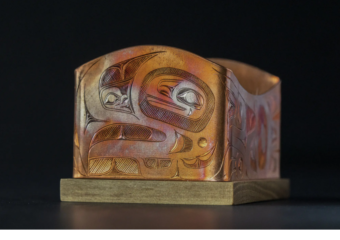
Best of Show winner: Ch’áak’ Aanyádi (The High Caste Eagle) by Jerrod Galanin. (Photo by Caitlin Fondell courtesy of Sealaska Heritage Institute)
Best of show went to Jarrod Galanin of Sitka for a formline engraved copper vessel, traditionally used to hold seal or hooligan oil. (Photo by Caitlin Fondell)

This week marks the beginning of Celebration: An event that brings thousands of Native Alaskan people to Juneau every two years. But this year, the festivities aren’t happening in-person. They’re happening online, due to COVID-19.  That includes a Northwest Coast art show, where art pieces were judged from a distance. 

Deborah Head, or Aanutein as she’s known by her Tlingit name, is sitting in her car about a mile from her house in Craig. She drives into town to get better cell phone reception. It’s also how she got a wifi signal so she could evaluate digital pictures of artist submissions. 

“Going to a friends house and saying, ‘Can I sit in your parking lot and do some downloading?'” Head said.

Besides the technology issues, Head says it was extremely challenging judging the intricate creations, like a formline painted drum or a beaded Chilkat wall hanging, from afar. 

“We knew the biggest obstacle was going to be not being able to go to Juneau and hold the pieces,” Head said.

Sealaska Heritage Institute organizes the juried art show as a way to amplify and encourage Native Northwest Coast art. But in March, the organization had to pivot this year’s exhibit to an online format after news broke that Celebration would be held virtually. Artists were given the choice to pull out the work they submitted back in 2019. Twenty-six artists decided to still enter the competition — knowing their work would be experienced by a few online photos rather than the judges seeing it up close. 

Head says, as a judge, that was a lot of responsibility. She combed through photos saved on her laptop for hours. Then, she’d wake up around 4 a.m. and do it again.

“It was a lot of revisiting and revisiting,” Head said. “And when a piece is well done, it just jumps out at you.”

Head has had her own journey as an artist. She started out as the lone cedar bark weaver in Craig. She had to learn much of the technique herself. Eventually, she was able to take a class with famed Haida weaver, Delores Churchill. She recalls the class started early in the morning.

“By 10 o’clock, I was out behind a tree crying because it was frustrating because I can tend to be a perfectionist, and that never goes away,” she said with a laugh.

But Head mastered the Haida style of weaving. Now, she creates pieces on commission and sells items like baskets to galleries. Lately, she’s been interested in an endangered style of Tlingit root weaving. 

As for judging traditional art virtually, Head says she looked for meticulous details, creative flair and also authenticity. In the online show, there was a piece that exemplified that. You could see it was something special even through a computer screen: a spruce root basket woven by a beginner in British Columbia. 

“You could see that maybe the person was reared by an elder, an auntie, a grandma — something like that,” Head said. “I can’t wait to follow this person.”

That submission, by Marlene Liddle, was a division winner. In total, eighteen artists placed in the art competition or received honorable mentions. You can see the full list of Sealaska Heritage Institute’s Northwest Coast Juried Art Show & Competition winners here.


xx
Small Spruce Root Basket by Marlene Liddle. (Photo courtesy of Sealaska Heritage Institute)

Alaska nursing homes are closed to the public, but joyful rituals are still happening inside.

xx
The salon at the Wildflower Court nursing home in Juneau. (Photo courtesy of Melissa Elmore)

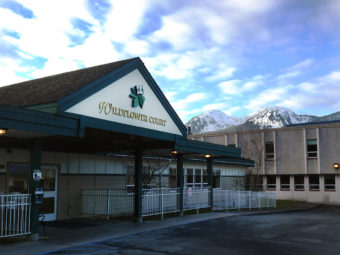
The coronavirus has wrecked many of our daily routines. And for people who live in nursing homes in Alaska, which have yet to reopen to the public, the feeling can be even more heightened. To deal with the changes, nursing home staff in Juneau are trying to create a sense of normalcy for the residents. 

When Melissa Elmore styles hair at Wildflower Court, the tunes are always playing. 

“You’re hair sure curls really nicely,” Elmore tells a resident in her 80s as she curls the woman’s blonde bob.

At times, they both sway to the song, Come and Get Your Love by Redbone. They talk about family and dancing. 

Elmore is wearing a blue face mask. But besides that, you wouldn’t know that a global pandemic is going on, or that the nursing home has been closed to the public for more than three months. 

Elmore says creating this calm environment for the residents is intentional.

“The one I just got done with, she always claps her hands and smiles real big and kicks her feet because she’s so happy,” Elmore said.

Styling hair isn’t Elmore’s normal job at Wildflower Court, where she’s worked for more than 10 years. She’s an assistant social worker. She handles things like resident admissions and Medicaid renewal. But because of the coronavirus pandemic, outside visitors — like beauticians — can’t come inside the building. So, Elmore temporarily adopted the role. 

She says, for residents, it’s about more than getting a refreshed hairdo to look good. 

“Even before this hit, it was something that was like a routine that happened every single week,” Elmore said. “I didn’t want them to have to miss that.”

Nursing home residents are missing a lot right now. They’re having to rely on video chats or window visits to stay in touch with their families. But activities that typically occupy the rest of the day have been affected as well.

Melissa’s spouse, Kirk Elmore, works at Wildflower Court, too. He organized actives around the time COVID-19 struck.

“It’s really important to have that thing that you can look forward to,” he said. 

He says the pair have taken added precautions to prevent contracting the virus and bringing it into the nursing home. Kirk Elmore hasn’t been inside a grocery since the nursing home closed its doors in March. 

And like Melissa Elmore, he’s trying to help residents fill their time with things they normally like to do. 

“We’re not doing something big and with a lot of people,” Kirk Elmore said. “But those interactions that we have, those real meaningful moments, are really nice.”

That can look like staff bringing a cup of coffee to a resident’s room and chatting for a bit, rather than a group meet-up. Singalongs have been replaced by watching Youtube videos, and religious leaders aren’t coming in to lead services: those are streamed live. 

Then, there are changes to another sacred activity. 

“Bingo is one of those things you don’t mess with because it’s typically so important to our residents,” Kirk Elmore said.

So instead of one big game, there are now two bingo games each day, which allows for smaller groups. 

Recently, dozens of people tested positive for COVID-19 at a nursing home in Anchorage. That hasn’t happened in Juneau, but Kirk Elmore said this can be a stressful time for nursing home staff, too. To cope with that added stress, Wildflower Court created a calming space for staff with essential oils and relaxing lighting. He says its a good place to pray or meditate on why the job is important.

Melissa Elmore summed it up best: 

“Not that we didn’t do it before, but we may be doing more of it,” she said. “Just to make sure that our residents are happy and safe and know that they’re loved and being taken care of.”

Juneau is getting an electric city bus, making it the first city in Alaska to have a plug-in in its fleet

zz
Juneau’s electric bus is made by the company, Proterra. (Photo courtesy of the City and Borough of Juneau)

Juneau is about to become the first city in Alaska to get a permanent electric bus in its fleet. (The Municipality of Anchorage leased an electric bus for a four-month trial period in 2018.)

The City and Borough of Juneau received a $5 million federal grant to purchase electric buses and charging stations. The first is expected to quietly hit the streets sometime October. 
A spokesperson for Juneau’s Capital Transit said most of its busses will remain diesel-powered for now. But it plans to replace seven of it’s aging vehicles with electric busses by 2022. 

Additional funding for this project comes from Alaska’s share of a multi-billion dollar legal settlement from Volkswagen. The car company was sued in 2016 after it illegally sold cars that masked pollution levels during emissions tests. 

In recent years, Juneau has become an enthusiastic adopter of electric vehicles. It’s been compared to places like Portland, Oregon when it comes to plug-ins per capita. 

As Alaska reopens, nursing homes stay closed to visitors. Here’s how families are staying connected.

xx
A family testing out a new way to have contact at Wildflower Court. (Photo courtesy of Wildflower Court)

Alaska has lifted restrictions on businesses and some people are getting out more after the pandemic radically altered social life in March and April. But for nursing homes, there’s no set date for when families can safely reunite. The state has set up a task force to look into how to reintegrate visits. However, there’s still a lot of unknowns about when that’s going to happen. In the meantime, families are coping with the distance.

Jodi Mitchell’s brother, Donnie, lives at Wildflower Court, a nursing home in Juneau. She sees him at least once a week or more through a computer screen. Usually, it’s a big family gathering. On the Zoom conference, there were family from Hawaii and California. Mitchell called in from Juneau.

There was talk of the weather, the pandemic and what Donnie’s been up to. He hasn’t been winning at bingo, but he smiles at a joke a family member makes about the winning prize being a new car.

It’s been over three months since Mitchell has seen her brother in-person. Wildflower Court closed its door to visitors in early March, around the time COVID-19 outbreaks struck nursing homes in Washington state. Normally, Mitchell brings her brother home on the weekends. He likes helping her pick weeds in the garden and going on shopping trips. It’s precious time they have together.

“As soon as they allow you out, believe me, I’m going to come and get you,” Mitchell tells her brother on the Zoom call.

“Oh, gosh. I can’t wait until that happens,” he replies.

At 57 years-old, Mitchell’s brother is one of the younger residents at Wildflower Court. He lives there because of short term memory loss. Mitchell says the pandemic has been disruptive to his routine. He has his ups and downs.

Wildflower Court has the option to visit through a window, but Mitchell’s not sure if that would be a good fit for her brother.

“If I had gone there and he saw me, he wouldn’t be able to understand why he can’t just come with me,” Mitchell said.

Last week, there were only nine cases of COVID-19 reported in nursing homes in Alaska and all of those cases had recovered. But that number jumped up over the weekend, after a cluster of tests came back positive in Anchorage.

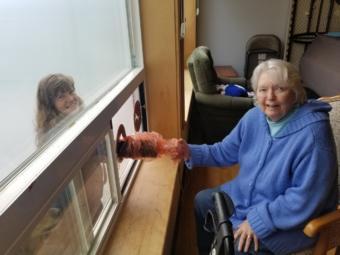
It’s unknown when nursing homes can safely allow families back in. So, facilities are having to come up with solutions to help close the emotional gap. That can look like video chats, like the one Mitchell has with her brother, window visits or holding hands through an arm-shaped hole.

Ruth Johnson, who oversees operations at Wildflower Court, says the nursing home constructed the setup, which allows families to touch with a long disposable glove that covers the arm.

She says, of course keeping residents safe during the pandemic has been a major concern — so has the psychological toll of people not being able to see their families in their typical way. It’s something that hits home for Johnson. Her father had to go into a nursing facility in Washington state in the spring — where later, dozens of people contracted the virus.

“I feel like my father may not die of COVID, but he may be part of the collateral damage: The isolation and loneliness … He has not seen anyone he loves in three months.”

Johnson says this is why she cares so much: She knows how Juneau families are feeling.

Not all nursing homes are equipped for video calls. But Wildflower Court was able to get video chats up and running in a matter of weeks. People donated electronic devices and staff set up a way for families to schedule time to talk.

Johnson wondered if communicating like this would be confusing for residents who can have difficulty recognizing faces or adjusting to sudden change. But overall, people seem to be adapting. She recalls a resident she saw recently with an iPad.

“She’s just of that age where she wouldn’t have used the technology,” Johnson said. “And she was sitting there with a pair of earphones on, plugged into the device, it was a private conversation, with just the most beautiful smile on her face talking to a family member.”

Jackie Pata says that’s been her experience, too. On video calls to Wildflower Court, her mom looks happy and calm. At first, she was reluctant to try video chatting. She worried her mom wouldn’t understand why she couldn’t be there in-person, and it would be upsetting.

But as social distancing measures continued, she decided to try it out. There were some technical issues when they first tried to connect.

“At that moment, my emotions got so real because I felt like, I’m so close to be able to talk to my mom. And now, I’m not going to be able to and that fear, that fear that you get was, like, overwhelming,” Pata said. “I realized in that moment how much I missed her and how much I needed to talk to her.”

But they were able to work it out, and she saw her mom for the first time in weeks.

Pata thinks her mother could sense that she was nervous and a little flustered. So her mom did what good mothers do: She says her mom told her exactly what she needed to hear in that moment.

“‘I love you. I think about you guys all the time. I miss you everyday. It hurts inside how much I miss you,’ and then she’d say, ‘But it’s all going to be OK. We’re going to be together again.'”

Pata says communicating like this has revealed a “blessing in disguise.” Her mom has been able to see grandkids from across the country on video calls. That’s not something that regularly happened before, but it’s something she hopes continues after nursing homes are able to welcome families back inside again.

Juneau resident is one of 13 new coronavirus cases in Alaska announced Thursday

Juneau’s City Hall, photographed in May 2020. Thirty-two Juneau residents have tested positive for COVID-19 in 2020. (Photo by William Gill/Creative Commons)

Another Juneau resident has tested positive for COVID-19. According to a press release from the City and Borough of Juneau, state officials weren’t able to identify the source of the virus after a thorough investigation, which indicates community spread.

Juneau’s case is one of 13 new cases reported on Thursday by the state, including seven new cases in the Kenai Peninsula Borough, four in Anchorage and one case in the North Slope Borough.

In total, 32 Juneau residents have tested positive for the virus and 29 people have recovered.

Most of the cases in the capital city have been linked to the Lemon Creek Correctional Center, where 11 staff members have tested positive for the disease since April. So far, there have been no reports of inmates testing positive for the virus. As of Thursday afternoon, no one could be reached at the correctional center to comment if this latest case is connected.

Juneau’s last reported case of COVID-19 was May 22.

Site notifications
Update notification options
Subscribe to notifications