Elizabeth Jenkins, Alaska's Energy Desk - Juneau
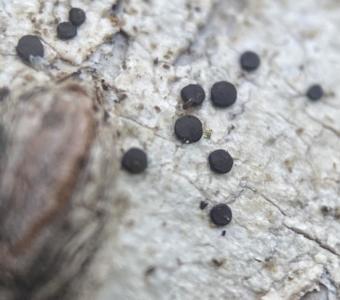
Meet Lecidea Streveleri: One of the lichens discovered in a “global hotspot” in Glacier Bay

xx
A specimen of Lecidea Streveleri discovered in Glacier Bay National Park. (Photo by Toby Spribille)
Lichens are so plentiful in some parts of Alaska you might not even notice them. But on the ground or growing in the trees is an entire universe that scientists are still trying to understand. 

Recently, 27 new species were discovered in Glacier Bay National Park. And though they now bear the names of some influential people in the region, it’s the lichens that are the center of the story.  

Recently, the University of Alberta completed a study on Glacier Bay, where they counted more than 900 species of lichen. They’re calling it a “global hotspot.” 

Greg Streveler is one of those lichens. It looks a little like chocolate chips on top of a toasted marshmallow. Whitish and grey, it grows on alder bark, and it’s named after a real person who lives in Gustavus. 

Through the years, Streveler made numerous contributions to Glacier Bay National Park, where he worked as a biologist. He’s an extremely humble person. In short, he describes his work as, “basically [greasing] the skids for research in the park.”

Some of that research meant tagging thousands of specimens through the years, essentially helping set up Glacier Bay’s scientific plant collection. Streveler is retired, but a new generation of scientists are still interested in that work. 

So, it seems fitting they would think of Streveler when it came time to name one of the newly discovered species. Streveler reacted in his usual modest way. 

“I laughed,” he said with a chuckle. “I was just thinking, ‘well, Toby found so darn many lichens he had to figure out some name for one of them.'”

Toby is Toby Spribille, a lichenologist at the University of Alberta. He met Streveler briefly and was impressed by his scientific efforts. 

Spribille’s team embarked on a three week field study in Glacier Bay National Park. By night they slept in tents protected by a bear fence. And by day, they meticulously surveyed the landscape — observing lichens through a hand lens. 

“I like to compare it to the field inventory equivalent of the Slow Food Movement,” Spribille said.

Like the Slow Food Movement, Spribille savors each inch across the environment like a six course meal. 

“I’ve always been fascinated by small things that are not greatly valued by the rest of society,” Spribille said.

xx
Toby Spribille’s team also named lichens after other people who’ve made scientific contributions to Glacier Bay, such as ecologist, Karen Dillman, and naturalist, William S. Cooper. (Photo courtesy of the University of Alberta)

For such a small plant, lichens have a lot going on. They’re a symbiosis between fungus and alga that provide sugars for the fungus to live on. Spribille says they’re basically in a long term, stable relationship, and he thinks that’s an uplifting thing to consider — especially right now, when so much of the news is dominated by pathogens, like COVID-19. 

“A lot of science is obsessed with things that can kill us,” Spribille said. “The whole world right now is obsessed with something that can kill us, but much of what we see in the word, the diversity of life and the different forms that are around us … they’re all built on principles of collaboration and mutual benefit between different organisms.”

Glacier Bay National Park is chock full of these feel-good little organisms. Spribille says there seems to be a bottomless variety of lichens thriving: It’s the second largest abundance of lichens recorded in an area of comparable size. 

So why is that important? Spribille is not a fan of justifying somethings value based on human need alone. But he says some species of lichens have been used in clinical trials to treat cancer

There are many reasons to handle these biodiverse areas with care. 

“We tend to value things that have names and that we can associate with. And so, bears and bald eagles get a lot of value because we can relate to them,” Spribille said. “But bears and bald eagles aren’t the only things that inhabit the forests of Southeast Alaska.”

But of course, one little lichen has a name — inspired by Greg Streveler. 

Streveler shares some of Spribille’s views. He sees the value of small, ecological things existing for their own sake, and he’s glad future generations of scientists can appreciate life in Glacier Bay National Park, even at a micro scale. 

“Any place that nature is allowed to kind of take care of itself is just like a spot of gold,” Streveler said.

And now, a lichen named Lecidea Streveleri occupies a spot on an alder tree. But it’s been there all along. 

NOAA Fisheries: Alaska chinook harvest not to blame for killer whale decline

(Photo by Greta Mart/KCAW)

The National Marine Fisheries Service says shutting down Southeast Alaska’s king salmon season would contribute little to saving an endangered population of killer whales in Puget Sound.

NOAA Fisheries filed a motion on May 11 in US District Court opposing a Washington state conservation group’s effort to block the summer troll and sportfishing season.

The motion in opposition to the Wild Fish Conservancy’s injunction petition is 34 pages, with over 2,000 pages in supporting scientific documents.

The question the court will have to decide is whether prey abundance is the sole limiting factor in the decline of the Southern Resident Killer Whale, which was listed as an endangered species in 2005.

The orcas eat chinook salmon — also called kings — which originate in the big river systems of the Pacific Northwest, but spend most of their lives rearing in the Gulf of Alaska.

Linda Behnken thinks that taking a conservation question directly to the federal courts is a costly distraction.

“This, to me, places orcas at greater risk,” she said.

Behnken is a former member of the North Pacific Fisheries Management Council, and a 30-year veteran of allocation and management battles in Alaska’s fisheries. She’s never wavered from the position that conserving resources are paramount, as is preserving the fishing economy. The two are inseparable.

So Behnken has no idea where the Wild Fish Conservancy is coming from in asking a federal judge to shut down chinook fishing before it even begins this summer.

“By not identifying the real issues of habitat loss, of dams, of climate change — there are even shifts in predator-prey relationships — they’re really preventing people from understanding the bigger issues, and taking actions that would save orcas,” said Behnken.

Behnken’s organization, the Alaska Longline Fishermen’s Association, put its name to a statement issued by the Alaska Trollers Association and Juneau-based conservation group SalmonState, opposing the Wild Fish Conservancy’s lawsuit and injunction petition.

In a state where environmental battles are common, it’s unusual for conservation organizations to be on opposite sides. Tyson Fick is a gillnetter and crabber out of Douglas. His official title with SalmonState is “Salmon Evangelist.”

He thinks the Wild Fish Conservancy, based in Duvall, Washington, wants to do more than help the endangered Southern Resident Killer Whales.

“Personally, I get really frustrated as someone who works in conservation and harvests salmon for a living when a group comes in under the guise of conservation, but really they want more fish in the rivers for sportfishing in Washington and Oregon,” said Fick.

Fick says he should be more careful about leveling accusations, but the Wild Fish Conservancy’s lawsuit doesn’t make sense to him. No one — not even the National Marine Fisheries Service, the defendant in the Conservancy’s lawsuit — denies that king salmon contribute to the diet of Southern Resident Killer Whales, but the complexities in the Endangered Species Act and fisheries management are so enormous, that singling out the Southeast chinook harvest seems like an oversimplification.

Fick thinks trollers are likely the slowest-moving target.

“And it really is unfortunate that as Alaskans, we’re once again put in a place where we’re going to have to explain how the fisheries work, how sustainability is something that we all believe in,” he said. “And meanwhile they’re painting a picture of this giant killing machine of hook-and-line fishermen, trolling in one-hundred year old wooden boats all along the coast.”

SalmonState hasn’t joined the legal fray, but the Alaska Trollers Association has. On April 23, the ATA filed a motion to intervene in the case, and shortly thereafter, a brief opposing the injunction.

The State of Alaska, meanwhile, is still holding its cards. In an email to KCAW on Monday, May 18, ADF&G Commissioner Doug Vincent-Lang wrote, “We are closely monitoring the lawsuit and respective filings with an eye towards ensuring that state interests are protected.”

The Wild Fish Conservancy suit argues that the National Marine Fisheries Service (aka NOAA Fisheries) failed to comply with the Endangered Species Act in developing a management plan for salmon fishing in Alaska, and it’s asked for an injunction to stop fishing until the case is decided.

The Alaska Trollers Association is being represented by the Portland-based law firm of Landye Bennett Blumstein. The Environmental and Natural Resources Division of the US Justice Department is representing the government. The case is being heard in the US District Court for Western Washington by US Magistrate Judge Michelle Peterson.

Invited to ‘virtual consultations’ to talk Roadless Rule, tribal governments feel distanced

xx
Because of COVID-19, Marina Anderson is working from her home, which is an old logging camp float house. She says it can sometimes take half an afternoon to download a zip file. (Photo courtesy of Marina Anderson)

The Trump Administration is still on track to make a final decision this summer on a federal rule that prevents road building in the Tongass National Forest. It could open up more access to logging. But tribal governments across Southeast Alaska say the entire process has been fraught, and while everything else seems to have slowed down because of COVID-19, federal officials are moving ahead quickly with their plans.

Marina Anderson, the Vice President of the Organized Village of Kasaan on Prince of Wales Island, says she’s felt rushed for the entire two years this most recent Roadless Rule discussion has played out. Technology issues have been a major hindrance.

When the U.S. Forest Service held its first public meeting on Prince of Wales Island in 2018, Anderson didn’t find out until the eleventh hour.

“We finally got our mail, and I opened it up, and I showed it to our administrator at the time, and she looked at me with big eyes,” Anderson said. “And she’s like, ‘get in the car we gotta go!'” 

Kasaan’s internet was spotty at best so the tribal government relied on an actual mailbox to stay connected. Anderson had to hurry to make the meeting — a two hour drive away. 

Kasaan is supposed to be providing important feedback on the Roadless Rule decision to top federal officials. Like the State of Alaska, it’s a cooperating agency. But unlike the state, it’s recommendations haven’t made it into the final draft, which is now under consideration in Washington D.C. 

Kasaan wants the Roadless Rule to stay in place. However, the Tongass National Forest could be totally exempted from the federal rule. And that’s at odds with the requests from several tribal governments across the region, who rely on the forest for food. Anderson worries history could repeat itself, and this could lead to more logging — damaging deer habitat and salmon streams on the island. 

“It’s been taken advantage of for so long,” she said.

Now, a final Roadless Rule decision is just weeks or months away. There’s also a global pandemic going on. 

Anderson says this is not a good time for the U.S. Forest Service to hold a government consultation meeting. But the agency scheduled one with tribal governments anyway. 

“To try to host a video conference consultation is completely inappropriate during a pandemic when everyone is trying to take care of their own,” she said.

Anderson is currently working from home — in an old float house where she lives, a remnant leftover from the industrial logging days.

Our conversation breaks up several times on both of our ends during the voice-only Zoom call for this story. And it’s one of the reasons the Organized Village of Kasaan asked to have a meeting with federal officials postponed: It’s hard to communicate the enormity of something between dropped sentences and long pauses. 

But in the end, the U.S. Forest Service meeting wasn’t rescheduled. It happened over the phone in late April. Anderson says not everyone showed up which was sad. In total, nine tribal governments have requested the feds hit pause on the Roadless Rule decision while the pandemic unfolds. 
Don Hernandez from the Alaska Regional Subsistence Advisory Council has asked for that, too. 

“They’re listening to us, but they’re not hearing what we have to say,” Hernandez said. “Because what we have to say has already been discounted from the start.”

Recently, a records request obtained by Southeast Alaska Conservation Council showed an unreleased federal report, detailing 96% percent of the people who weighed-in want to keep the Roadless Rule in place.

Kasaan’s Tribal Vice President says she’d like to see more acknowledgement of that reflected in the final decision making. But the whole process, including a push for a meeting during a global pandemic, has felt disrespectful. 

“I want them to say, ‘we heard you voice your opinion,'” Anderson said. “‘We heard all your comments. They were impactful. Keep coming to the table when we have proposals so your voice can be heard again.'”

In a written statement, the U.S. Forest Service said it was “aware” of the tribes’ request to pause working on the Roadless Rule because of COVID-19. But the agency is still moving ahead. “No delay has been announced.”

A Chilkat mask leaves a lasting impression of how ‘we took care of each other’ during the pandemic

Keeping with tradition, Lily Hope covers her weaving. She won't publicly share photos until the blanket is finished. (Photo by Elizabeth Jenkins/KTOO)
Lily Hope weaving a Chilkat blanket in 2016. (Photo by Elizabeth Jenkins/KTOO)

Chilkat weaving has been practiced for hundreds of years by Indigenous people in the Northwest Coast. The intricate design is a kind of woven record, documenting history and clan migration.

In Juneau, one weaver wanted to create a work of art to reflect the biggest story of our time: the coronavirus. And Chilkat weaving seemed like the perfect medium to express that.
For Lily Hope, being hunkered down with her family has been a creatively productive time.

“If the day was an orange, we are squeezing the drops out of it,” Hope said.

She’s a weaver and has been busy creating a commissioned Chilkat blanket in a private studio, a process which can take upwards of two years.

But recently, she made something else on a much tighter deadline at home, after she learned about an opportunity to create art about what’s going on right now. In early April, First American Art Magazine sent a call out for Indigenous artists to create masks, similar to the ones worn to prevent the spread of COVID-19.

“It was so intense to weave it on my floor with my children around me, in the midst of coordinated Zoom (calls) for my child who’s in public school and doing homeschool with my other four children,” Hope said. “It was a lot.”

She drew inspiration from her mother, the late master weaver Clarissa Rizal, who created a full Chilkat mask several years ago.

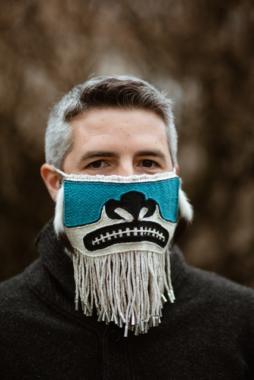
David Eckerson models Lily Hope’s “Chilkat Protector” mask. (Photo by Sydney Akagi)

Hope’s piece is called “Chilkat Protector.” It’s made from merino wool and cedar bark warp. Two ermine tails graze the cheeks. The mask covers the nose and mouth. In their place are the distinct ovoid shapes of the Chilkat face, an expression that’s confident and reassuring.

The mask isn’t something to be worn to the grocery store. It’s a work of art reflective of survival.

“When the person goes out, if they are a carrier, they are essentially protecting their whole community from being sick (by wearing a mask), and that’s foundational to the Tlingit, Haida, Tsimshian peoples. … My aunt says it best: ‘The mask serves to record that we took care of each other during this time.'”

Hope’s kids have begged her to make them one, too, but she estimates it took around 60 hours to weave the mask on a small loom. She has five kids, so that didn’t seem practical.

Hope wanted “Chilkat Protector” to show weavers were here during the pandemic and get the message across that Chilkat weaving warrants the designation of fine art and fine contemporary art.

The mask has gotten an enthusiastic response online, and Hope received a Judge’s Choice award from First American Art Magazine.

Her piece stands out: It’s one of the only COVID-19 masks woven in the Chilkat tradition — a skill which has seen a revival, but weavers like Hope are still few.

However, Hope thinks weaving hasn’t always gotten the artistic respect it deserves. It’s seen as craft, rather than a fine art.

And while she was happy her mask was recognized in the exhibition, she thinks the art world still has a ways to go until it fully accepts weaving into the fold.

“A carved mask wins over the bead work, over the quill work, over the weaving,” Hope said. “And I love First American Art for putting it into the world. But I’m like, that is the constant conversation: Men’s work is fine art and recognized as best of show, and women’s work is still hustling to catch up.”

But “Chilkat Protector” seems to be changing that.

The Burke Museum in Seattle recently acquired it, and Hope said for the first time in her career, she’s created a commission calendar for other museums which have shown interest in her weaving another COVID-19-inspired mask.

Editor’s Note: This story has been corrected to reflect the mask was woven on a small loom, not a lap loom. 

With social distancing in mind, a Juneau food cart rigs up a drive-thru

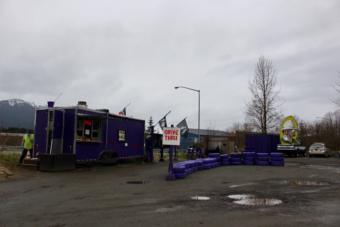
Pucker Wilson’s Mendenhall Valley location. (Photo by Elizabeth Jenkins/KTOO)

Drive-thru restaurants are a little like escalators in Juneau: There are very few of them in town.

But like the saying goes, necessity is the mother of invention. And as social distancing mandates were ordered in March, a drive-thru burger joint was born.

Stacks of purple tires lead the way to Pucker Wilson’s, where customers are now greeted by an intercom.

You can order a cheeseburger and fries from your car. Next, you’re instructed to park nearby, and an employee brings out the food wearing gloves and a protective mask. There’s also a mobile payment system.

Chad Edwards is the owner of Pucker Wilson’s. He built this setup in a little over a week around the beginning of April.

He runs two locations in town. Both establishments are small food carts, which customers normally walk up to. But with COVID-19 concerns, Edwards realized he needed to create more space between his kitchen staff and customers.

“I just kept driving past McDonald’s and seeing a line of cars around the block, and sometimes things are so obvious. It’s like the nose on your face,” he said.

That’s where he got the idea to pivot from a food cart to a bonafide drive-thru. It seems like an obvious solution, but Edwards said it hasn’t been an easy task.

Parts for the intercom system had to be ordered from Detroit. Inside, staff wear headsets and protective masks.

“We figured the best way to do it was just to jump in the frying pan. See what happens,” Edwards said. “So we opened up, and our first day we had a line of cars, and we made a few mistakes. I think we put a lot of sauce on burgers that weren’t supposed to have sauce. Little things like that. But there were no disasters. And it’s becoming a more smooth operation as the days go by.”

Edwards is in a camp with a lot of small business owners right now. It’s not enough to run the day-to-day operations. Businesses have to be nimble, whether it’s becoming a carpenter to construct a plastic barrier or learning IT skills to quickly establish a website for online ordering.

Another new thing for Edwards: He started providing paid sick leave so his employees don’t second-guess staying home.

He said these new systems he’s put into place for Pucker Wilson’s are working out pretty well, but there are some downsides.

“Now with the drive-thru, I don’t get to engage with too many people,” he said.

Edwards wants to reopen his flagship location, which is located close to downtown. Those plans are on hold at the moment.

The tiny food cart sits on a communal patch of grass, where people sit at picnic tables and gather for events during the summer — all things that seem unlikely to happen now.

Edwards misses flipping burgers and actually having face time with his customers.

“That’s what I’ve always loved about that. I just love cooking for people,” he said. “That’s a space where I can cook for people in real time, and they can look at me and we can have a conversation, and that’s great.”

For the time being, intercom conversations will have to do. He plans on the drive-thru location sticking around.


Site notifications
Update notification options
Subscribe to notifications