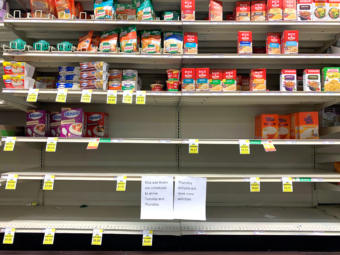
Bare shelves at Foodland IGA on March 14 in Juneau. (Photo by Rashah McChesney/KTOO)
The pandemic has highlighted some major inequities in the way people shop for groceries. For instance, it can be extremely difficult to order groceries online for curbside pickup if you’re paying with federal assistance programs.
Not all stores in Alaska are set up for that.
But one large chain has started allowing curbside pickup for individuals paying with benefits from the federal Supplemental Nutrition Assistance Program, known as SNAP.
Fred Meyer recently added SNAP as a payment option on its website. Customers can swipe their Electronic Benefits Transfer (EBT) card when they pick up groceries curbside.
Shawnda O’Brien, director of the state’s Division of Public Assistance, said the state doesn’t have oversight on the issue, but she was glad to see the change.
“From my perspective, I’m excited about that,” O’Brien said. “Kind of forcing us to utilize technology in a better way and give people more options. And so, oftentimes we’re faced with a lot of road blocks at different regulatory levels. So I think this is giving us an inside perspective of what might be coming in the future.”
However, purchasing groceries with assistance from the Women, Infants, and Children program, or WIC, still isn’t an option for online ordering and curbside pickup. And for customers who shop in person, O’Brien said there are other challenges.
She’s heard reports across the state of WIC-eligible items, such as milk and baby formula, disappearing off the shelves. She said that’s especially troubling for communities off the road system.
She thinks those items will be restocked. In the meantime, the state is working with federal agencies to eventually allow substitutions.
The Ketchikan headquarters of Alcan Forest Products and Alaska Forest Association. (Photo by Elizabeth Jenkins/Alaska’s Energy Desk)
The timber industry and the fishing industry have something in common. They’re both trying to figure out how to safely transport seasonal workers to Alaska during the pandemic.
Eric Nichols, the head of Alcan Forest Products, has a lot of errands to run to stock a pantry for a remote logging camp in Edna Bay. On the top of his grocery shopping list: potato chips.
Nichols says he wasn’t sure he’d be able run the logging camp this year. President’s Donald Trump’s ongoing trade war with China has been a big setback for his business.
But he decided to give this season a go. Now, the coronavirus is compounding an already challenging endeavor. Nichols needs to transport at least three skilled workers up from the Lower 48.
“Ideally, I would like to be able to go to the local hospital,” Nichols said. “I would like to to be able to have them test somebody and tell me ‘yes’ or ‘no’ fairly quickly.”
Ketchikan doesn’t have drive-through COVID-19 testing, like other parts of the state, and the hospital and a clinic are only testing people who are symptomatic.
So, for workers arriving to Ketchikan from Washington or Idaho, Alcan Forest Products has limited options. The company can take workers’ temperatures before putting them on a chartered plane to camp. But once they arrive, there’s no such thing as social distancing. The crew sleeps on boats close to the shore. They eat communal meals from a galley-style kitchen.
Nichols says he knows other industries — like fishing and oil — are looking for more clarity on this issue, too.
“I’m not sure how people [are] going to do it,” Nichols said. “I’m reaching out trying to understand if there are guidelines for this? What do we need to do? How do we need to ensure that we don’t infect some of our own people? I don’t want to end up like Conoco where they shut the whole thing down.”
Earlier this month, ConocoPhillips shut down its oil rigs on the North Slope in order to protect its employees.
Tessa Axelson is also trying to figure out how to keep timber workers safe. The executive director of the Alaska Forest Association says the timber industry has a lot of questions right now about how to best operate during the pandemic.
She’s reached out to various agencies to see about a better COVID-19 testing strategy.
“This is all new to everyone. It needs to be implemented yesterday,” Axelson said. “And it needs to happen on top of additional safety procedures and requirements for ensuring the safety of workforce.”
She’s also fielding questions from the timber industry about how to apply for federal funding from the CARES Act. The industry employs about 300 people in the region. Axelson calls it a network of “small businesses.”
“What does the potential economic fallout from COVID mean for those businesses? And how do we provide resources and information about their eligibility in the process of applying,” Axelson said.
Eric Nichols, at Alcan Forest Products, doesn’t plan on applying for federal relief. He thinks it could be too complicated for his specific operation.
He says he’s taking the double whammy of financial and health concerns one step at a time.
“It’s very dicey out there,” Nichols said. “I don’t know what’s going to happen here after this year. I don’t know what’s going to happen after July or August here. Like I said, we see a little bit of a window right now, and that’s what we’re trying to produce for.”