Clarissa Rizals’ heirs registered the design for this robe with the U.S. Copyright Office in 2019 and exclusively licensed it to Sealaska Heritage Institute. SHI filed a lawsuit against Nieman Marcus on April 20, 2020. (Sealaska Heritage Institute)
Sealaska Heritage Institute has filed a federal lawsuit against the high-end fashion retailer Neiman Marcus, alleging the company copied a traditional Ravenstail pattern when it produced a coat that retails for more than $2,500.
In a press release, Sealaska Heritage’s president Rosita Worl called it “one of the most blatant examples of cultural appropriation and copyright infringement” she’d ever seen.
This case is thought to be the first time a business has been sued in the U.S. for copying a traditional indigenous pattern.
The lawsuit alleges Neiman Marcus violated the Indian Arts and Craft Act, which ensures products marketed as Native American or Native Alaskan are authentic.
Neiman Marcus referred to the garment on its website as a “ravenstail knitted coat.”
The lawsuit also alleges the fashion company violated copyright laws. The coat looks similar to a robe protected by copyright and created by the late master weaver, Clarissa Rizal.
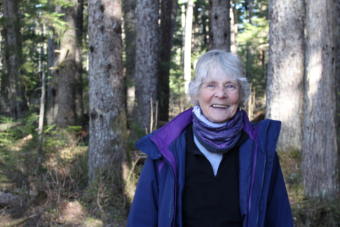
Linda Kruger’s forest therapy walks can last up to three hours. She says participants are always surprised to see something new along the trail. (Photo by Elizabeth Jenkins/Alaska’s Energy Desk)
In Juneau, one forest guide started leading therapeutic walks before the coronavirus hit. She says there are lessons the forest can teach us during a pandemic.

Linda Kruger leads me down a popular hiking trail in Juneau, where there are patches of ice sticking to the ground. We are standing about 6 feet apart, but recommendations have since been expanded to a 20-foot clearance on hiking trails.
Kruger has led dozens of people on walks like this since receiving her certification as a forest therapy guide last spring. Kruger is not a therapist, but she says there is one hanging around.
“The forest and nature are the therapist, and I will help guide us in having an experience,” Kruger said.
To have this experience, you don’t need to be in an altered state or believe in any particular doctrine or ideology. You just have to be fully in the moment — out here with a tangle of blueberry bushes and a thick canopy of hemlock trees and spruce.
There’s science to back this up. Outdoor mindfulness can lead to lower blood pressure and less stress hormones, among other benefits. In Japan there are even dedicated trails for spending therapeutic time outside. It’s part of the national public health system.
The Japanese expression for this translates to “forest bathing.” But it’s a practice you can do fully clothed, bundled up in a jacket, gloves and a hat.
Forest bathing is different than taking a jog outside or walking your dog. Kruger is about to lead me on a series of what she calls “invitations.” She says these exercises could be adapted for just about anywhere, even looking out a window. You just need a space that’s green. She thinks this could be especially helpful for people right now experiencing fear or dread because of the pandemic.
She points to a spot where a beam of sunlight is streaming through the trees.
“For the next 10 minutes, we’re going to experience this place using all of our senses,” Kruger explains. She instructs me to stand on an even surface and, if I’m comfortable, close my eyes.
“Breathe in,” Kruger said. “And notice your body, and notice how it feels to be present in your body here in this place.”
As instructed, I take in the smell of the damp earth, feel the pebbles beneath the soles of my feet and listen to the birds chirping.
“Listen for sounds that are interacting with each other,” Kruger said. “And then add your own sound! Breathe deeply or just make a sound yourself, so that you’re adding to the symphony around you.”
The Rainforest Trail in Juneau. (Photo by Elizabeth Jenkins/Alaska’s Energy Desk)
Kruger spent 28 years with the U.S. Forest Service. She was a social scientist, researching the effects of climate change on communities.
She says that was a formative experience. She saw how important an intact environment is for both physical and mental health. She became a forest therapy guide after she retired. So far, she’s been doing it on a voluntary basis.
“As a researcher, it makes sense to me, and what a wonderful way — especially in Alaska, where we have nature out our doorstep,” she said.
In March, Kruger sheltered in place after traveling back to Juneau from Texas and Seattle, where she was running a half-marathon. April will be the first month in seven years she hasn’t competed in one. Though she’s still planning on running the distance with her partner.
She says the coronavirus has taken a toll on her routine. Being outside provides some reprieve.
“But it’s been really challenging because I’m missing my friends, and I’m missing all the regular activities that I usually do,” Kruger said.
The second invitation in Kruger’s forest therapy session is to walk slow — like, really slow. The pace of a slug moving on the ground.
She acknowledges this part can be challenging for people who are used to moving faster.
“But you miss so much when you go fast, like right now,” Kruger said. “I’m seeing the moss, and I’m seeing the branches moving a little bit. If you’re walking fast, you miss those things.”
We don’t know when hunkering down orders will be lifted in Alaska, when things can go back to normal and people can return to school and work.
It feels weirdly chaotic, but also still. Kruger believes nature is like that, too.
Further down the trail, there’s a mess of giant trees which have fallen to the ground. A windstorm upended them. You can see the trees’ roots systems — the size of an overturned SUV.
Kruger says there’s a message there for our collective uncertainty. The forest has been through a lot.
“And it perseveres,” she said. “It’s a very resilient place, and so we can think about (that) and kind of absorb that resilience from nature … into us.”
So next time you’re outside, Kruger suggests:
Spend about 10 minutes sensing the outdoors. Close your eyes, if that feels comfortable, and take a moment to pause and tune into smells, sounds and felt sensations.
Open your eyes and take a moment to see what looks different than before. Then, begin a very slow walk, noticing what’s around you.
Find a spot, like a tree stump, to sit in contemplative thought. Kruger recommends about 20 minutes.
Express gratitude. Kruger likes to end her sessions with sipping locally foraged tea and pouring a little out on the ground to show thanks.
Additional resources:If you or someone you know needs help, call Careline at 1-877-266-HELP (1-877-266-4357), a 24/7 Alaska resource that can provide support, information and local resources.
The Ketchikan headquarters of Alcan Forest Products and Alaska Forest Association. (Photo by Elizabeth Jenkins/Alaska’s Energy Desk)
In reaction to the pandemic’s disruption of the global timber market, the U.S. Forest Service is allowing extensions on existing timber sale contracts with sawmills and timber operators.
Typically, Forest Service contracts expire after three to five years. But this change gives businesses a way to request up to a two-year extension on certain contracts so they can navigate the difficult times.
Alaska businesses are getting an extra year on top of that because of another setback: The ongoing trade war with China.
Much of Southeast Alaska’s timber is exported to China, and operators had expressed concern about the future of their business under the steep retaliation tariffs.
In a press release, U.S. Sen. Lisa Murkowski, R-Alaska, said that the pandemic is threatening timber jobs and could “potentially bankrupt mills.” She added that the state’s timber operators have suffered under the “draconian 20-percent Chinese” tariffs.
As uncertainty about the COVID-19 virus continues to mount, tribal governments and remote communities across the state are concerned about disruptions in the food supply chain.
That’s led to numerous requests for emergency hunts, which are now piling up for federal and state agencies.
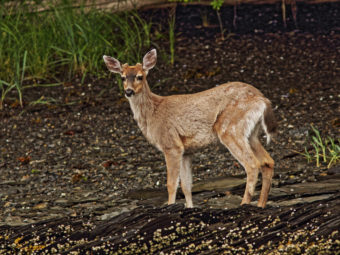
Last week, Tribal President Joel Jackson made a request on behalf of the Organized Village of Kake for an emergency use permit to hunt deer and moose out of season. The Southeast Alaska village hasn’t made a request like that before.
But as the pandemic plays out, Jackson said grocery store shelves have looked different.
“Pretty empty, and also their dairy products didn’t make it,” he said.
Kake isn’t on a road system. So when an Alaska Marine Lines barge arrived without some of its normal shipments, like meat, Jackson was alarmed.
It can take up to a week for a barge to arrive from Seattle. This system felt fragile before the COVID-19 virus struck.
“You know, if this thing gets any worse and we really get in a bind, then we’re going to be hurting here for a while,” Jackson said.
But Kake has an abundance of wild, local foods at its doorstep: the Tongass National Forest.
The village is requesting emergency access to it, and the community isn’t alone.
Chris McKee, a Wildlife Division supervisor at the federal Office of Subsistence Management, said so far the branch has received six special action requests across the state on federal land — from a mixture of tribal entities, communities and individuals. And McKee anticipates they’ll probably receive more.
His office has handled these types of requests before, like when a storm occurs and a shipment of food is delayed.
But the coronavirus is a different kind of storm, affecting everywhere in Alaska all at once.
“They’re in a unique situation, and the program is in a unique situation of having to respond to — not only how quickly folks want us to take action, but also just the sheer number of requests,” McKee said.
McKee said he understands there’s a lot of anxiety right now.
But the Office of Subsistence Management still has to follow federal regulations. He said they’re working hard to speed up the process so they can quickly grant special actions, if necessary.
“We don’t want to have communities like Kake, and the other folks that we’ve been getting these requests from, to have to sit around for weeks on end to find out to get a decision made,” McKee said. “We’re trying to be as timely as we can. But at this point, I can’t give a specific answer about when that’s going to be.”
This can be a complicated issue for another reason.
The federal subsistence board approves special actions on federal lands, like emergency hunts. And the state of Alaska has its own process for state lands.
Ryan Scott with the Alaska Department of Fish and Game said they’ve also received requests from across Alaska. But as long as communities are still receiving shipments of food, and hunting seasons like bear and waterfowl remain open, they’re proceeding carefully. Spring is a time when animals give birth — that’s why deer hunting isn’t open right now.
“I think it’s really easy to say, ‘Open a season and go harvest animals for food,’ and recognize the importance of that and the availability of that. However, we need to consider the biological implications of that as well,” Scott said.
In an emailed statement, the barge company Alaska Marine Lines said “there shouldn’t be any concerns over the food supply chain from the barge perspective” during the pandemic.
But Jackson said for village Elders and families, the situation is about more than food scarcity.
“Right now, the meat we’re getting is processed,” Jackson said. “And that’s not nearly as good our wild resources we have around here, like moose and deer.”
Jackson said people should have access to their traditional foods for optimal health.
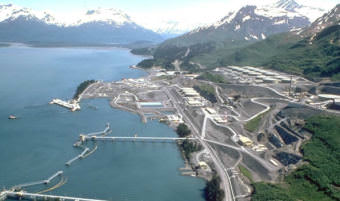
The Valdez Marine Terminal. (Photo courtesy U.S. Department of Interior)
Updated story, April 14, 2020 — Lex Treinen, Alaska Public Media
Thousands of gallons of oily water have been recovered from the harbor at the end of the trans-Alaska pipeline, but officials with the Department of Environmental Conservation say that the spill is contained.
On Sunday evening, crews reported an oil sheen on the water near the Valdez Marine Terminal’s small boat harbor. Personnel working for Alyeska Pipeline Service Company, which operates the pipeline, reported the spill just after 8 p.m. on Sunday. On Monday evening Alyeska set up an incident management team.
A spokesperson for Alyeska said that the decision to set up an incident management was made after seeing the seriousness of the spill. As of 6 a.m. on Tuesday, the team had recovered 326 barrels, or about 13,000 gallons, of oily water from a 30-foot by 30-foot contained area that was being monitored by fishing vessels and aircraft.
An initial report by Alaska’s Department of Environmental Conservation suggested the spill was coming from a sump that had overflowed. The department said that the trans-Alaska pipeline itself was operating as normal.
Original story, April 13, 2020 — Elizabeth Jenkins, Alaska’s Energy Desk
Alaska’s Department of Environmental Conservation is responding to an oil spill at the Marine Terminal in Valdez — at the end of the trans-Alaska pipeline.
On Sunday, equipment owned by Alyeska Pipeline Service Company malfunctioned and a mixture of North Slope Crude and water spilled under the snow. That mixture traveled over land and into the water in one of the tanker berths.
The amount of oil that was released is unknown at this time, but crews under contract with Alyeska have corralled a 30-foot by 30-foot area of oily water and are attempting a clean up.
The is a developing story. Please check back for updates.
Close
Update notification options
Subscribe to notifications
Subscribe
Get notifications about news related to the topics you care about. You can unsubscribe anytime.