In this newscast:
- An employee of the North Slope tests positive for COVID-19
- How is a Ketchikan hospital readying itself for the pandemic?
- Bear hunting season isn’t open yet. But across Alaska, children are hunting … teddy bears
In this newscast:
In this newscast:
In this news cast:

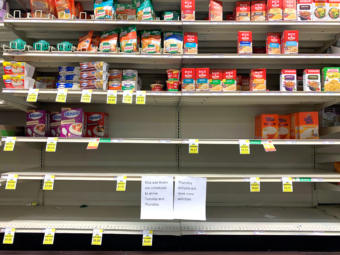
Now that people are hunkered down because of COVID-19, more customers are buying groceries online and picking them up curbside or having them delivered — outside their local store.
But for those paying with federal assistance, the options for shopping this way are inconsistent.
Nicole Church said grocery shopping with two rambunctious 5-year-old twin boys was a challenge before the coronavirus.
“That’s under normal circumstances,” Church said. “And under these circumstances it’s even more stressful. They’re always touching things and putting their mouths on counters. I’ve decided that’s not going to happen when we’re hunkering down.”
Running low on milk and other groceries, Church decided to use Instacart to order her groceries online and have them delivered from Juneau’s Costco.
But when she tried to check out, she realized she couldn’t use her Electronic Benefits Transfer card, or EBT card, on Instacart’s payment page.
On its website, Instacart says it accepts debit and credit cards, along with Google Pay and Apple Pay. But you can’t pay with federal assistance programs like Supplemental Nutrition Assistance Program (SNAP) or Women, Infants, and Children (WIC).
That’s left Church wondering what her options are for grocery shopping safely during the pandemic. She’s a single parent — she said finding someone to watch her children can be difficult.
“We can’t be left in the dust just because it’s a challenge to put that system in place,” Church said.
Right now, there’s not a consistent framework for people paying for online orders with federal assistance, and grocery stores are individually responsible for figuring it out.
Other big-box stores in Juneau, like Fred Meyer, can’t accept online orders purchased with federal assistance either.
Vanessa Cropley, a manager at Foodland IGA, thinks maybe the websites aren’t set up to process those kinds of payments.
Foodland doesn’t even have an online ordering system. Cropley and her husband are fulfilling orders for curbside pickup the old-school way: They’re communicating with customers directly by checking emails and having conversations over the phone.
They’re basically being personal shoppers for their customers. So far, they haven’t done the shopping for anyone paying with federal assistance programs yet. But she welcomes it.
“We’re all going to figure this out together,” Cropley said. “There’s no way we can’t figure this out with one another.”
https://www.facebook.com/Dolly.Delez/posts/1293617994181766
The Super Bear Supermarket IGA store in Juneau can take online payments with SNAP benefits. But grocery stores can’t process WIC assistance for curbside or delivery orders because of federal banking laws.
As for Church, she says a friend recently picked up her groceries. But she hopes a wider array of stores implement a way for people on federal assistance to get their shopping done while practicing social distancing.
This story has been updated.

With COVID-19 concerns, hand sanitizer has been flying off the shelves in grocery stores across the U.S and in Alaska. Nationally, it’s spurred a kind of movement.
Breweries and distilleries have been quick to respond — creating their own sanitizer out of a byproduct of their booze making process.
Now, one Juneau distillery has gone from serving cocktails to serving its community in a different way.
Brandon Howard makes gin and whiskey at Amalga Distillery. The alcohol is infused with wild botanicals from the rainforest: Labrador tea and juniper berries.
Howard remembers not too long ago people were lining up outside for a special release of rhubarb gin.
“The line started a couple of hours before we even opened, and it wrapped around the block,” Howard said. “And there were hundreds of people, and I can tell you that right now, hand sanitizer is a lot hotter of an item than rhubarb gin.”
It’s also hard to find small pump bottles for the hand sanitizer. So Howard is putting some of it in cans he normally uses for pre-made gin cocktails.
“We’ve been calling it hand canitizer,” Howard said. “Kind of a horrible pun.”
Just a few weeks ago, this scenario would have seemed unthinkable. But the COVID-19 virus is changing the definition of what normal looks like in Alaska and across the world.
Amalga’s hand sanitizer is made from a waste product that comes from distilling gin, a cloudy substance that’s super high in alcohol content — not something you’d want to splash into a drink.
Howard said for distilleries, sanitizing with ethanol isn’t that strange. It’s something they’ve been using to clean surfaces in their business all along.
“I can say with great certainty that the moment there was a rush on hand sanitizer, the moment it became a material that people in need weren’t having access to, distillers knew they had the raw materials to make this product,” Howard said.
But Howard said Amalga Distillery didn’t have everything they needed to make the 70% alcohol-by-volume hand sanitizer, similar to a recipe recommended by the Centers for Disease Control and Prevention.
You need a gel-like substance so it actually sticks to the hands. DIY hand sanitizer recipes are making aloe and glycerin harder to find in bulk. So Howard reached out to another Juneau business, Barnacle Foods, for xanthan gum, which they use to thicken their hot sauce.
Washing your hands with warm, soapy water for at least 20 seconds is still the most effective way to kill the virus. However, using hand sanitizer is a recommended alternative in a pinch.
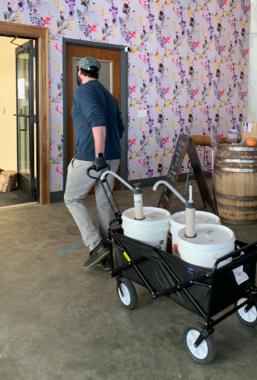
In the last few weeks, Howard has produced 30 gallons of hand sanitizer, but he said it’s not something he’s looking to sell.
“It wouldn’t be a good example to capitalize on the situation,” Howard said. “It’s not the time for it.”
Instead, Amalga Distillery is focusing their efforts on donating its hand sanitizer. The Southeast Alaska Food Bank was one of the recent recipients.
“What’s nice is he gave us not only the cans, but he also gave us a five-gallon jug with a pump on it,” said Chris Schapp, the manager of the food bank.
Schapp said food donations have dropped significantly with the COVID-19 scare. The organization still has plenty of hand sanitizer. But he said it’s nice to have an extra supply in times of uncertainty.
The food bank is sharing it with its partners in need, like a local domestic violence shelter.
“A couple of our agencies have already come out and refilled their empty bottles with that,” Schapp said.
Amalga Distillery would like to eventually distribute the hand sanitizer to individuals in Juneau.
But it’s complicated. Gatherings of 10 or more are canceled nationally, per guidelines set by the CDC. Howard doesn’t want a repeat of people crowding, like with the rhubarb gin. He said he wants his community to be safe.
He’s still working out how to offer the hand sanitizer responsibly and equitably.
“We’re creative. We’ve gotten through a lot,” Howard said. “We’ve solved a lot of problems. It’s one that we’ll figure out.”
At this point, being flexible is pretty much encoded onto the business’s DNA. Around the time Amalga Distillery first opened, it faced regulatory hurdles from the state’s alcohol control board.
However, the COVID-19 virus presents a new set of challenges.
In this newscast: