Elizabeth Jenkins, Alaska's Energy Desk - Juneau

One Juneau shop owner is scaling back a dream because of COVID-19

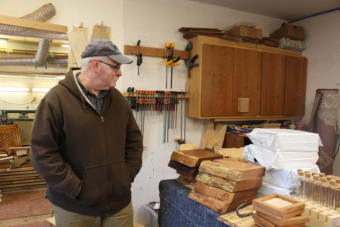
Dean Graber opened a second downtown location last summer. This summer, he was considering a year-round lease in a building but had to forego those plans. (Photo by Elizabeth Jenkins/KTOO)

The COVID-19 virus is drastically altering the social landscape we live in, and it’s also forcing Alaskans to reconsider their plans for the future.

Juneau typically sees more than a million cruise ship passengers a year. But with cancellations and travel restrictions stretching well into the summer, those numbers are now out of reach.

One business — now one of many — is making the tough decision to scale back their dream.

Entering Dean Graber’s wood shop, you’d think he’s moving in or moving out. There are boxes everywhere. An unplugged point of sale system shares a table with handmade sushi boards and wooden clocks.

“Cheese boards. I have a couple hundred of those right now,” Graber said. “I’ll probably need more.” He catches himself, adding, “I would have needed more.”

In anticipation of the summer, Graber created the cutting boards for his business, Rainforest Custom. Some of them are stacked around this workspace, not even oiled yet.

He mostly makes his wood pieces for custom orders. But he said his family had big dreams for a downtown retail space this summer, and it was guaranteed to get a lot of foot traffic from cruise ship passengers.

“I wanted it to be a place that people remembered when they came back to Juneau,” Graber said. “I wanted it to be a place the people of Juneau would like to come.”

Graber was planning on opening this second space year-round. He’d taken out a loan to help support the business.

He was about to sign a lease on a new building. Then, news of the COVID-19 virus struck.

“This last two weeks, my wife and I have gone back and forth, crunching numbers, looking at spreadsheets, cash flow,” Graber said. “And looking at the news and daily, it was just, ‘Yes let’s do it. No let’s not. Yes let’s do it.'”

Dean Graber had been working for many months on the items he’d sell at his downtown location. (Photo by Elizabeth Jenkins/KTOO)

Last week, several cruise lines that come to Juneau announced a suspension of cruises until May. Just days before that, Graber and his wife decided not to sign the lease. Fallout has continued to escalate for the visitor industry. Southeast Alaska likely likely won’t see a cruise ship until well into the summer — if that.

On Wednesday, a coronavirus relief package passed a major hurdle in Congress. It could provide paid sick leave, enhanced unemployment benefits and free coronavirus testing.

And billions more dollars could be on the way to help small businesses. But if that relief comes in the form of secured loans, Graber said that won’t be of much help.

“I don’t need a zero or no-interest loan, because I’ve already got debt to pay,” Graber said. “I don’t need any more debt. I don’t want any more debt.”

In an attempt to recover, Graber is selling some of the inventory of wood items flooding his shop for half off. He’ll still make custom pieces.

But it’s not just his business plans that are changing rapidly. He wonders what the future will look like for his family, with schools closed and retirement facilities on lockdown.

“I hope my son graduates — is able to graduate, otherwise. I hope my mother makes it OK. My daughter is coming from college in New York City. She’s being sent home,” he said.

As news of the pandemic unfolds, Graber said he’s taking it one day at a time. He hopes the United States pulls through quickly. He thinks it will. He says people are resilient.


As COVID-19 scare looms, small businesses in Juneau brace for tough times

xx
Amagla Distillery in downtown Juneau. (Photo by Elizabeth Jenkins/KTOO)

Small businesses across the state are having to adapt to a rapidly changing environment, as people stay in more because of the COVID-19 virus.

In Juneau, the situation looks much different than it did a week ago, and some businesses are trying to prepare for more uncertainty to come.

At Amalga Distillery, groups of people came and went throughout the weekend. But by late afternoon on Sunday, there were only a few people sipping gin cocktails. One of the patrons joked they should buy a round for the house.

Maura Selenak co-owns the business with her husband, and they’re trying to adapt to this new reality.

“We opened the doors today, and the first three customers were here to grab cans and head out on their way,” Selenak said.

Selenak said she appreciates that. She even created an Instagram post with a recipe so customers could make the herbaceous cocktails at home.

Keeping her staff working during this challenging time is a huge priority, and she wants everyone to be safe.

Like a lot of bars and restaurants over the weekend, Amalga Distillery removed some chairs to allow patrons to spread out. As of Monday evening, three people in Alaska had tested positive for the COVID-19 virus, but other test kits are still being determined.

https://www.instagram.com/p/B9sOqW8JuGw/?utm_source=ig_web_copy_link

Selenak said Amalga’s business model could change again in the weeks to come.

“So things that we’ve been preparing for are a tasting room closure, having a system of being able to come in by reservation only — just to really limit how many people are in here at one time,” Selenak said.

Across the country, doing business like this is starting to become the new norm, and measures to limit exposure to the virus in public spaces are happening in Alaska, too.

On Monday, Anchorage’s mayor issued an emergency order prohibiting dining out in restaurants and drinking at bars and breweries, which will remain in effect until around March 31.

Juneau’s city manager, Rorie Watt, said that’s not something the city is currently considering.

But one restaurant in Juneau is already taking the added precaution.

“I want everybody (to) enjoy the food and not get scared staying in my shop,” said Mae Wu, the owner of Lemon Tree Cafe. She decided to close her business for the next two weeks to see how things go with the number of people contracting the illness.

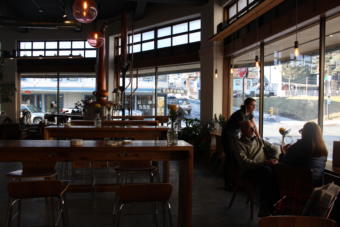
Mae Wu points to two of her favorite dishes at Lemon Tree Cafe in downtown Juneau on Dec. 3, 2019. (Photo by Scott Burton/KTOO)

Wu’s parents do the cooking at the Vietnamese/Chinese restaurant, and they’re in the age demographic the Centers for Disease Control and Prevention said is at a high risk of getting very sick.

Wu said they don’t have health insurance.

“I think I’m a little bit ahead of worrying,” Wu said. “But I’m a mom. I’m a daughter. I’m a business owner. I want everybody around me surrounded by my love.”

Wu said she’s aware of the xenophobia and racism other Asian restaurants have experienced across the country related to COVID-19.

But Wu doesn’t think that’s why her sales dipped in Juneau.

Her decision to temporarily close was based on concerns for her parents. She said many small businesses, especially those who can’t afford to insure employees, might have to make similar considerations.

Wu hopes the leaders in charge make both health and hardship a priority.

“I hope (the) government have enough resources for medical treatments and also help to protect those small businesses,” Wu said.

Lawmakers in Washington, D.C., are currently working on a coronavirus relief package, and there are talks of another stimulus package which could include small business grants and loans and expanded unemployment insurance.

Wu said she’s reached out to her landlord at Lemon Tree to see what options will be available for postponing the rent.

This story has been updated.


Gold Medal Basketball Tournament canceled for first time in more than 70 years

Gold Medal 2016
Gold Medal in 2016 at the Juneau-Douglas High School gymnasium. (Photo by Elizabeth Jenkins/KTOO)

The Gold Medal Basketball Tournament was canceled on Friday, Mar. 13, due to ongoing concerns over the COVID-19 virus. 
Every year, hundreds of people flock to Juneau from neighboring villages and communities to attend. This would have been the 74th year players gathered from across Southeast Alaska to compete, and it’s the first time this event has been canceled. 

Edward Hotch, the President of the Lions Club, says the games are an especially popular sport for elders, who travel annually to cheer for their favorite teams. 

According to the Centers for Disease Control and Prevention, older adults and people with chronic medical conditions are at a higher risk of getting very sick from coronavirus.

Hotch says that factored in to the decision to cancel the tournament. 

“It’s kind of a sad feeling because you were getting ready to see people you haven’t seen since last year,” Hotch said.

Gold Medal is a fundraiser for the Lions Club, which donates ticket sales to scholarships, local nonprofits and high school sports teams. 

Hotch says the event has sold about 100 tickets so far. The Lions Club is still discussing how to refund the tickets. 


USDA opens investigation into why Forest Service grant was given to Alaska to work on Roadless Rule

Tongass National Forest
Part of the Tongass National Forest on Douglas Island pictured in 2004. (Creative Commons photo by Henry Hartley)

The federal Office of the Inspector General is opening an investigation into how the U.S. Forest Service granted millions of dollars to the State of Alaska to work on a Roadless Rule decision in the Tongass National Forest.

In November, two Democractic members of Congress requested the investigation after Alaska’s Energy Desk obtained documents showing the state used some of the money to pay a timber industry group for additional industry perspective.

Sen. Debbie Stabenow of Michigan and Rep. Raúl Grijalva of Arizona questioned if the funds were misused. The money came from a modified federal grant typically used to prevent wildfires.

The state spent the money in a variety of ways, but it drew criticism from tribal governments and environmental groups for offering some of the funds to the Alaska Forest Association — at a time when a major decision is being made that could impact logging in the nation’s largest national forest.

Governor Mike Dunleavy has sharply denied any misuse of funds.

Corri Feige, Alaska Department of Resources Commissioner, reiterated that in a statement, which also says the state hasn’t received notification of the investigation yet, but will work cooperatively with the inspector, trusting that the inquiry is fair. 

The Office of Inspector General will determine if the Forest Service had the proper authority to award the $2 million grant to the state and confirm whether other stakeholders knew about it or not.

Editor’s note: This story has been updated.

The Mendenhall Glacier area could look different. Now’s the chance to weigh in.

Photo by Elizabeth Jenkins/Alaska's Energy desk
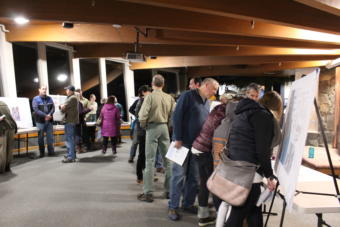
At an open house, people look at renderings of what the new Mendenhall Glacier Visitor Center could look like. (Photo by Elizabeth Jenkins/Alaska’s Energy Desk)

The Mendenhall Glacier Visitor Center in Juneau is getting closer to being updated. The 1960s building could be expanded, and the national forest lands around it could be used differently to address more tourists and a shrinking glacier.

Around 500,000 people visit the glacier annually in the summer. But, in 30 years or so, visitors might not be able to see the Mendenhall Glacier from the visitor center at all.

The U.S. Forest Service is preparing for that reality. The agency held an open house Thursday, Feb. 20, to discuss the new plans, which have been in the works for a number of years.

Most notably, the plans include docks for motorized boats that would carry people across the lake to the glacier’s face, where a remote visitor center would be built.

Brad Orr, the Forest Service district ranger for Juneau, says people want to get close to the ice.

“People want to be able to actually go to the glacier itself,” Orr said. “Not just to come here and look at the glacier from a distance. But actually go to the glacier.”

In May, John Neary, the Mendenhall Glacier Visitor Center’s director, retired. Neary was a proponent of electric boats instead of diesel-powered vessels. The plans don’t yet specify what type of craft could be on the water. Orr says that could be decided later.

Laurie Craig, a retired Forest Service employee, isn’t sure about the proposals in the plan. She’d like to see a more thorough risk and environmental assessment before public comments are finalized.

She worries about people getting too close to a receding glacier.

“The idea of chasing the ice by going over to that little corner, I hate to say it, but I think we’ve lost that battle. And what we have now is a big pile of gravel with some ice that could be kind of dangerous, and I don’t know that we want to get people that close to it,” Craig said.

The public comment period for the plans closes March 19. A final decision is expected to be made by September of this year.


Site notifications
Update notification options
Subscribe to notifications