Elizabeth Jenkins, Alaska's Energy Desk - Juneau
‘Much of Alaska’s history is not here anymore’: The National Archives are moving again, this time even farther away

Steven Henrikson has worked at the state museum since 1988. (Photo by Elizabeth Jenkins/KTOO)
Steve Henrikson has worked at the Alaska State Museum in Juneau since 1988. (Photo by Elizabeth Jenkins/KTOO)

The National Archives and Records Administration facility in Seattle is slated to close.

It warehouses federal documents obtained from states across the Northwest, and it’s especially important for the youngest one in the bunch: Alaska, since many landmark decisions were made just a half-century ago. So much of our recent history is from the state’s federal territory days.

At the Alaska State Library, Archives and Museum in Juneau, staff have already been making do with an incomplete history.

Examining microfilm can be a tedious task. But Steve Henrikson doesn’t see it that way. For him, it’s like being on a quest.

“I really enjoy the process of doing research. I like it a lot better than writing up the findings, to tell you the truth,” he said with a chuckle.

The building where he works in Juneau contains newspapers and trade magazines, but not the federal documents he’s often looking for: documents that help him create descriptions of the museum’s exhibits and dig up colorful facts.

One time, he found the report card of a famous Alaska artist. For a historian, that’s like hitting the jackpot.

“I hope that none of my report cards from my early career have ended up in the National Archives,” Henrikson said. “But I guess that’s what they say when something is going on your permanent record.”

Henrikson said it was fairly easy to get to the National Archives when a branch was located in Anchorage. But in 2014, despite public outcry, the U.S. Office of Management and Budget decided to move almost everything in Alaska to Seattle.

“It was disappointing. But it was still manageable,” Henrikson said.

Now, the National Archives could move again. The date hasn’t been set, but the building in Seattle was deemed a high-value property by a federal committee that recommended selling it.

This time, the collection could be sent to California and Missouri. Henrikson thinks that’s separating Alaskans even farther from their story.

“Much of Alaska’s history is not here anymore,” he said.

Karen Gray, the state archivist, agrees.

“We’re a pretty new state. We need those federal records,” Gray said.

After the close of the Anchorage branch of the National Archives, 5,000 boxes of territorial court records were transferred to the state. But Gray said many noteworthy items, such as records from the Bureau of Indian Affairs and the Bureau of Land Management, aren’t here.

She said that’s a problem, because some federal policies in the state are still being discussed.

“Uh, let’s see,” Gray said, examining a sheet of paper. “Correspondence relating to the Arctic National Wildlife Refuge. That’s still very important to today.”

So are documents that detail the creation of national forests in Alaska, and case files from the Alaska Native Claims Settlement Act.

Gray seemed a little exhausted as she ran down the list.

“I did make a frustrated shrug,” Gray said. “You hope that when our historical records move, there’s some way to access them. And it seems so easy to say, ‘Oh, digitize it and put it online.’ But it’s not that easy.”

Gray said this latest announcement — that the National Archives would be moving — caught her off guard. She found out just weeks before a final decision was made.

And many elected officials are also wondering why the federal government decided to proceed with no public input. U.S. Sens. Lisa Murkowski and Dan Sullivan signed a bipartisan letter questioning why more stakeholders weren’t in the loop.

Richard Peterson wonders that, too. He’s the president of the Central Council of the Tlingit and Haida Indian Tribes of Alaska, and he’s concerned about what could be lost.

“There are historical documents. Things where the government has made significant promises that we want memorialized,” Peterson said. “That when we need to hold them accountable, that we have access to.”

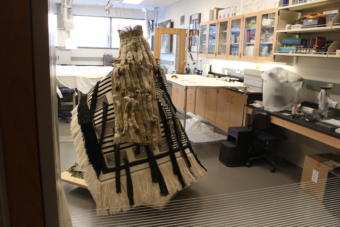
A contemporary robe to be exhibited at the Alaska State Museum in the summer. (Photo by Elizabeth Jenkins/KTOO)

Back at the museum, Henrikson unlocked a door leading to a large, well-ventilated space where most of the museum’s collection is kept. There’s one particular spot where Henrikson has been spending a lot of time.

“This is just a really large cabinet that has these wide, flat drawers that have our collection of ceremonial robes,” Henrikson said.

Henrikson would like to know more about the weavers who created these robes, woven in the Chilkat and Ravenstail tradition. He’s helping curate a new exhibit to be displayed in the summer.

“We’re hoping that our show will inspire young people to take it up,” Henrikson said.

Some of the details, like photographs and names, were documented by the Indian Arts and Crafts Board, a federal program created in the 1930s.

But Henrikson hasn’t been able to make it to Seattle to do the research. If the National Archives move even farther away from Alaska, he said those types of trips will go from being infrequent to becoming nearly impossible.

Donald Trump Jr. is headed to Juneau for a hunting trip — and you could join him

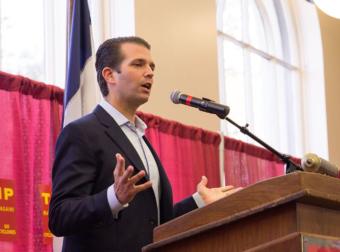
Donald Trump Jr. speaks into a microphone at a podium.
Donald Trump Jr. at a campaign rally at Iowa State University, Nov. 1, 2016. (Creative Commons photo by Max Goldberg)

Donald Trump Jr. and his son will be embarking on a weeklong hunt for Sitka black-tailed deer and ducks in Southeast Alaska — and a spot to join them was auctioned off to the highest bidder.

For one Juneau-based guide, it’s a way to teach his guests about the importance of the Tongass National Forest at a crucial time.

Keegan McCarthy owns Coastal Alaska Adventures, a business that guides visitors on yacht-based hunts.

He’s also developing a new program that will help kids learn the subsistence values he grew up with. A big part of that revolves around Sitka black-tailed deer.

“That’s what my family subsided on,” he said. “Growing up in Juneau, all we ate was Sitka black-tailed deer, and still do to this day. That’s what my family eats. So (I am) sharing that message and the importance of that resource with the young hunters.”

McCarthy is well-connected in the guided hunt scene. In fact, he spoke on a cell phone where he was attending the Safari Club International convention in Reno, Nevada.

McCarthy auctioned off the Alaska hunt there and online. It’ll help fund his new youth program.

And he tapped a famous acquaintance to come along: Donald Trump Jr.

A Sitka black tailed deer in June 2014.
A Sitka black-tailed deer. (Creative Commons photo by Kenneth Cole Schneider)

“As a hunter, I do personally believe that his morals and ethics are excellent in the hunting world,” McCarthy said.

Trump has been criticized by the Humane Society for his hunting practices. Photos of him posing next to a dead elephant in 2012 caused a stir among animal rights groups.

But McCarthy stresses Trump is conservation-minded. And the deer on this hunt aren’t being shot for just trophies. The meat will be served on board the yacht, taken home or donated.

“You know, like farm to table type concepts,” McCarthy said. “We stress the importance of how we eat what we harvest.”

But McCarthy has another thing he wants to teach Donald Trump Jr. and his guests about a subsistence lifestyle in Southeast Alaska: He thinks it’s largely dependent on protecting habitat in the Tongass National Forest.

McCarthy is outspoken in his opposition to changes to the Roadless Rule in the Tongass, which could increase logging. The Trump administration has been pushing for that.

But McCarthy said it’s not a secret that he would like to see an end to massive timber sales in the national forest. He’s spoken to Trump about it before, and that conversation will continue when he visits in November.

“Hopefully, if anything, we can bend a sympathetic ear towards getting somebody potentially as influential as he is out there to really see what we’re doing,” McCarthy said. “And see how important the Tongass National Forest is. So I do think this can be beneficial if done right.”

The auction closed on Saturday — the final day of the Safari Club International convention. It sold for $150,000.

This story has been updated.

Site notifications
Update notification options
Subscribe to notifications