Elizabeth Jenkins, Alaska's Energy Desk - Juneau
Early in the pandemic, a sick Juneau dance teacher scrambled to be tested for COVID-19

A row of ballet dancers' feet.
(Public domain photo)

Around the end of March, testing criteria for COVID-19 was expanded in Juneau so more people who suspect they have the virus can get test results easier. But before that, as news of the virus spread, some Alaskans scrambled to find a doctor to administer a test.

Mika Lynne Morford’s test results for COVID-19 came back negative.

But for weeks, she’s been living with the feeling that she has the virus. She was running a fever and having trouble breathing. Her doctor prescribed a machine called a nebulizer so she could fill her lungs with a soothing vapor.

Morford is a dance teacher and before the pandemic, many students would come to her home studio each week. She worried she’d unknowingly spread COVID-19 to them.

“You know, obviously I’m not teaching right now because I’m so sick,” Morford said. “But it’d be kind of nice to let our dance parents know, ‘Hey guys, we don’t have that scary virus going around.'”

In early March, Morford’s entire family fell ill. She says their symptoms seemed consistent with the coronavirus. At that time, no Juneau residents had tested positive for COVID-19. Still, Morford says she had a growing sense of dread. She wanted to be tested.

“Like, if I have this, we have to know now,” she said.

She first visited her primary care physician’s office in Juneau. But she says they told her, despite exhibiting symptoms, they couldn’t offer her a COVID-19 test. One of the criteria was having traveled and she hadn’t.

Morford met with two more doctors, including a pediatrician for her son, where she was told the same thing.

“So my husband and I spent some time brainstorming about how are we going to get me this test when three different doctors had shot it down?”

Nationally, there is a limited supply of coronavirus test kits, and that’s led to some tough conversations: When is a COVID-19 test medically necessary?

The Centers for Disease Control and Prevention expanded their recommendations at the beginning of March to include patients with fevers, coughs or difficulty breathing. Still, it depends on the doctor’s judgement if a test is administered.

And states, like Alaska, have been quickly catching up — implementing mostly free drive-through testing and expanding testing criteria. Much of that happened in late March.

But for Morford, the timing didn’t line up with her illness. Around March 15, she went to Bartlett Regional Hospital’s triage tent for a COVID-19 test. She remembers coughing so hard, saliva soaked through her protective mask. She had to keep swapping it out.

She was under the impression they were going to give her the test.

“Then when they took my temperature and I didn’t have a temperature above 100, they kind of stopped,” Morford said.

She says the hospital told her they couldn’t give her the test slated for the state lab because she didn’t have a fever.

“At that point I was just like, I’m not going to leave here unless you do that test,” she said.

In the end, hospital staff took a nasal swab to be sent to a private lab in the Lower 48. It could take up to a week to find out if she had the coronavirus.

While she waited for the results, she made a video for her dancers to let them know it was going to be OK.

“But also let them know that we are very sick and I need them to listen to their parents and to not complain about being at home and practice,” Morford said.

Finally, on March 25, after much anxiety, she got an answer. She didn’t test positive for the coronavirus. It seems like a reason to celebrate, but Morford says her emotions are mixed. She’s still processing the experience. But she says she thinks medical providers were trying to do their best in a rapidly escalating situation.

Juneau now has drive-through coronavirus testing. If you feel like you’re exhibiting symptoms or you’ve been exposed to the virus, you can call 586-6000 for a free test screening.

Editor’s note: The featured image for this story has been updated.

Juneau’s Bartlett Regional Hospital implements ‘no visitor’ policy

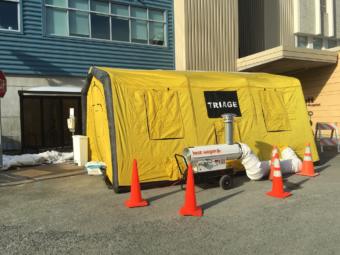
A triage tent sits outside the emergency department entrance to Bartlett Regional Hospital on March 13. (Photo courtesy of Katie Bausler)

To limit the spread of the COVID-19, Bartlett Regional Hospital has a “no visitor” policy in effect as of 3 p.m. on Wednesday.

But the hospital is making some exceptions for partners to laboring mothers, legally-authorized representatives of protected or high-risk patients, and law enforcement. One parent or guardian may visit a minor, and one person may be present for an impending death. Exclusions may be granted by the house supervisor or administrator on call.

Visitors should bring their own cloth face covering or a mask to the hospital. While there, the visitor must stay in the patient’s room at all times, and there will be no swapping out of caregivers. The hospital notes that a visitor cannot be in the room of a dying patient with coronavirus.

Senior care homes in Juneau have also implemented strict guidelines to protect residents: Wildflower Court and Juneau’s Pioneer Home haven’t had visitors since last month.

https://www.facebook.com/cbjuneau/posts/2260639044240316

Two more Juneau residents test positive for COVID-19

This scanning electron microscope image shows SARS-CoV-2 (in yellow) — the coronavirus that causes COVID-19 — isolated from a patient in the U.S., emerging from the surface of cells (in blue/pink) cultured in a lab. (National Institute of Allergy and Infectious Diseases – Rocky Mountain Laboratories)

As of April 5, two more Juneau residents have tested positive for the COVID-19 virus. That brings the total to 14 individuals. The City and Borough of Juneau sent out a press release stating the source of the virus in both cases is pending investigation. Officials with the State Division of Public Health are reaching out to people who may have come in contact with these cases. 

According to the Alaska Department of Health and Social Services, there are a total of 14 new confirmed Alaska cases, including a staff member of the McLaughlin Youth Center in Anchorage, and four new hospitalizations. On Sunday evening, the Petersburg Medical Center confirmed another case of COVID-19. 

A 71-year-old Anchorage resident, with pre-existing health conditions, died as of Sunday. So far, six Alaska residents have died from complications resulting from COVID-19. 

This story has been updated. 

Due to COVID-19, spring bear hunting isn’t happening for non-residents

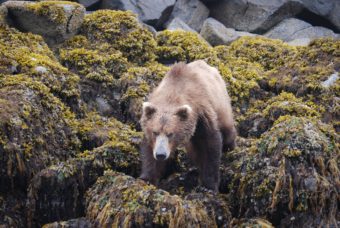
brown bear on shoreline in Katmai area
A brown bear in the Katmai area of the Alaska Peninsula, Nov. 18, 2010. (Creative Commons photo by Mandy Lindeberg/NOAA)

After announcing there would be no spring bear hunting in the state, the Alaska Department of Fish and Game has partially changed its mind. All non-resident brown and black bear hunts will remain closed through May 31. Spring bear hunting for Alaska residents remains open during that time.

“You know this was all about people moving around the state, specifically about hunters coming up from the lower 48, but also about people going from different communities in Alaska,” said Ryan Scott, assistant director of ADFG’s division of wildlife conservation.

“Right now we don’t have any concerns about bear populations. It remains to be seen how many people will take advantage of it, but it’s really good that resident hunters can get out there and take advantage of the bear opportunities.”

A Thursday letter from Fish and Game commissioner Doug Vincent-Lang reminds resident hunters to abide by health mandates, including social distancing and intrastate travel. That in-state travel between communities is prohibited except for supporting critical infrastructure or for critical personal needs.

Originally the Department closed non-resident and resident bear hunts until the end of May, via emergency order, in an effort to slow the spread of COVID-19 in Alaska. Even though Commissioner Vincent-Lang rescinded a portion of this closure, he emphasizes that general hunting has not been identified as a critical personal need, as defined by Governor Mike Dunleavy’s health mandates.

Scott said the department plans to work with the state’s Board of Game to accommodate hunters who’ve lost the opportunity.

“We recognize that there are lots of non-resident hunters planning to come to Alaska right now both for black bear hunts and brown bear hunts,” Scott said.

“We’re going to be looking for opportunities to move those permits around if we can to give those hunters the chance to come and do it again. We don’t know what it’s going to look like yet and it’s going to take some time to sort all that out. It’s important to recognize that we’ve issued drawing permits for next year already. So it’s going to take some finessing to distribute hunters across the landscape.”

Companies that accommodate out-of-state hunters can charge anywhere from a couple thousand dollars for a week-long self-guided black bear hunt to tens of thousands of dollars for a fully guided hunt from a wilderness lodge or tour boat. Brown bear hunts for non-residents are only allowed with a licensed guide or close relative who is a resident.

Eli Lucas owns Alaska Coastal Hunting, a guiding business based in Petersburg. He said the spring bear season is about half of his income for the year, but he understands the closure had to happen.

“We’ve offered refunds or switching dates but we really don’t know where to put people,” Lucas said. “We actually need more season if we’re going to put somebody to a full calendar because we don’t have room for the next years. And so, the other guides are in the same position. It’s a pretty complicated issue really.”

Outfitters, lodges, boat rentals and float plane companies will also lose business with the closure.

Fish and Game said they will announce further details in the coming days on how these spring bear hunts should be conducted by residents while complying with the Governor’s COVID-19 mandates.

Meanwhile, no closures are anticipated for other spring hunting seasons. And sport fishing remains open in Alaska with no current plans for closure.

Washington State has a temporary closure for its sport fishing along with the Columbia River in Oregon.

Site notifications
Update notification options
Subscribe to notifications