Tasha Elizarde

KTOO

Tongass Voices: Dave Hanson on the cosmos of Marie Drake Planetarium

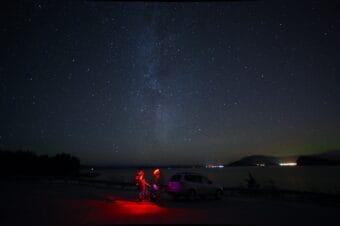
Dave Hanson photographs the starry, auroral night sky at False Outer Point on Douglas Island in December 2017. (Photo provided by Dave Hanson)

This is Tongass Voices, a series from KTOO sharing weekly perspectives from the homelands of the Áak’w Kwáan and beyond. 

Sandwiched between Juneau-Douglas High School and Harborview Elementary is the Marie Drake building, home to Juneau’s planetarium. Volunteers host free lectures, First Fridays, films, and field trips.

Dave Hanson is an astrophotographer and one of the planetarium’s board members. He says they hope to keep the planetarium open after the city takes over the building from the school district. His most recent lecture was about rogue planets.

Listen:

IC 1396, or Elephant’s Trunk Nebula, photographed by Dave Hanson in 2022. (Photo provided by Dave Hanson)

This transcript has been lightly edited for clarity.

Dave Hanson, speaking to the audience: So, welcome to the Marie Drake Planetarium. If you weren’t planning on being at the planetarium, you’re here now. Enjoy the show. 

Interview transcript: Okay, I’m Dave Hanson. I moved to Juneau seven years ago. And when we were thinking about moving here, we started googling Juneau. And one of the things we found was a planetarium, which just amazed me in a town the size of Juneau. 

Speaking to the audience: So tonight’s show is called “Going Rogue in the Cosmos.” The main thing I think we’re going to be talking about is mostly rogue planets. And we’ll talk a little bit in a bit about what that is. 

I woke up yesterday morning. And there was big news from the Euclid Space Telescope — which is yet another space telescope — that it found a bunch of rogue planets. And how timely is that?

Interview transcript: I’ve always been interested in astronomy. I do astrophotography, I had done that previously. So when I got here, I definitely wanted to check it out. I met the people here and started volunteering, stacking chairs, and eventually started doing presentations and joined the board. And it’s been a great experience. 

Speaking to the audience: Euclid is a little bit different. It’s what they call a survey telescope. So it’s going to be actually mapping the entire sky. So what it saw were 50 rogue planets, kind of in one shot. So what it did was, it looked at Orion. Can you see Orion in this photo? The constellation. We’ve got the head up there, we’ve got the belt, the sword, the feet. 

Interview transcript: To me, one of the most rewarding things are the kids. And the questions they ask are just so on point. And they’re so curious. So we bus in kids from all the schools. I don’t know how many we did this year. Last year, I think we brought 800 kids to the planetarium. 

Speaking to the audience: Up here, we kind of see this dark, dusty area with some glowing stuff up there. This is an object called M78, or Messier 78. And it’s a star-forming region. Well, Euclid took a picture of it, and we finally got some of the first science photos from Euclid. Just in this one image, they found 300,000 new objects that we didn’t know about. So these are new stars, planets, protoplanets. And they found 50, approximately 50, planets that aren’t associated with stars — rogue planets. And this is kind of way more than we thought we would find. 

Interview transcript: Yeah, there was a lot of anxiety among the board members, you know, when we first heard about the consolidation. Our hope is that, you know, if this becomes kind of a community center, this whole facility, that we can be one of the anchors for that, you know, as a long-standing organization. And that’s one of the things we’re trying to do is, you know, work with other nonprofits in the community. 

Speaking to the audience: That’s kind of the shocking thing. We think of, you know, our galaxy and our universe being very ordered in these star systems with planetary systems around them, which was a surprise, even, that so many of those existed. And now we found that there’s all these planets that aren’t even associated with stars. The more we know, the more we don’t know. So there’s plenty — don’t worry, all the discoveries have not been made yet.

Tongass Voices: Rebecca Hsieh on intertwining community and art with Head in the Clouds Collective

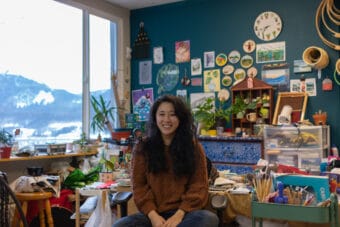
Rebecca Hsieh from ReccaShay Studios sits in her corner of the Heads in the Clouds Collective studio in March 2024.

This is Tongass Voices, a series from KTOO sharing weekly perspectives from the homelands of the Áak’w Kwáan and beyond. 

It’s been over a year since Rebecca Hsieh moved into her new studio space downtown. Since then, she and three other artists have formed Heads in the Clouds Collective, a growing community space for anyone in Juneau to learn a new art medium – or make new friends. 

The four artists work there and also host workshops or camps. As Hsieh explains, community is central to the collective’s ethos.
Listen:

This transcript has been lightly edited for clarity.

Rebecca Hsieh: So, we’re Heads in the Clouds Collective, downtown. There are four artists who share this space. And so there’s Tess Olympia, and she owns Juneau Woolies, she’s back in that corner. And then this is Glo Ramirez of Glo Ink, and she does everything, I think. A lot of things. She illustrates, she has clothing, she’s got earrings. That’s Grace Corrigan from Sundew Print. She’s about to teach the printmaking workshop. 

This beautiful mess is mine. I’m Rebecca Hsieh of ReccaShay Studios. And I do mostly like crocheting, just a lot of fibers.

I, when I was 10, for Christmas I got one of those really typical crochet kits that had a little book. And I remember looking through the book trying to figure it out, and I could not, so my uncle actually figured it out and then pseudo taught me, and it’s just something that I’ve always come back to. And before I moved to Juneau, as a young adult, I kind of picked it up again.

When I first moved to town, I actually worked at Kindred Post, and I don’t think I would have pursued art if I didn’t work there and make the connections I did because everyone was just so supportive. And so I just started making more and getting connected in the art scene. And then like having a market for the first time. And then people bought stuff, and I was like, ‘oh my god.’ And so then, I just keep making stuff that really make me happy and make me smile. 

I just wanted to crochet a hot dog that was like our height. So what’s gonna happen is, in that room in the JAHC, one side is going to be all the eastern foods I grew up with. And so I’m gonna make a dim sum table and all that, and then on the other side will be all the Western foods.

I think Juneau has been the most supportive place, in the sense that sometimes I think people can like gate keep grants, or market opportunities, or show opportunities, like exhibition opportunities. And here, whenever I’ve talked to any other artists, people are just so willing to share that information and be like, ‘Hey, I think you’d be great for this,’ even though they might be aiming for the same thing. But it’s just like, people are here to lift each other up. And so I try to do the same, like promoting other people’s work and all that.

This is what I do full time, so I’m in here the most and everyone kind of comes on their own schedule. This space actually was a nail place beforehand. So I think around a year and a half ago, I actually used to be in a studio across the hall and it flooded. And so we had to move all our stuff — or I had to move all my stuff — in here with another artist, but I’d been kind of eyeing the space just because the views are really nice. 

Just slowly started reaching out to other artists that I was friends with to see if they’d be interested in having a more focused artists space where we can kind of collaborate and you know, make this a community place. We’re trying to open it up and like, collecting other artists to teach in here, because we just want to, you know, make this a big community space where people can learn and create.

You can check out Hsieh’s art show, “Bite Sized”, at the Juneau Arts and Humanities Center now until May 26.

Tongass Voices: Juneau Hostel’s Khrystl Brouillette-Gillam and Joey Scoggins on keeping travel affordable

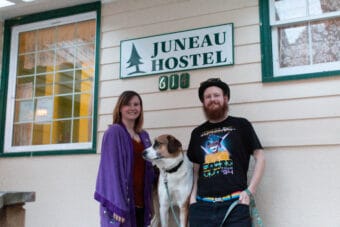
Khrystl Brouillette-Gillam and Joey Scoggins outside the Juneau Hostel in March 2024. (Tasha Elizarde/KTOO)

This is Tongass Voices, a series from KTOO sharing weekly perspectives from the homelands of the Áak’w Kwáan and beyond. 

Khrystl Brouillette-Gillam and Joey Scoggins are part of the team behind the Juneau Hostel. Their mutual desire to make travel to Juneau affordable is what drives them to keep the nonprofit hostel’s doors open.

Listen:

This transcript has been lightly edited for clarity.

Joey Scoggins: My name is Joseph Scoggins, I go by Joey, and I’m the manager of the Juneau Hostel. 

I’m from Georgia. And I never had an opportunity to really travel outside the state until I was almost 30. And then I just randomly needed a reset. So I moved out to California, because I had a friend with a couch and he said, c’mon over. I loved it out there, worked at Disneyland and all that fun stuff. One day, it just hit me. I was like, it’s March and it’s 100 degrees. I can’t live here anymore. So I went online, and I saw this hostel opportunity. I was like, you know, this is an opportunity to finally make it to Alaska, because I have been applying for jobs up here probably since I was like 19, you know, but it was always like, can you get here? Like, sorry, we can’t hire you. You know, so I finally got here. And that was the hardest part. 

Khrystl Brouillette-Gillam: No, I think yeah, the point of the hostel is to provide people with a low cost place to stay. And the point, the reason why we run it with volunteers like this, is to give people like Joey and others an opportunity to live in Alaska and enjoy everything we have in Juneau, but at a lower cost. 

My name is Khrystl Brouillette-Gillam, and I’m the president of the Juneau Hostel Board of Directors. So we’re the only nonprofit hostel in Alaska, and one of the very few that I can find, nonprofit hostels in the U.S. And that makes us different, makes us keep costs low. So that’s how we’re able to offer like $30 for a bunk versus other hostels that charge a little bit more.

Yeah, so what you’re seeing right now, obviously, we have a private group staying so there’s games around, and books around, and hostel’s full of life right now. In the wintertime, we don’t have that many guests. So the hostel is a very different vibe. But we’re excited to have the energy back in the hostel.

Joey Scoggins and his dog, Saint, play around with hats behind the Juneau Hostel’s front desk in March 2024. (Tasha Elizarde/KTOO)

Joey Scoggins: Compared to summer months, we’ll have like a couple dozen every day, you know what I mean? It’s a lot more fun. Gentleman that came last summer, he’s a big fan of an author that lived around here. And he was actually from somewhere in Eastern Europe. He was writing his own novel, and he had hit of a writer’s block kind of thing. So he was like, I’m gonna go there, I’m gonna go to Juneau, I’m gonna walk those same paths this guy did.

Khrystl Brouillette-Gillam: So like I said, the hostel operates as a nonprofit, which is great because it keeps our costs down for our guests, but has some other problems with it. And the biggest thing is just funding of course, that’s the biggest thing with all nonprofits. We do have a source of funding through renting rooms to people, but it’s definitely not enough to cover all of our expenses.

During COVID, we had to shut down operations almost entirely. I wasn’t on the board at that point. But we had to shut down all operations, and the hostel was actually thinking about closing — was very close to shutting our doors and not being open anymore. 

Joey Scoggins: This is just a few weeks ago, we had a prank call. But it turned into a serious conversation where the gentleman was concerned because all the other hostels he had called in Alaska to try and prank call had already closed down or turned into AirBNBs. And he was like, so, I was just messing with you, but I’m kind of glad you’re still there.

Khrystl Brouillette-Gillam: So if you don’t want the Juneau Hostel to turn into an AirBNB, please join the board. We would love to keep it running.

Correction: An earlier version of this story misspelled Khrystl’s name. 

Tongass Voices: Father-daughter production duo Joshua and Harmony Laboca bond through music

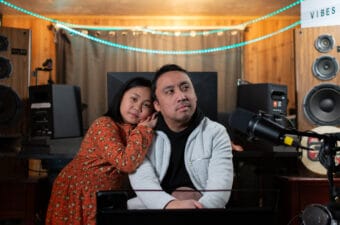
Joshua and Harmony Laboca pose in their home studio in February 2024. (Tasha Elizarde/KTOO)

This is Tongass Voices, a series from KTOO sharing weekly perspectives from the homelands of the Áak’w Kwáan and beyond. 

Joshua Laboca, known around Juneau as Jbo, is the music producer and content creator behind dozens of artists in Southeast Alaska. He and his nine-year-old daughter, Harmony, also produce music together. 

You can hear their song “Growing” and others on their YouTube page, Harmony & jboaudioe.

Listen:

This transcript has been lightly edited for clarity.

Joshua Laboca: Full name is Joshua Laboca. I go by JBo Audioe, J-B-O A-U-D-I-O-E. That’s what a lot of people know me as in town. And we are here at our home studio, where a lot of artists and bands come in to record and perform in the booth over here. So, I went to school at the Academy of Art University in San Francisco. 

So we had some family issues back here in Alaska. So I decided to continue going to school here, online. And then I ended up opening up a studio, but I never wanted to do music for artists. And then, so I had to tell myself, “I want to keep doing this. So how do I? How do I merge what I know about sound design, editing, Foley and effects? How do I apply it to music, like for artists?” So as I was mixing artists, like beats and stuff, and their vocals, I would apply it. And then I eventually grew a passion for mixing and producing for artists in town. 

My daughter and I, we do have a YouTube. It’s Harmony & jboaudioe, where we make instrumentals. I’ll have the beat down and I’ll do the mixing, and Harmony will do the guitar and pianos.

Harmony Laboca: Alright, Dad! Play my pre-roll please.

Joshua Laboca: She got inspired by the movie Sing. And there’s this character named Ash that plays the guitar voiced by Scarlett Johansson. And then the only way that I knew for us to continue to work on her playing guitar was that we had to make instrumentals. So every week she would play chords, she would lay chords down on instrumentals that I had. And every week it was just improving on that and that’s how she, she’s four years in now, she plays it pretty good now. 

Harmony Laboca: Um, usually we do a guitar first, and then if we’re making a song, we do guitar, vocals and then piano. 

Joshua Laboca: And she knows like, the basic controls of when to record, when to stop, going at certain bars and stuff, so. 

We usually film this whole process. So even during the mess-ups we still put it in the edit. So because it’s just, you’re never gonna get anything perfect.

But aside from that, once we get it mixed and edited, I’ll put some visuals to it. And then we put it on YouTube. And we just, yeah, that’s our process.

Harmony Laboca: It’s actually really fun. ‘Cuz we do it, he usually like, told me what’s wrong or like, what to improve on. And then he was like, and then sometimes we do games that we made up and like, practice together and sing stuff together, make videos together.

Joshua Laboca: We have a back and forth too, like it’s not always like Brady Bunch or anything. It’s like, ‘No, we should do this. No! No, yeah, no, I know, I know.’ You know, we have this like back-and-forth banter that we always do. But that’s kind of like the relationship that we have. And it makes it so that, you know, if I’m not doing something right, she calls me out, she’s not doing something right, you know, I call her out. 

Joshua and Harmony Laboca: The saying that we go, when right before we end our session is, “It’s never a good day without a challenge. So, fail fast. Fail forward. Fail a lot.”

Joshua Laboca: We say the word failure more than we say success. Because we’ve grown in the knowledge of music. And we’ve grown in making music from all of that.


Tongass Voices: Axel Brouillette-Gillam on the nostalgia that drives Cosmik Debriz

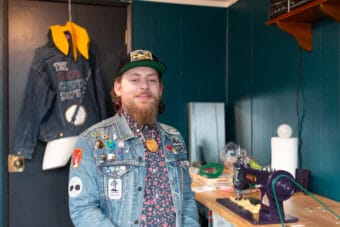
Axel Brouillette-Gillam sits at his embroidery desk in his shop, Cosmik Debriz, on Feb. 14, 2024. He is learning how to use a 1920s model of a chain stitch machine to create clothing inspired by Juneau history. (Photo by Tasha Elizarde/KTOO)

This is Tongass Voices, a series from KTOO sharing weekly perspectives from the homelands of the Áak’w Kwáan and beyond. 

Axel Brouillette-Gillam is a co-owner of Cosmik Debriz, a vintage Alaskana shop that began from his interests in thrifting and fashion, with his wife Khrystl. Brouilette-Gillam grew up in Homer before moving to Juneau in 2015, and it’s life in Alaska that inspires what he sells. 

Listen:

This transcript has been lightly edited for clarity.

My name is Axel Brouillette-Gillam, and I am the owner of Cosmik Debriz. 

We initially started the shop as kind of a pop-up situation. So, markets at the JAHC, the Mendenhall Mall had some Saturday markets — we would go to those and have a pop-up and kind of have our things. And then we kind of spontaneously found the space that we are now.

So yeah, to find us, we’re basically at the corner of North Franklin and Second Street, where High Tide Tattoo is. And then if you go up North Franklin Street a little bit, we’re the first door on that same blue building, and you’ll go up some nice stairs, and then we’re the first door that you see.

And when you come in, it’s basically three rooms that are connected to each other. And so we come to the room that has all of the clothes, we have racks that are just vintage clothing that has fun colors, fun patterns, fun styles. You know, I like these — we have some of these pieces that are from the early ‘90s when there’s this kind of Western thing going on. I enjoy those a lot. I think those are fun. 

And then we keep coming into the space, my favorite part of the store, which is the vintage Alaska clothing. So we have , this is the jacket from an Eagle Quality Centers from when I was a little kid in Homer. It’s now a Safeway, but when I was a kid, it was an Eagle Quality Center. An old Super Bear jacket with the old Super Bear logo on it, you know. So yeah, jackets like that. Super fun. And then we have vintage Alaska sweatshirts, and then t-shirts as well. 

So now we’re kind of in the, I call it the cashier room. It’s where the front counter is. We have our TV with our cassette deck.  

And then yeah, we have these flags here. I got these online from a guy in Ohio. And what’s significant about them is they have the 49 stars from when Alaska joined the United States, and 1959 was the only year that there was a flag that had 49 stars because December of 1959, Hawaii became a state [Editor’s note: Hawaii became a state in August of 1959]. 

And then another thing that we also have that’s vintage Alaska-related is things like postcards, press photos — so yeah, things like that. We have a Patsy Ann postcard from the 1930s.

And when I’m picking out items, when I’m looking at items, I’m often thinking of, there’s probably people out there that would connect to this thing. But like, one good example is, I had a 1990s Anchorage Aces — so, there used to be the Alaska Aces, it’s the hockey team that we used to have up here, and before they were called the Alaska Aces, they were called the Anchorage Aces. And so it was a jersey from the 1990s that had Anchorage Aces on it. And then so, I had a cowbell as well that had, you know, the season ‘97, ‘96 on it. But I had that up and for sale and I had a guy come in, and his dad played on the Anchorage Aces. And so he was just so incredibly excited to see it. He was so excited to get it for his dad, and to have it. 

And then moving into the last room. Currently, it is our halibut coat room. And then the exciting development is, the new exciting development is a chain stitch machine. And so what this is for doing is like custom embroidery, and it’s hand-operated, so there’s a crank underneath that I use to control the direction that the needle is going in. 

And you know, right now we’re running it, you know, this is kind of a slow mode, you know, not going too crazy fast right now. I need to work on my Ts, but it almost says KTOO. 

Going into the future, going to be doing basically vintage jackets, vintage clothing, and then doing direct to garment embroidery on those things related to Juneau’s history.

Yeah, just, I don’t know, these things, they make me really excited. I think they’re really cool. And it’s awesome to get to share them with others.

Site notifications
Update notification options
Subscribe to notifications