
Jeremy Hsieh

Local News Reporter, KTOO

I dig into questions about the forces and institutions that shape Juneau, big and small, delightful and outrageous. What stirs you up about how Juneau is built and how the city works?

Valley bear sightings prompt parent concerns

Riverbend Elementary School held its morning recess indoors Thursday after hearing reports of a bear sighting along the Mendenhall River.

Administrative assistant Lisa Peters says no one at the school saw the bear firsthand, but that the first recess shift at 9:10 a.m. was held indoors in “an abundance of caution.”

The seven other recess shifts during the day were held outside.

A video still from YouTube user Matt Mickle’s video “Brown Bear from Our Backyard” shows a bear crossing the Mendenhall River on Nov. 11.


The bear reports followed a backyard YouTube video of a bear crossing the Mendenhall River making its rounds on social media. The videographer could not be reached for comment, but the video description says it was shot on Monday.

Thin attendance at first middle school travel task force meeting

Only three people showed up for the first meeting on Sunday of a community task force looking at Juneau middle school travel policies.
Jon Kurland created the task force after the Juneau School Board in September adopted a ban of all out-of-town middle school athletic travel. The ban takes effect next school year.

He said he’s just getting the word out and will be reaching out to the Floyd Dryden and Dzantik’i Heeni middle school communities.

He’s calling the open-to-all body the Stakeholder Committee on Middle School Sports Travel.

Unlike picketers and other community opponents of the school board’s ban, Kurland said this is not a de facto repeal effort.

“I’m not trying to hide the fact that I’m hoping we’re gonna get to a place where the board can say ‘yes’ to middle school travel, I think that’s very much the goal,” Kurland said. “But I don’t think it’s going to be as simple just having the board reverse its September decision. I think we’re probably going to have to come up with a new framework that has different conditions attached to it so the board can feel comfortable that that’s an option that they can get behind.”

Kurland had lobbied the Juneau School Board for official participation in the committee. The board didn’t assign any staff or board members to it, but said it’s “acknowledging” the committee’s creation, and will hear the task force’s recommendations in the spring. The committee aims to have final recommendations ready by the end of February.

Kurland is a parent, though he doesn’t have a personal stake in the travel ban. His youngest child will be in high school when it takes effect.

“I recognize the educational and social value of teen travel opportunities and I think we owe it to these kids to take a harder look at this problem and try to explore solutions to create those opportunities,” Kurland said.

The committee’s next meeting has not been set, but people interested in participating can find updates on the Facebook group Save Our Middle School Sports – Juneau, Alaska or by emailing Kurland directly at JonKurland1@gmail.com.

Prospects for off-road vehicle park still fuzzy

(Photo by Michael Grosch/ Flickr Creative Commons)

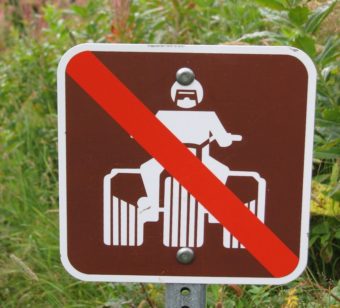
The possibility of building a park in Juneau specifically for off-road vehicles is still fuzzy.

City Engineering Director Rorie Watt on Tuesday presented four possible sites to the Parks and Recreation Advisory Committee. The two most appealing sites for both homeowners concerned about noise and ATV and motocross enthusiasts were out the road.

The two sites are next to each other near Echo Cove. The city owns one site at Mile 35. Goldbelt Inc. owns the other one. It’s a quarry that’s already popular with enthusiasts – who trespass.

Developing the city-owned site comes with a hefty price tag estimated at $3 to $12 million. That would be an extraordinary expense, Watt said.

“I don’t think in the ordinary city budgeting process, three to $12 million is at all likely. The funds are just not available easily for that scale of a project.”

The park at Mile 35 would also likely facilitate and exacerbate trespassing issues at Goldbelt’s quarry nearby, Watt said. And Goldbelt is already suffering from public safety and property issues spilling over from the city’s Echo Cove boat launch.

Watt said it’s unclear if the Native corporation is amenable to making a deal for public access to its land. If it were, the city estimates the cost of developing the site into an off-road vehicle park at less than $250,000.

After Watt’s presentation, the advisory committee heard public testimony on the park proposals. There were two camps: North Douglas residents in opposition to an off-road vehicle park specifically at the city’s Fish Creek quarry, and riding enthusiasts in support of any site.

“I think you guys need to keep in mind that we might seem like a small voice because everybody is very vocal about their trail walking, and their snowshoeing and their berry picking,” said Mendenhall Valley resident and rider Red Langel. “They have the opportunity to do that anywhere in Juneau. We don’t have the opportunity to do our stuff, really, legally, anywhere.”

Sixteen people testified in total. Seven were riding enthusiasts, nine voiced North Douglas noise concerns.

The advisory committee will take up the issue and hear public comment again at its Dec. 3 meeting.

Live from JDHS

Outside room 119 at Juneau-Douglas High School, a sheet of paper taped to the wall says, “FOG MACHINE IN USE.”

It’s the Friday before Halloween, and the usually no-nonsense control room and JDTV News anchor desk is dressed with spider webs, skeletons, jack-o-lanterns, black lights, and strobes.

Eleven students put together a live, 10-minute television newscast every week for their video production class. They shoot the video, write the scripts, and edit their stories. On Fridays, they run the studio cameras, a control room full of intimidating buttons, dials and screens, and go on camera as anchors and correspondents.

It’s a hectic scene as students – several in costume – distribute last-minute scripts, set mic levels, practice camera moves and load teleprompters.

And then there’s freshman Jessie Gregg. She’s in front of a green screen wearing a green bodysuit that covers her from neck to toe. It’s a visual effects gag. Viewers should only see her disembodied head and gloved hands floating over the weather graphics.

The effects test goes well.

“It was a little weird not to see my body when I like, looked on the screen, but it was – it’s a pretty cool effect,” Gregg says.

Mikko Wilson runs the class and directs the newscasts. It’s one of several part-time TV gigs he has, including with public television’s 360 North.

Mikko (and he goes by his first name with the kids, too) is busy, but there’s another idle observer in the studio. Carin Smolin manages the school district’s career and technical education programs, which includes Mikko’s contract.

“Mikko’s doing a great job. He’s been doing this for several years with us. And we’ve, we’ve got a full studio here, and people need to know about it,” Smolin says.

Much of the gear the class uses was donated by KTOO.

Then, from the anchor desk freshman Jade Kalk belts out, “Ready for rehearsal!” Smolin takes her leave.

The rehearsal gets under way and the first few minutes go smoothly. Gregg begins her weather routine:

“Thanks guys, and now for the weather. You may have noticed a teensie-bit of rain –“

But Mikko interrupts her midsentence on the squawk box.

“OK, bit of bad news. We need to stop our rehearsal there, we have 25 seconds to air,” he says, then ticks off a very fast, but intelligible series of instructions to the students sitting next to him in the control room and his two camera operators in the studio on headsets.

“Reset to the top please, black on air, first graphics ready. Ready two. Make sure you have the right script loaded. Ten seconds to air. We are recording. Quiet please.”

But there’s an equipment problem, and resetting takes more time than they have. The flurry of chatter and activity in the control room continues while dead air stretches on.

Eventually, Mikko begins counting down.

“Ready? We’re gonna go in 5, 4, 3, 2, 1 — take all.”

[youtube https://www.youtube.com/watch?v=RIXq6H7SowE]

The program opens with Kalk dressed as a gypsy and ninth grader Mirriam Meredith as a hippie at the anchor desk.

“Welcome to a very spooky episode of JDTV News,” Meredith says before the first scripted gag of the show. Kalk and Meredith say, “DUN DUN DUUUN!” as Keegan Brown on camera zooms in dramatically.

About 10 minutes later, the newscast winds down. There’s usually a burst of chatter after getting the all clear, but today the reaction is muted. There are a lot of deep sighs.

Mikko calls everyone into the control room.

The broadcast started almost half a minute late and went too long for the 10-minute slot on local cable channel 6. Viewers saw black at the beginning, and the show cut off before the end.

“How did we end up with black?” Brown asks.

“Prompter had a problem,” Mikko says. “And we cannot go without the prompter at the start of the show. K? What caused that problem? We weren’t ready. The script was not ready by deadline. The deadline for the script is before class on shoot day.”

They continue through the debrief identifying more problems. The students get a lesson in responsibility and consequences. Individual problems pile on and affect the whole team.

And the fog machine? They never fired it up.

The bell rings, and the students set aside their television responsibilities for the weekend – Mikko, too. He’ll be out of town next week, so the next show is truly a test.

One week later

A week passes with Mikko out of town. In his absence, Calvin Zuelow is directing. It’s his third year taking the class, which is an elective.

The scripts were closer to being on time. They got through the rehearsal with enough time to make some script changes. And even though a key piece of equipment crashed a few minutes before air, everything came together to hit their live slot on time.

“It worked OK, there were a few technical problems, but there’s always technical problems,” Zuelow says. “You can’t really always foresee those.”

Correction: An earlier version of this story misidentified the camera operator performing a dramatic zoom as Kyle Short. It was Keegan Brown.

How student attendance translates into state funding

A student count period at public schools across Alaska closed Friday. The average daily membership over the last four weeks determines state funding to local schools. (Photo by Images of Money/Flickr Creative Commons)

Across Alaska, Friday was the last day in a four-week period where student attendance translates into school funding.

Public schools receive a major chunk of their funding from the state under what’s known as the foundation formula. It’s complex, but generally, the more students in attendance in October, the more state funding each school receives.

This year, a typical student with perfect attendance between Sept. 30 and Oct. 25 is worth $5,680 to his or her school. That’s the figure that legislators and education officials call the “base student allocation.”

Funding adjustments, including extra money for students with special needs, cost-of-living differences from district to district, and reductions for efficiencies at larger schools, introduce more complexity.

Huge tables of data due to the state Nov. 8 are being compiled to count every public school student in Alaska.

The Juneau School District is expected to announce its final numbers early next week. Preliminary counts are about 106 students lower than expected – and that means the district is over budget by about $1 million this year. That amount covers salary and benefits for about 10 teachers.

10 weeks until Juneau goes over a fecal cliff

Juneau’s processed poop is going to start piling up come Jan. 1, unless a new disposal arrangement comes together soon.

The search for the latest stopgap to get rid of the capital city’s sewage sludge comes after municipal officials abandoned a new disposal contract.

The Juneau Assembly’s Public Works Committee is expected to hear an update at its next meeting, Oct. 28.

The city solicited contracts in August, and received only one viable bid from Juneau homebuilder Bicknell Inc. The Juneau Assembly had even approved funding the new contract in September, before municipal staffers decided to cancel it.

That leaves just 10 weeks before Juneau goes over the fecal cliff, as a KVOK radio host once called it. (Kodiak had a similar sewage sludge problem last year.)

Juneau’s sewage sludge disposal contract with Waste Management expires at the end of the calendar year. After that, the city doesn’t have the means to dispose of it on its own.

Bicknell declined to comment, but City Engineering Director Rorie Watt said the company’s plan was to heat dry the sludge. That means using specialized industrial equipment that’s kind of like a big, sophisticated laundry dryer. Heat drying is one of several methods the Environmental Protection Agency recognizes for processing biosolids to recycle as fertilizer.

Watt said three things led the city to abandon the contract: higher costs, risk of significant odor issues and lack of time.

Bicknell quoted its proposal at $1.6 million per year, which is about 40 percent more than what the city spends now on disposal.

A new contract with Waste Management wouldn’t necessarily be cheaper; it bid in August, too, with a higher price. And the bid was invalid because it demanded Juneau process the sludge up to fertilizer levels.

Waste Management’s local manager, Eric Vance, said he doesn’t know yet if he’ll still be in sludge business in 2014.

The odor risk became apparent after hearing from Stayton, Oregon. Watt said an operation there uses the same equipment Bicknell planned to use and processes the same kind of sludge produced by one of Juneau’s wastewater treatment plants. The town complained about odors, even though it was a mile away from wastewater treatment and sludge processing facility.

“So the sum total of it I think was, you know, good on Bicknell for trying to propose a solution for us, ‘cause we need one,” Watt said.  “But, you know, if we get that kind of odor issue and we’ve got a 5-year contract, and, and our costs increase by at least 40 percent, it doesn’t look like a good deal to us. And, realistically, could they be ready by Jan. 1? No way.”

Bicknell still needed to set up its facility as well as acquire municipal and state permits.

“We sort of bit the bullet and spent the money on watertight shipping containers,” Watt said.

That’s $800,000 for 40 new specialized shipping containers, because Waste Management doesn’t process the sludge. It’s been shipping hundreds of tons of the stuff a month via Alaska Marine Lines to an Oregon landfill. And AML has its own complaints about odors and leakage, which the containers resolve.

One of the city’s five watertight shipping containers it purchased last year. The city is buying 40 more to transport sewage sludge. They cost about $20,000 each. (Photo courtesy CBJ Public Works Department)

Watt said state grant money and municipal sales tax paid for the containers. Juneau bought five of the containers last year as an experiment, but needed many more for a continuous shipping rotation.

Juneau Assemblyman Randy Wanamaker chairs the Public Works Committee. He said the containers are expensive, but necessary.

“We have to have a solution. We cannot be caught at the end of December without having an option available,” he said.

Wanamaker’s committee will look at long-term options, and how to pay for them.

City staff and consultants outlined a variety of sewage disposal options in a report released in April that raises this policy question:

“Is it better or worse to have a big capital hit up front in exchange for lower rates over the long term? Or vice versa?” Watt asked.

To deal with the imminent fecal cliff, solid waste coordinator Jim Penor said the city will solicit a new contract.

Site notifications
Update notification options
Subscribe to notifications