Jeremy Hsieh

Local News Reporter, KTOO

I dig into questions about the forces and institutions that shape Juneau, big and small, delightful and outrageous. What stirs you up about how Juneau is built and how the city works?

Traffic slow on Egan Drive after 2 car accident

Traffic was moving slowly on Egan Drive outbound after a two-vehicle accident. (Photo courtesy of Angelo Katasse)

Traffic is moving slowly on Egan Drive near Fred Meyer after a two vehicle accident this evening.

Juneau Police dispatcher Joey Fox said no injuries were reported.

Traffic has been rerouted.

“Traffic’s a little backed up, but it’s still moving, slowly,” Fox said.

The initial call came around 4:30 p.m.

Juneau pushes fecal cliff out 3 more months

The City and Borough of Juneau has bought three more months to avert a fecal cliff.

The city has extended its contract with Waste Management to dispose of processed municipal sewage through March. It was previously set to expire with the new year.

“I guess the cliff has been stayed,” said City Engineering Director Rorie Watt.

Waste Management has been shipping the partially processed sludge to a landfill in Oregon. It’s been reluctant to continue doing so indefinitely because of odor and shipping issues.

Now, city staffers are working on a proposal that would improve processing at the Mendenhall Valley Wastewater Treatment Plant and buy even more time. Most of Juneau’s sewage passes through that facility.

About $3 million in upgrades there would let the plant turn sewage into biosolids that meet the Environmental Protection Agency’s minimum level for recycling as fill or fertilizer, Watt said.

“It wouldn’t be the final thing that we do, but it would give us stability in the short run in our shipping, it would lower our volume that we produce, and it would hopefully feed into what our long term solution is,” Watt said.

Disposing of the stuff has been problematic since the city’s sewage sludge incinerator went offline in 2010.

Juneau funnymen to skewer lawmakers in 6 webisodes

A video still from a 2013 episode of Alaska Robotics News with host Pat Race. (Courtesy of Alaska Robotics)

Update, 7:13 p.m. 11/26/2013: Pat Race says the $8,245 figure on Kickstarter doesn’t include another $225 in “brown bag” contributions from people in politically sensitive positions who gave anonymously.

Original post:

Alaska lawmakers and politicians will have a few more committed critics to contend with this session, but at least these guys have a sense of humor.

Alaska Robotics’ Kickstarter campaign closed last week after raising more than $8,000. That’s enough to fund six episodes of their satirical Alaska Robotics News video series over the course of 2014 legislative session.

Juneau-based Alaska Robotics is a label that Pat Race, Aaron Suring and Lou Logan use when they put out videos, illustrations, comic strips and other creative media.

The series will be available on the Alaska Robotics YouTube channel. The Legislature gavels in on Jan. 21.

From Minecraft to real craft

A 3D model created in the video game Minecraft by a Juneau high schooler became a real craft on Saturday.

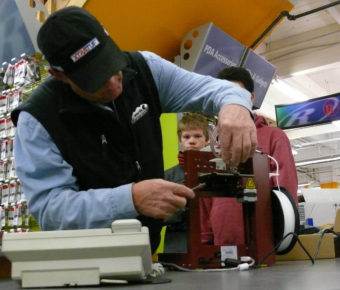
Freshman Caleb Brown is in a digital arts class at Thunder Mountain High School. He was at Western Auto Marine on Saturday morning with a few teachers and classmates watching a new 3D printer build his paperweight-sized sword in a stone out of melted plastic, layer by layer.

“Oh, I think it’s really cool. I just learned a lot about 3D printers over the summer just at my house. And I thought they were cool, and now I have the opportunity to see one and use one with my design, which is pretty cool,” Brown said.

Heather Ridgway is Brown’s digital arts teacher.

“A 3D printer is a great way to kind of pop it off the screen and put it in your hand. And go, oh, OK, this is where I’m going, you know? … You know, it just kind of takes it to another dimension,” she said with a laugh.

A 3D printer could let her incorporate jewelry and product design into her class, she said.

Western Auto is the only brick and mortar retailer in Juneau selling any kind of 3D printer. About three weeks ago, general manager John Weedman added two Afinia H-Series models to his inventory.

“One to show, one to go,” he said.

On Saturday, he was showing.

The $1,600 printer he’s selling weighs about 11 pounds and has a sturdy, industrial look with lots of right angles. Like a regular printer, the print head is suspended vertically over a printing surface. The print head only moves side to side and melts plastic filament fed from a spool.

The printing surface is a small platform that moves forward and back, like a sheet of paper fed through a typical printer. The platform also moves vertically to accommodate layering of the plastic material.

The printer can create small objects up to 5 cubic inches designed on home computers from a variety of software. It took several hours on Saturday morning for it to build student-submitted designs.

Weedman wants to sow consumer and educational interest in the technology, which, in recent years, has become much less expensive and much more accessible to hobbyists. After the holidays, he’s giving away his floor model to Thunder Mountain High School.

“It’s like donating fishing rods to Family Fishing Day at Twin Lakes. We want future fishermen,” he said.

With no previous experience, Weedman said had the printer doing its initial run in about four hours. Since then, he’s made luggage tags, a small skull, carabiner-like clips with flexible hinges, and some parts that attach to a mouse trap to make a toy car.

The designs came from the growing online community of do-it-your-selfers who share 3D print models.

Thunder Mountain robotics coach Carol May sees a lot of potential for her club. The rules in robotics competitions limit the off-the-shelf materials that can be used to build robots – but building things from raw materials is OK.

“So a 3D  printer will allow the kids to design a gear or a part or a sprocket or something that they don’t have the right size in the kit and actually print it on the printer and use it,” May said.

Other robotics teams in Southeast are already doing this, May said.

Weedman said he’ll arrange more 3D printer demonstrations as interest warrants.

Two bucks for a turkey huck

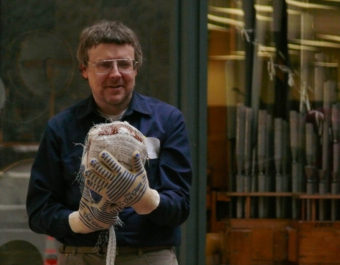
David Brabaw is clutching a frozen, 8-pound turkey in a pair of as-seen-on-TV Ove Gloves. He’s got a bowler’s stance as he eyes the pins at the end of the lane over the bird’s rump.

There’s a hush as bird strikes the pins, then an eruption of cheers as the pins settle, including an ecstatic, guttural “YEAH!” from Brabaw — he got a strike.

Brabaw’s not at a rowdy bowling alley, but on the eighth floor of Juneau’s State Office Building. He was one of a handful of state workers turkey bowling on Wednesday during the lunch hour. That unmistakable sound of bowling pins getting knocked around echoed up several stories of the building.

One makeshift bowling lane with 10 real pins was fashioned out of duct tape and a plastic drop cloth on the tile floor.

“Well, I have 34 right now in the fourth frame, but the last two frames, I’ll get a strike!” said Bong Carandang in the midst of a competitive game. “Or I’m gonna try and get a strike!”

[youtube https://www.youtube.com/watch?v=WyTMoyI9e7U]

The event was organized by employees of the division of Enterprise Technology Services. They charged $2 a throw, or $5 for a six-frame game. It was a fundraiser for the SHARE Campaign, a charitable giving program for state employees.

[vimeo 75331438 w=500 h=281]

State of Alaska Employees SHARE from Office of Governor Sean Parnell on Vimeo.

The turkey hucking was a spectacle. Folks were watching in the atrium, and several more gawked from interior office windows.

“Turkey bowling, I was very envious of, it sounded like great fun,” said Paula Pawlowski, the SHARE Campaign coordinator for the whole state, though her day job is as executive director of Serve Alaska. Different offices run the SHARE Campaign from year to year.

Turkey bowling was one many novel events state employees across Alaska put together to raise money for charities and nonprofits. Past events included selling chances to throw a pie at IT people, Halloween parties, coffee sales, silent auctions, chili cook-offs and bake sales.

“There are all kinds of creative ways that they’re having fun while giving at the same time,” Pawlowski said.

The SHARE Campaign goal for the year is to raise $415,000. The campaign is about two-thirds of the way there.

Wednesday’s turkey bowling event will kick in another $95, less the cost of the drop cloth. Taku Lanes donated the pins. The two turkeys used were also donated, but were too beat up to be regifted.

Gov. Parnell explains why he’s not expanding Medicaid in Alaska

Update, 2:12 p.m. 11/15/2013: A Storify post recapping the press conference and its coverage on Twitter is now embedded below.

Update, 12:05 p.m. 11/15/2013: The press conference has ended. Gov. Parnell says he will not expand Medicaid in Alaska, citing the cost to federal taxpayers and passing debt on to future generations. He says he’ll create a new Medicaid Reform Advisory Group to study and propose new ways to improve health care and reduce costs.

Original post:

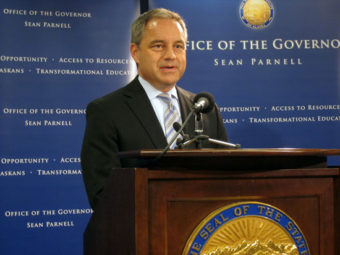
Gov. Sean Parnell is holding a press conference in Anchorage today scheduled to begin at 11 a.m. on whether Alaska will expand Medicaid coverage or not.

Medicaid is a federal safety net program that helps poor people pay for health care.

You can watch the press conference here:

Site notifications
Update notification options
Subscribe to notifications