Katie Anastas

Local News Reporter, KTOO

School Board votes to consolidate middle schools at Thunder Mountain, high schools at Juneau-Douglas: Yadaa.at Kalé

Juneau School District Superintendent Frank Hauser and finance consultant Lisa Pearce listen to speakers at a school board meeting on Thursday, Feb. 22, 2024. (Clarise Larson/KTOO)

The Juneau School Board has approved a plan that will put seventh and eighth grades at Thunder Mountain High School and ninth through twelfth grades at Juneau-Douglas High School: Yadaa.at Kalé. 

It’s an initial step in addressing the district’s $9.7 million budget deficit for next year, caused by dropping enrollment, an end to one-time state funding and per-student state funding that hasn’t kept up with inflation.

The district expects to save more than $2.6 million in staffing and $370,000 in maintenance costs. The plan will let the district close three buildings: the district office, Floyd Dryden Middle School and the Marie Drake building, which houses the alternative high school and Montessori Borealis. 

At a packed school board meeting on Thursday — with more than 500 others watching online — Juneau Education Association president Chris Heidemann said flat funding from the state was the main cause of deficits in districts across the state.

“Every educator that is laid off this year, in Juneau and across the state, can draw a direct line from their pink slip to the governor’s office,” he said.

Juneau Education Association President Chris Heidemann speaks at a school board meeting on Thursday, Feb. 22, 2024. (Clarise Larson/KTOO)

District leaders say the plan will let high school activities stay on the same schedule. It also provides career and technical education classes to all high school grade levels, a chief concern for many Juneau-Douglas High School: Yadaa.at Kalé students.

“It really does increase the offerings for all 9-12 students,” Hauser said about CTE classes.

Having middle school at Thunder Mountain will also let many students continue walking to school, according to the district, and it keeps both middle schoolers and high schoolers close to city pools. The Thunder Mountain campus is next to the Dimond Park Aquatic Center, and Juneau-Douglas High School: Yadaa.at Kalé is next to the Augustus Brown Pool.

Students at Juneau-Douglas High School: Yadaa.at Kalé rallied in support of the model on Tuesday, saying they wanted the four high school grades to stay together at a campus with trades classrooms.

Junior Sophia Percy said she knows she wants to go to college. But she told the school board on Thursday that not all students do.

“Does the student who wants to be a welder or a carpenter or to work at the mine not deserve the resources and support that I get? Is their path in life less important or less respectable than mine?” she asked.

Juneau-Douglas High School: Yadaa.at Kalé students attend a school board meeting on Thursday, Feb. 22, 2024. (Clarise Larson/KTOO)

Thunder Mountain High School students spoke against combining the high schools at all, saying that they enjoy being able to choose between two high schools with distinct climates. 

“I take pride in the fact that we are a community that believes in individualized education, that fewer than 600 students per school is a pleasant number for optimal education,” said Thunder Mountain senior Jade Hicks.

The board at first voted the plan down after four hours of public comment and more than two hours of discussion. But at 12:30 in the morning, after taking a recess, they quickly approved it with specifications for two optional programs: moving the Yaaḵoosgé Daakahídi alternative high school to the Dzantik’i Heeni Middle School building and leaving the Tlingit Culture, Language and Literacy program at Harborview Elementary.

The motion passed, with members David Noon and Britteny Cioni-Haywood voting no.

Members of the public watch a school board meeting in the common area of Juneau-Douglas High School: Yadaa.at Kalé on Thursday, Feb. 22, 2024. (Clarise Larson/KTOO)

Federal education officials say Alaska owes millions to Juneau, Kenai and North Slope school districts

The Juneau School District office on Tuesday, Dec. 16, 2024. (Clarise Larson/KTOO)

The U.S. Department of Education says Alaska underfunded three school districts when they distributed COVID relief funds in the 2021-2022 school year.

The American Rescue Plan Act gave billions of dollars in emergency assistance to schools during the pandemic. But in order to receive those funds, states had to ensure the money would support communities that needed it most. Rules attached to the funding prevented states from disproportionately reducing their own funding to high-need districts.

Yet in a December letter to Alaska Department of Education and Early Development Commissioner Deena Bishop, federal education officials said state funding fell short by more than $5 million for the Kenai Peninsula Borough School District, $2.5 million for the Juneau School District and $190,000 for the North Slope School District in the 2021-2022 school year.

“One way that Alaska may resolve the identified compliance issues for FY 2022 is by making supplemental payments,” Deputy Assistant Secretary for Policy and Programs Adam Schott wrote in the letter.

Schott wrote that DEED had 30 days to submit a plan describing whether, when and how they would make supplemental payments to the districts. In an October letter to Bishop, U.S. Office of State and Grantee Relations Director Laura Jimenez wrote that supplemental payments would be excluded from the disparity test, which allows Alaska to count some federal aid as state funding

“If DEED does not provide a timely response, the Department may take appropriate enforcement actions,” Schott wrote.

A U.S. Department of Education spokesperson said Thursday that they have not received a formal response from DEED. 

Kenai Peninsula Borough School District Superintendent Clayton Holland hasn’t heard anything from DEED about the letter. He said $5 million in additional funding would make a big difference for his district, which is facing a $13 million deficit for the next fiscal year.

“That would be a huge thing for our district to receive as we’re in these challenging financial times,” he said.

Juneau School District Superintendent Frank Hauser, whose district is facing a $9.7 million deficit for next year, said he hasn’t heard anything from DEED either. He said district leaders shouldn’t bet on getting that money back anytime soon.

“I really would urge extreme caution at this early date about adding this amount to the revenue columns for the districts mentioned in here, because we just need to hear from the state first and see the response to the U.S. Department of Education,” he said. “My sense is that the state will probably contest this, but we’re just going to have to wait and see.”

Education commissioner Bishop did not respond to an interview request.

KDLL’s Riley Board contributed reporting.

Students rally to keep high school at Juneau-Douglas: Yadaa.at Kalé

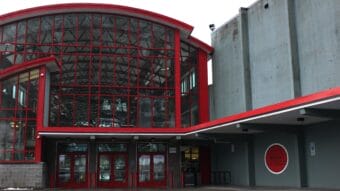
Juneau-Douglas High School: Yadaa.at Kalé on Dec. 15, 2023. (Katie Anastas/KTOO)

The Juneau School Board is considering consolidating Juneau-Douglas High School: Yadaa.at Kalé and Thunder Mountain High School to help address the district’s $9.7 million budget deficit for next year

On Saturday, the board proposed putting 10th through 12th graders at Thunder Mountain and putting seventh, eighth and ninth graders — along with students from optional programs — at Juneau-Douglas High School: Yadaa.at Kalé. That would let the district close some other schools.

Dozens of students from Juneau-Douglas High School: Yadaa.at Kalé rallied on Tuesday in opposition to that idea, saying ninth through 12th grades should be at their campus instead.

LISTEN:

“It’s not JD versus TM, it’s one building compared to the other,” said Bristol Casperson, a junior. “Which one has the most space? Which one has the proper classrooms — wood shop, auto shop, metal shop? If TM had that, if they had the space for us, if they were the proper place to receive a good four year education, then we would have to put it aside and go there. But J-D is that space. This building has those amenities.”

Thunder Mountain opened in 2008 under the assumption that Juneau’s population would continue to grow. Instead, the school-aged population shrank.

According to the school district, Juneau-Douglas High School: Yadaa.at Kalé has 545 students this year, putting it at 50% capacity. Thunder Mountain has 569 students, which is 76% of its capacity.

Juneau-Douglas High School: Yadaa.at Kalé can fit 1,091 students. The district expects there to be 1,050 students in 9th through 12th grades next year.

Junior Maisy Messing said she thought ninth through 12th grades should stay together.

“I think that our upcoming ninth graders deserve to have the same high school experience that we did,” she said.

Freshman Sabine Auger joked that if the high school became 10th through 12th, she’d find herself back at the “bottom of the food chain.”

“But I think it’s inevitable that we’re probably all going to be in the same school together, so we should just accept that,” she said. “I really, really hope that the school board knows that we want to be together at JD, which has the bigger capacity, and that it needs to be ninth through 12th like it always has been.”

Students at Juneau-Douglas High School: Yadaa.at Kalé learn construction skills in this classroom. (Katie Anastas/KTOO)

In 2017, the city and school district hired an architecture firm and consultants to create a school facility master plan. Their report listed challenges and strengths of the two campuses.

Juneau-Douglas High School: Yadaa.at Kalé had been newly renovated. It’s next to the University of Alaska Southeast Technical Education Center and the Augustus Brown Pool. It has a wood shop, metal shop and garage. But it has smaller classrooms, minimal parking and not enough outdoor space.

Thunder Mountain was a newer, well-organized building. It has a football field and track, and the Dimond Park Aquatic Center and Mendenhall Valley Public Library are nearby. But it had minimal space for career and technical education classes and underutilized teacher planning rooms, the report said.

“The big argument is that TM has the pool, the library and all the amenities there, which is true, but they don’t have the capacity,” Juneau-Douglas High School: Yadaa.at Kalé senior Maggie Higgins said. “There’s lots of neighborhoods with residential parking that you can park in when people are at work. Maybe it’s a little more of a walk, but I walk to school every day. I don’t think it’s that big of a deal.”

Freshman Sam Uyanik said many families have a deep connection to the downtown school. Elders and leaders representing the Áak’w Ḵwaan and T’aaḵu Ḵwáan gifted the high school its Lingít name in 2019.

“A lot of our ancestors and our families went there,” Uyanik said. “I think it would be pretty disrespectful, if you ask me.”

Mary Canapary, a junior, said the rivalry between the high schools can be fun.

“But at some times, I think it’d be really nice to just get everyone together, standing together, for a common goal,” she said. “And I think education should be that common goal.”

The school board is set to decide on a school reconfiguration model at a meeting on Thursday at 5:30 p.m. The board will consider two models at the meeting. One puts seventh through ninth grades and optional programs at Juneau-Douglas High School: Yadaa.at Kalé while putting 10th through 12th grade at Thunder Mountain. The other puts seventh and eighth grade at Thunder Mountain and all high school grades at Juneau-Douglas High School: Yadaa.at Kalé.

Members of the public can attend the meeting at the Juneau-Douglas High School: Yadaa.at Kalé library or on Zoom.

Dunleavy moves to control appointments to Alaska Marine Highway Operations Board

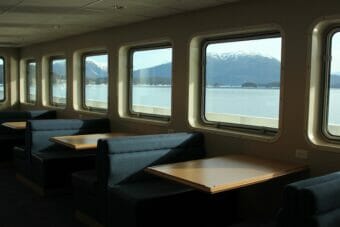
A seating area on the Tazlina ferry on March 9, 2023. (Katie Anastas/KTOO)

Gov. Mike Dunleavy issued 12 executive orders at the beginning of this year’s legislative session. One of those would bring big changes to a board tasked with overseeing Alaska’s ferry system.

Right now, legislative leaders in the Alaska House and Senate have the power to appoint four of the board’s nine members. The executive order would change that — allowing the governor to appoint all nine.

The order didn’t get a formal look from senators until this week, when it came before the Senate Transportation Committee. It’s scheduled for public testimony tomorrow at 1:30 p.m.

Alaska Public Media state government reporter Eric Stone spoke to KTOO’s Katie Anastas about what the board does and why some lawmakers are skeptical.

LISTEN:

Katie Anastas: So, this executive order is all about the Alaska Marine Highway Operations Board. Let’s start with the basics — what is this board?

Eric Stone: So, it’s a committee made up of nine members. It’s supposed to help the AMHS plot its future course, so to speak. They’re also supposed to give advice on basically how to run the ferry system better. It was created by the Legislature to replace the previous version, the Marine Transportation Advisory Board, which was criticized as ineffective. And there are all kinds of folks on it. There’s a union member, a representative of a tribal group, there’s a deputy transportation commissioner, and then six members who have specific expertise in a variety of areas that are helpful to the Marine Highway System. 

Here’s Sen. James Kaufman. He is an Anchorage Republican, and he was one of the architects of the board:

James Kaufman: We wanted to be sure that, in aggregate, that the board had, not any one person, but when pulled all together, that the board had the technical competencies around enterprise management, quality management, the different things that help.

Eric Stone: And I spoke with Rep. Louise Stutes, the former speaker, in early February about this — she’s a Kodiak Republican and a big ferry system booster  — and she says the board and its structure was the product of consensus:

Louise Stutes: We really took a lot of time and care to work on it. It was a bipartisan, bicameral piece of legislation that passed both bodies unanimously. So it’s a little bit difficult for me to accept redoing the whole board.

Katie Anastas: And so the executive order would allow the governor to appoint all members, and not just a majority of them.

Eric Stone: That’s right.

Katie Anastas: And do we know why the governor wants that change?

Eric Stone: I was wondering that for quite a while, actually. Until this week, all the administration had really said about this publicly is that the executive order made the government more effective and efficient and provided mechanisms for accountability, but they hadn’t really explained how. And we did get something of an explanation from the Department of Transportation on Tuesday. DOT’s Andy Mills works with the board pretty closely. He’s also the legislative liaison for the Department of Transportation. And he told the Senate Transportation Committee that the administration wanted the board to be accountable to the governor:

Andy Mills: How the board appointing power works does create a layer of accountability that may not exist for the board to work with the department and again, my words, my characterization, but sometimes interactions and again, very specific interactions, not the entire board. It’s been more adversarial than advisory, which is unfortunate.

Eric Stone: DOT Commissioner Ryan Anderson says the board isn’t delivering the short- and long-term plans that it’s tasked with crafting, and he compared the board with some of the other boards that have all the members appointed by the governor, like the Roads and Highways Advisory Board.

Ryan Anderson: Alignment is a word that I think of quite a bit when we’re talking about these boards that you know, boards that are aligned that come together, move things forward quickly.

Katie Anastas: And did those ideas ring true for lawmakers?

Eric Stone: Some lawmakers were skeptical. Sen. Kaufman took issue with the idea that it’s the board’s job to come up with short- and long-term plans for the ferry system. Kaufman says the board’s job is to give advice on plans that DOT is supposed to come up with, thus it’s not quite right to say that the board isn’t doing its job. Sen. Jesse Kiehl, he’s a Juneau Democrat, big booster of the ferry system. He took issue with the commissioner’s characterization that certain members weren’t aligned with one another. He said in past years, he’s seen marine highway leadership pretty well aligned…   

Jesse Kiehl: …making tens or hundreds of millions of dollars of decisions, sometimes in ways that have turned out to be inefficient, sometimes in ways that have turned out to be failures. Quickly achieving alignment may or may not be in the best interest of the system at all.

Eric Stone: So Anderson, the DOT commissioner, he emphasized later in the meeting that two of the members that are appointed by the Legislature — who happen to be the chair and vice chair of this board — would not necessarily be replaced if this order takes effect. But, of course, all the members would serve at the pleasure of the governor, and that means that they could be replaced at any time.

Katie Anastas: Okay, got it. So what comes next?

Eric Stone: So, the Senate Transportation Committee will hear some public testimony, and then they’ll likely move it out of committee to the Senate floor. From there, the path is a bit murkier. The Legislature has until mid-March to take a joint session vote on disapproving the governor’s executive orders, and that would prevent them from taking effect. But the House has to invite the Senate into joint session for that to happen, and all this objection we’ve been hearing has been on the Senate side. Last we heard, the House was open to a joint session, but they hadn’t quite worked out the details of how that would work. And even if they do come into joint session, it’s no guarantee they’ll wind up voting the orders down. So you’ll just have to stay tuned.

Katie Anastas: Alright. That was Alaska Public Media’s Eric Stone. Eric, thanks for being here.

Eric Stone: Thanks for having me.

Closing Juneau schools’ budget gap likely will mean eliminating dozens of jobs

Juneau Education Association President Chris Heidemann speaks at a school board meeting on Feb. 13, 2024. (Clarise Larson/KTOO)

The Juneau School District is facing a $9.7 million deficit for the next fiscal year, caused by a likely drop in enrollment, an end to one-time state funding and increases in staff salaries and other costs. That’s on top of the deficit in the current year’s budget.

District leaders are considering closing schools to balance the budget, which would allow them to lay off duplicate staff, like principals, nurses and librarians. But those cuts alone would not be enough to balance the budget.

“Anything that is not realized in structural savings is coming straight from the very finite levers we have, which is staff,” Superintendent Frank Hauser said at a school board work session on Saturday.

Lyle Melkerson, the district’s human resources director, estimated how many other layoffs it would take to close the budget gap depending on how many schools they close.

Filling the budget gap after combining just the middle schools would require laying off 60 to 100 people, depending on their positions. But combining middle schools, combining high schools and closing an elementary school could cut the number of layoffs needed in half.

The district has 309 teachers. Melkerson said 30 to 50 typically leave the district each year.

“I believe we can hit those marks with natural attrition by the end of the year, or close to it,” he said.

Juneau School District Superintendent Frank Hauser speaks at a school board work session on Saturday, Feb. 17, 2024. (Katie Anastas/KTOO)

District leaders said combining the high schools would also help them staff elective classes. Board president Deedie Sorensen said students already have limited course offerings, which can make it hard to meet graduation requirements. 

“I don’t think we have two comprehensive high schools right now. I think we have two high schools that are grossly understaffed,” Sorensen said. “We are relying on a whole range of online courses to provide electives to students who should be able to get those electives in an in person class.”

Andy Bullick teaches construction and welding at Yadaa.at Kalé Juneau-Douglas High School. He said it’s important for kids to have access to electives like his.

“It’s a fun outlet for them. It allows them to discover things they like to do,” he said. “A lot of kids that have gone through these classes we’ve offered, it’s sparked an interest in them and they have really good jobs.”

Students at Yadaa.at Kalé Juneau-Douglas High School learn about welding and other construction skills in this classroom. (Katie Anastas/KTOO)

At a school board meeting last week, Juneau Education Association president Chris Heidemann said layoffs would lower the quality of education in the district and push more young people out of Juneau.

“Layoffs will continually and repeatedly damage this community because the people that are laid off, according to our collective bargaining agreements, are the youngest, early career teachers who will leave this town,” he told the board. “This town will continue to get older, we will have fewer kids to educate and our schools will continue to suffer.”

The board asked district staff to come up with a plan that would keep both high school buildings in use, and from there, use as few buildings as possible. One example they discussed was putting 10th through 12th graders at Thunder Mountain High School and seventh, eighth and ninth graders, along with students from the optional programs, at Yadaa.at Kalé Juneau-Douglas.

The board’s next meeting is on Thursday, Feb. 22.

Site notifications
Update notification options
Subscribe to notifications