Katie Anastas

Local News Reporter, KTOO

Juneau Tlingit and Haida Community Council donates $150,000 to local school programs

Parents, teachers, students and district staff attend a Juneau School Board meeting on Feb. 13, 2024. (Clarise Larson/KTOO)

The Juneau Tlingit and Haida Community Council has donated $150,000 to the Juneau School District. The funding will support school activities, a snack program and Indian Studies programs.
Rhonda Butler is the president of the community council, an elected group that represents Juneau’s Tlingit and Haida citizens. The council’s weekly bingo games fund their annual donation program, and Butler said they’ve donated to the school district in the past.

“This year it was a little bit higher, especially when we were getting notice from different tribal members that the need for food was on a rise,” she said.

The council donated $55,000 to help pay for snacks at the district’s schools.

They also donated $45,000 to support student activities, including the high school basketball teams, Thunder Mountain’s wrestling team, Yadaa.at Kalé Juneau-Douglas High School’s cheer team, the district’s Native Youth Olympics programs and the Tlingit Culture, Language and Literacy program’s robotics team.

The council also donated $50,000 for the district’s Indian Studies programs, which help address academic and cultural needs of Alaska Native students.

Butler said partnerships like this will be key to supporting all of Juneau’s students through the district’s budget crisis. The district is facing an $8 million deficit for the current school year and is considering closing schools.

“I think with collaboration and partnership a lot of these deficits or financial cuts might be lesser in the future,” she said.

The Juneau School Board accepted the donation at its meeting Tuesday night.

City proceeds with Telephone Hill plan that would demolish houses, add apartments

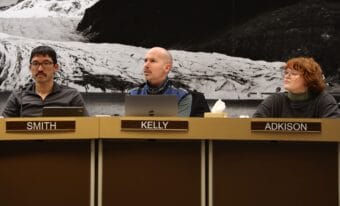
Assembly member Paul Kelly, center, asks a question during an Assembly committee meeting on Monday, Feb. 12, 2024. (Clarise Larson/KTOO)

The Juneau Assembly has asked city staff to move forward with a Telephone Hill redevelopment plan that would demolish the neighborhood’s historic homes and add more than 100 new housing units.

Designers shared four redevelopment models with Juneau residents in the fall. Option C added the most new housing — 100 to 200 apartments in mid-rise buildings. Option D was the only plan that preserved some of the existing houses while adding apartments among them.

In an online survey, Juneau residents gave Option C just 13 more votes than D. But at an Assembly Committee of the Whole meeting Monday night, member Christine Woll said their decision was a response to Juneau’s housing crisis, not the survey.

“Option C barely quote-unquote won the survey,” she said. “I think that’s a useful piece of information, but I think our decision should be based on what we think is best for the community based on what we know.”

Assembly member Paul Kelly objected, saying he didn’t want to make Telephone Hill’s remaining tenants leave their homes

“The level of housing people are asking for, I think we can achieve that and allow people who are living in the area to remain in their homes if we proceed with, instead, Option D,” he said.

First Forty Feet’s Options C and D were the most popular Telephone Hill redevelopment models in a recent city survey. (Screenshot from City and Borough of Juneau document.)

But Mayor Beth Weldon said tenants may have had to leave even if the city left the houses standing.  

“We have to remember that if we leave the houses there, the people that are in them currently may not stay in them because they’ll go up to fair market value,” she said. “And after my tour there — there’s a house there that has some land. It’s a big house with a view. That house is going to go for $900,000.”

Assembly member Wade Bryson said they had a responsibility to serve all of Juneau’s residents.

“I would hate for this Assembly to take an action that would stop economic growth for a small group of individuals, a small group of Juneauites,” he said. “That doesn’t seem like the common good or good for the community.”

The Assembly voted to direct staff to refine Option C, with Kelly voting no.

The Assembly also agreed that the historic review process had been sufficient, and that a more extensive review wasn’t necessary. Kelly cast the only no vote.

Architects had reported on the historic significance of Telephone Hill and its houses, most of which were built in the early 1900s. The state had owned the buildings from 1984 until last March, when it transferred ownership of the land to the City and Borough of Juneau. 

An assessment of the buildings’ condition found water damage, roof leaks and rotten window sills and door frames in many of the houses. In the assessment, engineers wrote that it is “likely not economically feasible for CBJ to own or rent” the houses.

Juneau teachers, students and parents react to proposals for closing or reorganizing schools

The Juneau School District held a community input session on Wednesday, Jan. 31, 2024 at the Thunder Mountain High School library. Attendees wrote questions and stuck them on a board on the wall. (Katie Anastas/KTOO)

The Juneau School District is facing a nearly $8 million budget deficit for the current school year. District leaders are considering closing or reorganizing schools and cutting staff to balance the budget. 
At community input sessions over the past week, teachers, parents and students shared their concerns about combining high schools and splitting elementary levels.

One option district leaders have proposed is closing Thunder Mountain High School and sending its students to Yadaa.at Kalé Juneau-Douglas. According to the district, Juneau-Douglas has 545 students, putting it at 50% capacity. Thunder Mountain has 569 students, which is 76% of its capacity. Thunder Mountain opened in 2008 under the assumption that Juneau’s population would continue to grow

Some coaches and students at the input sessions worried about limiting the amount of space on high school sports teams. Josiah Loseby, Thunder Mountain’s head swim and dive coach, said sports help many kids keep their grades up.

“Sports across the board and activities across the board keep students engaged, keep students coming to school, and encourage them to do well,” he said. “I think there’s going to be a drastic reduction in the graduation rate, a drastic reduction in student performance overall.”

Thunder Mountain senior Jade Hicks attended Tuesday’s input session. She said parking is a big concern for students who drive — Juneau-Douglas doesn’t have Thunder Mountain’s large parking lot. Plus, she said, students like having high school options.

“There’s a reason people choose their own respective schools,” Hicks said. “I chose Thunder Mountain because I wanted to learn Russian.”

School board member Emil Mackey said if they don’t close a high school, the district might have to offer fewer electives instead.

“Consolidating the schools, I believe, will actually preserve more student activities and more electives, because you’ll have more people under a common roof to actually provide those services,” he said.

Another proposal is to change how elementary grades are split. Right now, Juneau’s elementary schools house kindergarten through fifth grade. The district is considering dividing elementary buildings into kindergarten through third grade schools and fourth through sixth grade schools.

In an interview, Superintendent Frank Hauser said savings would come from distributing students more evenly among classrooms according to the pupil-teacher ratio, which the district uses to allocate teachers among grade levels.

“If there’s only three schools that have second graders, versus six schools, you have more opportunity to get that ideal number across more teachers in those three schools,” Hauser said.

But splitting up the elementary grades worried many teachers, including Janarose Odenheimer, a special education teacher at Sayéik: Gastineau Community School.

“The people who are going to get hurt the worst are the lower socioeconomic students and families within our district,” Odenheimer said. “Absenteeism will go up, because how are my sixth grader and fifth grader going to bring my kindergartener and first grader to school?”

Rosemary Slotnik, a behavioral paraeducator at Sayéik: Gastineau Community School, told district leaders on Thursday that having siblings at the same school helps build relationships with families.

“In a neighborhood school, the school knows and supports the whole family,” she said. “If a second grader is struggling, we can check in with the fourth grade teacher of an older sibling and see if they’re seeing what we see. We know which family needs extra support.”

Some savings from school closures would come from eliminating duplicate staff positions, like principals, nurses, librarians and office staff. The district estimates it would save $668,000 by closing an elementary school, $913,000 by closing a middle school and $1.3 million by closing a high school from salaries alone.

Hauser said the district would also save on utilities, custodial and maintenance costs. Exact savings would vary depending on the school. 

“Thunder Mountain is a more modern building that has more energy saving features, but it’s a smaller footprint, so it’s going to have less utilities cost,” he said. “JD is going to be able to have more capacity for students but has a different cost for property insurance.”

Hauser said enrollment projections are a key piece to estimating the full savings for the different options, since school size affects state funding. The district is still waiting on demographic projections for next year.

In the meantime, the district is asking the Juneau Assembly to cover nearly $4 million in maintenance, utilities and property insurance costs.

The Assembly Finance Committee will discuss the request at a meeting Wednesday at 5:30 p.m. The meeting will be open to the public at City Hall and on Zoom.

New condos built with Juneau Affordable Housing Fund loan are being sold at market rate

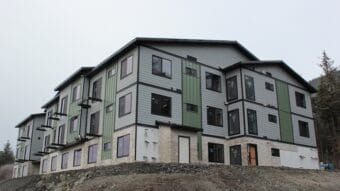
Construction at the Ridgeview subdivision was still underway on Nov. 29, 2023. (Katie Anastas/KTOO)

Last summer, a sign by a construction site on Glacier Highway advertised a development called Ridgeview, with apartments for rent coming in fall of 2023

For Juneau resident Carissa Armstrong, who has two children, it was a glimmer of hope for more rental options in Alaska’s capital city.

“I make enough money to be able to kind of afford your standard two bedroom in Juneau, but there’s just nothing available,” she said.

By winter, the “apartments for rent” text on the sign was covered up. An email sent to those who signed up for the Ridgeview waitlist said the first 24 units would be available for purchase at market price.

“I was like, ‘Well, that’s out of the question,’” Armstrong said. “I don’t have $150,000 to $200,000 to go buy a flat.”

She would have needed much more than that. On Monday, Ridgeview announced online that one-bedroom units would start at $375,000 and two-bedroom units would start at $495,000. 

A sign next to the Ridgeview construction site previously said “apartments for rent.” Now, that part of the sign is covered. (Katie Anastas/KTOO)

Those prices surprised many Juneau residents because Ridgeview’s developer is borrowing $1.2 million from the Juneau Affordable Housing Fund

City leaders defend their decision to approve the loan but say they want to adhere more closely to affordability requirements in the future.

Assembly to discuss future housing fund loan conditions

The City and Borough of Juneau created an Affordable Housing Commission in 2007 to advise city leaders on how to create more affordable housing. The city established the affordable housing fund a few years later with federal and state funds. Early recipients included programs that help Juneauites build accessory dwelling units and make down payments on mobile homes. In 2017 and 2022, Juneau voters approved contributing some sales tax money to the fund.

The city invites developers, nonprofits and tribal governments to apply for grants and loans from the fund annually. The review committee includes city staff and members of the public from the lending and construction fields.

“The primary purpose for establishing the JAHF is to direct resources toward the creation of affordable (0% to 80% area median income (AMI)) and middle-income housing units (80% to 120% AMI) in the City and Borough of Juneau,” the 2022 and 2023 competition guidelines read.

The guidelines say for-profit developers borrowing from the fund must reserve at least 20% of the units they build for tenants earning 80% or less of the area median income for at least ten years or the life of the loan. That means rental rates for those units would be capped at $1,712 for an efficiency unit, $1,834 for a one bedroom and $2,200 for a two bedroom, according to the 2023 guidelines.

But the guidelines also say certain projects may require deviation from those requirements.

The Assembly is now revisiting the terms and conditions they’d like to set for future loans from the fund. City Manager Katie Koester brought a potential list of conditions they could formally adopt to the Assembly Committee of the Whole meeting on Monday night.

Many of them are already in the program’s guidelines, like the minimum number of affordable units. Others are more specific, like requiring units to be rentals or prohibiting short-term rentals for the life of the loan.  

“There are pros and cons to adhering to these guidelines, and of course, the Assembly can still do whatever the Assembly wants – obviously within charter and law,” Koester told them. 

Koester said this is a chance for the Assembly to more clearly set expectations for themselves, potential applicants and the public. She said they’re considering a fundamental question: “Is the Assembly okay awarding funds through the Affordable Housing Fund if there’s no affordability component?”

Member ‘Wáahlaal Gíidaak Barbara Blake said she supports adopting guidelines for future loans. She said she wants the Assembly to maintain the integrity of the fund’s title and prioritize projects that result in affordable units.

“This is not just money that comes out of nowhere, this is money that comes from our citizens,” she said. “And we have a responsibility to manage that in a way that provides for our community.”

Koester was the city’s public works director, not city manager, when the city agreed to loan Ridgeview’s developer affordable housing funds. In an interview, Koester said the idea to formalize the fund’s guidelines isn’t necessarily a response to that project.

“The Ridgeview ordinance and contract was a different time and a different lending environment,” she said. “I’m not sure if it’s a response, but it’s certainly a way to provide some structural guidelines and process around the fund.”

She said the two latest loan applicants recommended for funding show economic conditions may have changed. Both projects – which are set for public hearing on Feb. 5 – propose a monthly rent of $1,400 for some or all of their units.

Former city manager suggests removing affordability requirement

Ridgeview’s developer, Rooftop Properties, applied for a loan from the affordable housing fund to help build 24 units. The Assembly’s Lands, Housing and Economic Development Committee sent an ordinance appropriating $1.2 million to the full Assembly for approval in November 2022

That version of the ordinance said five units would be rented to people making at or below 80% of the area median income per household. The Assembly approved the loan, along with grants to AWARE, St. Vincent de Paul and Tlingit Haida Regional Housing Authority, in December 2022. 

After the Assembly approves the funding, it’s up to city staff to negotiate the terms and conditions of the lease. In March 2023, former City Manager Rorie Watt suggested they remove the requirement to include five affordable units at Ridgeview. 

“In the details of negotiating that loan, we sort of uncovered the root economic issue,” he told the Assembly Committee of the Whole at the time.

Watt said the developer wanted 25 years to pay off the loan if it required five affordable housing units.

“That’s only going to get us five units at affordable prices,” Watt said. “That is a long time to tie up $1.2 million for that many units.”

Instead, Watt suggested a shorter term loan for a market rate project.

Former Assembly member Carole Triem said adding any units would help lower the overall cost of housing in Juneau.

“Our aim is on affordability,” she said. “One way we do that is through this directed requirement of having a certain number of units be reserved for a certain level of income. But another way we do that is just adding any housing units to what we currently have.”

‘Wáahlaal Gíidaak opposed removing the affordable housing requirement.

“To me, that is not what the intent of the Affordable Housing Fund is for,” she said. She was the only Assembly member to vote against moving the revised ordinance forward.

The revised ordinance passed at a special Assembly meeting in May without objection. It shortened the loan’s payment term from 25 years to 10 years and set the interest rate at 0% for the first five years and 2% for the remaining five years.

“When a bank is involved, the bank is going to only loan to a developer if they are certain that they are going to get return on their investment,” Watt told the Assembly at the May meeting. “The unfortunate problem we have is high cost of construction and land development makes projects very difficult to finance through conventional banking loans, which is why we have begun the path of low interest loans to help stimulate housing development.”

In an interview, Juneau Planning Manager Scott Ciambor said Rooftop’s loan contract doesn’t require the units to be rented rather than sold.

“The ordinance actually gives the manager the wherewithal to negotiate the final terms of the contract,” he said. “The final terms of the contract are new housing units.”

Rooftop Properties manager Garrett Johnson told the Juneau Planning Commission in December 2022 that they were designing the units to work either as condos or rentals.

“Doing them as condos gives the most flexibility, allowing the units to be lived in as a primary residence or used as a rental,” Johnson wrote in an email to KTOO.

Ridgeview is one of two projects that have received an Affordable Housing Fund loan without affordability requirements. Gastineau Lodges, a 72-unit apartment building approved by the Juneau Planning Commission for downtown in December, got a $700,000 loan to help with predevelopment costs. Ridgeview is expected to start making loan payments in January 2025.

Assembly Member Alicia Hughes-Skandijs chairs the Lands, Housing and Economic Development Committee. In an interview, she said she’s heard from Juneau residents who are upset about Ridgeview’s prices.

“I’ve definitely heard from people who are just like, ‘This is a loan from the affordable housing fund,’” she said. “And then saying, ‘Do you think a two-bedroom condo for half a million dollars is affordable?’ And I don’t.”

But she still thinks loaning Rooftop money from the fund was the right decision.

“I think having something built that otherwise would not be built is good,” she said. “If I gave a grant and those were the prices and it was condos, no, I would not feel that way. But it’s a loan, and there are that many more units in Juneau. So I do see that as the right move.”

Hughes-Skandijs said every affordable housing fund grant or loan helps the city refine the process. As they shape future guidelines, she said, she’d like to see the affordability requirement at the center.

Site notifications
Update notification options
Subscribe to notifications