Katie Anastas

Local News Reporter, KTOO

Alaska Rep. Mary Peltola stops in Juneau during reelection campaign launch

U.S. Rep. Mary Peltola gives a speech at a meet and greet in Juneau on Saturday, Jan. 27, 2024. (Clarise Larson/KTOO)

Alaska Congresswoman Mary Peltola was in Juneau this weekend for a meet-and-greet with voters. It was the last stop on a six-day tour to kick off her reelection campaign. 

Juneau Democratic Sen. Jesse Kiehl introduced Peltola to a crowded top floor of the Crystal Saloon. 

“She has stood up for the environment and the economy,” he said. “She is pro-jobs, pro-family, pro-freedom and pro-fish.”

“Fish, family, freedom” has been Peltola’s campaign slogan since 2022, when she won a special election to fill the remainder of Congressman Don Young’s term. That November, she was reelected for a full term.

Peltola said she and the rest of the Alaska delegation – Republican Sens. Lisa Murkowski and Dan Sullivan – have accomplished a lot in the last year. She pointed to an executive order barring Russia from selling seafood to U.S. markets after processing it through other countries.

“That impacts fishermen throughout Southeast Alaska and throughout Alaska,” she told attendees. “After 10 years of the delegation pushing that executive order, we got it through a few weeks ago.”

Juneau resident Karen Smith, a former troller and longline fisher, said fish is a top priority for her.

“I’m glad she’s out protecting one of our mainstays here,” Smith said. “If you’ve eaten any other fish anywhere else, it’s not as good as ours.”

U.S. Rep. Mary Peltola gives a speech at a meet and greet in Juneau on Saturday, Jan. 27, 2024. (Clarise Larson/KTOO)

Peltola is a Democrat, but she’s more in line with the Republican Party on issues like Arctic drilling and even gun control. In an interview, she said one of her biggest accomplishments has been advancing the Willow oil project.

“I am proud of the fact that I helped bring it across the finish line,” she said. “I was the one who worked with the leadership in my caucus to really insist that Joe Biden meet with us.”

For Juneau resident Kevin Maier, Peltola’s bipartisanship is a selling point. He said voting across party lines isn’t as surprising in Alaska as it might be in the Lower 48.

“She is actually trying to solve problems, not just trying to yell at people, and that requires reaching across the aisle,” he said. “It’s cool that she can have positions that are different than mine but I can still be all in for her.”

Alyson Kenney attends U.S. Rep. Mary Peltola’s meet and greet in Juneau on Saturday, Jan. 27, 2024. (Clarise Larson/KTOO)

University of Alaska Southeast sophomore Alyson Kenney is studying environmental resources. This will be the first election she can vote in, and she said she was excited about Peltola’s advocacy for fish conservation. But she was surprised to learn about Peltola’s support of the Willow project in her opening remarks.

“I didn’t know she did until she just was speaking positively about it. That’s definitely something that’s a little iffy,” Kenney said. “I’ll have to do more research on that.”

Peltola’s challengers include Republican Nick Begich. He finished third in both 2022 races behind Peltola and former Alaska Gov. Sarah Palin. 

Alaska Lt. Gov. Nancy Dahlstrom, another Republican, is also running for the U.S. House seat. Her campaign is backed by a fundraising committee affiliated with U.S. House Speaker Mike Johnson.

Visitors to Juneau’s emergency cold weather shelter climb as temperatures drop

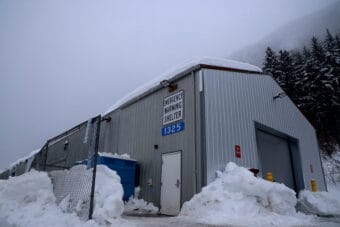
Juneau’s emergency warming shelter on Thursday, Jan. 25, 2024. (Clarise Larson/KTOO)

More than 60 inches of snow has fallen in Juneau during the last two weeks. That’s made it harder for people to get to the city’s emergency cold weather shelter in Thane.

Dave Ringle is executive director of Juneau’s St. Vincent de Paul chapter, which operates the shelter. He said the number of people staying there has increased as temperatures have dropped.

“Our numbers increased dramatically at the start of the new year,” he said. “We went from averaging 42 to averaging 52 people a night starting Jan. 1.”

A van usually drives downtown throughout the night to pick up people and take them to the shelter. But the snow made that impossible at times. 

“We’ve had some nights where the van was unable to be unstuck,” he said. 

On those nights, Juneau police and CARES sleep off center staff have stepped in to help. 

“On nights when it’s been really bad, they’ve been the ones on the lookout,” Ringle said. “They find people who are unsheltered and find the right places for them.”

Some warming shelter guests have continued to walk there despite the weather. Ringle said St. Vincent de Paul will accept donations of reflective vests and tape at their Teal Street office. They’re also accepting blankets and food that’s easy to distribute and prepare, like fruit snacks, granola bars, instant noodles and fresh produce.

Ringle said homeless service providers have been able to connect some people to housing this week, but there aren’t enough affordable options in Juneau to fully meet the demand.

This year’s Point-in-Time count will happen on Tuesday. It’s part of a nationwide effort to count the number of people experiencing homelessness and connect them to services. 

The count will take place at Juneau’s shelters, including Family Promise, the Glory Hall and Shéiyi X̱aat Hit Youth Shelter. Teams will also visit camps to meet people and distribute toiletries, clothing and other supplies.

Resurrection Lutheran Church will also host a breakfast on Tuesday morning at 7 as part of the count.

Juneau School District may close schools and cut staff amid budget crisis

Juneau School District Superintendent Frank Hauser explains the district’s projected $9.5 million budget deficit during a meeting on Thursday, Jan. 18, 2024. (Clarise Larson/KTOO)

Last week, the Juneau School District outlined its budget crisis at a community meeting in the Yadaa.at Kalé Juneau-Douglas High School auditorium.

Many parents asked how the district got here – how accounting errors by the district’s school finance manager, who resigned last month, could have created most of the deficit.

But others, like parent Kate Hudson, wanted to know what’s next. 

“Are schools going to close?” she asked. “Are teachers going to be sacked? Are teachers going to be told they need to take retirement? What are you actually saying?”

School Board members said all of those options were on the table.

“The thing we need from the public is an awareness and an acceptance that nobody is coming out untouched,” member Emil Mackey said. “Nobody.”

During a board retreat on Saturday, Superintendent Frank Hauser brought the board three examples of what school closures might look like.

The first model involves moving sixth grade to elementary schools and consolidating seventh and eighth grade at one campus. That would let the district close one middle school.

“All the elementary schools in the neighborhood become K through 6 schools,” Hauser said. “Sixth grades would no longer go to the middle schools. It would consolidate Floyd Dryden and D’zantiki Heeni to one school with grades 7 and 8.”

The second model goes a step further and splits elementary grades into kindergarten through third grade schools and grades 4 through 6 schools. District staff said that could allow them to consolidate the services it provides for younger and older elementary students.

The third model would close two schools through a combination of splitting grades and consolidating. Elementary grades would be split into K through third grade schools and grades 4 through 6 schools. Thunder Mountain High School would become a junior high, with grades 7 through 9. Grades 10 through 12 would go to Yadaa.at Kalé Juneau-Douglas High School.

But board member Will Muldoon said he was hesitant to split up high school grades.

“No other district does that, and I don’t know how that impacts activities, athletics,” he said. “We hear that those are the reasons that kids come to school.”

All three models would save money by eliminating staff positions like principals, office staff and nurses. Increasing class sizes could lead to further staff cuts.

Saturday’s meeting included some good news: further analysis puts the district’s estimated deficit at $8.5 million instead of $9.5 million. Finance contractor Lisa Pearce said she and district staff found $1 million in savings related to health insurance.

But addressing the deficit will still require other cost saving measures.

District leaders discussed splitting custodial, maintenance and utilities costs with the City and Borough of Juneau. District and city leaders have also discussed moving programs like Community Schools over to the city. After Sitka’s Community Schools ended in 2019 amid budget cuts, the City and Borough of Sitka revived it as a city program.

The board also asked the superintendent to look into four-day school weeks, something the Kenai Peninsula Borough School District is also considering.

The district has created a reorganization committee made up of teachers, community members and school board members to provide input on potential school consolidations. The board’s next budget work session is Tuesday at 5:30 p.m.

City asks Juneau drivers to move cars for Friday night snow plowing

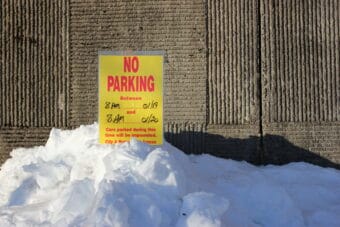
Juneau drivers parked in certain areas downtown must move their cars by 8 p.m. on Friday, Jan. 19, or be towed. (Katie Anastas/KTOO)

Juneau drivers parked in certain areas downtown must move their cars by 8 p.m. Friday or be towed.
The city is removing snow from 8 p.m. Friday through 8 a.m. Saturday from stretches of Fifth, Sixth and Eighth Streets along with East Street, Gold Street and Basin Road. 

The city is asking drivers to remove vehicles from the following areas:

  • Basin Road, from Eighth Street to Sixth Street
  • Eighth Street, from Basin Road to Gold Street
  • Gold Street, from Eighth Street to Fourth Street
  • Sixth Street, from Main Street to Gold Street
  • East Street, from Sixth Street to Fifth Street
  • Fifth Street, from Gold Street to East Street

Any cars parked there after 8 o’clock tonight will be towed to the Whittier Street parking lot by Centennial Hall.

A map from the city shows where drivers should avoid parking on Friday night. (Courtesy of the City and Borough of Juneau)

Juneau superintendent says ‘small, targeted cuts’ won’t fix budget crisis

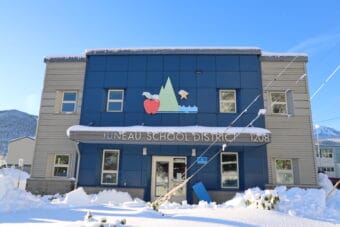
The Juneau School District office on Tuesday, Dec. 16, 2024. (Clarise Larson/KTOO)

At a Juneau school board meeting Tuesday night, Superintendent Frank Hauser said the district needs to cut about 10% of its budget to address its $9.5 million deficit.

“With the magnitude of this problem and these numbers, I don’t believe it’s possible any longer for the district to make small, targeted cuts to address these huge numbers,” he said.

The size of the deficit — which was driven in part by accounting errors and shrinking enrollment — only came to light this month. On Tuesday, Hauser presented a list of immediate changes the district can make to start chipping away at it. 

His list included a hiring freeze, limiting travel and reducing summer school offerings to high school credit recovery, grant-funded classes and Alaska Reads Act requirements — a small slice of the deficit.

“These are a rough saving estimate of approximately $350,000,” Hauser said. “I actually have a goal of identifying $1 million in savings to enact before June 30.”

Hauser also outlined broader changes the board could consider, like increasing class sizes or consolidating schools. Hauser said that increasing the ratio of students to teachers by two in elementary grades and three in secondary grades could save more than $2 million. But he warned that closing schools could cost the district state funding because the state’s school funding formula benefits smaller schools.

From there, Hauser said, the district could start thinking about more targeted cuts. That could include eliminating certain positions, like librarians, counselors, nurses and office staff. 

The board could also consider cutting elective classes. Hauser said it could be complicated.

“The question of what is ‘not required’ has a lot of variables for the board to consider,” Hauser said. “Teachers might teach one section of a required class, like English 9, and one section of an elective class, maybe yearbook.”

Board member David Noon, a professor at the University of Alaska Southeast, said he understood how district employees might be feeling. Gov. Mike Dunleavy proposed major budget cuts for the university system in 2019.

“Those of us who worked there spent six months in a kind of continual panic over the future of our positions,” he said. “And I know there are a lot of people watching this meeting right now who are also concerned about the future of their employment with the district.”

Even with major cuts, the district won’t be able to close its budget gap in one year. Hauser said the Alaska Department of Education and Early Development is giving the district five years to address the deficit.

But the district will still be required to pass a balanced budget. Hauser said the district could consider taking out a loan. For example, he said, if the district made enough cuts to get the deficit to $5 million, it could take out a $5 million loan.

That would require approval from the state. And board finance committee chair Will Muldoon said the district would still need to address its underlying budget challenges.

“Even if the agreement with DEED does work out, it still does not change the size of the deficit. It just changes the size of the runway that we have to land this issue,” he said.

The school board and district leaders will continue discussing budget cuts in the coming weeks. The board’s finance committee will meet on Thursday at 12 p.m. on Zoom.

Site notifications
Update notification options
Subscribe to notifications