Nation & World

An Alaska Tribal court judge breaks down ICWA’s past, present and future

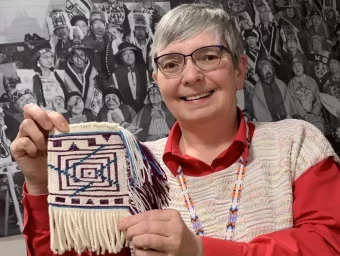
Judge Debra O’Gara pictured in 2020. She has spent over a decade working on Indian child welfare cases and directing trainings on ICWA for guardians, case workers and lawyers, in the state and Tribal court systems.  (Photo courtesy of Debra O’Gara)

On November 9th, the U.S. Supreme Court will hear Haaland v. Brackeen, a case that challenges the constitutionality and the future of the Indian Child Welfare Act (ICWA).

ICWA was established in 1978 “to protect the best interest of Indian Children” by creating federal standards for removing Native children from their families and making sure Native children were placed in homes that would reflect their culture. 

Judge Debra O’Gara has spent over a decade working on Indian child welfare cases and directing trainings on ICWA for guardians, case workers and lawyers, in the state and Tribal court systems. 

O’Gara, who is Lingít, Yupik and Irish, lives in Petersburg. She and her siblings were raised by a single mom who worked nights as a cocktail waitress.

“In one of the suburban, predominantly white neighborhoods that we lived in, there was twice in my childhood where [Child Protective Services] was called in and an investigation was conducted,” she said. “There were assumptions that we weren’t taken care of because my mom wasn’t home at night. In fact, we actually were taken care of and had somebody staying there with us. We were doing just fine.”

This was before ICWA, and these childhood experiences led O’Gara to carve out a career protecting Native families from unnecessary separation. 

The state of ICWA in Alaska

O’Gara says that some states are better than others at adhering to ICWA. 

“But right now, Alaska, I would say, is not doing so well,” she said. “The state of Alaska has not followed the spirit or the letter of the law.”

More than 20% of Alaskans are Alaska Native or Native American, but about 55% of children in state custody are Alaska Native.

Presiding Judge Debra O'Gara stands in the Juneau courtroom of the Central Council of Tlingit and Haida Indian Tribes of Alaska. (Photo by Ed Schoenfeld/CoastAlaska News)
O’Gara in the Juneau courtroom of the Central Council of Tlingit and Haida Indian Tribes of Alaska in 2017. (Photo by Ed Schoenfeld/CoastAlaska)

O’Gara said that many of these children are eventually adopted by non-Native families and often even removed from Alaska, despite the passage of ICWA.

“So what happens there is the Tribe loses their children,” she said. “And the children lose their connection to their Tribal affiliation. For those of us here in Southeast that grow up in a clan, they lose their identity as a clan, what clan they belong to, what house they belong to, what their Lingít name is or how to name who their relatives are, and that whole belonging and knowing who they are.”

O’Gara pointed to multiple factors that lead to this high percentage of Alaska Native children being removed from their homes. Some of it, she attributes to a lack of training and consistent, skilled staff in the state’s system leading to a backlog of cases in the courts. 

“Training needs to be consistent with every new staff that comes in,” she said.

Without that, she says, staff bias figures into the equation. For instance, part of many Native cultures is having many relatives living under one roof. But for the state, a house with three or four times more people living in it than if it was a non-Native or white house is considered overcrowded. 

In Southeast Alaska, clan members are considered family. 

“And that’s as that’s actually as strong as a blood relation, sometimes stronger,” O’Gara said.

To her, these multi-generational families meant that there were lots more mentoring, opportunities for teaching and sharing childcare responsibilities. 

But, because these familial structures are less common in the U.S., she says, the system often gets concerned about who is taking care of the children in these households. 

“There’s prejudices and assumptions that are made that then lead to the children being removed when they shouldn’t have been removed in the first place,” O’Gara said. “And then once you get into that system, it’s really hard to prove that there’s nothing going on.”

Where ICWA began

Before ICWA, one way Native children were systematically removed from their families was by declaring they were neglected or abused by their parents. Another way is perceived “poverty and lack of parenting by Western standards” says O’Gara.

“There was a great outcry in the 60s and 70s about the continued removal of children,” O’Gara said. “At the same time that this was happening, there were also children being removed from their communities and forced to go into boarding schools, which we in the Native community all know about.”

She added that this was especially devastating to the Native community because much of the culture is based on the land they live on and the ceremonies that are performed with their families.

“The removal of the Native children was just one of the ways to completely annihilate and disappear Native people,” she said.

When ICWA was finally passed in 1978, O’Gara says it recognized that children have the right to know who they are.  

“It also recognized that the Tribe had a legal interest in protecting the Tribe’s children,” she said.

The future of ICWA

Today, ICWA is often considered the “gold standard” for all children by child welfare experts.  

“The other thing that ICWA did is to mandate placement preferences,” O’Gara said. “And the placement preferences, I have always argued, should be universally applied to not just Native children, but to all children who find themselves in the child welfare system.” 

These placement preferences she outlined mean that children removed from their parents would first be placed with family. The next option after biological family is clan family or psychological family, which includes community members and long term friends, she said. 

“Lastly, when all of those [options] have been exhausted, and there’s no placement found, then with an appropriate non-Native family,” she said. “Often in the current child welfare system in Alaska, those first three get skipped over. And there’s efforts to continue to have those systems be improved, so that the first that the preferences can be placed.”

O’Gara believes that parents who are being accused of neglect or abuse of a child need time to seek treatment or help, but in the meantime, children shouldn’t lose their connected to their community or their family. 

The plaintiffs in the Brackeen v. Haaland case say that giving additional support to Native parents and prioritizing Native homes for Native children violates the equal protection clause.

“So one argument I’ve heard is that Native [people] should not be given special treatment,” O’Gara said. “Well, my answer to that is the guidelines should be applied to everybody equally… Because all children also have the right to know who they are, who their family is, where they belong, and some of their family history.”

She thinks that providing active efforts and services for parents and children—like those outlined in ICWA—would “benefit every child in the child welfare system.”

“We’re not just a minority like any group,” she said. “We have a special relationship with the federal government, in that we are sovereign nations.”

There have been many attempts to change or weaken ICWA in various state courts, but she also sees this as an opportunity for states to go in and strengthen ICWA. Washington state, where O’Gara grew up, has extra provisions that protect Indian children more than the federal ICWA does.

“And certainly Alaska is able to do that,” she said. “Ever since ICWA has passed, there’s been political forces that have attempted to eliminate it, and they have not yet been successful. It doesn’t mean that it’s not as strong as it was when we first passed. And at some point, we will be able to turn that tide and get back to strengthening it.”

Your Alaska 2022 midterm election questions answered

KTOO has partnered with America Amplified to answer questions about how to participate in the special and midterm elections. Here are some of the top questions from Alaskans we have been able to answer thus far. 
Do you have a question we haven’t answered yet? Submit your question at the bottom of this page. 

​​Frequently Asked Questions about the midterm elections: 

When is the election?

The Midterm Election is Tuesday, November 8, 2022. 

In general, the polls open at 7:00am and close at 8:00pm in Alaska.  But check your local polling place to make sure.  

Early voting in most precincts begins on October 24. You can search for early voting locations here:  https://www.elections.alaska.gov/avo/. Voted mail-in ballots can be delivered to any Division of Elections office, an Early or Absentee In-Person Voting Location, or at a Polling Place on Election Day.

What’s on my ballot?

Each house district has a different ballot.  You can view the different ballots by clicking on your house district.

Where do I register to vote? How do I find out if I’m registered to vote?

You can check your voter registration status by going to the Division of Elections website and filling in your information.  The registration deadline for the November Midterm Election was October 9, 2022. 

If you moved after the registration deadline, and still wish to vote with your new address, call the Voter Hotline at 907-243-8683 and you will be given instructions to go to a Vote Center to vote.  You will be offered a Questioned Ballot so election officials can get your new address to update the voter registration database.  

What do I need to take with me to the polls?

You will be asked for identification by the precinct register worker such as: Voter ID card, driver’s license, state ID, military ID, passport, hunting or fishing license or other current or valid photo ID. If you do not have the one of the identifications listed above, you may present a current utility bill or paycheck, government check or bank statement or other government issued document.   The election worker will look up your name on the precinct register. Upon locating your name, you will check your residence address. If your residence address has changed, you will be asked to vote a questioned ballot. If you do not have any changes, sign your name in the space provided. 

What CAN’T I bring with me to the polls?

Alaska law prohibits campaigning within 200 feet of any entrance into a polling place while the polls are open. This prohibits campaigning materials on your car, displaying campaign items such as signs, buttons, etc. for candidates or issues appearing on the ballot or discussions of candidates or issues appearing on the ballot within the 200 foot perimeter.

Who running is an election denier? 

We asked all the candidates for governor and US House and Senate if they believe Joe Biden won the election in 2020. Their answers are published in our candidate comparison guide

If I don’t rank a candidate, will they be ranked lower than if I rank them #3? If I don’t rank them, will they be ranked lower than if I ranked them #2?

If you don’t rank a candidate your vote will not be counted toward that candidate. Your vote is only counted for one candidate. If your first choice is eliminated, your vote moves to your choice for #2. If you do not rank a #2, your vote does not get redistributed.

I lost my Driver’s License and my Real ID is still in the mail. My passport is in the process of being renewed. I have my voter registration card. Are there other forms of ID (birth certificate, printed temporary REAL ID) that work to vote?

You will be asked for identification by the precinct register worker such as: Voter ID card, driver’s license, state ID, military ID, passport, hunting or fishing license or other current or valid photo ID. If you don’t have one of those, you can bring a current utility bill or paycheck, government check or bank statement or other government issued document. Voting this way will be considered a questioned ballot which just means a bi-partisan review board will review and determine if your ballot can be counted. 

Why is the final list of  candidates to rank limited to only four? A bigger list will allow more choice which is the whole point of ranked choice voting. 

The ballot measure that passed in 2020 limits the number of candidates to four. That is an increase from the traditional two candidates, one from the Republican party and one from the Democratic party. You can read more about the ballot measure from Ballotpedia

I don’t understand the Nonpartisan Pick One Primary Election. How are the candidates qualified to move to the general election?  

In the nonpartisan pick one primary election, voters vote for one candidate in each race regardless of political party or affiliation. The four candidates who receive the most votes advance to the general election. If there are less than four candidates in the primary, they all automatically advance to the general election. There’s more information on the nonpartisan primary election process and ranked choice voting at the state Division of Elections website

For the special general election, are voters able to write in two names to rank along with selecting one candidate from the names listed on the ballot?  

There is only room to write in one candidate per race on your ballot, according to the Alaska Division of Elections. It also notes that write-in candidates will only advance if they come in first or a close second. You can read more information about ranked choice voting here: https://www.elections.alaska.gov/RCV.php.

So the ballot measure of 2020 that instituted ranked choice voting did not apply to primary elections?  That’s why we have pick one primaries?  When and how (e.g. statute, court order) did primaries with all parties on one ballot start?

The pick-one open primary was part of the ballot measure in 2020, the voter-approved law that begins with this year’s elections. You can read more at alaskansforbetterelections.com, which is the group that lobbied for the new law.

Where can I get information about each of the candidates? 

You can check out our very cool Candidate Comparison tool at ktoo.org/elections for a more complete listing of the candidates. 

Where can I see a sample ballot for the election that is starting today, 10/24/22?

The Alaska Divisions of Elections website can show you your sample ballot, based on what House district you live in.  (If you don’t know your district, go to census.gov and put in your address to find out).

The contest [for Governor] appears to be between the size of the dividend and funding education.  Where do the candidates stand?

Using our candidate comparison tool, you can look at where candidates stand on the issues that matter most to Alaskans, including the dividend amount and other state budget considerations. 

Did Buzz Kelly withdraw [from the U.S. Senate race]?  What will happen to the votes that are for him?  Will he be in the first round of vote counting?

Buzz Kelly withdrew from the race in September after finishing fourth out of five candidates in the primary election. He did not withdraw before the Alaska Division of Elections’ Sept. 5 withdrawal deadline. So his name remains on the ballot and votes for him will be counted. It’s likely that he’ll finish last and if that happens, in a second round of counting the people who ranked him first will have their votes reallocated to the candidate they ranked next. But if somehow he wins with more than 50% of first place votes, then he will have to decide after the election results are certified if he wants to be senator or not. If he doesn’t want to be senator, then the Governor would call a special primary election to fill the vacant senate seat.  

I’m thinking about just dropping my completed ballot off at the Division of Elections Juneau office.  Am I able to do that now? Could they lose my ballot there easier than if I mailed it?  

You can drop off your ballot at one of the two polling places in Juneau that are open for Early Voting: the Division of Elections office at the Mendenhall Mall in the Valley or in the State Office Building Downtown. In Alaska, this is considered in-person absentee voting — because you are submitting an absentee ballot in person instead of sending in the mail.  If you drop it off anytime between now and 8 p.m. on Election Day you can be assured that your ballot will be secure and your vote will be counted.

The only risk with mailing your ballot is missing the deadline – if it is not postmarked on or before election day, your ballot won’t be counted. 

This post will be updated as we continue to get questions, and find answers!

This FAQ is part of KTOO’s participation in the America Amplified initiative to use community engagement to inform and strengthen our journalism. America Amplified is a public media initiative funded by the Corporation for Public Broadcasting.

2020 changed how America votes. The question now is whether those changes stick

A voter dropping a ballot in a drop box
Voters deposit their mail ballots at Desert Vista Community Center in Las Vegas on Oct. 22. Mail voting, which has increased for years, surged in 2020 during the early months of the pandemic. Nevada has since codified an expansion of mail voting. (Photo by David Becker/Getty Images)

The story of how 2020 changed voting in America has been well told by now: Whether it was 24-hour early voting sites or ramping up mail voting options, virtually every election jurisdiction in the country did something to expand access and make voting easier and safer during the early months of the pandemic.

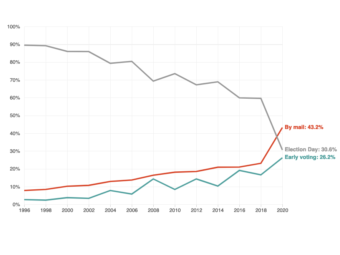
And voters responded. Roughly 70% of the more than 150 million votes cast in that election were cast before Election Day.

The question now is whether that was a blip in voting behavior, or whether the country will, decades from now, look back on 2020 as the election that changed voting patterns for good.

With more than 15 million early votes cast already in this year’s midterms, University of Florida political scientist Michael McDonald says it’s looking more and more like the latter.

“We were already in that direction. [Early and mail voting] had been slowly increasing over time, but 2020 just turned everything around,” said McDonald, who wrote a book that analyzed turnout trends in the 2020 election.

A line graph showing steep growth in voting by mail in 2020
Source: U.S. Census Bureau
Credit: Thomas Wilburn and Connie Hanzhang Jin/NPR

In the two years since, state legislators everywhere have been reckoning with whether to codify those voting expansions, or whether to rein them back. That’s led to a historic amount of new election laws over the past two years.

And while much of the national news coverage has focused on states that have passed restrictive measures in that time, the broad trend nationally over the last decade has actually been toward more early voting access. McDonald says that partially explains the historic level of early voting this cycle — it’s much more available than it was even four years ago.

“In some places, we’re simply seeing more early voters because there wasn’t really an opportunity to vote early in many places back in 2018. So that’s one part of it,” he said.

States like Nevada and Massachusetts, for instance, have expanded their vote-by-mail options permanently since the start of the pandemic. Even Georgia’s election law, which made voting by mail more difficult, actually expanded the amount of early in-person voting available in the state.

In fact, a recent report from the Center for Election Innovation & Research found that there are now just four states — Alabama, Connecticut, Mississippi and New Hampshire — that don’t allow for either widely available in-person early voting or no-excuse mail voting. (Connecticut voters are weighing a ballot measure this cycle that would allow an expansion of early voting in the future.)

“Despite some unnecessary laws passed in response to lies that the 2020 election was somehow stolen, most voters in 2022 will find that the process is similar to 2020 and 2021, and relatively convenient,” David Becker, CEIR’s founder and executive director, said in a statement about the report’s release.

A map of the U.S. showing what types of voting are available in which states
This graph from researchers at the Center for Election Innovation & Research shows that the vast majority of states now offer in-person and mail voting to all voters.
Center for Election Innovation & Research

Some Republicans are now using that broad trend toward access — and the record early turnout this midterms — as a cudgel against those who raised alarm at restrictive laws passed by GOP legislatures over the past two years.

“Georgians have already cast 1 million votes. Biden’s home state of Delaware hasn’t even opened early voting yet. But sure, keep calling us Jim Crow 2.0!” former Georgia Republican Sen. Kelly Loeffler tweeted on Thursday.

But Democrats like Georgia gubernatorial nominee Stacey Abrams noted that calculating the people who still didn’t vote in an election due to law changes is almost impossible. Even in Georgia’s record turnout election in 2020, for instance, nearly a third of the voting-eligible population didn’t vote.

“The vernacular way of putting it is more people in the water does not mean there are fewer sharks,” Abrams said. “The barriers to access are real.”

McDonald similarly said it was way too early to declare one way or another the effect of Georgia’s or any other state’s legislation. He’ll be analyzing post-election data to see whether different demographic groups were able to vote at similar rates, for instance.

“You could see turnout go up … but maybe there are some communities that are left behind,” McDonald said. “We should have an election that’s fair for everybody.”

There’s a partisan divide in how people vote

The most obvious takeaway from the underlying early vote data available so far is the clear partisan divide.

Influential Republicans like former President Donald Trump and election denial influencers like Mike Lindell have spent the past few years spinning conspiracies about mail voting, and to a lesser extent early voting more broadly.

In 2020, that messaging led Joe Biden supporters to vote by mail at nearly double the rate as Trump supporters, and similar trends are bearing out in 2022 as well.

In Pennsylvania, which offers absentee voting ahead of time but no precinct-based early voting option, votes from registered Democrats outnumbered those from registered Republicans, 531,430 to 143,334, as of Oct. 27.

Similarly, in North Carolina, registered Democrats are roughly tripling registered Republicans in returned mail ballots.

It’s hard to read too much into those leads, however, as Republicans say they will turn out in droves on Election Day. A recent NBC News poll found that 60% of Republicans said they planned to vote on Nov. 8, compared to just 36% of Democrats.

Charles Stewart, an elections expert who founded MIT’s Election Lab, says he thinks at some point Republican distrust of mail and early voting will fade, simply because it’s an illogical campaign strategy.

“I think in the long run there’s going to be a [partisan] convergence, but in the short run as along as the Lindell-ites are out there doing their work, there’s going to be a constant buzz within Republican circles that ‘we’re out to constrict the use of voting by mail and we’re trying to push everybody to vote on Election Day,’ ” Stewart said.

But, he adds, getting voters to re-embrace Election Day voting would be an uphill battle.

“The immovable force in elections over the last 20 years hasn’t changed,” Stewart said. “And that is voters really demanding more convenience.”

Copyright 2022 NPR. To see more, visit https://www.npr.org.

In the U.S., some 4.6 million people are disenfranchised due to a felony conviction

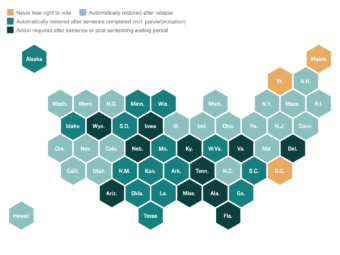
In North Carolina, as of July 27, 2022, people serving felony sentences who aren’t in jail or prison may vote. A legal decision on the matter is being appealed. Source: National Conference of State Legislatures/NPR reporting (Credit: Kaitlyn Radde/NPR)

An estimated 2% of the voting age population in the United States will be ineligible to cast ballots during this year’s midterm elections due to state laws banning people with felony convictions from voting.

That’s according to research released Tuesday by the Sentencing Project, a nonprofit organization that advocates for restoration of voting rights for people with prior felony convictions.

“This report makes it clear that millions of our citizens will remain voiceless in the upcoming midterms,” Amy Fettig, the group’s executive director, said in a statement. “Felony disenfranchisement is just the latest in a long line of attempts to restrict ballot access, just like poll taxes, literacy tests and property requirements were used in the past.”

The impact of these state-level bans, which are on the books in 48 states across the country, varies significantly depending on where someone lives.

According to the Sentencing Project, state-level disenfranchisement rates range from 0.15% in Massachusetts to more than 8% in Alabama, Mississippi and Tennessee. In Vermont and Maine (along with Washington, D.C.), none of the population is disenfranchised because those jurisdictions allow people in prison to vote.

Currently, 11 states deny voting rights to people after they finish their full sentences, including parole and probation.

Overall, the number of Americans disenfranchised due to a felony conviction has been dropping in recent years. Since 2016, that number has declined by 24% “as more states enacted policies to curtail this practice and state prison populations declined modestly,” according to the new research.

In 2016, 6.1 million people with felony convictions were disenfranchised. This year it’s estimated that 4.6 million people will be barred from voting.

Demographic disparities and Florida turmoil

The Sentencing Project also found that state-level voting bans have a disproportionate impact on Black and Latino voters.

According to the report, “1 in 19 African-Americans of voting age is disenfranchised, a rate 3.5 times that of non-African Americans.”

And researchers estimate that “at least 506,000 Latinx Americans or — or 1.7 percent of the voting eligible population” are also disenfranchised during this year’s midterm elections.

Because ethnicity data is unevenly reported and limited, researchers say, this estimate is likely an undercount of true disenfranchisement rates among Latinos. Even with the undercounting, the report notes, “31 states report a higher rate of disenfranchisement in the Latinx population” than in their general population.

Among states, Florida has the highest number of disenfranchised citizens, with more than 1.1 million people currently prohibited from casting a ballot. Most of those individuals, researchers say, are disenfranchised simply because they cannot afford to pay court-ordered fees or fines.

In 2018, Florida voters approved a ballot measure restoring voting rights to people who completed their prison sentences — except people convicted of murder or a felony sex offense. But Republican lawmakers in the state then passed a bill requiring these returning citizens to fulfill every part of their sentence, including paying any fees or fines, in order to regain their voting rights. The Sentencing Project estimates that about 934,500 Floridians who have completed their sentences remain disenfranchised because of the state’s law.

The Florida measure returned to the forefront in August, when Republican Gov. Ron DeSantis announced the state was charging 20 people with voter fraud because they allegedly voted in the 2020 election despite having been convicted of a crime that prohibited them from having their voting rights restored.

Many of the individuals charged told law enforcement officials they thought they were eligible to vote because they had completed their sentences and had been issued a voter registration card. So far, at least one of those cases has been dismissed.

Voting rights advocates say these arrests were largely due to confusion created by Florida’s law, as well as a lack of a database for election officials to check to see if someone qualifies to have their voting rights restored.

Copyright 2022 NPR. To see more, visit https://www.npr.org.

Children’s hospitals grapple with a nationwide surge in RSV infections

""
Models of a protein from the respiratory syncytial virus are shown at The University of Texas at Austin on March 31, 2022. A spike in RSV cases among children is pushing some hospitals to capacity. (The Washington Post via Getty Images)

An unseasonably early spike in respiratory syncytial virus cases among young children is pushing some hospitals to capacity.

RSV, as it’s called, is a respiratory virus that mostly manifests as a mild illness with cold-like symptoms in adults but can cause pneumonia and bronchiolitis in very young children. It can be life-threatening in infants and young adults.

Most years, infections typically occur in the late fall and winter, often overlapping with flu season. But at least since last year, physicians have begun seeing surges starting during summer months.

Children’s hospitals in the Washington, D.C. area, including Children’s National Hospital, Inova Fairfax and Johns Hopkins in Baltimore, are at or near capacity, DCist reported.

Connecticut Children’s Hospital in Hartford has had its pediatric in-patient beds full for the last few weeks, WTNH reported. With no indication of the spread slowing down, officials there are seeking the help of the National Guard and FEMA to set up tents in order to expand capacity.

In Texas, doctors at Cook Children’s hospital in Fort Worth told ABC News they are treating some 300 RSV patients a day.

“Last year, more people were wearing face masks and children were more likely to stay home while sick,” Dr. Laura Romano said in Cook Children’s in-house publication.

“This year, parents are sending their children to daycare and school for the first time following two years of the pandemic. … Children who haven’t been previously exposed to respiratory viruses are getting sick,” Romano said.

Health officials in King County, Wash., are also alarmed as they brace for more cases once winter hits. Dr. Russell Migita with Seattle Children’s Hospital told King 5 News they are seeing about 20 to 30 positive cases every day, adding that those are “unprecedented” figures.

How RSV shows up

RSV symptoms are similar to a cold and can be harmless in adults, but the CDC says children under the age of 5 are the most affected group. According to the agency’s data, each year approximately 58,000 children in that age range are hospitalized for RSV. The next most vulnerable group are adults over 65, in whom the infection causes 14,000 deaths a year.

RSV can lead to bronchiolitis, an infection that causes airways to become inflamed and clogged with mucus, making it difficult to breathe. If the infection travels to the lung sacs, it can result in pneumonia.

Dr. Sara Goza, physician and former president of the American Academy of Pediatrics, talked to NPR last year about how the infection presents in infants.

“A lot of the babies under a year of age will have trouble breathing. They stop eating because they can’t breathe and eat at the same time. And they’re wheezing, so they’re in respiratory distress,” Goza said.

Other symptoms include coughing, excessive sleeping and lethargy.

There is no vaccine to prevent RSV, but doctors are urging patients to get the flu shot. It doesn’t prevent the infection but it could spare people from more aggressive symptoms and keep them from seeking medical attention at already strained hospitals.

Copyright 2022 NPR. To see more, visit https://www.npr.org.

Ukrainians keep a wary eye on US midterm elections, fearing a loss of support

Soldiers in uniform operating a large field gun
Ukrainian servicemen prepare to fire at Russian positions from a U.S.-supplied M777 howitzer in the Kharkiv region on July 14. (Photo by Evgeniy Maloletka/AP)

KYIV, Ukraine — Sitting on a park bench by a tram stop in Kontraktova Square, Marta Makarova, a 21-year-old budding social media influencer, takes a break from talking with two friends about Instagram to talk instead about the war. Makarova explains how much of their safety depends on U.S. support.

“We have some problems in our country,” she says, “and we need help, very, very, very much.”

Her friend Kyrylo Bessarab, 20, a photographer, nods his head. He holds up his phone.

He says the top issues trending on his social media channels are the upcoming U.S. elections and billionaire Elon Musk’s controversial comments about negotiating an end to the war.

Three young people sit on a bench outside, looking at one of their phones
From left: Friends Marta Makarova, Kyrylo Bessarab, 20, and Chistyakova Valeriya, sit in Kontraktova Square in Kyiv on Oct. 11. They are worried about the possible loss of U.S. support for Ukraine if Republicans win the House in next month’s midterm elections. (Photo by Franco Ordoñez /NPR)

“I know in the States there’s going to be elections,” Bessarab says. “Soon there might be some changes and society may be shaken.”

Plugged-in Ukrainians are keeping a close eye on next month’s U.S. midterm elections. The likelihood that Republicans will take control of the House has triggered concerns about long-term support for the war effort.

This week, House Republican Leader Kevin McCarthy warned that his party members will not write “a blank check” to Ukraine if they win control of the lower chamber next year.

“I think people are gonna be sitting in a recession and they’re not going to write a blank check to Ukraine,” he told Punchbowl News in an interview published Tuesday.

Many Ukrainians — elected officials and citizens alike — worry about how long the money will keep flowing.

Kevin McCarthy speaks from behind a lectern with other lawmakers standing behind him
U.S. House Minority Leader Rep. Kevin McCarthy speaks during a press conference at the U.S. Capitol in Washington on Sept. 29. He warned this week that his party members would not write a “blank check” to support Ukraine if they take control of the House. (Photo by Alex Wong/Getty Images)

“There are concerns that the support will become smaller,” says Mykola Kniazhytskyi, a member of parliament who represents western Ukraine.

Dozens of House Republicans voted against a Ukraine aid bill in May. And last month, all but 10 House Republicans voted against a government funding package that included billions of dollars earmarked for Ukraine.

A line of Ukrainian politicians, activists — even soldiers — have been traveling to Washington in advance of the midterms to keep up relations and lobby for more aid.

Yevheniia Kravchuk is a member of parliament with President Volodymyr Zelenskyy’s Servant of the People party. She’s traveled twice to Washington since the beginning of the war to meet with administration and congressional leaders, making sure to meet with both Democratic and Republican leaders.

“And every time, from both of the parties, we receive confirmation that bipartisan support will continue,” she says.

But Kniazhytskyi worries about the influence of a vocal group of Republicans, many aligned with former President Donald Trump, as well as conservative TV personalities who have been speaking out against the billions of dollars going to Ukraine.

Two women speaking to Sens. Ron Johnson and Lindsay Graham
Ukrainian parliament members Yevheniia Kravchuk and Anastasiia Radina, from left, meet with Wisconsin Republican Sen. Ron Johnson and Republican Sen. Lindsey Graham of South Carolina before a meeting at the U.S. Capitol in Washington in June. (Photo by Chip Somodevilla/Getty Images)

“When we see Fox News commentators, from our perspective, promote isolationist positions — that looks like support for Russia,” he says.

A Pew Research Center poll last month found that 32% of Republican and Republican-leaning independents believe the United States is providing too much support for Ukraine in the war. That’s an increase from only 9% in March.

Over roughly the same time, the percentage of Americans who said they were extremely or very concerned about Ukraine’s defeat fell from 55% in May to 38% in September.

The politics surrounding aid to Ukraine is not an easy subject to talk about in Kyiv, where government officials say avoiding partisan politics in the U.S. is a key pillar of Ukrainian foreign policy. That was the lesson learned during the Trump years, says Petro Burkovskiy, a senior fellow at the Democratic Initiatives Foundation who spent years in the Ukrainian government.

Three men in camouflage working around a field gun, one of them carrying a large artillery shell
A Ukrainian serviceman carries a 155 mm artillery shell before firing at Russian positions from a U.S.-supplied M777 howitzer in the Kharkiv region, on July 14. (Photo by Evgeniy Maloletka/AP)

Speaking at a mall that reopened after being bombed, Burkovskiy says leaders never want to appear to take sides.

“It means that you’re hedging your bets, working with both parties,” he says.

Burkovskiy laments how Ukraine got sucked into Trump’s first impeachment, after Zelenskyy came close to submitting to Trump’s demand to announce an investigation into the family of then-candidate Joe Biden.

Another factor contributing to fears about the U.S. midterms is that many Ukrainians don’t understand U.S. politics, says Volodmyr Dubovyk, the director of international studies at Odesa Mechnikov University.

He’s had to tell several Ukrainian reporters in recent weeks that, no, their country will not lose weapons if Republicans take the House.

“When there is someone, let’s say a member of House, and he or she speaks about ‘why are we spending money and Ukraine is corrupt, is not winning,’ and people in Ukraine hear this — it means, like, ‘Oh my God, that’s a new American position that’s going to prevail,'” he says.

Three young people sit talking at an outdoor coffee shop table.
From left: Ivan Sushchyk, Vadym Zahozytsky and Yana Yelizarova discuss U.S. support for the war in Ukraine at a coffee shop in Kyiv on Oct. 11. (Photo by Franco Ordoñez/NPR)

At a downtown coffee shop, Vadym Zahozytsky, 24, who works at a local insurance company, says he’s not worried.

The balance of power in Washington means that a few Republicans can’t change the direction of U.S. support for the war, he believes. And he emphasizes that Ukraine has much bigger problems than U.S. politics.

“I have concerns about the politics of only one country that affects Ukraine and our security,” he says. “Russia.”

Copyright 2022 NPR. To see more, visit https://www.npr.org.

Site notifications
Update notification options
Subscribe to notifications