An image released by the NASA Earth Observatory shows the volcanic eruption on Home Reef. (Photo by Lauren Dauphin/NASA Earth Observatory)
There’s a new island in the South Pacific.
Earlier this month, an underwater volcano near Tonga erupted, oozing lava and expelling steam and water above the surface. It also formed a new land mass that’s quickly grown from one to more than eight acres in size.
According to NASA’s Earth Observatory, a volcano on what’s known as the Home Reef seamount began to erupt on Sept. 10. Eleven hours later, the unnamed island poked out of the water.
On Saturday the Tonga Geological Services estimated that the island had expanded to roughly 8.6 acres and stood at around 50 feet above sea level as of Sept. 19.
The geological agency said “volcanic activities” were continuing at Home Reef but that they posed only a low risk to the local Vava’u and Ha’apai communities.
This isn’t the first time Home Reef has erupted. The region of submarine volcanoes flared up in 1852, 1857, 1984 and 2006, producing new islands each time.
Islands created by underwater volcanic activity can exist for years, though they typically don’t last long, NASA said.
But there’s hope the little atoll located southwest of Tonga’s Late Island could endure. An island created by the nearby Late’iki Volcano in 1995 lasted for 25 years.
According to the space agency, Home Reef is part of the Tonga-Kermadec subduction zone, where three tectonic plates are smashing into each other and creating an active area for undersea volcanoes.
Copyright 2022 NPR. To see more, visit https://www.npr.org.
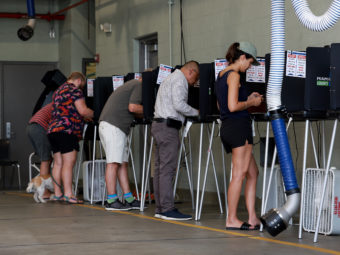
Voters cast their ballots at a polling station set up in a fire station on Aug. 23 in Miami Beach, Fla. (Photo by Joe Raedle/Getty Images)
With two months to go until the midterms, tech companies are getting ready: rolling out fact checks, labeling misleading claims and setting up voting guides.
The election playbooks being used by Facebook, Twitter, Google-owned YouTube and TikTok are largely in line with those they used in 2020, when they warned that both foreign and domestic actors were seeking to undermine confidence in the results.
But the wave of falsehoods in the wake of that election — including the “big lie” that Donald Trump won — has continued to spread, espoused by hundreds of Republican candidates on ballots this fall.
That’s left experts who study social media wondering what lessons tech companies have learned from 2020 — and whether they are doing enough this year.
The host of election-related announcements in recent weeks add up to a “business as usual” approach, said Katie Harbath, a former elections policy director at Facebook who’s now a fellow at the Bipartisan Policy Center.
The return of familiar playbooks
The platforms are largely taking a two-pronged approach: tamping down misleading or outright false claims, and boosting authoritative information from local election officials and reputable news sources.
In the first case, all four major platforms are leaning on labels to flag falsehoods and, in many cases, direct users to fact checks or accurate information. In some cases, users won’t be able to share labeled posts and the platforms themselves won’t recommend them. YouTube, Facebook and TikTok also say they will remove some specific false claims about voting and threats of violence.
Platforms are often hesitant to spell out exactly how they enforce their policies to avoid giving bad actors a roadmap. The range of approaches to labeling and removal also illustrates the fraught balance the companies try to strike between letting users express themselves and protecting their platforms from being weaponized — all while facing scrutiny from politicians on both sides of the aisle.
Policies diverge most when it comes to political ads. Twitter and TikTok have banned ads for candidates and about political issues. Google and Facebook both allow them, requiring disclosure of who pays for them. Facebook is once again freezing all new political ads in the week before Election Day but will allow existing ads to continue running.
But defining when an ad or issue qualifies as political isn’t straightforward, leaving gaps that experts worry could be exploited.
“It’s actually a quite confusing landscape because there is no regulation, there are no standards these companies have to follow,” Harbath said. “Everyone is just making the choices that they feel are best for them and their company.”
On the flip side, all four platforms are highlighting features that aim to put more reliable information in users’ feeds, such as providing information about candidates, voter registration and when and where to cast ballots. That information will also be available in Spanish across platforms.
Branching out beyond English is an important step towards addressing a “glaring omission” in previous elections, said Zeve Sanderson, executive director of New York University’s Center for Social Media and Politics.
In the final days of the 2020 election, Latino voters were targeted with social media posts discouraging them from voting, according to voting rights activists and disinformation experts.
Evidence is mixed on how well platform policies work
Even as social media companies double down on their 2020 tactics, researchers say it’s not always clear how effective their interventions are.
In the case of labels, there is mixed evidence about whether they help dispel false impressions, or if, in some cases, they may inadvertently encourage people to double down on those beliefs.
Last year, researchers at NYU analyzed what happened after Twitter labeled some of Trump’s tweets before and after the 2020 election as containing misinformation. They found the labeled messages spread even further on Twitter, and also took off on other platforms including Facebook, Instagram and Reddit.
The platforms have given small peeks into what they know about how well their tools work. Twitter has said after it redesigned its misleading information labels last year, more people clicked through to read accurate information.
Facebook, meanwhile, says it will be more choosy about what it labels, after users said labels were “over-used” in 2020. “In the event that we do need to deploy them this time round our intention is to do so in a targeted and strategic way,” Nick Clegg, president of global affairs at Facebook parent Meta, wrote in a blog post.
But for NYU’s Sanderson, that raised more questions the company has not answered.
“What was the feedback? From which users? What do the words ‘targeted’ and ‘strategic’ mean?” he said. “It would be really helpful for them to contextualize it within actual details of what their internal research has found.”
Pro-Trump protesters gather in front of the U.S. Capitol on Jan. 6, 2021. (Photo by Brent Stirton/Getty Images)
Moving beyond misinformation “Whac-A-Mole”
What’s more, it’s hard to know how well the companies enforce their policies — which Harbath, the former Facebook official, described as a “huge gap.”
“The companies are like, ‘These are our policies, these are all the things that we’re going to do.’ But they don’t talk enough about, ‘OK, but humans are fallible. The technology is not 100% perfect,’ ” she said.
In the hours after polls closed in 2020, Trump supporters began rallying online under the slogan “Stop the Steal,” Facebook removed the first Stop the Steal group on its platform quickly, under its rules against casting doubt on the legitimacy of the election and calling for violence. But more groups kept popping up — and Facebook was unable to keep up.
Researchers warn that the 2020 approach to election falsehoods doesn’t address the reality of 2022. Tech companies approach elections as discrete events, typically putting policies in place and then turning them off when the voting is over — even though false claims don’t end when the ballots are counted.
“The companies should be doing a lot more to have an always-on policy, because clearly these topics around the integrity of elections are certainly staying in the lexicon and the conversation well beyond Election Day,” Harbath said.
The big challenge is for companies to move beyond being reactive and find ways to prevent their platforms from being used to spread these kinds of falsehoods so widely in the first place.
“When it comes to election misinformation and disinformation, platforms are kind of just playing Whac-A-Mole — trying to get on top of something before something else arises,” said Spandi Singh, a policy analyst at the Open Technology Institute at the think tank New America.
Editor’s note: Facebook parent Meta pays NPR to license NPR content.
Copyright 2022 NPR. To see more, visit https://www.npr.org.
They told Willie Grayeyes (Diné) to sleep in his clothes — to not even take off his black shoes. At any moment, the Tuba City Boarding School staff members said, the 7-year-old would be called upon. Not knowing what that meant, he obeyed, and, in the middle of the night, they woke him. Staffers drove Grayeyes 11 miles to the junction of U.S. Highway 89 and Highway 160 near Tuba City, Arizona, in the Western Agency of the Navajo Nation. There, in the red dinosaur land, he boarded a Greyhound bus. He rode it all night long until early morning, when they arrived in Richfield, Utah for a year in the mid-1950s. He did not go back his second year because the residential hall was full and he was transferred back to Tuba City for another Greyhound bus to the Santa Fe Indian School in New Mexico.
“We were treated in Tuba City like we were in the military,” Grayeyes said, remembering the boarding school system that tried to assimilate him and many thousands of other Indigenous children. “We were marched; we were physically abused by being kicked. I did not know anything at the time of the decree.”
The decree in question was the compulsory attendance mandate employed by the federal boarding school system, which often resulted in the physical, emotional, sexual and spiritual abuse of Indigenous children. The boarding school staff at the Navajo Mountain Boarding and Day School, built between 1934 and 1946 by the Civilian Conservation Corps, had notified the local trading post announcing that Diné children would be rounded up. Any parents, guardians or clan relatives who resisted were punished by law. Grayeyes, now a San Juan County commissioner, was just 6 years old when he first entered the boarding school system in 1953.
“That was my first encounter with an Anglo, a white lady, by the name of Elizabeth Eubank, who was a schoolmaster and teacher,” Grayeyes said. “Ms. Eubank arranged everything, as far as who is going to be transferred and so forth.”
After that first year at the Navajo Mountain Boarding and Day School, he was transferred to the Tuba City Boarding School, established in 1903. He loaded up his suitcases and rode in the flatbed trailer of a government vehicle to get there, 93 miles away from his homelands in Paiute Mesa in the community of Naatsis’áán, San Juan County, Utah. After just a few months at Tuba City, his luggage was returned, and they woke him in the middle of the night so he could take that Greyhound bus to Richfield Residential Hall in Richfield, Utah.
This was life as a boarding school student in northern Arizona and southern Utah — constantly being shuttled around on Greyhound buses or flatbed trailers, never told where you were going or who would be waiting for you when you finally arrived. The only stability to be found was in the black shoes on their feet and the Greyhound buses that trafficked them from school to school.
Grayeyes survived his boarding school experience. Not everyone did. Some students never returned; they went missing or were buried at unmarked graves at various boarding schools across the country. The survivors’ accounts of their experiences — along with the grisly discovery of bodies at residential schools in Canada and the reports of similar discoveries at schools in the U.S. — have finally prompted a federal investigation by the Department of Interior, led by Secretary Deb Haaland (Laguna Pueblo) under the Federal Indian Boarding School Initiative. Earlier this spring, Haaland and Assistant Secretary of Indian Affairs Bryan Newland released the first volume of their investigation. The initial report laid the groundwork, noting that 408 federal schools operated between 1819 and 1969, and that the report’s authors have found unmarked burial sites at 53 different boarding schools, a number that is expected to rise.
Newland and other Interior officials made it clear that this first report was never intended to be conclusive; rather, it should be seen as merely the first step in a long review, with a follow-up report slated for 2023. Meanwhile, there remain countless untold histories — experiences that could be lost if the federal review process doesn’t reach the survivors in time to hear their stories. As investigators listen to survivors and try to map the lingering impact of the boarding schools in the Southwest, one shared experience comes up over and over: the memory of being lined up to board one of those infamous Greyhound buses.
“I remember everybody on a certain day would go up to the local day school, and there would be these Greyhound buses parked up there,” said Leigh J. Kuwanwisiwma, a Hopi historian, former director of the Hopi Tribal Historic Preservation Office and a Christian boarding school survivor. “There used to be just piles of suitcases out on the sidewalk, and they would be loading that (bus) up.”
Hopi students from the villages of Hotevilla and Bacavi boarded buses that took them to the Phoenix Indian Industrial School, more than 200 miles away. Kuwanwisiwma had spoken to other students and felt somewhat prepared for boarding school. His older sister was forced to attend the Ganado Mission School, and her experience there helped him navigate not just school but also the strange customs and fashions, such as the blazer and tie that he wore to Sunday church.
“I remember just kind of going on the road and staring out of the back, just thinking, ‘Man, I’m leaving the rez,”’ Kuwanwisiwma said, recollecting riding in his parents’ 1955 pickup on his way to the Ganado Mission School. “I had this inner feeling of uncertainty inside as we drove through the villages.”
Kuwanwisiwma often felt lonely at the school, but he enjoyed some of the extracurricular activities — becoming a student-athlete at the Hopi Mission School and later at the Ganado Mission School, both Presbyterian-run institutions. He says his experience differed greatly from that of his ancestors, who endured the trauma of compulsory attendance, military discipline and having their hair cut, back in the days when Hopi leaders were jailed for resisting Bureau of Indian Affairs roundups of their children. That was years before the Greyhounds came.
The Greyhound generation remembers more than just the buses and their polished shoes. They also remember the stories of those who went before them.
Kuwanwisiwma’s father and grandfather both went through the BIA boarding school system. His father was forced to attend the Albuquerque Indian School, where he was punished for speaking the Hopi language with other Hopi students. Kuwanwisiwma’s father wanted to protect his own children from the BIA boarding school system, so he encouraged them to go to the mission schools instead, for their primary and secondary education.
As early as 1875, the BIA focused on recruiting Hopi students, often around 4 and 5 years old, from various Hopi villages. In the early 1900s, Kuwanwisiwma’s grandfather was rounded up by U.S. soldiers and forced to attend Keams Canyon Boarding School. His grandfather said that he was out herding sheep when he saw other young Hopi children crying for their parents, and the parents crying for their children. He stood there watching, believing that since he was older, he would not have to go. But the BIA agents told him to come with them anyway. Kuwanwisiwma’s grandfather resisted, running away. He fled from the agents until they fired warning shots into the air. Then he froze, surrendering.
The soldiers took him and the other Hopi children to a small building in Kykotsmovi Village, where the children cried all night while their mothers wept, calling out their Hopi names. The next morning, his grandfather’s long black hair was shaved off. “All their hair was being snipped off, girls and boys. Of, course, long hair was culturally important to both the Hopi boys and men. Long hair meant spiritual strength and courage to face the enemy,” Kuwanwisiwma said. “That’s what long hair means to the Hopi people.”
When his grandfather arrived at Keams Canyon, at the Hopi BIA Agency, the administrator told the soldiers that the boy was too old to attend the school. They let him go, but Kuwanwisiwma said, ashamed of his newly shaven head, hesitated to go home. His parents wondered why he was missing, although he soon came home.
“I tell this story, because around that time, around the turn of the century, there was a big division among the villages of what to expect from the white men,” Kuwanwisiwma said. “The white man was imposing education, and some of the people, the conservatives, the traditionalists did not want that. There was a big conflict developing.”
Ultimately, Kuwanwisiwma’s grandfather sided with the traditionalists and vowed to fight against the white men forever, he said.
“He became a die-hard conservative and traditionalist throughout his life, and those are some of the values I grew up with,” Kuwanwisiwma said.
Kuwanwisiwma holds the same values and is proud that his Hopi people held on to their language, ceremonies and agricultural lifeways. As a historian, he said, he knows that many tribes were less fortunate than his people — the Paiutes, for instance, who were nearly exterminated by the forced boarding school system. For the Paiute Indian Tribe of Utah, as well as Shivwits Band of Paiute Indians and Kaibab Band of Paiutes, the trouble started at the former Panguitch Boarding School, which operated from 1904 to 1909. Superintendent Walter Runke — who started his career as a disciplinarian at Tuba City Boarding School — believed in compulsory attendance, meaning that attendance was enforced at gunpoint, according to a news clipping of the Coconino Sun in the Arizona Memory Project. Historical records from an independent researcher show that at least 12 Paiute children were buried at the Panguitch Boarding School. The site is now part of Haaland’s federal investigation.
Corrina Bow, chairwoman of the Paiute Indian Tribe of Utah, said that a memorandum of understanding between the tribe, the two bands and Utah State University, which leases the former school’s land from the state, has been under negotiation for the last year. The conversations, first reported by the media in August 2021, sparked the investigation of USU’s agricultural lands in the predominantly ranching Mormon community of Panguitch. On behalf of her people, Bow said that she is pleased to have the former boarding school included in the ongoing federal investigation by the Department of Interior. Before the publicity, Panguitch was an unknown residential school.
“As a Tribe, we continue to address the former Panguitch Boarding School and are still saddened by the treatment of our little ones at that school,” Bow said in a statement. “We thank you for respectfully honoring our wishes to address this heartbreaking piece of our history privately following our cultural practices and beliefs.”
Steven Lee, an independent researcher who assisted the tribe, says that the overall narrative around Indigenous boarding schools, including Haaland’s federal report, confirms what he has learned so far: that some Paiute children never returned home, and that the story of the former administrator, Runke, did not end with his tragic stints at Panguitch and the Tuba City boarding schools. Runke went on to oversee a Navajo boarding school, and in 1916, was arrested for killing a Diné man, Taddy Tin, who resisted his recruitment tactics. Runke was acquitted by an all-white jury and later served two terms as an Arizona state senator.
Lee has worked with Bow to find out whether children were buried at the school, studying the school’s old records. He first learned about the traumatic history of Panguitch when he was the town’s events and marketing director. His discovery that a schoolteacher had died from an opium overdose back in 1905 inspired him to do more research, and that led him to the death records of at least 12 Paiute children. But city officials discouraged his research, and he resigned from his job working for the town.
The Interior Department’s first report, Lee said, confirms his own findings: Indigenous children were highly sought after by townspeople, who used them as cheap labor. The report said that USU is waiting for tribal approval to investigate the possible remains of Paiute children, according to Judson Finley, anthropologist and archaeologist at Utah State University.
Meanwhile, Haaland and her team are hosting listening sessions for their second report. Earlier this month, they held a second listening session in the Midwest, giving boarding school survivors the opportunity to tell their stories, some for the first time in their lives. Another listening session for survivors is slated for Arizona later this fall or winter. For the survivors, at least it’s a start.
Despite those memories of the endless Greyhound rides, Grayeyes takes pride in the resilience he and others showed in the face of a system designed to strip him of his cultural identity, starting with cutting off his hair. Today, he proudly wears his tsiiyéél, a Diné hair bun, as he fulfills his various leadership roles — including as the sitting board president of the Navajo Mountain Boarding School.
In his efforts to reclaim the school for the community, Grayeyes has relied on his own experience as a boarding school survivor to inform his decisions about how the school should serve its students. He believes in the importance of parental involvement, something that his generation and the ones before him were denied by the boarding school system. Grayeyes thinks parents need to get involved in their children’s education if they want to help shape the minds of their children in a healthy way.
This same line of thinking informs his beliefs as to what tribal nations and boarding school survivors should get out of the ongoing federal review. The survivors’ needs — their mental health, first and foremost — must be centered. But they deserve more than simply the chance to be heard; they deserve justice and an actual sense of closure. The first report fell short, in Grayeyes’ opinion, who thought it “should have had more depth.” But achieving that depth, as well as any justice or sense of closure, may require more litigious methods than a review process whose continuation depends on a favorable presidential administration.
“If it were up to me,” Grayeyes said, “I would go for a lawsuit (against the federal government). The treatment of Native American students — with the idea to extinguish their lifestyle, their songs, their language — is pretty well planned out.”
Until that happens, however, Grayeyes, like so many others from his generation, will hope for the best from Haaland and her agency, and he’ll continue to work to provide a stable, healthy educational environment — one free of Greyhounds, guns and polished shoes.
Alastair Lee Bitsóí is Diné from Naschitti, Navajo Nation, New Mexico. An award-winning journalist, he formerly reported for The Navajo Times and The Salt Lake Tribune and now works as a correspondent for High Country News and other outlets.
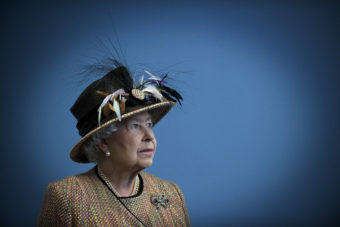
Queen Elizabeth II pictured in 2012. (Photo by Eddie Mulholland /WPA Pool/Getty Images)
Queen Elizabeth II, whose seven decades on the throne of the United Kingdom was a longer reign than any other British monarch, has died at the age of 96.
The queen “died peacefully” on Thursday afternoon at Balmoral Castle, her estate in the Scottish Highlands, royal family officials announced. King Charles, her son, is at Balmoral and will return to London on Friday.
The Queen died peacefully at Balmoral this afternoon.
The King and The Queen Consort will remain at Balmoral this evening and will return to London tomorrow. pic.twitter.com/VfxpXro22W
The queen had been placed under medical supervision earlier Thursday, officials said. “Following further evaluation this morning, The Queen’s doctors are concerned for Her Majesty’s health and have recommended she remain under medical supervision,” the palace had said in a statement.
Other members of the royal family had also traveled to Balmoral, including her grandson Prince William, who is now the heir apparent. Prince Harry, who was already in the country for a charity event, was also reportedly en route.
In recent years, the queen had taken on fewer public duties, occasionally canceling appearances in which her attendance was once tradition. Mobility issues had troubled her in recent months, and she had taken to spending much of her time at Windsor Castle, the family’s country estate near London, and at Balmoral, the castle in Scotland.
In February, she contracted COVID-19, which she later described as leaving her “very tired and exhausted.”
Elizabeth acceded to the throne on Feb. 6, 1952. Over her 70-year-long reign, she oversaw an extraordinary period of British history, including decolonization and the independence of more than 20 countries that were once a part of the British Empire.
Charles, 73, is now Britain’s king.
This is a breaking news story and will be updated.
Copyright 2022 NPR. To see more, visit https://www.npr.org.
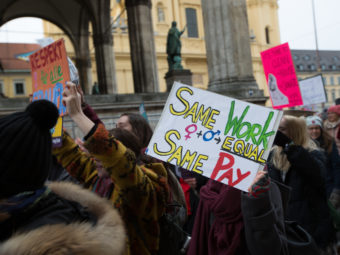
Woman hold a banner for equal pay during the women’s march against against US-president Donald Trump’s sexism in Munich, Germany, on 20 January 2018. (Photo by Alexander Pohl/NurPhoto via Getty Images)
When Marilyn Loden first uttered the phrase “the glass ceiling” in the 1970s, and even as it became an increasingly permanent fixture of the lexicon, she hoped the invisible barrier it described would soon become a thing of the past.
Instead, it outlived her. Loden — who died in August at age 76 after a battle with cancer in — was saddened to know that would be the case, according to a recent obituary in the Napa Valley Register.
“I thought I would be finished with this by the end of my lifetime, but I won’t be,” Loden told The Washington Post in 2018. “I’m hoping if it outlives me, it will [become] an antiquated phrase. People will say, ‘There was a time when there was a glass ceiling.’ ”
While the glass ceiling may be Loden’s most memorable contribution to society, it’s far from her only legacy.
After her early years in human resources, Loden went on to become a management consultant and workplace diversity advocate who worked with a wide variety of entities, from Citibank to the University of California to the U.S. Navy. Her work at the Navy led to policy changes increasing leader accountability for sexual harassment and lifting the ban prohibiting women sailors from serving on submarines, and she received its civilian Superior Service Medal in 2016.
Loden authored three books, the first of which — called Feminine Leadership, or How to Succeed in Business Without Being One of the Boys — was deemed one of the 50 best business books of 1985 by the Library Journal and has been published in six languages.
Loden was also a benefactor of numerous causes including global health, animal rights and democracy. She was predeceased by her husband, and leaves behind a sister, two nephews and grand-nieces and many close friends, according to the obituary.
“Friends and family often described her as ‘the smartest person I know,’ and she could be wickedly funny,” it added. “Throughout her many years as a consultant, speaker, and author, she attracted many women who were inspired and motivated by her own story and passion.”
Loden gave an impromptu name to a pervasive problem
This particular chapter of Loden’s story began at the 1978 Women’s Exposition, a feminist conference in New York City.
Loden, then 31 and working in the HR department at New York Telephone Co., was invited to join a discussion panel about women’s advancement (after the company’s only female vice president couldn’t make it, according to The Post).
The panel was called “Mirror, Mirror on the Wall” and focused on “messages of limitation which confront women and the effect on aspirations,” as Loden recalled in a 2008 blog post. She happened to be the last speaker, meaning she had time to listen to — and reflect on — the other panelists’ comments.
“It was a struggle to sit quietly and listen to all the criticisms,” she wrote.
The speakers focused on generalizations and stereotypes about women — that they weren’t properly socialized for success, they limited their own career aspirations due to low self-esteem — that bore very little resemblance to Loden’s own observations and experiences in the workplace.
“True, women did seem unable to climb the career ladder beyond the lowest rung of middle management and there were certainly moments when I had seen capable women managers filled with self-doubt about their own abilities to ‘do the job,’ ” she wrote. “However, while the general lack of advancement was evident, it seemed to me the causes were very different from the ones enumerated by my fellow presenters.”
When it was finally Loden’s time to speak, she chose to talk about concrete, cultural barriers to women’s professional success, like the biased attitudes of male managers, unequal pay and a lack of role models and emotional support for women. And she gave those obstacles a name: the invisible glass ceiling. She later told The Post that the metaphor came to her in the moment, and didn’t seem like a big deal.
“These comments drew some surprised looks from the other panelists but the response from the audience made it clear that my words had struck a familiar cord,” Loden wrote in her blog post. “Until that moment, it seemed we were relentlessly blamed for our lack of progress because, as women in a man’s world, we didn’t ‘dress for success’ or ‘play games mother never taught us.’ ”
Loden later recalled some of her own experiences with the glass ceiling, telling the BBC in 2017 that her male boss often told her to smile more and “made a point of commenting on my appearance at literally every meeting.”
She was told repeatedly that the advancement of women within middle management was “degrading the importance” of those positions. And she lost out on a promotion to a male coworker despite her better performance record, because, as her employer told her, the coworker was a “family man” who was his household’s main breadwinner and therefore needed the money more.
Loden left the company after working there for 12 years, when she was ordered to take a job that she didn’t want.
Despite relative strides, the problem and the phrase have persisted
While Loden is widely credited with creating “the glass ceiling,” a sprinkling of archival bread crumbs suggest a few others started using the phrase around the same time.
The phrase first appeared in writing in a 1984 AdWeek profile of Gay Bryant, who was then the editor of Working Women magazine (Merriam-Webster lists its origin as that same year). The Wall Street Journal has reported that the phrase may have originated at a dinner conversation between two female employees of Hewlett-Packard in 1979, and also noted that it appeared in a headline in its own pages in 1986.
Whatever its origins, the “glass ceiling” made its way into print, popular culture and politics in the 1980s and has maintained its status as a reliable shorthand in the decades since.
In 1991, Congress created the Glass Ceiling Commission to address the advancement of women and minorities in business: Its final report, issued in 1995, found that women held only three to five percent of senior management positions in Fortune 500 companies, and that in those rare cases, their compensation was lower than that of their male counterparts..
The phrase has popped up in significant speeches by women leaders in fields such as business, entertainment and politics, including in several speeches by Hillary Clinton, the 2016 Democratic presidential nominee and first woman to be nominated by a major party. From the late former Secretary of State Madeleine Albright’s shattered glass brooch to a glass portrait of Vice President Harris (the first woman, the first Black person and the first Asian American to be elected to that role), the imagery is still pervasive.
So too is the problem it represents. According to the 2021 Women CEOs in America report, just 8.2% of Fortune 500 CEOs are women, and less than one percent are women of color.
While there’s much room for improvement, there has been some progress in the years since Loden first addressed that feminist panel. She reflected on that in 2017, as one of the BBC 100 Women.
“Over the past four decades women have closed the education gap, moved into non-traditional jobs at remarkably high rates, simultaneously managed families and challenging careers, and demonstrated their ability to innovate, inspire and manage effectively in every sector of the global workplace,” she said. “We need only remove the blinkers to appreciate and leverage all that they have to offer.”
Copyright 2022 NPR. To see more, visit https://www.npr.org.
A nurse prepares to administer a dose of the Johnson & Johnson COVID vaccine at a clinic in Anchorage. In early September 2022, the Centers for Disease Control and Prevention recommended updated COVID boosters for people ages 12 and older. (Photo by Hannah Lies/Alaska Public Media)
These newly authorized shots are reformulated versions of the Moderna and Pfizer-BioNTech COVID-19 vaccines and they’re available at pharmacies, clinics and doctors’ offices around the country.
The boosters target both the original strain of the coronavirus and the two omicron subvariants which are causing most of the current infections. Vaccine makers have scrambled to rejigger the vaccines as they’ve become less effective against new variants.
“This virus has been mutating so quickly over the past two years,” said Judith Guzman-Cottrill, an infectious disease specialist at Oregon Health & Science University. “I feel like we’ve been playing catch up and finally we have caught up.”
Pfizer’s updated booster is available for anyone 12 and older. The Moderna booster is available for anyone 18 and older.
But after talking to several infectious disease experts, we found there’s a whole range of opinions on who needs to boost and when. So, if you are navigating this decision, here are some things to consider:
Who needs a booster as soon as possible?
“I would recommend this booster shot for those who are immunocompromised or those who are 60 years [old] and above,” said Monica Gandhi, an infectious disease expert at the University of California, San Francisco. Gandhi says people in these groups are at highest risk.
According to CDC guidance, people are eligible if it’s been at least two months since they received their last COVID shot, either a booster or an initial vaccine, but some vaccine experts say it would be better to wait at least four months.
“I will get it,” says Physician Bob Wachter, who’s in his mid-60s and in good health. “I’m about eight months out from shot number four. And so my immunity has waned significantly,” Wachter says. He plans to get an updated booster as soon as it’s available as a hedge against serious infection, given COVID is still circulating widely with about 400 deaths per day.
“There’s no question that getting a booster increases the likelihood that you’ll have a benign case,” if you do get infected, he said.
Wachter also agrees with the CDC recommendation that younger adults get the booster. Boosting can protect against the risk of long COVID and helps protect the community at large by reducing transmission, if there’s another surge, he says.
“There are good reasons to get it, even for people that have a low chance of a super severe infection,” Wachter said.
When does it make sense to wait?
If you’ve had a recent COVID infection, it makes sense to wait.
Guzman-Cottrill and her children had mild infections in August, so she says she’ll wait until November to get boosted.
“Our natural antibody response will protect us against COVID for another few months. So I do think it makes sense to wait and get the updated booster about three months after our positive COVID test,” she says.
This is in line with the recommendation from CDC vaccine advisers — people who recently had COVID-19 may consider delaying a booster shot by three months. That’s what the country’s top infectious disease expert, Dr. Anthony Fauci says he plans to do. Fauci tested positive in mid-June and says he’ll wait three months before he gets his updated booster.
Guzman-Cottrill says both her teenagers will also get the new booster “to protect us from COVID this winter so we can avoid sick days from work and from school,” she said.
Can I time my shot for maximum protection at the holidays?
It won’t be a surprise if there’s another COVID surge this coming winter. Since the protection from boosters may only last several months, some people say they plan to wait to get the new booster in order to have maximum protection when the risk of infection is higher. “You can make a rational argument to wait until case rates are higher,” Wachter said.
If you’re trying to time it for the period of highest risk, he says, there are likely to be a ton more cases in December and January than there are in September and October.
However, Wachter says, this strategy is a bit like trying to time the stock market. It’s hard to predict exactly when the surge will happen, so there’s a risk in waiting.
“You are basically accepting a period of vulnerability that you don’t need to have,” he said. “And as I weigh all that, my thinking is I’d rather not do that.”
Another argument against waiting is that the protection from a booster shot is not instantaneous. “It does take a few weeks for our immune systems to be primed,” said Dr. Aniruddha Hazra, an infectious disease specialist at the University of Chicago. He says it could be risky to wait until a surge is already underway.
Hazra points out the vaccines can activate our immune systems in a few ways. Immune cells, known as B cells, help produce antibodies that fight off the virus in the short-term. Research shows COVID vaccines boost antibodies for several months, but then they begin to fade. After that, B cells and another type of immune cell, known as T cells, which can destroy infected cells, stick around to build a deeper immunity.
He says this deeper immunity was triggered and primed from the initial vaccines, so everyone who’s been vaccinated should have some protection against COVID But given the omicron subvariants circulating now are so different. “This [new] booster will definitely provide you with higher levels of antibodies, which are short term and short lived. It may also provide more deep-seated immunity,” he said.
Will the new booster shots prevent COVID infections completely?
No. There’s lots of enthusiasm for the updated boosters, but they are not a magic bullet.
As SARS-CoV-2 has evolved, it’s become more transmissible, which is why delta and omicron led to such large surges, despite widespread vaccination in the U.S.
“The goal of this vaccine is to prevent severe illness,” said Paul Offit, director of the Vaccine Education Center at the Children’s Hospital of Philadelphia. He argues that many people who’ve already received three doses of vaccine remain well protected, so he doesn’t see a clear benefit to giving the new boosters to everyone 12 and up.
According to CDC data, people who have had one or two boosters have a 0.024% chance of being hospitalized with COVID-19. For people under 50, it’s even lower — 0.014%
Offit agrees that certain groups should receive the new booster including elderly adults, people who are immunocompromised and those with chronic conditions that put them at higher risk of serious illness. But he questions the value of another booster for healthy, younger people.
Offit says he had a mild infection in May that lasted a few days. He’s decided against getting the new booster. “I think I’m protected against serious disease.”
The new boosters offer a few months’ protection against infection, he says, but there’s no clear evidence of benefit beyond that.
Copyright 2022 NPR. To see more, visit https://www.npr.org.
Close
Update notification options
Subscribe to notifications
Subscribe
Get notifications about news related to the topics you care about. You can unsubscribe anytime.