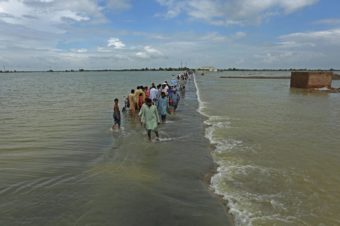
A man walks over his collapsed mud house after heavy monsoon rains in Jaffarabad district, Balochistan province, on Aug. 28. (Photo by Fida Hussain/AFP via Getty Images)
One-third of Pakistan is inundated, as floods sweep through the country this summer. The catastrophic floods, resulting from monsoon rains that began in June, are unprecedented in scale and scope. So far, they have affected some 33 million people — about 14% of Pakistan’s population — causing death, damage, displacement and loss whose effects will be felt for months and years to come.
More than 1,000 people have been killed. Agriculture, a mainstay of Pakistan’s economy, has been overwhelmed as fields drown. Nearly half the cotton crop has been lost in southern Sindh province.
Pakistan’s Federal Minister for Climate Change Sherry Rehman has called the flooding a “crisis of unimaginable proportions.” Of Sindh — which is still bracing for more floods as rivers to the north swell and burst their banks — she tweeted: “The crops are gone, lives ruined, livelihoods wiped out, roads swept away, houses destroyed or barely standing … Where to pump/drain the water? There’s water everywhere.”
Khairpur by boat. Most of Sindh is under water.The crops are gone,lives ruined, livelihoods wiped out, roads swept away, houses destroyed or barely standing. The Navy is also deployed in inland Sindh and Balochistan.Where to pump/drain the water? There’s water everywhere. ?? pic.twitter.com/CuaIaP6hNH
Pakistani authorities estimate rebuilding will cost upward of $10 billion, and are pleading for help. The U.S. announced Tuesday that it’s providing $30 million for shelter, food and sanitation. China, Turkey, the European Union and the United Arab Emirates also are sending aid.
The United Nations has launched a joint appeal with Pakistan’s government for $160 million. “The Pakistani people are facing a monsoon on steroids — the relentless impact of epochal levels of rain and flooding,” said U.N. Secretary-General António Guterres, who will visit the country on Friday. He referred to the flooding as a “climate catastrophe.”
Here are images showing some of the extent of destruction and emergency response efforts.
CHARLOTTESVILLE, Va. — In a downtown park, grass grows over the spot where there once stood a massive bronze statue of Confederate Gen. Robert E. Lee, astride his horse Traveller.
The space feels different now, says Don Gathers, co-founder of the local Black Lives Matter group.
“It’s much more serene,” he says.
Gathers is in the park to reflect on five years since a violent and deadly white nationalist rally ravaged his hometown.
“It’s not what you can remember. It’s what you’re still trying to forget,” says Gathers. “All the hatefulness and the evilness that transpired here.”
Organizers targeted Charlottesville for the Unite the Right rally after the city voted to take down the Lee statue, part of the town’s reckoning with a fraught racial history.
On the night of Aug. 11, 2017, Neo-Nazis, Ku Klux Klansmen and other white supremacists marched through the University of Virginia campus bearing torches and terrorizing students with chants of “Blood and soil” and “Jews will not replace us.”
Neo-Nazis, alt-right supporters and white supremacists encircle counter-protestors at the base of a statue of Thomas Jefferson after marching through the University of Virginia campus with torches in Charlottesville, Va., on Aug. 11, 2017. (Photo by NurPhoto via Getty Images)
The next day, they rallied around the Lee statue at the downtown park.
“This represents a turning point for the people of this country,” then–KKK leader David Duke declared at the time. “We’re going to fulfill the promises of Donald Trump because he said he’s going to take our country back.”
But the rally was met with resistance from hundreds of residents who rejected racism, chanting “Nazi scum off our streets.”
Gathers was there and says it quickly turned violent.
“They lobbed all manner of things – rocks, soda cans filled with concrete and cement, water bottles filled with urine, tear gas and smoke grenades.”
Gathers says police didn’t intervene until then-Gov. Terry McAuliffe declared a state of emergency and shut down the rally.
“This is an absolute outrage,” Richard Spencer, an alt-right leader and rally organizer, said at the time. “You’re going to have to drag us out of here.”
As demonstrators were pushed from the park, they dispersed through town, leading to pockets of violence and ultimately the deadly attack on a group of anti-racists. Neo-Nazi James Fields rammed his car into the crowd, injuring dozens of people and killing 32-year-old Heather Heyer. Two state police officers monitoring the scene died in a helicopter crash.
April Muniz mourns with the Charlottesville community the day after a Neo-Nazi plowed his car into a crowd of anti-racists, killing Heather Heyer and injuring dozens. (Photo by Eze Amos)
Charlottesville violence is seen as a catalyst
Racial justice advocates see the terror here as a turning point for the country – one that encouraged far right political violence, including the attack on the U.S. Capitol last year.
Gathers blames “continuous dog whistles” from President Trump that gave the white supremacists cover to come out of the shadows.
“They’re emboldened,” he says. “No one wanted to accept that or believe it as it was unfolding, but after August 11th and 12th in Charlottesville, there was January 6th.”
“I think Charlottesville really was a catalyst for much of the white supremacist chaos that has ensued since,” says April Muniz, who was in the crowd when the Neo-Nazi drove his car into the counter-protesters.
“What I witnessed is something that just broke me, basically,” she says.
Muniz says she suffered PTSD and panic attacks and was unable to work for a time. And she grew increasingly frustrated that Fields was the only person arrested in the immediate aftermath of the Unite the Right violence.
April Muniz sees the events in Charlottesville as a catalyst for far-right political violence. (Photo by Eze Amos for NPR)
“Everybody left town. Who’s going to be held responsible?” she wondered at the time. “Because these folks that came were not immediately held accountable, they had permission to wreak havoc, and that is what they’ve done.”
Fields was sentenced to life in prison on state murder and federal hate crime charges. When no criminal charges were brought against event organizers, some victims of the violence filed a civil lawsuit against about two dozen white nationalist leaders including Richard Spencer and Jason Kessler. A jury awarded more than $25 million in damages to the plaintiffs, among them April Muniz.
Holding organizers to account is an important step, says Ian Solomon, dean of the University of Virginia’s Frank Batten School of Leadership and Public Policy. But he says it’s unclear which direction the country will take.
“Are the pro-democratic forces and pro-democracy movements going to prevail or not?” asks Solomon.
He too considers events in Charlottesville a warning.
“One of the things about that weekend of 2017 was it revealed, it re-energized, it revived in many people’s minds the reality that anti-democratic forces are ascendant in this country,” he says. “Hate is quite brazen to show its face proudly, confidently with encouragement from elected officials.”
At the time, Trump drew criticism when he condemned what he called an “egregious display of hatred, bigotry and violence on many sides,” seemingly equating neo-Nazis and white nationalists to the anti-racist demonstrators.
Days later as reporters questioned his response, Trump declared that there were “very fine people on both sides.”
Ian Solomon, dean of UVA’s Frank Batten School of Leadership and Public Policy, says the violence in Charlottesville showed that anti-democratic forces are ascendant in the U.S. (Photo by Eze Amos for NPR)
Racial violence is part of the American fabric
Solomon says although the racial violence in Charlottesville was shocking for some, it was really a familiar refrain.
“We have a long rhythm in America of progress followed by a backsliding or backlash to that progress, so for many racial violence is nothing new,” he says. “It has a long thread through American history, and yet for many it was perceived as a wake-up call.”
It was certainly a wake-up call for Susan Bro, who was forced in the most painful way imaginable to understand the consequences of hate when her daughter Heather Heyer was murdered. She comes regularly to the memorial at the spot where Heather was run over, removing dead flowers and making sure the sidewalk is clear.
“To see that people still interact with this tells me that the events of the day still matter,” says Bro.
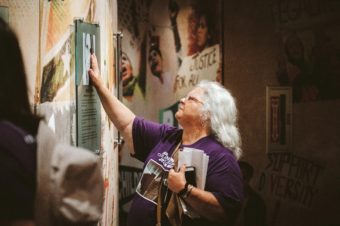
Heather Heyer’s mom, Susan Bro, has a moment with a commemoration of her daughter at the Civil Rights Memorial Center in Montgomery, Ala. (Photo by Eze Amos)
She takes solace in all the messages posted on the brick walls including “Gone But Not Forgotten” and “Don’t Let Hate Be Louder than Love.”
Bro started an educational foundation in Heather’s name and has connected with other families across the country who are victims of hate crimes. They successfully lobbied Congress to pass the Khalid Jabara and Heather Heyer NO HATE Act that was signed into law last year. It calls for stiffer penalties and provides incentives to better track hate crimes.
Bro says that’s a sign of progress. But she thinks more work is needed to combat a well-organized white supremacist movement, a movement she wasn’t really aware of until her daughter was murdered for standing up to it.
“The biggest lesson is none of us pay attention, including me, until it happens to you,” says Bro. “As long as anybody’s marginalized, as long as anybody’s being mistreated, this is going to continue to happen.”
Susan Bro has been working to combat hate crimes after her daughter, Heather Heyer, was killed on Aug. 12, 2017, in Charlottesville, Va. (Photo by Eze Amos for NPR)
Civic engagement in Charlottesville has increased in the last five years. Community activists are pressing the city on equity issues, including in housing and public schools.
One survivor of the violence, Emily Gorcenski, is tracking white supremacists and Neo-Nazis through online projects, including How Hate Sleeps.
“These projects were designed to try to help aid the understanding of how white supremacists live in our society and how they act in our society,” she says.
Gorcenski, a transgender woman, was attacked during Unite the Right events in Charlottesville and pepper sprayed by a white supremacist, who later pleaded guilty to assault charges.
After a series of death threats, she moved to Germany but remains active in fighting the groups responsible for what happened in her hometown.
“There isn’t awareness of the ways that these white supremacist groups recruit, attract members, share their ideology, share their messaging,” she says in a Zoom interview. “That’s a real problem because we can’t simply eliminate the groups to solve the problem. We have to eliminate the undercurrents of white supremacy that give rise to these groups.”
Transforming a Confederate statue into a more-inclusive display
Another project in Charlottesville is trying to upend the narrative around the statue of Confederate Gen. Lee. It’s called Swords Into Plowshares, and is being overseen by the Jefferson School African-American Heritage Center.
“Taking something that it was harmful and then transforming it into something that is useful and of the cultural desire of the place,” explains Jefferson School Director Andrea Douglas.
Andrea Douglas, director of the Jefferson School African American Heritage Center is overseeing a project to transform a statue of Confederate Gen. Robert E. Lee into a more inclusive work of public art. (Photo by Eze Amos for NPR)
The city donated the statue to the Heritage Center after approving its plan to melt down the bronze and use it for a new work of public art. Two groups have filed a lawsuit trying to stop the plan. But Douglas says they’re moving forward with the process of gathering public input, and in a more inclusive way.
“Before one portion of this community made decisions about what would be in our common spaces and negated the voice that, had it not been for Jim Crow, could have had a voice,” Douglas says. “We are trying to return that voice.”
Douglas says the idea is to create an inviting and equitable space where all of Charlottesville can interact with one another and the reworked art.
For Don Gathers, it’s still hard to come to the park where Robert E. Lee stood sentry since 1924.
“It’s kind of surreal because the ghost of his presence still permeates heavily in this space,” says Gathers.
Much like the country, he says, it feels like there are warring spirits vying for dominance.
Copyright 2022 NPR. To see more, visit https://www.npr.org.
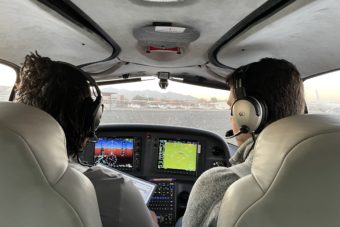
A student pilot and flight instructor prepare to take off on a training flight outside of Phoenix. (Photo by David Schaper/NPR)
Air travelers just endured another weekend of widespread flight delays and cancellations. Airlines cancelled more than 5,100 flights that had been scheduled from Thursday, Aug. 4 through Monday, Aug. 8, and close to 30% of the flights that did take off were delayed.
It’s something that’s become all too common this summer, as airports have been busier than at any time since the pandemic began, but airlines struggle to meet the surge in air travel demand.
The airlines blame the chronic delays and cancellations, in part, on a shortage of staff, and especially of pilots, which gets magnified in times of bad weather or other operational problems.
The pilot shortage is also forcing airlines, especially regional carriers, to reduce the number of flights they offer, particularly to smaller cities.
United Airlines has ended service to 25 destinations since the pandemic began. American and Delta have dropped dozens of cities from their flight schedules, too.
Places like Twin Falls, Idaho; Mason City, Iowa; and Elko, Nev., are down to one flight a day. United’s single daily flight to Mason City also stops in Fort Dodge, Iowa, and is that small city’s only flight each day, too.
Even Chicago’s O’Hare, one of the world’s busiest airports, has nearly 25% fewer departures each day than it did in 2019, because of the sharp drop in the number of regional airline flights to smaller cities, according to the aviation data analytics firm OAG.
The Regional Airline Association says its member airlines, including SkyWest, Republic, Envoy, Endeavor, and Mesa, which fly regional routes on behalf of the big legacy carriers such as American Eagle, Delta Shuttle and United Express, are not cutting service to these smaller airports because they want to, but because they don’t have enough pilots to staff the flights.
So to address the shortage, some in the industry and in Congress are calling for some big changes. Among them are raising the mandatory pilot retirement age from 65 to 67, and reducing the number of flight hours required before a pilot can be certified.
“We have a crisis when it comes to airline travel,” Sen. Lindsay Graham of South Carolina said recently at his home state’s Greenville-Spartanburg airport. “We have a pilot shortage and those who say we don’t, well, they’re just full of it.”
“We’re suffering because of this,” Graham added. “Airlines have to make decisions, so when you have less pilots, you gotta pick what routes to fly, and regional airports like Greenville and throughout other smaller communities suffer the most.”
With too few pilots to staff flights, airlines have had to park hundreds of airplanes.
“There are approximately 500 fewer regional aircraft operating today than at the end of 2019,” says Drew Lemos of the Regional Airlines Association. “This represents a loss of a quarter of the regional fleet. Five-hundred parked aircraft equates to a deficiency of approximately 5,000 pilots.”
Calls for raising the minimum retirement age
So to keep the industry from losing even more pilots, Graham is sponsoring legislation that would raise the mandatory airline pilot retirement age from 65 to 67, as long as they continue to meet the FAA’s stringent medical qualifications to fly commercial aircraft.
The federal Bureau of Labor Statistics projects that U.S. airlines will need to hire about 14,500 pilots each year over the next decade, but new pilot training and licensing is not keeping up with that demand.
And Graham and the RAA say in the next two years, 5,000 pilots will be forced out the industry as they reach that mandatory retirement age, and 14,000 pilots will age out of the cockpit by 2026.
“Pilots will be aged out, not because they’re unsafe, just simply because they reach 65,” Graham said. “My legislation would allow pilots to continue to fly if they meet the qualifications. We’re not dumbing down anything.”
“This legislation is critical to help address the pilot shortage and prevent air service loss in communities across the country,” added Lemos.
But the unions representing airline pilots disagree.
“It’s a bad idea and it doesn’t solve the problem,” says Capt. Dennis Tajer, a 737 pilot for American Airlines and spokesperson for the Allied Pilots Association.
He contends the air travel problems this summer are not simply because of a shortage of pilots.
“There’s a shortage of plans,” says Tajer, adding that airline “management did not plan for this recovery” in air travel.
Tajer suggests that to the extent there is a shortage of pilots, the airlines brought that upon themselves. He points out that even though the airlines received $50 billion in taxpayer funding to keep employees on the payroll during the pandemic, many of them gave pilots generous early retirement packages, including partial pay, benefits and other enticements.
“To save money, they incentivized pilots to retire early and they never started training the pilots that would fill those seats,” Tajer said.
The other major union representing airline pilots, the Air Lines Pilots Association, echoes those comments, while contending that there is no pilot shortage. The union says in a news release that the proposed legislation is a “misguided attempt to solve a problem that doesn’t exist.”
“This legislation is yet another attempt to distract the conversation from the real issue, which is that some U.S. airlines have clearly failed to plan for the industry’s comeback that we are experiencing today,” Capt. Joe DePete, ALPA’s president, said in the news release. He added that raising the retirement age “would only increase costs for airlines as well as introduce unnecessary risks to passengers and crew alike.”
Because the international mandatory retirement age for pilots is also 65, if the age was raised in the United States, pilots 65 or older would no longer be allowed to fly overseas. Those routes are usually flown on widebody jets, such as Boeing’s 777 and 787, so those veteran pilots would have to be retrained on smaller narrow body planes to keep flying.
That is one of the reasons some of the bigger, legacy airlines oppose raising the retirement age. They and others also bring up safety concerns, citing research showing that cognitive abilities decline as people age.
When asked recently about increasing the mandatory retirement age, United Airlines CEO Scott Kirby said he doesn’t think it’s a solution, telling CNBC that “at United, of our age 64 pilots, 36% of them are unavailable to fly on a given day for sick, short-term or long-term medical” reasons.
“We’re already at 36% at that age, so extending the age … I don’t think is going to be the answer,” Kirby added.
And Transportation Secretary Pete Buttigieg echoed such concerns recently on Fox News Sunday.
“Look, these retirement ages are there for a reason and the reason is safety. I’m not going to be on board with anything that could compromise safety,” Buttigieg said. “The answer is not to keep the baby boomer generation in the cockpit indefinitely. The answer is to make sure that we have as many and as good pilots ready to take their place; to have a stronger pipeline.”
Many aviation experts don’t doubt that some airline pilots would be able to continue flying safely after turning 65, but they say, at best, it’s only a short-term fix.
“This is not a solution to the pilot-supply issue,” says Elizabeth Bjerke, a pilot, aviation professor and associate dean at the University of North Dakota. “This would be maybe a short term, extra bubble of pilots, but it’s not going to fix the long-term issue of needing more pilots. We really need to focus on inspiring, exciting and supporting the next generation of aviation professionals.”
Also looking to lower mandatory training hours
Another proposal aimed at quickly increasing the number of airline pilots is to reduce the 1,500 hours of flight time required for airline pilot certification.
There are exceptions to the FAA’s 1,500-hour rule. Pilots with military training can be certified with 750 hours of flight time because that is considered optimal training; those earning a 4-year college aviation degree can earn an Air Transport Pilot certification with 1,000 hours; and those with 2-year degrees can be licensed with 1,250 hours.
Regional carrier Republic Airways has petitioned the FAA for an exemption to allow graduates of it’s flight school to get a first officer’s ATP certificate with 750 hours of flight time, the same level as pilots trained in the military.
Some experts argue that it’s not the amount of time in the air that matters, but the quality of the training, and training in a commercial jet simulator will actually be more valuable to an aspiring airline pilot than flying a few hours in a small airplane a couple times a week or on weekends.
But Bjerke and others point out that the United States has enjoyed an unprecedented period of commercial airline safety since the 1,500-hour rule and other safety regulations went into effect a decade ago.
And she notes that one of the best ways to gain flight hours and valuable experience is working as a flight instructor after completing a flight school program. Most aspiring commercial airline pilots earn their flight hours by getting certified to be and working as flight instructors, so luring them to the airlines prematurely could actually exacerbate the pilot shortage.
There’s already a shortage of flight instructors, Bjerke says, so losing the current pipeline of flight instructors to the airlines “would be detrimental to how many students we could bring into our aviation program. So, again, what looks like a short-term fix is going to have long lasting impacts on the pilot supply because we need qualified flight instructors to train that next generation.”
But despite such concerns, as passenger frustrations this summer grow over chronic flight delays and cancellations, Congress may feel compelled to take up the proposals to increase the pilot retirement age and cut the number of hours required for air transport pilot certification.
Copyright 2022 NPR. To see more, visit https://www.npr.org.
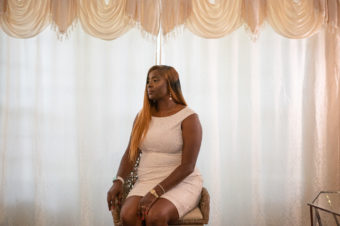
Tomeka Kimbrough-Hilson was diagnosed with uterine fibroids in 2006 and underwent surgery to remove a non-cancerous mass. When she started experiencing symptoms again in 2020, she was unable to get an appointment with a gynecologist. Her experience was not uncommon, according to a new poll by NPR, the Robert Wood Johnson Foundation and the Harvard T.H. Chan School of Public Health. (Photo by Nicole Buchanan/NPR)
When the pandemic started, Tomeka Kimbrough-Hilson knew she had a small growth inside her uterus. She was first diagnosed with uterine fibroids back in 2006 and had been able to have the non-cancerous mass removed through outpatient laser surgery. Over the years, she’d also been able to manage her symptoms with medication and changes in her lifestyle.
But when those symptoms – a bloated belly, irregular periods, nausea – returned in 2020, Kimbrough-Hilson was unable to get an appointment with a specialist.
“March 27th came and everything got shut down,” says Kimbrough-Hilson, 47, of Stone Mountain, Georgia. “I wasn’t at the tier of care that needed [immediate attention], because of all the precautions that had to be taken.”
But even after the lockdown in spring of 2020 was lifted, Kimbrough-Hilson, a mother of five who works in the health insurance industry, was unable to see a gynecologist.
She left message after message with providers. But her calls went unreturned, or providers were booked for months at end. “I couldn’t get the appointments,” she says. “I couldn’t follow up.”
These days, her belly is swollen, and she says she often feels fatigued and nauseous: “It makes me want to throw up a lot.”
She also struggled to get appointments for other members of her family. Her 14-year-old daughter underwent brain surgery before the pandemic, but then couldn’t get follow-up appointments until recently.
Kimbrough-Hilson’s family’s experience isn’t uncommon, according to a new poll by NPR, the Robert Wood Johnson Foundation and the Harvard T.H. Chan School of Public Health.
Among households that had a serious illness in the past year, one in five respondents said they had trouble accessing care during the pandemic.
That’s a “staggering” number of people unable to access care, says Mary Findling, the assistant director of the Harvard Opinion Research Program. “From a health and a good care standpoint, that’s just too high.”
Other recent studies have found significant delays in cancer screenings, and disruptions in routine diabetes, pediatric and mental health care. While it’s still early to know the long-term impacts on people’s health, researchers and physicians are concerned, especially as the disruptions continue with the country’s health care system struggling to bounce back from the pandemic.
The new poll also found that disruptions in care hit some racial and ethnic groups harder. Among households where anyone had been seriously ill in the past year, 35% of American Indian and Alaska Native households and 24% of Black households had trouble accessing care for serious illness, compared with only 18% of White households.
Among Black respondents who had seen a provider in the past year, 15% said they were disrespected, turned away, unfairly treated, or received poor treatment because of their race and ethnicity, compared with only 3% of White respondents who said the same.
“What’s really sad is the racial gaps in health care between Black and White Americans has remained,” says Findling. “And looking across a broad range of measures, it’s better to be a White patient than a Black patient in America today. And when you just stop and think about that, that’s horrible.”
Health insurance wasn’t a barrier to access
The vast majority of people – across racial and ethnic groups – who experienced delays in care reported having health insurance.
“One thing it tells us is that just the provision of more health care insurance is not going to plug some of these gaps and holes that we’re seeing in terms of individuals getting more care,” says Loren Saulsberry, a health policy researcher at the University of Chicago, who worked closely with Findling on the poll.
“There are broader issues at play here,” says Findling, like the historic workforce shortages among health systems. “The pandemic continues and it’s wreaking havoc on everyone.”
Saulsberry, who studies health disparities in vulnerable populations, says that the pandemic has exacerbated those disparities because of a range of barriers, including a person’s zip code.
For example, the state of Georgia, where Kimbrough-Hilson lives, has had one of the lowest numbers of OB-GYNs in the country for years. Now, she’s having a harder time getting an appointment with one than ever before.
“I’ve been able to get my teeth done, my eyes checked,” she says. “But I can’t get to women’s health.”
She has a referral from her primary care provider, she says, but it’s for a practice “30 to 40 miles away.”
Health systems too overwhelmed for routine care
While the pandemic exacerbated disparities in care, it also overwhelmed the health care system, causing delays and disruptions across the board, says Cassie Sauer, CEO of the Washington State Hospital Association.
And it’s also taken a huge financial toll, says Dr. Arif Kamal, chief patient officer at the American Cancer Society. “Some of that is related to actually taking care of patients who are very complex, who have very serious illnesses due to COVID-19,” he says. “But also during that time there was also loss of revenue because other activities had to be stopped, for example, elective surgeries.”
As a result, preventive services and early detection activities – not the “highest margin activities” for health systems – have taken a back seat, he adds.
“Over the last two years we estimate about 6 million women, for example, have missed routine cancer screening,” says Kamal. That includes missed mammograms for breast cancer detection, and Pap smears to check for cervical cancer.
Kamal is concerned that in a year or two, providers will start to detect cancers at later stages because of missed screenings, which makes them harder to treat or cure.
In the meantime, health systems are continuing to feel the repercussions of the pandemic, causing continuing delays in what was once routine care.
Sauer has experienced this at work and in her personal life.
“In my own family, we have struggled to get access to health care for my kids and my parents,” says Sauer.
Her 80-year-old father, who has Parkinson’s disease, had a fall over the winter holidays and was hospitalized. “I was with him, caring for him in the hospital. My mom had COVID at the time, so she wasn’t able to be there,” she says. “And I couldn’t figure out how to get him out of the hospital.”
He needed to go to a skilled nursing facility, but she couldn’t get him into one. “I found two nursing homes that seemed like good fits,” says Sauer. “And they both shut down because they had COVID outbreaks the same day.”
This is still one of the biggest problems that the state’s hospitals are facing right now, she adds. “We can’t get people out of the hospitals right now. There’s no back door, but the front door is wide open to the emergency room.”
There are patients who spend as many as 90 days in a hospital, she says, when the average hospital stay is three days. “So they’ve taken the space of 30 patients who needed care.”
This is why, more than two years into the pandemic, she says, people are still unable to schedule regular procedures, everything from knee and heart valve replacements, to cancer treatments.
These procedures may be considered “elective,” but postponing them can have major repercussions on a patient’s health and quality of life, she adds.
“You have a chance of falling, you are probably going to gain weight,” says Sauer. “You’re going to lose flexibility. You know, all those things contribute to a potential decline, cardiac issues, respiratory issues.” Which can in turn also increase someone’ risk of serious illness from COVID.
“I think that the toll of this delayed care is tremendous,” she says.
Copyright 2022 NPR. To see more, visit https://www.npr.org.
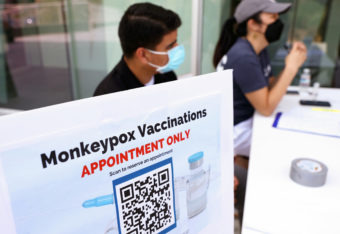
An emergency declaration frees up resources to help fight the monkeypox outbreak. There are currently more than 6,600 cases in the U.S. (Photo by Mario Tama/Getty Images)
The White House today declared monkeypox a public health emergency.
“We are prepared to take our response to the next level in addressing this virus and we urge every American to take monkeypox seriously,” HHS Secretary Xavier Becerra said to reporters during a briefing on Thursday.
A public health emergency can trigger grant funding and open up more resources for various aspects of a federal response. It also allows the Secretary to enter into contracts for treatments and other necessary medical supplies and equipment, as well as support emergency hospital services, among other things. Public health emergencies last for 90 days but can be extended by the Secretary.
CDC Director Rochelle Walensky said the declaration will provide resources and increase access to care. She also said it will expand the CDC’s ability to share data.
Some have been calling for a federal public health emergency, saying it will signal to the country that this is a serious outbreak.
So far, there have been more than 6,616 cases detected in the U.S., but that is likely an undercount. The vast majority of cases in the U.S. are concentrated in the gay and queer community, primarily among men who have sex with men.
The virus, in this current outbreak is spreading primarily through physical contact during sex — so very close intimate contact. However, it is possible for the virus to spread in other ways — including through face-to-face interactions with someone or from touching a contaminated surface — but data show this is exceptionally rare. Experts say it takes prolonged interaction or a lot of the virus to contract the disease this way.
Scientists are also looking at evidence that suggests the virus can be spread through semen.
The focus of the Biden Administration’s response to the outbreak has been to vaccinate those at high risk of contracting the disease, but critics say vaccine availability has been limited and slow to come online.
The administration says it has shipped more than 1.1 million doses of the JYNNEOS vaccine to states and territories.
Governors in California, New York and Illinois have already declared state of emergencies in response to the monkeypox outbreak. Some cities, including New York City and San Francisco, have also made their own emergency declarations.
The World Health Organization has already declared the monkeypox outbreak a Public Health Emergency of International Concern. There are currently more than 26,000 cases worldwide.
Copyright 2022 NPR. To see more, visit https://www.npr.org.
When the Hunga Tonga-Hunga Ha’apai volcano erupted on Jan. 15, it sent the equivalent of more than 58,000 Olympic-size swimming pools’ worth of water into the stratosphere, researchers say. (Tonga Geological Services)
The violent eruption of Tonga’s Hunga Tonga-Hunga Ha’apai volcano injected an unprecedented amount of water directly into the stratosphere — and the vapor will stay there for years, likely affecting the Earth’s climate patterns, NASA scientists say.
The massive amount of water vapor is roughly 10% of the normal amount of vapor found in the stratosphere, equaling more than 58,000 Olympic-size swimming pools.
“We’ve never seen anything like it,” said atmospheric scientist Luis Millán, who works at NASA’s Jet Propulsion Laboratory. Millán led a study of the water the volcano sent into the sky; the team’s research was published in Geophysical Research Letters.
The volcano sent vapor and gases to a record height
The Jan. 15 eruption came from a volcano that’s more than 12 miles wide, with a caldera sitting roughly 500 feet below sea level. One day earlier, Tongan officials reported the volcano was in a continuous eruption, sending a 3-mile-wide plume of steam and ash into the sky. Then the big blast came, sending ash, gases and vapor as high as 35 miles — a record in the satellite era — into the atmosphere.
One day after an intense eruption by the Hunga Tonga-Hunga Ha’apai volcano, an astronaut on the International Space Station took this photograph of the gargantuan plume. (NASA)
Drone aircraft and other video from that day show the dramatic scale of the blast, as the volcano launched an incredibly wide plume into the sky. The intense eruption sent a pressure wave circling around the Earth and caused a sonic boom heard as far away as Alaska.
The huge amount of water will likely raise temperatures
Earlier large volcanic eruptions have affected climate, but they usually cool temperatures, because they send light-scattering aerosols into the stratosphere. Those aerosols act as a sort of massive layer of sunscreen. But since water vapor traps heat, the Tongan eruption could temporarily raise temperatures a bit, the researchers said.
It normally takes around 2-3 years for sulfate aerosols from volcanoes to fall out of the stratosphere. But the water from the Jan. 15 eruption could take 5-10 years to fully dissipate.
Given that timeframe and the extraordinary amount of water involved, Hunga Tonga-Hunga Ha’apai “may be the first volcanic eruption observed to impact climate not through surface cooling caused by volcanic sulfate aerosols, but rather through surface warming,” the researchers said in their paper.
NASA says the data for the study came from the Microwave Limb Sounder instrument on its Aura satellite, which measures water vapor, ozone, aerosols and gases in Earth’s atmosphere.
The volcano interrupted the ‘heartbeat’ of water in the stratosphere
The Jan. 15 eruption emphatically disrupted annual water patterns in the stratosphere (which also holds most of the atmosphere’s ozone).
The normal mechanism by which water rises into the stratosphere is so reliable that researchers refer to it as a sort of tape recorder, marking annual temperature cycles through alternating bands of dry and moist air rising from the tropics.
January is normally the middle of the dry period in that seasonal cycle — but then the Tongan volcano erupted in the South Pacific Ocean, suddenly injecting a huge amount of water high in the atmosphere.
“By short-circuiting the pathway through the cold point, [Hunga Tonga-Hunga Ha’apai] has disrupted this ‘heartbeat’ signal” in the planet’s normal atmospheric water pattern, the researchers said.
They recommend closely monitoring the water from the volcanic eruption, both to predict its impact in the near term and to better understand how future eruptions might affect the planet’s climate.
Copyright 2022 NPR. To see more, visit https://www.npr.org.
Close
Update notification options
Subscribe to notifications
Subscribe
Get notifications about news related to the topics you care about. You can unsubscribe anytime.