Nation & World

No cases of monkeypox in Alaska yet, but health officials are readying for the disease’s arrival

""
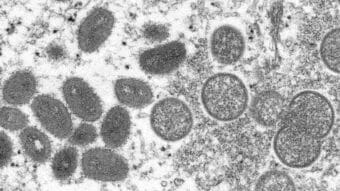
This 2003 electron microscope image shows mature, oval-shaped monkeypox virus particles, left, and spherical immature particles, right. (Image by Cynthia S. Goldsmith, Russell Regner/Centers for Disease Control and Prevention)

Alaska has not yet confirmed a case of monkeypox, but state health officials are preparing a response for the disease.

“We’re expecting our first case any day now,” Alaska state epidemiologist Dr. Joe McLaughlin said on Monday.

According to the Centers for Disease Control and Prevention, the U.S. has over 3,000 confirmed cases in 45 states so far. The World Health Organization declared it a global health emergency on Saturday.

McLaughlin said so far nine Alaskans have been tested for monkeypox, and all were negative. Seven have been vaccinated. He said the state currently has enough vaccine doses for just 50 people and only five courses of antiviral treatment.

“Nationally there’s only a very limited supply of vaccines,” he said.

Vaccines have been distributed to states based on their population and the number of infections they’ve recorded.

McLaughlin said the federal government is expected to send more vaccine doses to Alaska soon. Plus, once the state sees its first case, additional vaccines and treatment courses are expected to come in fairly quickly, he said. The state will use its existing vaccine distribution network to get doses out to rural areas as needed.

The state is also educating public health nurses and other health care providers in how to identify, test and treat monkeypox cases, said McLaughlin.

“This is really a disease that health care providers in the United States generally have not ever seen before, unless they worked in West Africa or Central Africa where there is monkeypox circulating,” he said.

Monkeypox is a viral disease transmitted most often through skin-to-skin contact. It produces fever, aches and fatigue, plus sometimes a rash resembling pus-filled blisters. The CDC reports the type of monkeypox identified in this outbreak is rarely fatal, with over 99% of infected people likely to survive.

Currently, vaccines are being prioritized for people with a known exposure to someone who tested positive for monkeypox. People who have had or may have high risk exposures — for example, having multiple sexual partners, especially among men who have sex with men — in areas where monkeypox is circulating are next on the priority list for vaccination, said McLaughlin.

If you have symptoms or a known exposure to monkeypox, McLaughlin said it’s important to reach out to a health care provider immediately and isolate yourself from others. He’s also urging health care providers to test liberally, even in cases where they think monkeypox is unlikely.

Trump rallies his Alaska faithful against Murkowski, for Tshibaka and Palin

A woman in a white suit stands at a podium in a large crowd dressed in red, white and blue.
Donald Trump briefly stepped aside to let U.S. Senate candidate Kelly Tshibaka address the rally crowd at the Alaska Airlines Center on Saturday. (Kendrick Whiteman/Alaska Public Media)

Former President Donald Trump held a campaign rally in Anchorage Saturday, making good on a pledge to come to Alaska and punish U.S. Sen. Lisa Murkowski for turning against him in his last days in office.
“She voted to impeach me. And I did more for this state than any president in history. And that piece of,” he said, pausing to mouth the word “garbage” to the crowd, “voted to impeach me!”

Trump spoke for 90 minutes in the 5,000-seat Alaska Airlines Center. The official count of attendees, according to the Center staff, was almost 5,100. The facility holds 6,000, including standing room. A crowd also watched on big screens in the parking lot.

Republican Kelly Tshibaka, who is challenging Murkowski, opened for Trump, as did former Gov. Sarah Palin, now a candidate in Alaska’s open U.S. House seat.

Palin had the crowd roaring and cheering as she vilified Democrats, government and the media. She said the stakes are huge in this year’s midterm elections.

“It’s no longer Democrat versus Republican. This is all about control versus freedom,” she said. “It’s good versus evil. It is a spiritual battle.”

She said she learned from her dad to stiffen her spine and fight back.

“Well, my dad’s words exactly were: ‘Don’t retreat. Reload,'” she said to loud cheers.

A person stands in the middle of a crowded arena with a flag draped over their shoulders that reads "Don't blame me. I voted for Trump."
The 5,000-seat arena was nearly at capacity by the time Trump took the stage at 4:30 p.m. (Liz Ruskin/Alaska Public Media)

The rally was aimed at promoting the campaigns of Palin, Tshibaka and Gov. Mike Dunleavy.

When Trump praised Dunleavy, some boos were mixed into the cheering. A number of rally attendees had campaign buttons promoting more conservative challengers, Charlie Pierce and Christopher Kurka.

Dunleavy did not attend the rally. A spokesman said he’s traveling out of state on official business.

But Anchorage Mayor Dave Bronson attended, as did spokesman Corey Young. Young said they were not there in an official capacity.

Trump delivered a version of his standard rally speech, frequently repeating his lie that he won the 2020 election, but with references to the Alaska candidates, Alaska place names and prominent Alaska Republicans.

He castigated U.S. Sen. Dan Sullivan for not denouncing Murkowski.

“Dan Sullivan should never ever have given her an endorsement,” Trump said. “Dan Sullivan should be ashamed of himself.”

Murkowski’s campaign responded after the rally with a few factual corrections. Among other things, Trump claimed among his Alaska successes that he “got … Cove Road, or whatever the hell they call it,” an apparent reference to King Cove road.

“For 50 years, they’ve been trying to get the highway, right?” he said. “I got that.”

Murkowski and the entire congressional delegation have been trying to get a road for King Cove. Her father, the former Sen. Frank Murkowski tried for years, too. Murkowski’s campaign notes that it would be a single lane gravel road, not a highway, and it’s not been built yet.

Trump did not say he was running for president in 2024 but he sounded like a candidate.

That would make retiree Denise Dotson, 71, happy. She said she got up at 4 a.m. to drive in from Wasilla and was among the first in line for the Trump rally, at 6 a.m.

“I hope and pray to God that we can get him back in,” she said. “Because we need God back in our life. We need church back in our life. We need our kids to be taught properly in school, our history, instead of teaching them this gender s–t.”

It wasn’t hard to find Trump fans in the crowd who came from other states to attend.

People dressed in red, white and blue stand by a crowd control barricade.
Hospice nurse Mimi Israelah (center) flew up from California for the event. She’s part of a band of regulars who call themselves “Front Line Joes.” (Liz Ruskin/Alaska Public Media)

Hospice nurse Mimi Israelah flew up from California for the event. She’s part of a band of regulars who call themselves “Front Line Joes.” She said she loves Trump rallies and has been to more than she can count.

“The energy. The excitement. The love, patriotic love, all the time,” she said. “And I met so many friends that we became like family. So we travel across the country. It’s like a reunion all the time.”

Federal Reserve chairman Powell says recession ‘a possibility’ but not likely

""
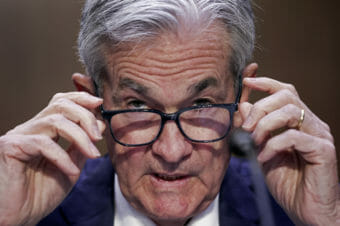
Jerome Powell, Chairman, Board of Governors of the Federal Reserve System testifies before the Senate Banking, Housing, and Urban Affairs Committee on June 22, 2022 in Washington, DC. (Photo by Win McNamee/Getty Images)

Federal Reserve chairman Jerome Powell says the central bank is committed to regaining control over inflation, even as he acknowledged the Fed has little power to address its most visible symptoms at the gas pump or the supermarket.

Powell addressed the Senate Banking Committee Wednesday, a week after the Fed ordered the largest interest rate increase since 1994. The central bank is under growing pressure to combat inflation, which hit a four-decade high of 8.6% in May.
“We need to get inflation back down to 2%,” Powell told lawmakers. “We’re using our tools to do that. And the public should believe that we will get inflation back down to 2% over time.”

Sen. Elizabeth Warren, D-Mass., cautioned that an abrupt increase in borrowing costs could produce a surge in layoffs, while doing little to untangle supply shocks that have driven up the price of gasoline and groceries.

“You know what’s worse than high inflation and low unemployment?” Warren said. “It’s high inflation and a recession with millions of people out of work. I hope you’ll reconsider that, before you drive this economy off a cliff.”

Powell stressed the economy is well-positioned to withstand higher interest rates, although he acknowledged that the war in Ukraine and lingering supply-chain problems increase the risk of an economic slowdown.

“It’s certainly a possibility,” Powell said. “It’s not our intended outcome at all but it’s certainly a possibility.”

“We’re not trying to provoke — and don’t think that we will need to provoke — a recession,” he added. “But we do think it’s absolutely essential that we restore price stability, really for the benefit of the labor market as much as anything else.”

A growing number of forecasters now see storm clouds on the horizon. Economists surveyed by the Wall Street Journal put the odds of a recession in the next 12 months at 44%, up from 28% in April.

Powell argued that predicting recessions is notoriously difficult, but added that he doesn’t see the risk as particularly high.

“The U.S. economy for now is strong. Spending is strong. Consumers are in good shape. Businesses are in good shape,” Powell said. “Monetary policy is famously a blunt tool. And there’s risk that weaker outcomes are certainly possible. But they’re not our intent.”

After keeping interest rates near zero for the first two years of the pandemic, the Fed is now moving aggressively to increase borrowing costs in a bid to tamp down demand. The Fed’s benchmark rate has jumped to 1.6%, and additional rate hikes are expected in the coming months.

Mortgage rates have climbed sharply in anticipation of the Fed’s moves, and that’s beginning to weigh on both home sales and home construction.

Some Republicans on the committee faulted the Fed for waiting too long to crack down on inflation, and blamed the $1.9 trillion dollar relief bill passed by Congressional Democrats last year for fueling consumer demand.

“The Federal Reserve and this administration failed the American people by not heeding these warnings a year ago, and not acting sooner to address it,” said Sen. Richard Shelby, R-Ala.

Powell and other officials have admitted that they initially misjudged both the severity and the staying power of inflation. But the Fed chairman insists he’s determined to bring prices under control.

“We have the tools and the resolve and hopefully the judgement to accomplish that task,” Powell said.

Copyright 2022 NPR. To see more, visit https://www.npr.org.

CDC clears the way for vaccinations for children 6 months to 5 years old

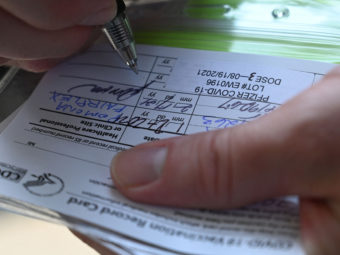
A child receives the Pfizer BioNTech COVID-19 vaccination at the Fairfax County Government Center on November 04, 2021 in Annandale, Virginia. The federal government approved the coronavirus vaccine for children between the ages of 5 and 11 this week. (Photo by Chip Somodevilla/Getty Images)

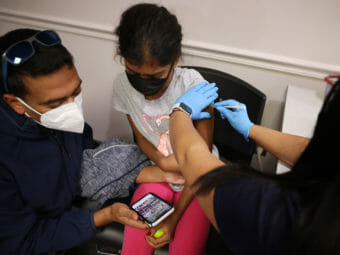
Providers across the country can start vaccinating kids ages 6 months to 5 years as early as this coming week after regulators cleared the final authorization steps on Saturday.

An independent panel of advisers to the U.S. Centers for Disease Control and Prevention voted on Saturday to recommend vaccinating all children in the age group with one of two separate COVID-19 vaccines manufactured by Moderna and Pfizer-BioNTech.

“I am fully confident that vaccines should be recommended,” said Dr. Grace Lee, the chair of the panel and a pediatrician at Stanford University. “We can clearly prevent hospitalizations and death, and we have the potential to prevent long term complications from infection that we don’t yet understand well.”

CDC director Dr. Rochelle Walensky quickly endorsed the recommendation, the final step before the vaccines could be rolled out.

“We know millions of parents and caregivers are eager to get their young children vaccinated, and with today’s decision, they can,” Walensky said in a statement. “I encourage parents and caregivers with questions to talk to their doctor, nurse, or local pharmacist to learn more about the benefits of vaccinations and the importance of protecting their children by getting them vaccinated.”

During a two-day meeting starting Friday, the panelists reviewed data from clinical trials by both pharmaceutical companies, as well data on the need for vaccines for this age group.

According to the CDC, as of May 28, more than 400 children 0-4 years have died due to COVID.

“Among people ages 1-4, COVID is fifth most common cause of all causes of death,” said Dr. Matthew Daley, speaking at the meeting Friday.

And data from older children and adults show that vaccination prevents death, said Daley, a senior clinician investigator at Kaiser Permanente’s Institute of Health Research. In fact, he added, among people 5 years and older, the unvaccinated are 10 times more likely to die from COVID than the vaccinated.

“Phrased another way, deaths from COVID-19 are preventable through vaccination,” he said.

The vaccine made by Moderna for 6-month-olds to 5-year-olds is a two-dose series, given four weeks apart. The Pfizer-BioNTech vaccine for 6-month-olds to 4-year-olds is a three-dose series. The first two shots are given three weeks apart, and the third one eight weeks after the second shot.

The CDC advisory panel voted 12-0 in favor of recommending both vaccines for this group of children, concluding that both vaccines protect children in this age group against symptomatic COVID-19, and the benefits outweigh possible risk.

“I am tremendously excited,” said Dr. Adam Ratner, head of pediatric infectious diseases at NYU Langone Medical Center and a spokesperson for the American Academy of Pediatrics.

“This is a day a lot of us have been waiting for since the very beginning of the pandemic,” he told NPR.

Many providers across the country have already pre-ordered the vaccine and can start administering it as early as this coming week.

“In early June, our state department of health put out a call for pre-orders,” says Dr. Jennifer Shu, a pediatrician based in Atlanta.

She pre-ordered both the Pfizer and Moderna vaccines and is expecting to start making appointments and giving the shots on Tuesday.

“We’ve had a lot of interest in the vaccine,” she told NPR. “Our phones have been ringing off the hook.”

Data from a survey conducted in February showed that around half of parents of this age group “said they would definitely or probably vaccinate their child once they become eligible,” said the CDC’s Dr. Sarah Oliver, speaking at Saturday’s meeting.

A third of parents said they “definitely or probably would not vaccinate their child,” she added. And a fifth of respondents said they would within three months of vaccines becoming available.

“This infection kills children,” said Dr. Beth Bell, a member of the panel and a public health expert at the University of Washington, speaking at the meeting. “We have an opportunity to prevent that and every parent will want to consider that calculus as well.”

Copyright 2022 NPR. To see more, visit https://www.npr.org.

There’s a nationwide Sriracha shortage, and climate change may be to blame

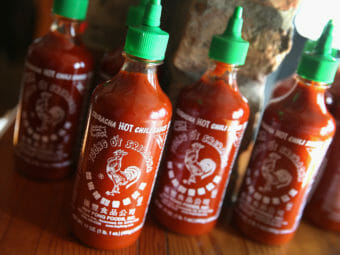
The impact of the Sriracha shortage is starting to be felt. (Photo by Scott Olson/Getty Images)

Sorry, Sriracha fans, your favorite hot sauce is running out nationwide.

The company that makes Sriracha, Huy Fong Foods, wrote in an email to customers in late April that it will have to stop making the sauce for the next few months due to “severe weather conditions affecting the quality of chili peppers.”

The spicy sauce has something of a cult following, and so when the news filtered through, some fans took to social media to express their dismay and post about panic buying (with varying degrees of irony.)

Grocery stores in some parts of the country have already started running low on stock, and restaurant owners have been facing higher prices.

Michael Csau, co-owner of the restaurant Pho Viet in Washington D.C., has been paying much more in recent weeks for his Sriracha orders.

“Usually when I bought one case, it was roughly around $30 to $32. Now it’s up to $50, almost double the price. If it keeps going up, we cannot afford it,” Csau said.

If the price gets much higher, Csau said he would probably have to switch to a different brand.

“But people, they are used to the taste right now. So when they taste it, they’ll know right away,” he said.

Michael Csau says he may have no choice but to move away from Sriracha. (Photo by Ashish Valentine/NPR)

Florence Lee, who was at Csau’s restaurant waiting for a bowl of pho, summed up her thoughts on a Sriracha swap-out: “A little bummed out.”

“Because this is where I’m like, you have to have the Hoisin sauce and the Sriracha, together!” she said.

Other food could be affected too

The shortage is due to a failed chili pepper harvest in northern Mexico, where all of the chilies used in Sriracha come from, according to National Autonomous University of Mexico’s Guillermo Murray Tortarolo, who studies climate and ecosystems.

“Sriracha is actually made from a very special type of pepper that only grows in the southern U.S. and northern Mexico,” Murray Tortarolo said. “These red jalapeños are only grown during the first four months of the year, and they need very controlled conditions, particularly constant irrigation.”

Irrigation, of course, requires lots of water, but northern Mexico is in its second year of a drought.

“The already difficult conditions were pushed over the limit by two consecutive La Niña events. And the dry season has not only been intense, but also remarkably long,” Murray Tortarolo said.

As a result, the spring chili harvest was almost nonexistent this year. Murray Tortarolo thinks it’s very likely that climate change is a factor, although it requires further study to confirm.

He said that if the drought continued, it was likely that prices for other foods from the region like avocados, tomatoes and meat would rise as well.

This is the view of La Boca dam in Santiago, Mexico in March. The lack of rain has reduced the dam capacity to 10%, the lowest in the last 40 years. (Photo by Julio Cesar Aguilar/AFP via Getty Images)

On top of these conditions, the entire region that includes the southwestern U.S. and northern Mexico is suffering a “megadrought.” And it’s also connected to climate change.

“This has been the driest 22 years in the last 1,200 years,” UCLA hydroclimatologist Park Williams said. Williams recently led a study of the megadrought, published in Nature Climate Change.

He said the megadrought conditions drying up water reservoirs in the U.S. made it harder for Mexico to deal with its water shortages.

“We share some of the same climate, but we also share some of the same water,” Williams said. “So over the last 23 years as we’ve seen our largest reservoirs get drained, this puts Mexico and Mexican agriculture at a risk of being even more water limited than it would be already.”

It’s hard to say climate change caused the drought, Williams said, but it’s certainly made it worse. His research estimates that about 40% of the drought can be attributed to human-caused climate change.

Still, Williams said we can make a huge difference by limiting how bad climate change gets.

“Limiting global warming to below 2 degree Celsius puts us in a much better situation than if we let global warming go to 3 degrees or 4 degrees Celsius.”

So keeping Sriracha hot may depend on keeping the planet cool.

Copyright 2022 NPR. To see more, visit https://www.npr.org.

Early results have Palin, Begich, Gross and Peltola in top 4 for special US House election

Former Alaska Gov. Sarah Palin speaks at the 2016 Politicon at the Pasadena Convention Center in Pasadena, California, June 26, 2016. (Creative Commons photo by Gage Skidmore)

Update — June 13, 8:42 a.m.

Sarah Palin is leading the pack in the special primary for U.S. House.

The Division of Elections counted the first batch of ballots on Saturday night – 109,000 of 135,000 ballots returned so far.

Palin, a Republican, has about 30% of the votes counted so far. She’s followed by Nick Begich, also a Republican, who took 19%  and independent Al Gross with 12%.

The biggest surprise is that Democrat Mary Peltola is in fourth place with 7%. If that holds, she would make it to the special general ballot, along with the leading three.

She is followed by Tara Sweeney, who has 5%, and Santa Claus, with 4%.

The ballots counted Saturday night are from all over the state. They include ballots mailed, hand-delivered and cast in person.

The division says it will resume counting on Wednesday.

A lawsuit on behalf of voters who are visually impaired threw the timeline for certification in doubt on Friday. But Saturday the Alaska Supreme Court reversed the lower court judge. The order was brief. The justices said they’d explain at a later date.

The special election is to serve the remainder of the late Congressman Don Young’s term in office. Alaskans will determine the winner in the August 16 election by ranked choice voting.

Meanwhile, more than 30 candidates are running to serve the congressional term that begins in January. Santa Claus, a city councilman from North Pole, is not running for the full term, but most of the other frontrunners are. 

This story has been updated.

Site notifications
Update notification options
Subscribe to notifications