Nation & World

The student debt relief application is live: Here’s what you need to know

A student texts on a cellphone in this stock photo. President Joe Biden announced Monday that student loan borrowers can begin to apply for debt relief through a new online application. (Photo by Ariel Skelley/Getty Images)

WASHINGTON — President Joe Biden announced Monday that student loan borrowers can begin to apply for debt relief through a new online application.

Biden said the application is easy and fast. It will allow every borrower with an income of $125,000 or less ($250,000 for married couples) to have up to $10,000 in debt forgiven, or $20,000 forgiven for those with Pell Grants. Those income levels have to have been during 2020 or 2021.

No documents need to be uploaded with the application, Biden said.

Late Friday, a beta version of the student loan forgiveness application was released by the Department of Education. Biden said 8 million borrowers were able to fill out the application “without a glitch.”

The White House estimated that 43 million borrowers would qualify for some relief.

Those who qualify have until December 31, 2023, to fill out the application.

GOP lawsuit

The president called out Republicans for attacking the debt relief program, as well as Republican-led states that filed a lawsuit to prevent borrowers from applying for financial relief. The suit argues Congress did not approve the debt cancellation and the Department of Education is misusing its emergency authority.

“Their outrage is wrong and hypocritical,” Biden said. “I don’t want to hear from Republican officials who had hundreds of thousands of dollars, even millions of dollars, in pandemic relief loans—PPP loans—who now attack working class Americans for getting relief.”

U.S. Secretary of Education Miguel Cardona also joined the president for the announcement. Cardona said the department is working to also include borrowers with private loans to qualify for debt relief.

“We are working on pathways there to support those,” Cardona said. “But we’re moving as quickly as possible to provide relief to as many people as possible.”

The administration quietly dropped a section of borrowers—nearly 800,000—from qualifying for the student loan forgiveness plan if they have loans administered through the now-defunct Federal Family Education Loan program, or Perkins loans, following a lawsuit from half-a-dozen Republican-led states.

A Missouri judge will issue a decision on the lawsuit filed by attorneys general from Missouri, Nebraska, Arkansas, Kansas and South Carolina and on behalf of Iowa’s governor.

Another lawsuit, filed in Texas, seeks to block the program, arguing that the Biden administration did not ask for public comment before moving forward with its action

​​More than 43 million Americans have student loan debt, and the Federal Reserve estimates that the total U.S. student loan debt is more than $1.75 trillion.

Watch out for scams

Biden also warned of a scam in which callers will pretend to be from the federal government, asking about assisting a borrower with student loan debt.

“Let’s be clear,” Biden said. “Hang up. You never have to pay for any federal help from the student loan program.”

He said student loan repayment, which has been paused since early 2020, will resume in January.

Those borrowers who continued to pay off their loans during the student loan freeze in the early stages of the pandemic are allowed to get reimbursed for payments made beginning of March 13, 2020, by contacting their loan servicers to request a refund.

From Iran to Alaska, godson and godmother weigh in on current global protests

It’s the fourth week of protests in the Islamic Republic of Iran, sparked by 22-year-old Mahsa Amini’s death after she was detained by morality police over what she was wearing.

From Berlin to Los Angeles, thousands around the globe have marched in solidarity with the Iranian people. And for some Alaskans, these protests hit close to home. 
Finding refuge in Alaska

Samuel Bayanineek left Tehran in 2005. After spending more than four years in Turkey, he arrived in Anchorage as a refugee. 

He was greeted by Minoo Minaei, a long-time Anchorage resident, who was volunteering at Catholic Social Services and was assigned as his interpreter.

 “Sammy looked at my eyebrows and asked who did them,” Minaei said. “I told him I did. He said, ‘you do such a lousy job.’ And I just loved that, so I called my husband and said, ‘I think we have inherited a son.’”

Minaei left Iran when she was 13. She first arrived in Anchorage in 1980 and spent 33 years teaching in the Anchorage School District.

She eventually became Bayanineek’s godmother. He was a barber back in Iran and she helped him go to beauty school in Alaska to get his cosmetology license.  

A new generation in Iran

“[My father] got us out before the revolution,” Minaei said about her journey out of Iran.  “I have never really gone back, so I have never seen the change. I just read about it and it’s just heartbreaking. We have really gone backwards so far, and I don’t know if it’s ever going to go forward.”

Minoo Minaei and Samuel Bayanineek in Anchorage, Alaska. (Photo courtesy of Samuel Bayanineek)

By mid-October, 185 people — including 19 minors had been killed in Iran, along with many injuries and thousands of arrests at the hands of government security forces. Videos of women and schoolgirls at the frontlines of the protests have circulated the internet.

“It is really heartbreaking to see how the women try so hard to fight with nothing in their hand except their brain,” Minaei said of the students protesting.

Bayanineek is hoping that this time, the protests can end in a “good revolution.” 

“This was going to happen sooner or later because when you have a systematic religious government, this is exactly what’s going to happen,” he said. “For most of the younger generation of high schoolers and even younger than high school, people are tired and raising their voices.”

Minaei pointed to social media as another factor. She said the older generation witnessed the revolution, but never tasted freedom. 

“If they are educated, they can see how much opportunity they could have,” she said. “I feel really sorry for them. I just really hope that the Western world would do something to help these people. And I don’t know if that will ever happen, if it’s just a can of worms that nobody wants to open.”

Fighting for their future

Every day, Bayanineek speaks to his mother in Tehran on the phone. And every day, she tells him that there are protesters on the street.

“The government should belong to the young generation today,” Bayanineek said. “They are the ones that should have the voice and run it.”

He said generations of witnessing the government “suck out all the resources from the country and get rich” while most citizens were suffering from recessions and bankruptcy has pushed the younger generation to the brink. 

“Let’s hope the young generation and these women are going to change that because they have to,” Bayanineek said. “It’s a matter of the next generation.”

Protests have periodically erupted in Iran since the 1978 revolution, but none have successfully overturned their regime.

“The majority, the public, wants freedom and they can’t get it,” Bayanineek said. “But it doesn’t matter how long it takes, they will get it.” 

 “Home sweet home, Alaska.”

Bayanineek estimates that there are no more than 200 Iranians in Alaska, but the community of around 50 in Anchorage is tight-knit.

“We do need more protesting,” he said. “In Charlotte, California, D.C., they have protesters. I know because we don’t have a big community, it’s not going to be a big protest, but what we can do is to pass our voice in the media.” 

During past protests, Minaei has written letters to U.S. senators — ranging from Ted Stevens to Lisa and Frank Murkowski — encouraging them to condemn the Iranian government and end the sanctions on Iran. 

“The sanctions that we are constantly putting on that poor country are killing the poor,” Minaei said. “And the only thing we can do is basically encourage [the protesters] to be strong and to stay together.”

Bayanineek is hoping that he can go back and visit Iran once the regime is changed.

“Not permanently, though,” he said. “Alaska is my permanent home. I will never leave — home, sweet home, Alaska.”

In the meantime, Bayanineek tries to support from afar and hopes that people around the world will help too. 

“For once in history, we should see the feminist revolution, and I hope it starts in Iran,” he said.

Whose lands are you on? This map of Native territories, languages and treaties will show you

The Sealaska Cultural Values Pole represents all three Indigenous groups of what is now known as Southeast Alaska. It was dedicated at the Arts Campus opening during Celebration. June 8 2022, Juneau AK (Photo by Yvonne Krumrey, KTOO)

President Biden became the first president to officially recognize Indigenous Peoples’ Day in 2021, and did so again this year. It falls on the same day as Columbus Day, which was established by Italian American groups to celebrate their heritage and to acknowledge the mistreatment of the immigrant group in the U.S.

Indigenous Peoples’ Day is a time of reflection, recognition and celebration of the role Native people have played in U.S. history, as NPR has reported. One way to mark the day — and to learn about Indigenous history year-round — is to learn whose lands you live on.

Acknowledging an area’s original inhabitants and stewards is a valuable process, albeit a complex one, as the National Museum of the American Indian explains. The museum suggests reaching out to local Indigenous communities for guidance involving formal land acknowledgements, which can be offered at the start of public and private gatherings.

“Many places in the Americas have been home to different Native Nations over time, and many Indigenous people no longer live on lands to which they have ancestral ties,” the museum says. “Even so, Native Nations, communities, families, and individuals today sustain their sense of belonging to ancestral homelands and protect these connections through Indigenous languages, oral traditions, ceremonies, and other forms of cultural expression.”

This map’s creators want it to convey more than borders

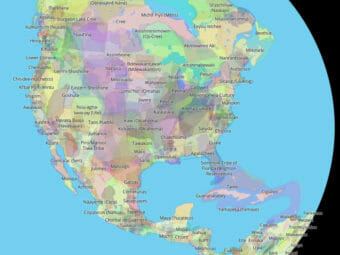
Native Land Digital, an Indigenous-led nonprofit based in Canada, is working to facilitate such conversations and document this history including by putting together a searchable map of Native territories, languages and treaties.

Users can click on labels across the Americas and around other parts of the globe — or type a specific city, state or zip code into the search box — to see which Indigenous tribes lived where. You can zoom in or out, as well as choose to apply “settler labels” to see how the map corresponds with contemporary state lines. Clicking on the name of each nation brings up links for related reading.

The map is available on the organization’s website and on iOS and Android mobile apps. Native Land Digital also publishes resources to go with the map, including a teacher’s guide and a territory acknowledgement generator.

The nonprofit says it aims to improve the relationship of people — both Indigenous and non-Indigenous — with the history and sacredness of the land around them. That involves “acknowledging and righting the wrongs of history.”
“We hope to inspire people to gain a better understanding of themselves, their ancestors, and the world they live in, so that we can all move forward into a better future,” it says.

The map itself is “more than a flat picture,” as the nonprofit explains, pointing out that land is sacred to everyone regardless of how consciously they appreciate it.

“In reality, we know that the land is not something to be exploited and ‘owned,’ but something to be honoured and treasured,” it says. “However, because of the complexities of history, the kind of mapping we undertake is an important exercise, insofar as it brings an awareness of the real lived history of Indigenous peoples and nations in a long era of colonialism.”

Mapping tribal lands comes with challenges

The nonprofit acknowledges the many logistical and ethical questions that come with mapping Indigenous territories. Those range from defining “Indigenous” across time and space to engaging with those communities so they can “represent themselves and their histories on their own terms.”

Native Land Digital aims to use at least two valid sources (including oral history, written documents or “maps sketched by people deemed to be reasonable authorities”) when updating the map, and says in cases of conflicting maps it generally errs on the side of being “more expansive.”

It cautions that the map does not represent definitive or legal boundaries of any Indigenous nations, and is a work in progress with many community contributions.

“We … encourage people to treat these maps as a starting point and to do their own research in engaging with communities and history themselves,” the group says.

The map has already made an impact

Native-Land.ca was created in 2015, and the organization was incorporated as a nonprofit in 2018. The group says it’s found over the years that its maps have made a direct impact on peoples’ lives.

That’s been true of Indigenous people, who have been glad to see their nation mapped or surprised to see how large their traditional territories look on a standard Western map, as well as non-Indigenous people who may be “for the first time, encountering the depth, breadth and complexity of Indigenous history on the land.”

“Some people may be made uncomfortable by the new information and history the map brings forth,” the nonprofit adds. “But we are secure in knowing that truth is the best teacher, and we hope to provide the best information we can to help people come to their own conclusions about themselves and their place in the modern world.”

Copyright 2022 NPR. To see more, visit https://www.npr.org.

Coast Guard captain describes encounter with Chinese, Russian warships off Alaska

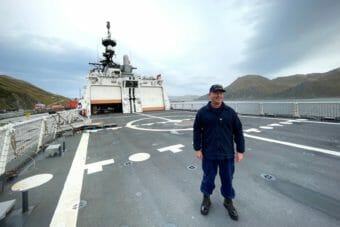
U.S. Coast Guard Capt. Thomas D’Arcy aboard his command, the cutter Kimball, during an Unalaska port call. The Kimball encountered several Chinese and Russian warships off Alaska in late September. (Maggie Nelson/KUCB)

The U.S. Coast Guard cutter Kimball calls Honolulu home, but recently it’s seen a lot of action in the Aleutians.

Just last month while on a routine patrol, the vessel encountered a group of seven Russian and Chinese warships traveling together through the Bering Sea. The Kimball’s commander, Capt. Thomas C. D’Arcy, recalled the encounter during a port call in Unalaska last weekend.

“We tracked them from about Kiska Island and then down through the pass,” D’Arcy said, pointing at a map of the Bering Sea. “So I’m assuming that they came up into the Bowers Ridge area and then moved in formation.”

The path the ships took was similar to that of a group of Chinese vessels that the Coast Guard tracked and followed in the region just about a year ago, according to D’Arcy.

The Kimball — which carries about 120 crew members, defensive weapons and a helicopter — came within about a mile of the group and made radio contact with them. Crew members on the foreign warships responded, but never declared who was coordinating the formation, he said.

While the group didn’t break any rules or give reason for direct contact, D’Arcy said the Kimball accompanied the ships until they passed into the Pacific side of the Aleutian Islands, where they split up.

He said they encountered the warships in the Bering Sea, in the U.S. Exclusive Economic Zone — an area up to 200 nautical miles offshore, where the U.S. has jurisdiction over natural resources. The formation never entered U.S. territorial seas.

A Coast Guardsman aboard the cutter Kimball monitors a vessel from a group of Chinese and Russian warships in late September 2022. (Courtesy U.S. Coast Guard)

NATO officials have warned of a strategic Arctic partnership between Russia and China that challenges the organization’s values and interests. For D’Arcy, Russia’s persistence to militarize and develop a presence in the Arctic is concerning. But, he said part of the Coast Guard’s duty is to ensure that the U.S. sovereign interests are protected and to spend more time in the region.

The most important piece for the Coast Guard is to make sure that we’re there and that we’re observing what’s happening, whether it’s a foreign vessel that’s coming up to do research or another naval vessel from a different country that’s operating in that area, especially if it’s anywhere near our interested waters,” D’Arcy said.

On Saturday, the crew of the 418-foot vessel welcomed more than 100 guests for tours, while docked up at Unalaska’s spit.

D’Arcy said he was excited to host the community, especially after about two years of limited interaction with locals due to the COVID-19 pandemic.

“It’s great to have the crew interact with the local community,” D’Arcy said. “The Coast Guard’s presence has been here since like the 1880s. We’ve been part of Unalaska. We’re not always the same ship or the same crew, but I think being able to demystify what we’re doing here was one of the goals that we had for this visit.”

Unalaska residents tour the U.S. Coast Guard cutter Kimball during an October 2022 port call. (Courtesy U.S. Coast Guard)

About half of the visitors that boarded the ship throughout the day on Saturday were school-aged kids, he said.

“We had stations out where they could try on gear, ask questions of our specialists — whether that was our cooks or maritime law enforcement specialists,” D’Arcy said. “We had our unmanned aerial surveillance aircraft out.”

D’Arcy said the event is meant to show Unalaskans that the Coast Guard cares about their well being and safety, but it’s also a great chance for the crew to get to know the island community.

Unalaska residents tour the U.S. Coast Guard cutter Kimball during an October 2022 port call. (Courtesy U.S. Coast Guard)

“When we say, ‘Hey, we want to do open tours,’ we have more volunteers than needed,” he said. “Everyone was like, ‘Come on, can I wear (my fancy uniform)?’ … They’re eager to show what they do. And it makes me proud.”

Unalaska residents tour the U.S. Coast Guard cutter Kimball during an October 2022 port call. (Courtesy U.S. Coast Guard)

This is D’Arcy’s second trip to Unalaska, and it’s the Kimball’s second deployment to the state. Right now, the ship is about two months into its roughly three-month station in the area.

D’Arcy didn’t comment on the strategic implications of the foreign warships the Kimball encountered last month. But he said the cutter is staged for just about anything and will continue monitoring the area for foreign military activity.

“Kimball will be ready and respond,” he said. “But if there is no foreign presence and no threat there, no adversarial strategic competitor operating in our waters, then we shift to the next tasking and priority.”

For now, the Kimball will continue patrolling near Unalaska in the Bering Sea region and into the Arctic.

As the fall weather builds and fishing seasons begin picking up, D’Arcy said the crew is preparing for weather-related accidents and enforcement of fishing regulations.

Meet the Alaska Native creatives in the NYC writers room for ‘Alaska Daily’

Playwright Vera Starbard listens to a question during "An Evening of Stories," an event Monday, April 23, 2018, to raise awareness of domestic violence and sexual assault, at the Elizabeth Peratrovich Hall in Juneau. (Photo by Tripp J Crouse/KTOO)
T’set Kwei Vera Starbard in 2018. Starbard is one of the writers of the ‘Alaska Daily’ TV show that premiers on Oct. 6, 2022. (Photo by Tripp J Crouse/KTOO).

The new TV show “Alaska Daily” premieres on Thursday. It stars Hilary Swank as a hard-charging investigative reporter, fresh from New York City – but quick to see that her new state has far too many cases of missing and murdered Indigenous women.

The series is fiction, loosely based on the Anchorage Daily News, and at least two Alaska Native writers work on the show.

“Overall, I really hope people see in this, in some way, the Alaska that I love,” said Lingít playwright Vera Starbard, whose career took off when she was tapped to write episodes for the PBS hit children’s series, Molly from Denali.

Her writing partner, Andrew MacLean, is Inupiat, and known for his award-winning film from 2011, “On the Ice.” And even though he’s familiar with making movies, MacLean says nothing prepared him for a TV series like this.

Andrew Okpeaha MacLean, who produced the award-winning film, On the Ice, is now living in New York City, where he is works on the screenplay for Alaska Daily (Photo courtesy of Andrew MacLean).

“Somebody compared it to building a train hurtling down a track and I think that’s kind of right,” he said.

Even as the show premieres, MacLean and Starbard are hard at work on upcoming episodes for the season that haven’t been filmed yet.

“It’s literally hour by hour,” Starbard said. “You don’t totally know what you’re going to be doing, so you might show up and think you’re going to work on Episode 9, and in fact, there’s an urgent thing they need you to figure out for Episode 5 that they’re shooting right now.”

For the past few months, both Starbard and MacLean have been sequestered in what they call, “The Writing Room” in New York City, where they work with producers and writers they describe as some of the best in the business. But even so, it hasn’t been easy to teach them about Alaska.

“So many different communities. So many different peoples and tribes and ethnicities. And so many different lived realities. It can be overwhelming,” said MacLean. “It probably causes us to lose the most sleep.”

MacLean says millions of people will watch this show.

“And that’s a powerful thing. A powerful way to educate and a powerful opportunity just to reach out and tell our stories in a truthful and authentic way,” he said.

“I have such a strong belief,” Starbard said. “And it’s so much of the reason that I do the work that I do – that Alaska Native people have amazing, wonderful, beautiful, extraordinary things to give the world.”

And that includes a sense of humor. Just before she left New York City to return home, the crew gave her a card with a word in Lingít.

“And it just says júk on it, which means ‘Go away’ in Lingít,” she said. “I taught them too much.”

She says she finds it ironic that to tell stories about Alaska, she had to go all the way to New York City, where she was asked to treat the state as more than just a backdrop, but a character in its own right.

Listen to the interview from Juneau Afternoon:

Vera Starbard is a member of KTOO’s board of directors.

White House grants $13 million to help combat Alaska’s opioid crisis

In May 2022, the state packed 3,000 opioid overdose emergency kits and sent them across Alaska. In September, President Biden announced $13 million for Alaska to address opioid epidemic. (Image courtesy of Project HOPE.)

As part of National Recovery Month in September, the Biden Administration announced $1.5 billion in funding for states and Tribes to address the opioid epidemic.

Fifteen Tribal organizations across the state were granted a total of $9 million. The Alaska Department of Health and Social Services will be getting $4 million.

The state’s plan for using the money includes increased syringe exchange programs and distribution of the overdose reversing drug naloxone. There are also plans for educating youth about substance abuse, including trauma-informed programs specifically for Alaska Native youth. The project is expected to serve a total of 300 clients and 2,240 providers over the course of two years.

Site notifications
Update notification options
Subscribe to notifications