High Country News

High Country News is an independent magazine dedicated to coverage of the Western U.S.
Native languages need radio, which is at risk of being lost

A woman wearing headphones speaks into a radio studio microphone
KUYI-Hopi Radio general manager Samantha Honani Molina on the air at the station in Arizona in June. (Photo by Deidra Peaches/High Country News)

Samantha Honani Molina was about 20 when KUYI-Hopi Radio first came on air. She was attending college, hours and miles from her home village, and every time she tuned in, she felt connected, hearing her community’s songs and language.

“I was struggling to find my place, because when you’re coming from the rez, you’re trying to find your space in a city or town, and there’s nothing of who you are and where you come from. You feel the sense of, not lost, but just uncertainty, and missing home and stuff like that,” said Molina. “By hearing language on the radio, it brings the sense of cultural identity that almost highlights and strengthens that — no matter where you are, even here at home. If you don’t hear yourself represented in large spaces, you’ll just get enveloped and folded into the mainstream.”

After graduating, she returned home and later became general manager of KUYI-Hopi public radio, a position she’s held for three years. Previously, she was the program director for the Hopi Foundation, the station’s radio licensee and parent nonprofit, which provides several year-round programs on topics ranging from youth leadership to community development. The station — located in Lower Sipaulovi, below Second Mesa on the Hopi Reservation in northern Arizona — made its on-air debut in 2000 and began broadcasting online in 2010. It is the only news outlet of its kind that focuses on the Hopi community, and uses the Hopi language, Hopìlavayi.

And now, as it celebrates its 25th anniversary, KUYI has to contend with the reality of losing a significant portion of its funding, possible cuts and changes to the ways it operates.

Currently, 42 Western radio stations are considered vulnerable because over 30% of their annual funding comes from the Corporation of Public Broadcasting. Twenty of those stations serve Indigenous communities and are located in the rural reaches of reservations and Alaska Native villages.

In May, President Donald Trump signed an executive order ending CPB’s congressionally approved funding of National Public Radio and the Public Broadcasting Service. NPR, PBS and various local stations filed lawsuits in response. In early June, Trump asked Congress to claw back the $1.1 billion it had already set aside for public media. The House of Representatives narrowly approved that legislation, which the Senate approved in mid-July despite receiving pushback from both Democrats and Republicans.

Molina said the bill would be “devastating” to KUYI.

“KUYI radio capacity is at a place where we’re able to provide all these avenues of service, which is safety, education and entertainment. We’re finally just beginning to really explore its possibilities,” Molina said. “If pulling public media funding is done, it would destabilize not only the progress made but also jeopardizes the essential safety and cultural services we provide daily.”


“By hearing language on the radio, it brings the sense of cultural identity that almost highlights and strengthens that …”– Samantha Honani Molina, general manager of KUYI-Hopi Radio


The station, which has five full-time staff members and a newly built modular studio, broadcasts at 60,000 watts across northern Arizona down to Winslow as well as online on its website. CPB funding accounts for over 48% of its operating budget, according to a June 30 letter the Hopi Tribe sent to the Senate, urging it to preserve funding for public media.

Native Public Media and the National Federation for Community Broadcasters have held summits over this, and Molina said that many broadcast organizations are already planning for cuts, regardless of whether the legislation is ultimately passed.

The immediate and significant budgetary impacts are obvious, but the long-term losses and their ramifications are incalculable. Stations like KUYI provide more than news and information: They’re community hubs where Indigenous languages can thrive, a space to preserve and grow Indigenous people’s connection to their culture and their own place within the world.

At KUYI, volunteer DJs host music and news segments, often providing bilingual weather and community updates, even a “Hopi Word of the Day” that introduces new words and tells listeners how to use them in conversation — mavasta, for example, which means “to aim” in the Hopi language.

KTNN in St. Michaels, Arizona — “The Voice of the Navajo Nation” — not only broadcasts sports events and other announcements, it also delivered essential information during June’s Oak Ridge Fire, all in Diné Bizaad, the Navajo language.

In Barrow, Alaska, the northernmost community in the United States, KBRW offers an hourlong five-day-a-week program called Uqalugaat Inupiat Stories that also teaches Inupiaq words and phrases. The late Fannie Kuutuuq Akpik-Piquk gave lessons on-air, explaining that misiġarriuq means “to make seal oil from blubber.”

Every day, the Talking Drum and Language Hour show on KWSO in Warm Springs, Oregon, plays Indigenous drum music and offers language lessons featuring the Ichishkin, Kiksht and Numu languages of the Confederated Tribes of Warm Springs.

In 2024, the United Nations Education, Scientific and Cultural Organization conducted a study recommended by the United Nations Permanent Forum on Indigenous Issues. UNESCO’s report highlighted the need for developing accessible Indigenous-produced media that provides news, entertainment and cultural programming. The report found that radio is the most widespread media and accounts for 34% of Indigenous media use. Indigenous media in general contribute significantly to the preservation and promotion of Native languages, cultural practices and traditional knowledge, helping “foster a sense of belonging and recognition.” But there are still barriers to providing Native language content on the radio, including technical hurdles, programming quotas and the heavy reliance on voluntary efforts that require long-term support.

Altogether, Indigenous radio and media help Indigenous communities engage and grow in their understanding of their language and show them how they can better connect with their culture.

Tiffany Lee, a Native American studies professor at the University of New Mexico, researches language reclamation and identity for Native youth. She promotes the benefits of immersive bilingual education for Indigenous students and adults, noting that having access to learning one’s language is key to revitalizing it.

“The number-one issue for language revitalization today is making sure our youth, our families, all have access to learning in some way and in multiple ways,” said Lee. “Just one isn’t going to work and isn’t always the best method for learning, so you need a diverse array of accessing the language and learning it.”


“If pulling public media funding is done, it would destabilize not only the progress made but also jeopardizes the essential safety and cultural services we provide daily.” – Samantha Honani Molina, general manager of KUYI-Hopi Radio


Indigenous language use on the airwaves bolsters the other places where Native languages are spoken, including schools and other immersion language programs. Examples in the Southwest include organizations like Saad K’idilyé — of which Lee is a board member — and Hopitutuqaiki, which teach Navajo and Hopi respectively in culturally relevant ways.

For Lee, learning one’s language is not just about being able to communicate within the community.

“I have this shirt that says ‘Indigenous language education is education,’ and I love that shirt and that saying because it’s so true,” Lee said. “It’s not just learning the mechanics of speaking your language — it’s an education unto itself. You’re learning your community and your culture’s worldview; you’re learning how language is tied to cultural practice, how it is cultural practice.”

No one understands the impact of sending Indigenous languages out onto the airwaves more than Navajo radio broadcaster L.A. Williams.

Williams, who’s been a radio broadcaster for 32 years, is widely known for reporting Phoenix Suns games in Diné Bizaad, providing play-by-play commentary, making the sport more accessible for people who speak only that language. Williams said the language continues to thrive largely because of its continued use.

“We’re not losing our language,” she said. “Our language is what puts us further in life as it makes us live longer into life by knowing the Navajo language.”

Throughout her career, Williams has seen broadcast opportunities as another way of encouraging use of Diné Bizaad at home, bridging the connection between elders who are fluent and youth who lack full command of the language. This creates a connection between past and future, reminding people that tribal history and culture will continue.

KUYI-Hopi Radio staff (from left) Darion Kootswatewa, Samantha Honani Molina, Brennyn Masawytewa, and Josh Sakenima. Molina and Masawytewa hold dolls of the station’s mascot. (Deidra Peaches/High Country News)

Despite the national threat to public media and funding cuts’ impact on rural and tribal stations, Williams is confident of the persistence and resilience of Indigenous languages.

“As far as the language, the tradition, the culture, that goes on,” she said. “That life goes on into the future.”

Meanwhile, Molina and Lee remain hopeful that current U.S. policy, including proposed funding cuts to Indigenous public media, won’t derail the conviction and resilience of people who are determined to preserve and reclaim their traditional ways of life.

KUYI is working on seeking alternative funding and keeping stakeholders informed. And Indigenous public media organizations such as Native Public Media, Vision Maker Media and Koahnic Broadcast Corporation, attended the National Congress of American Indians mid-year conference, seeking support from the organization.


“The number-one issue for language revitalization today is making sure our youth, our families, all have access to learning in some way and in multiple ways.” – Tiffany Lee, a Native American studies professor at the University of New Mexico


“Thankfully, we have a good parent organization, the Hopi Foundation, who is stepping up to see how they can supplement during this loss,” Molina said. “But they can’t carry us for that long. We’ll see what they’re able to do to help us fundraise or carry us for a little bit, but it’s not going to sustain — it won’t sustain.”

Despite the uncertainties and hardship, Molina said it’s been humbling to witness the outpouring of support from other radio stations and their listeners. The station’s 25th anniversary in August serves as a reminder of what really matters.

“That’s a really pivotal point for us to reflect on,” Molina said. “Then go forward with strength and resilience, just like our people have always done. It’s an opportunity for us to really show what we can do to support something so important, and I’m really excited to see what that looks like.”

We welcome reader letters. Email High Country News at editor@hcn.org or submit a letter to the editor. See our letters to the editor policy.

This article appeared in the August 2025 print edition of the magazine with the headline “Indigenous languages on the airwaves.”

This article first appeared on High Country News and is republished here under a Creative Commons Attribution-NonCommercial-NoDerivatives 4.0 International License.

How Alaska Native youth are protecting the land for their future ancestors

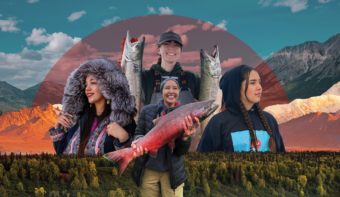
Clockwise from top center: Malia Towne, Mackenzie Englishoe, Sophie Swope and Jazmyn Lee Vent. (Mer Young/High Country News)

Alaska Native youth are living through a pivotal time, bearing witness to the dramatic impacts of climate change that have occurred during their lifetimes: rapidly melting permafrost, warming oceans and declining salmon runs. Subsistence living, which is critical to Alaska Native culture and rural food security, has suffered in turn, whether it involves Iñupiaq whale hunts, Gwich’in caribou harvest or Tlingit salmon fishing. The threat to a shared way of life is uniting many Indigenous people across the state, calling them to protect Alaska Native homelands and cultural continuity.

In light of this, many Alaska Native youth are dedicating their careers to protecting the environment and bringing Indigenous knowledge into mainstream spaces, including environmental science, policy work, increased tribal co-management and conservation initiatives. High Country News talked to four young Alaska Native women from different parts of the state who are working in climate advocacy, from community organizing to fishery sciences.

JAZMYN LEE VENT

Siqiniq Jazmyn Lee Vent (Koyukon Athabascan and Iñupiaq) has attended Ambler Road meetings for half her life. Vent, who is 24, went to her first meeting at 12 years old. At that time, the Ambler Road project — which would build a 211-mile-long highway to a mining project through sensitive habitat — was in the beginning stages, and different road maps were still being considered.

“I remember that, in our hall, a bunch of our elders (were) sitting in the meeting, and even though they might have not known exactly what was going on in those early stages of the proposed development, they knew that it was really important to show up and speak out against it,” Vent said. “So I really try to carry that with me.”

Vent co-founded No Ambler Road in 2023 to amplify the voices that oppose the proposed road, which could harm caribou migration patterns and habitat along with salmon spawning streams. For Vent and many others working on No Ambler Road, the project is much too risky, given that caribou populations are declining in Alaska and across the Arctic, and people can’t fish in the Yukon River.


I really envision a future where Alaska Native people have title to our land and are able to engage in these decision-making processes that directly impact our livelihoods.

– Jazmyn Lee Vent


Projects like these are often at the whims of the current administration. Last year, the Biden administration rejected the Ambler Road project, citing the harmful impacts it could have on the environment. But the U.S. Army Corps of Engineers never fully revoked the project’s permit, and Alaska’s congressional delegation and Gov. Michael Dunleavy support building the road, while President Donald Trump has long been enthusiastic about resource extraction in Alaska.

Vent wants the federal government to uphold the Alaska National Interest Lands Conservation Act (ANILCA) and its obligation to sustain subsistence hunting and fishing. Most of all, though, Vent wants Alaska Native people to be centered in these decisions and for companies, politicians and governments to leave their homeland alone.

“People might think this is crazy,” Vent said, “but I really envision a future where Alaska Native people have title to our land and are able to engage in these decision-making processes that directly impact our livelihoods.”

SOPHIE SWOPE

Anaan’arar Sophie Swope (Yup’ik) founded the Mother Kuskokwim nonprofit three years ago at 24 in her hometown of Bethel, Alaska.

Previously, she was the self-governance director for Orutsararmiut Traditional Native Council, which was in consultation with federal agencies about the Donlin Gold Mine project. If built, it would be one of the largest open-pit gold mines in the world — and it would be located dangerously close to salmon spawning tributaries in the Yukon-Kuskokwim Delta (Y-K Delta).

“I noticed the energy was low,” Swope said. “I kind of stood up and was like, ‘Hey guys, this stuff is really important, and we have to really fight to take care of all of our natural resources. Because it’s all that we have, and it creates who we are.’”

It was a key experience that inspired her to found Mother Kuskokwim. Swope now works full-time on fighting the Donlin Gold Mine, a project that is supported by her own Native corporation, Calista Corporation, despite its potential impact on salmon populations.

She helped organize a lawsuit against the U.S. Army Corps of Engineers, arguing that its environmental impact statement was insufficient — a lawsuit the group recently won.


This stuff is really important, and we have to really fight to take care of all of our natural resources. Because it’s all that we have, and it creates who we are.

– Sophie Swope


If chemicals from the mine get into rivers and food, it would be devastating for people in the Y-K Delta, who already suffer from extremely low salmon runs. And Swope doesn’t want future generations to have to worry about toxicity in their food or having a large tailings dam nearby.

“One day, I will have children, and hopefully I’ll have grandchildren, too,” Swope said. “I want them to have the same access to these resources that our DNA was literally created to thrive off of.”

Her elders taught her how to find her own voice. Now she wants younger generations to realize that they can and should use their voices when their way of life is threatened — and that they, too, have an obligation to take care of this place for future generations.

“Our time here on this Earth is very short,” Swope said. “We were gifted all of the things that we have by our ancestors, and we’re only borrowing this space on earth from the future generations.”

MALIA TOWNE

Malia Towne, who is Haida and Tlingit, grew up subsistence fishing every summer on her family’s traditional lands near Ketchikan, Alaska. As the years went by, they watched as the salmon population that their community had relied on for centuries began to fluctuate and decline. “It made me realize that something needed to be done,” said Towne.

Towne’s Tlingit values drove her to work in fishing sustainability.

“Everything is circular within traditional values,” she said. “What I do today affects tomorrow. It’s the whole reason I got into this work, because I want to be able to continue practicing what my ancestors practiced and want future generations to be able to do the same.”

Now a senior at Northern Arizona University, Towne, who is 20, studies environmental science, hoping to help ensure healthy fishing populations within Alaska. Last summer, she worked at the Alaska Longline Fishermen’s Association, a nonprofit that promotes sustainable fishing practices and flourishing coastal communities. Her goal is to protect subsistence salmon harvesting and create more access for subsistence fishers, many of whom are Alaska Native.


Everything is circular within traditional values. What I do today affects tomorrow.

– Malia Towne


“My mom says it’s genetic,” joked Towne. Her grandfather worked in fishing sustainability, and her sister does as well. “It’s in our blood.”

Towne aims to create policies that prevent environmental damage from happening in the first place, as opposed to laws that merely slap Band-Aids on serious injuries that have already occurred. These policies would incorporate an Indigenous approach to conservation, protecting the environment while still allowing for sustainable harvesting and resource use.

Towne cited the recent movement to list the king salmon as endangered. “It’s something that needs to be protected, but you shouldn’t cut off all access, because that hurts more people,” she said. “It’s incredibly detrimental to subsistence fishers.”

After graduating, Towne plans to return to Alaska and continue working on fishing sustainability, ideally in tribal co-management. She hopes that the policies she works on today will help salmon populations thrive for generations to come.

“What we do now is important, whether or not it’s recognized or appreciated today,” she said. “It will be appreciated eventually. Eventually, we’ll be thankful for it.”

MACKENZIE ENGLISHOE

Mackenzie Englishoe’s great-grandparents taught her to live off the land, using Gwichya Gwich’in knowledge that had been passed down for centuries. Englishoe’s great-grandparents, who experienced the dramatic changes caused by colonization, dedicated their lives to ensuring that her generation would be able to continue living the Gwich’in way of life.

“Our relationship to the land, it’s physical, mental, emotional and spiritual,” said Englishoe, who was raised between the remote Chandalar Lake in the Brooks Range, and Gwichyaa Zhee (Fort Yukon), a village of roughly 500 people on the Yukon River. “When I think about the future, I cannot — I will not — live in a future that does not have that, or where I’m not able to provide that for my family.”

Englishoe, 21, is living during another time of change. Using the traditional knowledge her great-grandparents taught her, she works on climate crisis issues that impact villages in Interior Alaska: fostering healthy caribou and moose populations, protecting Indigenous land rights and water and improving wildfire management. She’s been particularly involved in efforts to combat king salmon’s decline in the Yukon River, advocating for closing salmon fishing in Area M near the Aleutian Islands and ending bottom trawling.


When I think about the future, I cannot — I will not — live in a future that does not have that, or where I’m not able to provide that for my family.

– Mackenzie Englishoe


“Seeing the king salmon decline over time has really broken me,” she said. “And then seeing people who do not have this connection to the salmon, people who are not from these lands, making decisions about it, and a lack of action from them. … It’s just broken me.”

Last March, Englishoe was elected the emerging leaders chair for the Tanana Chiefs Conference, representing 42 Alaska Native communities in the Interior Region through her role as youth advisor. She wants young Alaska Natives to know that they’re capable of making change and that they deserve to have a seat at the table.

“Indigenous people, we do this work out of a place of love. For our community, for future generations, but also for people who are not Native,” she said. Everything is connected, she explained, from the salmon to the bears to entire food systems beyond Alaska. “So we’re trying to protect everybody, out of love.”

How Alaska Native youth are protecting the land for their future ancestors was originally published on April 1, 2025, at High Country News

Alaska is short on gravel and long on development projects

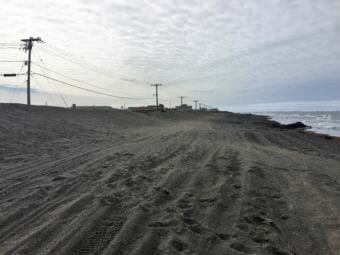
A gravel berm is one of the ways that the North Slope Borough protects infrastructure from storm damage.

Every year, millions of migratory birds flock to Arctic Alaska. Hundreds of thousands of caribou use the tundra, rich in plant life, as their calving grounds. Alaska’s North Slope is also rich in other natural resources: oil, gas, minerals. But one important thing is lacking: Rocks. “Yes, gravel is a precious commodity on the North Slope,” said Jeff Currey, an engineer with the state’s Department of Transportation and Public Facilities who works in the agency’s Northern Region Materials Section. For decades, Currey said, the state has been searching for gravel all over the North Slope, with limited success.

Gravel is essential for all kinds of long-term development: building projects, road construction, runways and other major infrastructure. “There’s a big need for gravel, and not a lot of it, is really what it comes down to,” said Trent Hubbard, a geologist with the Alaska Division of Geological and Geophysical Surveys.

“We need roads. We need housing developments,” said Pearl Brower, president and CEO of Ukpeaġvik Iñupiat Corporation (UIC), based in Utqiaġvik, during a panel discussion at last year’s Arctic Encounter Symposium, the largest annual Arctic policy symposium in the United States. Brower was among a handful of leaders from across the Arctic speaking on the region’s future.

“I definitely think it’s kind of a paramount necessity,” said Brower. UIC runs a construction company that has completed more than $1 billion in construction projects throughout the United States. The company’s website boasts that it specializes in remote locations. Brower said its projects over the last three decades have exhausted two gravel pits, and the corporation is now developing another. “You look all around (Utqiaġvik) and we’re very gravel-based,” Brower said. “You know, we don’t have pavement for the most part, and you wonder, ‘Wow, you know, where did all this gravel come from?’”

Ross Wilhelm — the project superintendent at UIC Sand and Gravel, which opened a new pit last year — said that if all the projects that currently require gravel from UIC’s pit are completed, it could be in operation for up to nine years.

A piece of the Utqiagvik coastline in a residential area near downtown. Much of this bluff collapsed during the September 2017 sotrm. Visible to the left are “supersacks,” part of the North Slope Borough’s strategy at the time for protecting the coastline from storm damage. (Ravenna Koenig/ Alaska’s Energy Desk)

According to Wilhelm, climate change is increasing demand: Gravel is needed for stabilizing existing infrastructure as the frozen ground underneath it thaws, as well as for a seawall to protect Utqiaġvik from high rates of coastal erosion. “I think it’s a big factor,” he said. A five-mile-long sea wall was priced at nearly $330 million, according to a 2019 feasibility study by the U.S. Army Corp of Engineers.

Gravel may also be a means to a richer economic future for Alaska’s North Slope. “To keep the economy growing, it’s so vital,” said Wilhelm. Many of the region’s residents dream of connecting at least some of its eight main communities by road, but doing so would require lots of gravel. The state and the North Slope Borough are partnering on a project, the Arctic Strategic Transportation and Resources, or ASTAR, that could do exactly that. It’s been under evaluation by state geologists since 2018.

The issue isn’t just locating enough gravel for projects like ASTAR; the cost can also be exorbitant. Currey said he’s heard of other North Slope projects where the bids are as high as $800 a cubic yard for gravel, enough to cover about 50 square feet. In Anchorage, a cubic yard of aggregate gravel — the kind used for building projects — goes for about $15. “The DOT has paid on the order of a couple hundred dollars a cubic yard for material being barged in, because that’s the only way to do it,” Currey said. Some of those barges come all the way from Nome, traveling more than 700 sea miles north and east through the Bering Strait and up and into the Beaufort Sea to deliver gravel.

Gravel is also a prized commodity for the oil and gas industry. Last year, the Biden administration approved ConocoPhillips’ Willow Project, a decades-long oil-drilling project in the National Petroleum Reserve. The controversial endeavor will require 4.2 million cubic yards of gravel — more than 12,800 Olympic-size swimming pools’ worth of rocks — for its three oil drilling pads, as well as enough for more than 25 miles of new road. Much of that gravel will come from a 144-acre mine ConocoPhillips will dig itself.

ConocoPhillips’ Willow prospect, pictured here, is still being explored. (Photo courtesy ConocoPhillips)

When it comes to gravel, the Willow Project may fare well, mainly due to its geography; it will be located just west of the village of Nuiqsut, where there’s actually plenty of gravel. Nuiqsit lies on the eastern side of Alaska’s North Slope, where the Brooks Range is closer to the coast. Streams that run northward down the mountains carry gravel with them, according to Hubbard.

But the North Slope is vast, spanning nearly 95,000 square miles, and further west, gravel resources dwindle: The mountains are farther from the coast, and gravel gets caught in the Colville River. “Much of the material north of the Colville River is largely silt and sand left over from historic sea-level rise and fall,” said Hubbard. It’s the kind of material that doesn’t work for projects like Willow or the roads and critical infrastructure that communities rely on. “Gravel,” said Hubbard, “is just a really hard resource to find.”

Emily Schwing is a reporter based in Alaska.

Email High Country News at editor@hcn.org or submit a letter to the editor. See our letters to the editor policy.

This story originally appeared in High Country News and is republished here with permission.

Alaska’s Arctic waterways are turning orange, threatening drinking water

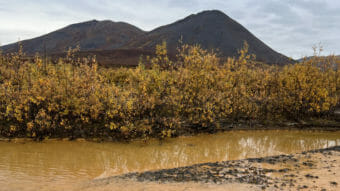
A river running orange with orange brush on its bank and bare hills in the background.
Tributary of Kugururok River located in Noatak National Park and Preserve, Alaska with orange water. (Jon O’Donnell/National Park Service)

Dozens of once crystal-clear streams and rivers in Arctic Alaska are now running bright orange and cloudy, and, in some cases, they may be becoming more acidic. This otherwise undeveloped landscape now looks as if an industrial mine has been in operation for decades, and scientists want to know why.

Roman Dial, a professor of biology and mathematics at Alaska Pacific University, first noticed the starkest water-quality changes while doing field work in the Brooks Range in 2020. He spent a month with a team of six graduate students, and they could not find adequate drinking water. “There’s so many streams that are not just stained, they’re so acidic that they curdle your powdered milk,” he said. In others, the water was clear, “but you couldn’t drink it (because) it had a really weird mineral taste and tang.”

Dial, who has spent the last 40 years exploring the Arctic, was gathering data on climate-change-driven changes in Alaska’s tree line for a project that also includes work from ecologists Patrick Sullivan, director of the Environment and Natural Resources Institute at the University of Alaska Anchorage, and Becky Hewitt, an environmental studies professor at Amherst College. Now, the team is digging into the water-quality mystery. “I feel like I’m a grad student all over again in a lab that I don’t know anything about, and I’m fascinated by it,” Dial said.

Most of the rusting waterways are located within some of Alaska’s most remote protected lands: the Arctic National Wildlife Refuge, the Gates of the Arctic National Park and Preserve, the Kobuk Valley National Park and the Selawik Wildlife Refuge.

Orange water meets clear water at the confluence of two Arctic streams.
Mainstem of Kugururok River located in Noatak National Park and Preserve, Alaska. (Jon O’Donnell/National Park Service)

The phenomenon is visually striking. “It seems like something’s been broken open or something’s been exposed in a way that has never been exposed before,” Dial said. “All the hardrock geologists who look at these pictures, they’re like, ‘Oh, that looks like acid mine waste.’” But it’s not mine waste. According to the researchers, the rusty coating on rocks and streambanks is coming from the land itself.

The prevailing hypothesis is that climate warming is causing underlying permafrost to degrade. That releases sediments rich in iron, and when those sediments hit running water and open air, they oxidize and turn a deep rusty orange color. The oxidation of minerals in the soil may also be making the water more acidic. The research team is still early in the process of identifying the cause in order to better explain the consequences. “I think the pH issue” — the acidity of the water — “is truly alarming,” said Hewitt. While pH regulates many biotic and chemical processes in streams and rivers, the exact impacts on the intricate food webs that exist in these waterways are unknown. From fish to stream bed bugs and plant communities, the research team is unsure what changes may result.

The rusting of Alaska’s rivers will also likely have an impact on human communities. Rivers like the Kobuk and the Wulik, where rusting has been observed, also serve as drinking water sources for many predominantly Alaska Native communities in Northwest Alaska. One major concern, said Sullivan, is how the water quality, if it continues to deteriorate, may affect the species that serve as a main source of food for Alaska Native residents who live a subsistence lifestyle.

The Wulik River terminates at the village of Kivalina, a community of just over 400 people, 80 miles north of the Arctic Circle, that relies on the river. “We are always worried about drinking water,” said Tribal Administrator Millie Hawley, adding in a written message that her friends and neighbors fish for trout in the river year-round. The community has seen the river become increasingly turbid in recent years, she said, and some people blame the nearby Red Dog Mine. But Hawley said everyone is aware that the permafrost around them is melting, and that increased erosion is causing the level of dissolved minerals and salts in the Wulik to rise.

In addition to present-day impacts, the researchers are also considering the historical record. “I’m sure it has happened (previously),” said Dial, “because, in some sense, this is a natural phenomenon.” But Dial and Sullivan note that the rate of climate warming is greater than anything recorded in the past. “So, it’s very possible that something like this has happened before, but it happened really slowly. And maybe there wasn’t just this massive pulse of orange that wound up in these streams,” Sullivan said.

The team believes there could be more than one climate change-related factor at play. 2019 and 2020 — two of the warmest summers on record — were both followed by winters with unusually high snowpacks. “Snow is a great insulator of soils, and it can be a potentially potent driver of permafrost thaw,” said Sullivan. He likens it to adding an extra blanket to the ground before it freezes. For now, none of the researchers know for sure whether the orange streams and rivers are an anomalous occurrence, coinciding with a handful of unseasonably warm seasons followed by high snow pack. And only time will tell how long it might continue.

This story originally appeared in High Country News and is republished here with permission.

Emily Schwing is a reporter based in Alaska. Find her on Twitter @emilyschwing. Email High Country News at editor@hcn.org or submit a letter to the editor. See our letters to the editor policy.

Carving a future for the Tongass National Forest

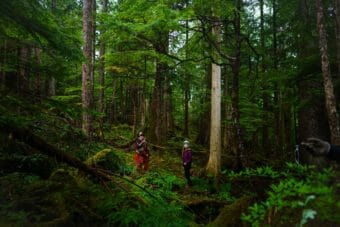
The sun sets through the Tongass National Forest. Loggers have clear-cut a quarter to half the region’s stands of large old-growth trees. During the 20th century, federal management often prioritized timber interests over the needs of Alaska Native communities, and high-value cedar trees were logged and exported. Forging stronger relationships among tribal governments, federal agencies, land managers and local youth is a first step toward improving overall management practices. (Bethany Sonsini Goodrich/High Country News)

Allison Mills manually drilled a bit into the base of a massive yellow cedar tree on Prince of Wales Island, in Southeast Alaska. The drizzly August day filled with the dull squeak of metal rubbing against wood. Once she reached the center of the tree, she gently pulled the delicate core sample free, lifted it to her face and inhaled the wood’s slightly spicy, medicinal scent. “I love the smell so much,” she said. 

Mills, 16, is Lingít and Haida, and had enthusiastically volunteered for the task. She is part of the Prince of Wales Island chapter of the Alaskan Youth Stewards, or AYS, a collaborative program that provides job experience, teaches leadership skills and gives rural youth a chance to support their communities and cultures. For 10 weeks this summer, her crew worked on natural resource and cultural stewardship projects serving their community. The session culminated in a four-day camping trip in a remote forested area, where the crew members searched for trees that might someday be transformed into totem poles or dugout canoes. The search — and the program itself — are part of a regionwide revitalization of carving and other cultural wood practices.  

Mills uses a clinometer to estimate the height of a cedar tree, a skill the Alaska Youth Stewards crew learned from foresters with the United States Forest Service and Sealaska, an Alaska Native Corporation. Indigenous carvers, builders and weavers worked with tribal governments and local land managers to outline the ideal attributes of trees for cultural use, including size, minimal trunk twist, location, concentration and distribution of branches, and more. Cultural-use harvests are selective and much smaller in scale than timber harvests, and are part of a land-management shift focused on sustainability rather than short-term economic gain. (Bethany Sonsini Goodrich/High Country News)
Allison Mills cradles a core from a western redcedar between her finger tips. Mills, who is Lingít and Haida, and other members of the Prince of Wales chapter of the Alaska Youth Stewards program collected data on red and yellow cedar trees that meet the stringent requirements for cultural uses, such as totem pole and dugout canoe carving. Trees of this quality are increasingly rare. (Bethany Sonsini Goodrich/High Country News)

The crew was exploring the Tongass National Forest, the largest national forest in the United States and the largest intact temperate rainforest in the world. At 16.7 million acres, it stretches across more than a thousand islands and encompasses 32 communities in Southeast Alaska. The forest sequesters carbon, provides drinking water and hydropower for thousands of people, and supports large fish and wildlife populations. It’s the foundation for sustenance, culture and a way of life for the Lingít, Haida and Tsimshian, who have lived in the region for millennia.

Michael Melendrez of the Forest Service takes measurements with Olivia Vickers of Alaska Youth Stewards. AYS is a partnership among the Forest Service, Sealaska, local and regional sovereign tribal governments, community and conservation organizations, school districts, the National Forest Foundation and others. Forest Service personnel joined the AYS crew for a field day to answer questions and support the crew members as they collected data. The data they gathered will join a growing database documenting trees suitable for cultural uses. (Bethany Sonsini Goodrich/High Country News)
Justin Reno measures the diameter of a tree. Reno, a Forest Service employee, grew up on Prince of Wales Island. Programs like the Alaska Youth Stewards initiative are meant to boost local and Alaska Native representation in outdoor and natural resource jobs. (Bethany Sonsini Goodrich/High Country News)

Over the last several centuries, Russians, Europeans and Americans colonized the region, and between 1902 and 1909, the U.S. government established the national forest on Lingít, Haida and Tsimshian homelands. The logging industry boomed a few decades later, with the first large-scale mills built in the 1950s. Global, state and national interest in Southeast Alaska’s timber intensified, peaking in the 1990s, when thousands of loggers clear-cut about 800,000 acres of productive old-growth forest, according to a 2013 study in the journal Conservation Biology, taking out a quarter to half of the region’s stands of large old-growth trees.. Clear-cutting remains a threat, since federal management of the national forest changes with each administration. Tribal nations and local residents have sought more involvement in managing the forest, but tribal governments have at times felt that federal agencies have discounted or overlooked their expertise. 

Elizabeth Thomas (Lingít name: Kinda.aat), who helps oversee the regional Alaska Youth Stewards program, cores a cedar tree. For Thomas, who works for the Central Council of the Tlingit and Haida Indian Tribes of Alaska, supporting the health of the local environment begins with equipping rural and Indigenous youth with the skills, confidence and experience needed for land-management positions. (Bethany Sonsini Goodrich/High Country News)

The AYS program may be helping to change that. Founded in 2017, it’s a partnership among tribal governments, tribal corporations, conservation groups, federal and state agencies, nonprofits and community organizations. 

After letting her fellow crew members smell the core, Mills carefully placed it in a protective container to be shipped to the College of Wooster Tree Ring Lab, in Ohio. Scientists will analyze it to better understand the decline of yellow cedar in Alaska and Canada, and how much of it is driven by climate change.

In Klawock, Jon Rowan Jr. (Lingít name: Tooyeek) discusses totem pole carving with the Alaska Youth Stewards crew and learns about their experiences in the forest. One of his current apprentices served on the 2021 AYS crew. In 50 years of carving, Rowan has completed about 30 poles and trained many young carvers. (Bethany Sonsini Goodrich/High Country News)

Meanwhile, four other crew members got to work assessing the tree. They measured the trunk’s circumference and height, looking for a minimum of 34 inches around and a height of at least 36 feet. They perched on fallen moss-covered logs to observe the twist of the trunk and the number of limbs and knots that obscured its face, factors that can hamper carving. They shouted the numbers to another crew member, who sat on the damp, spongy forest floor, recording data on a U.S. Forest Service-issued tablet. The information will join a database of trees that have the right characteristics for cultural uses.

Allison Mills shows her grandfather, Edward Thomas (Lingít names: TSA Xoo and Shaans Kadake; Haida name: Skil Quidaunce), president emeritus of the Tlingit and Haida Central Council, a core that she collected from a cedar tree. Mills, whose father works with Sealaska, was eager to share her new skills with the family members who inspired her desire to work in forestry. As an aspiring land and resource manager, Mills may one day make decisions about this forest that help sustain it, and the cultural practices it supports, into the future. (Bethany Sonsini Goodrich/High Country News)

It’s not clear how many of the rare forest giants known as monument trees are left. This inventory is part of an effort to shift away from unsustainable logging toward long-term management that supports cultural needs and new growth. “I love learning about our forest and our village, and learning how I can help protect it,” Mills said. “So even someday when I’m older, I can show my kids and grandkids everything, and just be able to have this beautiful place stay alive.”

Charlene Wolfe (Haida name: Jaat Gíigangaa), a Haida and Lingít carver from Craig, joined the search for totem trees on the last day of the campout, sharing her knowledge of trees suitable for carving. Wolfe told stories about growing up on the island and about her art, and she spoke of the hope local youth inspire. “I think it’s pretty phenomenal to see these kids out here, learning the things that they’re doing,” Wolfe said. “They’re the future. … We lost out on a lot of this because our culture, our native language, was taken away from us.” Forced assimilation included federal bans on cultural practices. “But we’re coming back stronger now. These kids here already have two steps ahead of what we had back in the day.”

After breaking camp, the crew traveled to the town of Klawock and met with Jon Rowan Jr. (Lingít name: Tooyeek), a Pueblo and Lingít carver and teacher, to get an idea of the possible fate of the trees they cataloged. Still in their muddy camp clothes, they gathered around a half-carved log inside Rowan’s carving shed, a large shop filled with loud rock music, the scent of cedar and piles of wood shavings. Rowan talked about the spark he felt the first time he saw a totem pole being carved in Klawock, in the 1990s. At that time, the practice of carving was rare in the area. “Now it’s happening all over the place,” he said. “It’s really cool.”

At his carving shed in Klawock, Jon Rowan Jr. (Lingít name: Tooyeek) rests his hand on a pole with crests belonging to the Ishkihittaan people. Rowan and two young apprentices are carving it as part of the Kootéeyaa Deiyí (Totem Pole Trail) for the Juneau waterfront. The trail is a project of the Sealaska Heritage Institute, an Alaska Native nonprofit that promotes Lingít, Haida and Tsimshian culture. Its existence highlights the cultural value of large trees, as well as the contribution that selective harvesting can make to the region’s tourist economy. Trees large enough for totem poles typically take more than 450 years to grow. (Bethany Sonsini Goodrich/High Country News)

The recent resurgence is part of a larger push toward community and cultural healing. Healing is happening in the woods where AYS crews work on rehabilitation projects and catalog cultural-use trees, in the carving sheds where the doors are always open, and at the pole-raising events that bring everyone together to celebrate. 

“I feel like it’s a really cool thing that we’re doing, being able to look at all the different cedars and decide which ones are good for people in the future,” Mills said. “Maybe they won’t be used, but it’s still cool to have those trees noticed so that carvers could maybe one day be like, ‘Oh, yeah, that is a good tree.’”


A totem park sits in the heart of Hydaburg, beside the school. The practice of carving and raising totem poles and then letting them return to the earth has been part of the rhythm of life here for thousands of years. Carvers, land managers, culture bearers and local youth are working hard to care for the old-growth forest that sustains this practice and the lifeways tied to it for thousands of years to come. (Bethany Sonsini Goodrich/High Country News)

Carving a future for the Tongass National Forest was originally published July 20, 2021 at High Country News.

Editor’s note: Photographer Bethany Sonsini Goodrich is an employee of the Sitka Conservation Society, a member of the Sustainable Southeast Partnership, a collaborative of community organizations, tribal governments, native corporations, land managers and others that supports the Alaskan Youth Stewards program.

Correction: This story has been updated to correct statistics on logging in Southeast Alaska. About 800,000 acres of productive old-growth forest were logged, not 1 million acres; and a quarter to half of the region’s stands of large old-growth trees, not half of all old-growth, were lost.

Bethany Sonsini Goodrich is a Southeast Alaskan writer and photographer who is deeply passionate about the power of story to inspire positive social and environmental change. When she’s not behind the camera, you’ll find her hunting, fishing, foraging, surfing, playing or sharing all sorts of tasty wild foods in the Tongass National Forest — her home.

Victoria Petersen is a freelance journalist living in Anchorage, Alaska. Previously, she was a reporting fellow at The New York Times and a High Country News intern. Follow her @vgpetersen 

In Arizona and Utah, the boarding school round-ups live with survivors to this day

""
J.D. Reeves / High Country News

They told Willie Grayeyes (Diné) to sleep in his clothes — to not even take off his black shoes. At any moment, the Tuba City Boarding School staff members said, the 7-year-old would be called upon. Not knowing what that meant, he obeyed, and, in the middle of the night, they woke him. Staffers drove Grayeyes 11 miles to the junction of U.S. Highway 89 and Highway 160 near Tuba City, Arizona, in the Western Agency of the Navajo Nation. There, in the red dinosaur land, he boarded a Greyhound bus. He rode it all night long until early morning, when they arrived in Richfield, Utah for a year in the mid-1950s. He did not go back his second year because the residential hall was full and he was transferred back to Tuba City for another Greyhound bus to the Santa Fe Indian School in New Mexico.

“We were treated in Tuba City like we were in the military,” Grayeyes said, remembering the boarding school system that tried to assimilate him and many thousands of other Indigenous children. “We were marched; we were physically abused by being kicked. I did not know anything at the time of the decree.”

The decree in question was the compulsory attendance mandate employed by the federal boarding school system, which often resulted in the physical, emotional, sexual and spiritual abuse of Indigenous children. The boarding school staff at the Navajo Mountain Boarding and Day School, built between 1934 and 1946 by the Civilian Conservation Corps, had notified the local trading post announcing that Diné children would be rounded up. Any parents, guardians or clan relatives who resisted were punished by law. Grayeyes, now a San Juan County commissioner, was just 6 years old when he first entered the boarding school system in 1953.

“That was my first encounter with an Anglo, a white lady, by the name of Elizabeth Eubank, who was a schoolmaster and teacher,” Grayeyes said. “Ms. Eubank arranged everything, as far as who is going to be transferred and so forth.”

After that first year at the Navajo Mountain Boarding and Day School, he was transferred to the Tuba City Boarding School, established in 1903. He loaded up his suitcases and rode in the flatbed trailer of a government vehicle to get there, 93 miles away from his homelands in Paiute Mesa in the community of Naatsis’áán, San Juan County, Utah. After just a few months at Tuba City, his luggage was returned, and they woke him in the middle of the night so he could take that Greyhound bus to Richfield Residential Hall in Richfield, Utah.

This was life as a boarding school student in northern Arizona and southern Utah — constantly being shuttled around on Greyhound buses or flatbed trailers, never told where you were going or who would be waiting for you when you finally arrived. The only stability to be found was in the black shoes on their feet and the Greyhound buses that trafficked them from school to school.

Grayeyes survived his boarding school experience. Not everyone did. Some students never returned; they went missing or were buried at unmarked graves at various boarding schools across the country. The survivors’ accounts of their experiences — along with the grisly discovery of bodies at residential schools in Canada and the reports of similar discoveries at schools in the U.S. — have finally prompted a federal investigation by the Department of Interior, led by Secretary Deb Haaland (Laguna Pueblo) under the Federal Indian Boarding School Initiative. Earlier this spring, Haaland and Assistant Secretary of Indian Affairs Bryan Newland released the first volume of their investigation. The initial report laid the groundwork, noting that 408 federal schools operated between 1819 and 1969, and that the report’s authors have found unmarked burial sites at 53 different boarding schools, a number that is expected to rise.

Newland and other Interior officials made it clear that this first report was never intended to be conclusive; rather, it should be seen as merely the first step in a long review, with a follow-up report slated for 2023. Meanwhile, there remain countless untold histories — experiences that could be lost if the federal review process doesn’t reach the survivors in time to hear their stories. As investigators listen to survivors and try to map the lingering impact of the boarding schools in the Southwest, one shared experience comes up over and over: the memory of being lined up to board one of those infamous Greyhound buses.

“I remember everybody on a certain day would go up to the local day school, and there would be these Greyhound buses parked up there,” said Leigh J. Kuwanwisiwma, a Hopi historian, former director of the Hopi Tribal Historic Preservation Office and a Christian boarding school survivor. “There used to be just piles of suitcases out on the sidewalk, and they would be loading that (bus) up.”

Hopi students from the villages of Hotevilla and Bacavi boarded buses that took them to the Phoenix Indian Industrial School, more than 200 miles away. Kuwanwisiwma had spoken to other students and felt somewhat prepared for boarding school. His older sister was forced to attend the Ganado Mission School, and her experience there helped him navigate not just school but also the strange customs and fashions, such as the blazer and tie that he wore to Sunday church.

“I remember just kind of going on the road and staring out of the back, just thinking, ‘Man, I’m leaving the rez,”’ Kuwanwisiwma said, recollecting riding in his parents’ 1955 pickup on his way to the Ganado Mission School. “I had this inner feeling of uncertainty inside as we drove through the villages.”

Kuwanwisiwma often felt lonely at the school, but he enjoyed some of the extracurricular activities — becoming a student-athlete at the Hopi Mission School and later at the Ganado Mission School, both Presbyterian-run institutions. He says his experience differed greatly from that of his ancestors, who endured the trauma of compulsory attendance, military discipline and having their hair cut, back in the days when Hopi leaders were jailed for resisting Bureau of Indian Affairs roundups of their children. That was years before the Greyhounds came.

The Greyhound generation remembers more than just the buses and their polished shoes. They also remember the stories of those who went before them.

Kuwanwisiwma’s father and grandfather both went through the BIA boarding school system. His father was forced to attend the Albuquerque Indian School, where he was punished for speaking the Hopi language with other Hopi students. Kuwanwisiwma’s father wanted to protect his own children from the BIA boarding school system, so he encouraged them to go to the mission schools instead, for their primary and secondary education.

As early as 1875, the BIA focused on recruiting Hopi students, often around 4 and 5 years old, from various Hopi villages. In the early 1900s, Kuwanwisiwma’s grandfather was rounded up by U.S. soldiers and forced to attend Keams Canyon Boarding School. His grandfather said that he was out herding sheep when he saw other young Hopi children crying for their parents, and the parents crying for their children. He stood there watching, believing that since he was older, he would not have to go. But the BIA agents told him to come with them anyway. Kuwanwisiwma’s grandfather resisted, running away. He fled from the agents until they fired warning shots into the air. Then he froze, surrendering.

The soldiers took him and the other Hopi children to a small building in Kykotsmovi Village, where the children cried all night while their mothers wept, calling out their Hopi names. The next morning, his grandfather’s long black hair was shaved off. “All their hair was being snipped off, girls and boys. Of, course, long hair was culturally important to both the Hopi boys and men. Long hair meant spiritual strength and courage to face the enemy,” Kuwanwisiwma said. “That’s what long hair means to the Hopi people.”

When his grandfather arrived at Keams Canyon, at the Hopi BIA Agency, the administrator told the soldiers that the boy was too old to attend the school. They let him go, but Kuwanwisiwma said, ashamed of his newly shaven head, hesitated to go home. His parents wondered why he was missing, although he soon came home.

“I tell this story, because around that time, around the turn of the century, there was a big division among the villages of what to expect from the white men,” Kuwanwisiwma said. “The white man was imposing education, and some of the people, the conservatives, the traditionalists did not want that. There was a big conflict developing.”

Ultimately, Kuwanwisiwma’s grandfather sided with the traditionalists and vowed to fight against the white men forever, he said.

“He became a die-hard conservative and traditionalist throughout his life, and those are some of the values I grew up with,” Kuwanwisiwma said.

Kuwanwisiwma holds the same values and is proud that his Hopi people held on to their language, ceremonies and agricultural lifeways. As a historian, he said, he knows that many tribes were less fortunate than his people — the Paiutes, for instance, who were nearly exterminated by the forced boarding school system. For the Paiute Indian Tribe of Utah, as well as Shivwits Band of Paiute Indians and Kaibab Band of Paiutes, the trouble started at the former Panguitch Boarding School, which operated from 1904 to 1909. Superintendent Walter Runke — who started his career as a disciplinarian at Tuba City Boarding School — believed in compulsory attendance, meaning that attendance was enforced at gunpoint, according to a news clipping of the Coconino Sun in the Arizona Memory Project. Historical records from an independent researcher show that at least 12 Paiute children were buried at the Panguitch Boarding School. The site is now part of Haaland’s federal investigation.

Corrina Bow, chairwoman of the Paiute Indian Tribe of Utah, said that a memorandum of understanding between the tribe, the two bands and Utah State University, which leases the former school’s land from the state, has been under negotiation for the last year. The conversations, first reported by the media in August 2021, sparked the investigation of USU’s agricultural lands in the predominantly ranching Mormon community of Panguitch. On behalf of her people, Bow said that she is pleased to have the former boarding school included in the ongoing federal investigation by the Department of Interior. Before the publicity, Panguitch was an unknown residential school.

“As a Tribe, we continue to address the former Panguitch Boarding School and are still saddened by the treatment of our little ones at that school,” Bow said in a statement. “We thank you for respectfully honoring our wishes to address this heartbreaking piece of our history privately following our cultural practices and beliefs.”

Steven Lee, an independent researcher who assisted the tribe, says that the overall narrative around Indigenous boarding schools, including Haaland’s federal report, confirms what he has learned so far: that some Paiute children never returned home, and that the story of the former administrator, Runke, did not end with his tragic stints at Panguitch and the Tuba City boarding schools. Runke went on to oversee a Navajo boarding school, and in 1916, was arrested for killing a Diné man, Taddy Tin, who resisted his recruitment tactics. Runke was acquitted by an all-white jury and later served two terms as an Arizona state senator.

Lee has worked with Bow to find out whether children were buried at the school, studying the school’s old records. He first learned about the traumatic history of Panguitch when he was the town’s events and marketing director. His discovery that a schoolteacher had died from an opium overdose back in 1905 inspired him to do more research, and that led him to the death records of at least 12 Paiute children. But city officials discouraged his research, and he resigned from his job working for the town.

The Interior Department’s first report, Lee said, confirms his own findings: Indigenous children were highly sought after by townspeople, who used them as cheap labor. The report said that USU is waiting for tribal approval to investigate the possible remains of Paiute children, according to Judson Finley, anthropologist and archaeologist at Utah State University.

Meanwhile, Haaland and her team are hosting listening sessions for their second report. Earlier this month, they held a second listening session in the Midwest, giving boarding school survivors the opportunity to tell their stories, some for the first time in their lives. Another listening session for survivors is slated for Arizona later this fall or winter. For the survivors, at least it’s a start.

Despite those memories of the endless Greyhound rides, Grayeyes takes pride in the resilience he and others showed in the face of a system designed to strip him of his cultural identity, starting with cutting off his hair. Today, he proudly wears his tsiiyéél, a Diné hair bun, as he fulfills his various leadership roles — including as the sitting board president of the Navajo Mountain Boarding School.

In his efforts to reclaim the school for the community, Grayeyes has relied on his own experience as a boarding school survivor to inform his decisions about how the school should serve its students. He believes in the importance of parental involvement, something that his generation and the ones before him were denied by the boarding school system. Grayeyes thinks parents need to get involved in their children’s education if they want to help shape the minds of their children in a healthy way.

This same line of thinking informs his beliefs as to what tribal nations and boarding school survivors should get out of the ongoing federal review. The survivors’ needs — their mental health, first and foremost — must be centered. But they deserve more than simply the chance to be heard; they deserve justice and an actual sense of closure. The first report fell short, in Grayeyes’ opinion, who thought it “should have had more depth.” But achieving that depth, as well as any justice or sense of closure, may require more litigious methods than a review process whose continuation depends on a favorable presidential administration. 

“If it were up to me,” Grayeyes said, “I would go for a lawsuit (against the federal government). The treatment of Native American students — with the idea to extinguish their lifestyle, their songs, their language — is pretty well planned out.”

Until that happens, however, Grayeyes, like so many others from his generation, will hope for the best from Haaland and her agency, and he’ll continue to work to provide a stable, healthy educational environment — one free of Greyhounds, guns and polished shoes.

Alastair Lee Bitsóí is Diné from Naschitti, Navajo Nation, New Mexico. An award-winning journalist, he formerly reported for The Navajo Times and The Salt Lake Tribune and now works as a correspondent for High Country News and other outlets. 

This story was originally published by High Country News and is republished here with permission.

Site notifications
Update notification options
Subscribe to notifications