High Country News

High Country News is an independent magazine dedicated to coverage of the Western U.S.
More shrubs means way more moose in western Alaska

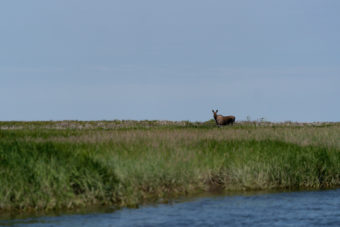
A moose, seen from across a stream, stands in tall grass
A moose near Newtok, Alaska, in the Yukon-Kuskokwim Delta. (Katie Basile)

Fall moose hunts are beginning across Alaska. In western parts of the state, biologists hope that hunting pressure will help protect the health of booming populations. They also want to know why there are so many moose in the first place.

It may have a lot to do with shrubs — particularly scrubby willows shooting up at the edges of open tundra. Moose feast on their leaves during the spring and summer. These short woody plants are spreading west, aided by climate change, and moose populations are expanding along with them. Researchers say it highlights the way that ecological changes cascade. Meanwhile, it’s prompting changes in hunting management, as people in rural areas depend increasingly on moose for subsistence.

The shrub spread appears to be caused by warming temperatures and the loss of snowpack in the Subarctic. Rick Thoman, a climate specialist with the International Arctic Research Center at the University of Alaska Fairbanks, said that spring in southwest Alaska has changed substantially, with snow melting earlier as temperatures rise. In the Yukon-Kuskokwim Delta, for example, the average springtime temperature has increased by more than 4 degrees Fahrenheit between 1972 and 2021. “That’s of course critically important for vegetation, because the earlier you can start to grow, the more you’re going to grow, in a Subarctic environment,” said Thoman.

Shrub expansion across the tundra, sometimes called “shrubification,” is visible from space: In satellite images, areas dominated by shrubs are greener than open tundra during the summer. Researchers track shrubification by comparing the greenness of images across the years. Shrubs have been proliferating in the rapidly warming global Arctic since at least the 1980s, and recent research shows that they are expanding in tundra below the Arctic Circle as well.

For moose in western Alaska, it’s been a boon. Their populations have swelled to record numbers in parts of the Yukon-Kuskokwim Delta and in the nearby Togiak National Wildlife Refuge. “From the early ’90s to now, we’ve seen at least a 400-fold increase in the moose population (in the refuge), which has tremendous effect on the environment,” said Sebastian Zavoico, a master’s student at the University of Alaska Fairbanks. A rise in moose predators, including bears, could be among the possible consequences. There might also be physiological changes to the shrubs moose eat. Willows can produce chemicals that make them less nutritious for moose as a defense.

A woman watches as children butcher a moose on a wooden table
Students learn subsistence skills while butchering a moose at Ayaprun Elitnaurvik, a Yup’ik immersion charter school in Bethel, Alaska. Subsistence hunting is vital both culturally and economically in rural areas. (Katie Basile)

Zavoico is studying changing moose demographics in the refuge. He’s found that when summer vegetation does well, so do moose: They give birth to more twins, and more calves survive. Satellite data shows that the refuge has grown significantly greener in the last two decades. That confirms what people who live in the refuge have told Zavoico: “Shrubs, which are the main moose food, have just exploded.”

But Zavoico is careful not to equate correlation with causation. For years, hunting and habitat management have aimed to boost moose populations in the refuge. Still, he said, the fact that moose are expanding in other western areas of the state suggests that climate change is also propelling the population boom. “It’s important to understand why (moose have) been expanding in the past so that we can better manage for the future,” Zavoico said.

The moose boom has huge implications for communities in the region that rely on the animals for subsistence. One moose can supply more than 500 pounds of meat, which is usually divvied up between several freezers as hunters share the bounty with family, friends and elders. It’s vital both culturally and economically, because it can help offset the high cost of groceries in rural areas. And moose hunting is increasingly important as numbers of caribou, another important subsistence animal, have declined steeply in this area in recent years.

The Mulchatna caribou herd in southwest Alaska is a traditional food source for villages from the Yukon-Kuskokwim Delta to Bristol Bay. For several years, however, the herd’s numbers have fallen below half the minimum population objective of 30,000 individuals.The Togiak National Wildlife Refuge and the Alaska Department of Fish and Game canceled last year’s fall caribou hunt. There won’t be one this year, either.

Biologists suspect that the decline is caused by a combination of factors, including disease, overhunting and increased predation by wolves and bears, according to public radio station KYUK.

Whatever the cause of the caribou decline, more people are relying on moose to stock their freezers. “In procuring lots of meat efficiently, moose are kind of your best bang for the buck, but also because the caribou population does not have any harvest available at this time, there’s a lot more people putting a lot more importance on the fall (moose) hunt,” said John Landsiedel, an Alaska Department of Fish and Game wildlife biologist for the west side of Bristol Bay.

A herd of caribou stands skylined on top of a snowy rise
Caribou from the Mulchatna herd graze near Eek Lake in the Yukon-Kuskokwim Delta. With a decline in some caribou populations, more people are relying on moose to stock their freezers. (Katie Basile)

This fall and winter, bag limits for local hunters are more liberal than usual in parts of Bristol Bay and the Yukon-Kuskokwim Delta: These hunts will allow people to harvest two moose each, and some of the harvested animals can be “antlerless,” or female. This could help moose as well as people: Managers don’t want the moose populations to outstrip the capacity of their winter food sources. “Antlerless harvest only occurs where … you’re trying to bring that population back down to a level that biologists have determined is more sustainable on the landscape,” said Landsiedel.

Last winter in the lower Yukon, the Federal Subsistence Board increased the limit for local hunters to three moose each at the request of the Yukon Kuskokwim Delta Subsistence Regional Advisory Council, which was concerned about a potential moose population crash. The council also said that low salmon runs in the region and the decline of the Mulchatna caribou herd underscore the urgency of the local moose hunt.

However, moose population trends are not uniform across Alaska’s southwest. Just east of the Togiak National Wildlife Refuge, moose numbers are dropping, mostly because bears are preying on calves. In that area, Choggiung Limited, an Alaska Native Corporation, has restricted hunting on land it owns near Dillingham, Alaska, to improve subsistence opportunities for its shareholders. For the second year in a row, it is reserving hunting big game animals — including moose — on portions of its property for its shareholders, with exceptions for other Alaska Native people, family members and proxy hunters.

“The bigger game is their primary meat for winter, so we’re trying to give the shareholders of our organization a little bit better opportunity to find big game,” said Mark Bielefeld, Choggiung Limited’s land manager. “We are stewards of this land. … It’s our future generations’, and we’re trying to uphold it for the future.”

More shrubs means way more moose in western Alaska was originally published Aug. 29, 2022 at High Country News.

Interior is pushing states to replace derogatory place names with colonial ones

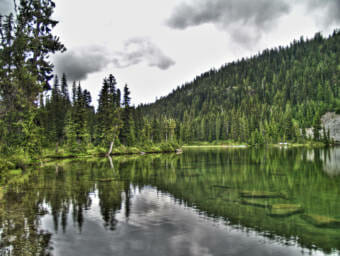
Sq— Lake” in Skamania County, Washington, near Columbia River Gorge. (Photo by Dan Zelazo/Creative Commons via Flickr)

In February, the U.S. Department of the Interior announced the removal of the slur “sq—” from over 660 geographic place names around the country. The agency, which is bypassing state renaming processes, has issued its own list of suggested replacement names. But Washington state officials, noting that the new names are largely colonial, want to gather tribal input and find culturally appropriate names instead.

The renaming decision follows a formal federal declaration in November that the term is derogatory. The process is moving quickly: The February announcement initiated a 60-day window for public input that ends April 25. But what are the new names going to be?

To determine this, Interior conducted a survey of place names near the locations in question, offering them as default replacements. For example, “Sq— Lake” in Skamania County, Washington, is not too far from the Columbia River Gorge, so the first recommended replacement name is “Columbia Lake.” (See the full list of suggested names.) But in Washington, where 18 places will be renamed, state officials aren’t satisfied with these recommendations.

“You pick the five closest names around any given geographic feature and you end up with White, Bonneville, Columbia and Franklin Delano Roosevelt,” said Sara Palmer, chair of the Washington State Committee on Geographic Names. While everyone on the committee acknowledges that the current names are derogatory, Palmer noted that many of the suggested replacements are flawed as well, owing to their colonial origin; finding a suitable replacement isn’t as simple as just removing the slur. Many of the sites involved are areas where Indigenous women gathered food, for example, so the new names ought to honor those women and their histories, Palmer said. “We want to continue to memorialize Indigenous women on the landscapes of Washington state, and the current proposals from the feds will not really do that.”

Therefore the committee is asking both tribes and the public for different ideas. “You could write a name-change application,” said Palmer. “I can’t, while I’m chairing the committee. So we need the public to help us fix this situation.” Interested parties can submit names during an upcoming Board of Natural Resources meeting or by emailing comments to the board.

In Washington, the renaming process usually takes from six to 12 months, during which officials gather public input and get approval from both the state Board of Natural Resources and the Committee on Geographic Names, as well as the federal Board on Geographic Names. The Interior Department’s plan bypasses those state-level channels and goes directly to the federal level. The expedited timeline may force Palmer’s committee to accept imperfect names for now, and work to replace them in the coming months. “We should look at these names as interim,” said committee member Mike Iyall, an elder and former Tribal Councilmember with the Cowlitz Indian Tribe, at the committee’s March 7 meeting. “There is no reason to attempt anything like a rush.”

When HCN asked Interior to comment on the short timeline, a representative replied with a paragraph from the Federal Register notice of the plan, which reads in part: “The Derogatory Geographic Names Task Force (Task Force) created by S.O. 3404 will consider all comments and any proposed additional candidate replacement names received through the Tribal Consultation in developing a single recommended replacement name for each feature.”

Iyall pointed out that different tribes may have conflicting ideas about place names for geographic locations they have in common. Some features might be of interest to a dozen tribes. “Or maybe there will only be one tribe and nobody cares,” he said. “We don’t know that.”

Since the committee can only consider the wishes of tribes that come forward to participate in the process, it is asking for as much input as possible. It has already begun reaching out to tribal officials around the state. Palmer explained that the committee’s place-renaming process has no state-mandated tribal consultation requirement, and it lacks a formal mechanism to hold the committee accountable to tribes. Instead, tribes will be grouped together with the general public, rather than treated as sovereign nations. Still, “we are working toward a more tribal-inclusive process than was necessarily envisioned by the Legislature when they framed that up,” Palmer said. “That’s why we’re doing this outreach, because this is of particular concern to tribes.” The committee, she added, is “very committed to getting tribal input.”

At the federal level, there will be formal government-to-government consultation for the replacement names selected after the public input window ends in April, albeit in very a limited capacity. Interior has planned three two-hour virtual sessions for consultation. If every federally recognized tribe shows up, each tribe will have less than 38 seconds of consultation.

Palmer said the decision to replace Washington’s 18 instances of the slur with names that honor Indigenous women and their histories is a win for everyone. “When we talk about people with respect, and when we tell these bigger stories and these complicated stories, that’s good for everybody,” she said. “It really strengthens everyone. And that’s what I’d like to get us to.”

This story was originally published by High Country News and is republished here with permission.

The first answer for food insecurity: data sovereignty

Native American Agriculture Fund’s CEO, Toni Stanger-McLaughlin (Colville). (Courtesy image)

For two years now, the COVID-19 pandemic has exacerbated almost every structural inequity in Indian Country. Food insecurity is high on that list.

Like other inequities, it’s an intergenerational product of dispossession and congressional underfunding — nothing new for Native communities. What is new, however, is the ability of Native organizations and sovereign nations to collectively study and understand the needs of the many communities facing the issue. The age of data sovereignty has (finally) arrived.

To that end, the Native American Agriculture Fund (NAAF) partnered with the Indigenous Food and Agricultural Initiative (INAI) and the Food Research and Action Center (FRAC) to produce a special report, Reimagining Hunger Responses in Times of Crisis, which was released in January.

According to the report, 48% of the more than 500 Native respondents surveyed across the country agreed that “sometimes or often during the pandemic the food their household bought just didn’t last, and they didn’t have money to get more.” Food security and access were especially low among Natives with young children or elders at home, people in fair to poor health and those whose employment was disrupted by the pandemic. “Native households experience food insecurity at shockingly higher rates than the general public and white households,” the report noted.

It also detailed how, throughout the pandemic, Natives overwhelmingly turned to their tribal governments and communities — as opposed to state or federal programs — for help. State and federal programs, like the Supplement Nutrition Assistance Program, or SNAP, don’t always mesh with the needs of rural reservations. A benefits card is useless if there’s no food store in your community. In response, tribes and communities came together and worked to get their people fed.

Understanding how and why will help pave the way for legislation that empowers tribes to provide for their own people, by using federal funding to build local agricultural infrastructure, for instance, instead of relying on assistance programs that don’t always work. HCN spoke with the Native American Agriculture Fund’s CEO, Toni Stanger-McLaughlin (Colville), to find out more.

This conversation has been edited for length and clarity.

High Country News: The big number from this report is that 48% of Native people surveyed experienced food insecurity during the pandemic. Was this a failure of infrastructure, like supply chain issues and trucks not getting to reservations?

Toni Stanger-McLaughlin: It was a perfect storm of all of those things during the height of the pandemic. Reservations are the rural of rural — they’re oftentimes so far removed from access to transportation, or any type of processing or storage plant, that they fully rely on those systems operating in a timely manner. When they don’t, it means that those communities go without.

HCN: According to this report, Natives changed where they got their food during the pandemic. They stopped going to farmers markets and community gardens because of social distancing and did more home gardening, foraging and collecting of seeds, as well as sharing food. But, surprisingly, they hunted and fished less. Do you know why?

TSM: A lot of the communities were on strict lockdown. You weren’t supposed to leave your home. Going on a couple years now, these communities are still reeling and still having to figure out what to do. We also saw a real big uptake in direct farm-to-family. You could buy a cow in your neighborhood, or in your community, where before you couldn’t. Those farmers were selling to stockyards, who were then selling to big processing plants. Your meat could go three states before it would return to your community. Instead, we saw more direct sales. And the federal government allowed that. It hasn’t happened at that scale in a long time.

HCN: The gap in food security seems to have most impacted medium-income households as opposed to the poorest households. Is that correct?

TSM: Yeah. … When we receive this data, and we look at the income level of the respondents, that doesn’t correlate to the requirements to participate in some of the food assistance programs that exist in the federal government, and then trickle down to state and tribal governments. So, for instance, to qualify for what used to be called the food stamp program, SNAP, or WIC (the Special Supplemental Nutrition Program for Women, Infants, and Children) or free school meals, all those programs are income-contingent. And they get continued servicing.

For those that could qualify, income-wise, those programs weren’t obstructed in a way that the general food access (was) — getting a food distribution box versus going to a grocery store where everything is gone, everyone has purchased the goods from that grocery store. We saw it with toilet paper, but we saw it with food, too. There was a huge shortage of meat, or the meat was so expensive that it disabled people from being able to get the full nutritional value of each of their meals. They had to pick and choose. Those are, in our respondents in our survey, largely the ones that identified as being food insecure and lacking nutrition.

HCN: FRAC — the Food Research and Action Center — talks about opportunities to address food insecurity with the Build Back Better plan, or through Congress. But your organization seems more focused on tribal efforts, saying that instead of increasing benefits, the federal government should increase support and empowerment of tribal governments. Why is that distinction important?

TSM: Well, unfortunately, we have to do both. When we saw in the report that people were turning to their tribal governments, not their state governments, for assistance, it’s just another indication of the ability of tribes to administer those program dollars and keep an alignment with the requirements and mandates that come from receiving federal funding.

IFAI — the Indigenous Food and Ag Initiative — and FRAC and NAAF came together to provide the data that will help educate Congress when they’re making decisions about food implementation and agricultural production across the country, in particular Indian Country.

HCN: Why is self-sufficiency so much more effective?

TSM: Because they intimately know their neighbors. They know culturally how their communities function. And they know how to get to their membership in the best possible manner. So, in one community, it might be working through mobile slaughter (units). In another community, it might be distribution of food boxes. In another community that’s not so far removed from a town or city, it might be working with food banks. And so those community members, the tribal governing authority — they know that better than an outside entity, better than a state entity.

A lot of our tribes have economic arms of their tribal government that have some type of food- or agricultural-based business. They utilize those businesses to get that food to their community members. And that’s the model we want to see. Those producers within those communities can sell their food locally. It reduces transportation and storage costs, it reduces or works toward eliminating issues that you would see in long transportation. In the end, they will save money, because these communities will have additional dollars, so the value of their dollar will remain stronger, won’t be chipped away by having to go through multiple states or processing plants or transportation companies. And again, if we have natural disasters, we have a pandemic, then the communities can stand up and serve their citizens, as opposed to waiting for Washington, D.C., or even the state capital to try to get to them.

If you look at eastern Washington, the Yakama Nation and the Colville Confederated Tribes, collectively, we have close to 10 million acres. The export industry in cherries and apples alone is in the billions — and yet our tribes are not billionaires. So there’s an opportunity there to pivot and diversify away from, say, gaming, and work towards making agriculture not only a food-security issue, but an economic development opportunity.

HCN: Are you optimistic that Congress is going to take this data into account and begin to more deeply or meaningfully empower tribal communities to support themselves through their own agricultural infrastructure?

TSM: We hope so. Our overall vision document is, through this regional agricultural infrastructure, about standing up everything that these communities or regions will need in order to feed themselves. That’s grain elevators, it’s rail transportation, it’s kitchens and processing plants. But it’s also marketing, packaging and distribution. And so having access to all of those in a regionalized manner will unburden the individual tribe or individual farmer or producer from having to stand up that infrastructure themselves. it would all be done in a regenerative, climate smart manner. And again, reducing the amount of transportation, all of those things moving towards helping the environment and helping these rural tribal communities at the same time. We’re asking tribes to reach out and engage with us if they’re applying for federal funding, to use our work as a model of how we can all come together and actually leverage private and federal funding and expand and unify our mission, which is to feed our communities, but do so in a manner that supports those community members and not necessarily a corporation.

This is just the beginning. We’re going to continue to do more data-related research. For the first time, we’re going to take ownership of our data, and also the messaging and how that data is going to be interpreted. A lot of this generation has benefited from the work of our ancestors. And we’re in a place where a lot of tribal communities are working toward large scale, either cultural development, gaming, you name it, government contracting. These tribes are moving into spaces they’ve never been before, they’re able to support their communities better. We have higher rates of participation in higher education and vocational education. And we want to continue that upward trajectory and supply the celebration of our traditional ecological knowledge. So this is just an opportunity. And it’s our first step going after and providing this type of data.

And we’re not just working with tribal entities; we’re working across the spectrum. We’re working with other large-scale agricultural industry groups, and nonprofits and federal agencies. And our hope is that we can do some focus work, to stand up agricultural infrastructure in rural communities and show the world that it can work and that these communities can have ownership over their food and food security.

This story was originally published by High Country News and is republished here with permission.

How heat waves warp ecosystems

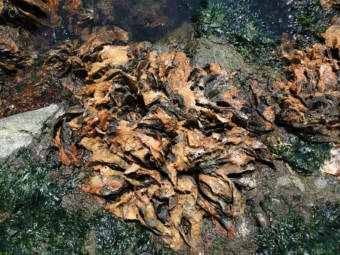
Bleached kelp on San Juan Island, Washington, during this summer’s heat dome. (Courtesy of Robin Fales)

During this summer’s stifling heat wave, Robin Fales patrolled the same sweep of shore on Washington’s San Juan Island every day at low tide. The stench of rotting sea life grew as temperatures edged toward triple digits — roughly 30 degrees above average — and Fales watched the beds of kelp she studies wilt and fade. “They were bleaching more than I had ever seen,” recalled Fales, a Ph.D. candidate and marine ecologist at the University of Washington. She didn’t know if they would make it.

Never in recorded history had the Pacific Northwest experienced anything like the “heat dome” that clamped down on the region in late June 2021. Temperatures reached a withering 116 degrees Fahrenheit in Portland, Oregon, and 121 degrees in Lytton, British Columbia — the highest ever recorded north of the 45th parallel.

Scientists said the event would have been “virtually impossible” without climate change. It killed hundreds of people, damaged roads and power lines, and devastated crops. It also caused widespread ecological fallout, the full extent of which scientists have yet to grasp.

Initial reports were sobering: A billion shellfish and other intertidal animals baked to death on the coast of British Columbia. The Portland Audubon Society declared a “hawkpocalypse” as it tended to scores of sick and injured birds. And in eastern Oregon, state officials estimated that tens of thousands of sculpin, a bottom-dwelling fish, perished in streams already throttled by drought.

‘They were bleaching more than I had ever seen’

By fall, headlines and memories had faded, but the heat wave’s impacts linger on. In fact, researchers have learned that short bursts of high temperatures can pose a greater threat to plants and animals than long-term warming, and may even increase the risk of extinction.

In one recent study, researchers looked at 538 species from around the world, nearly half of which had already disappeared in at least one location. They found that the doomed populations endured greater (and faster) increases in maximum yearly temperature than others. Surprisingly, though, they often experienced smaller changes in average temperature, said John Wiens, an evolutionary ecologist at the University of Arizona and a co-author of the study. “The most important variable is these hottest summer temperatures.”

Extreme heat can kill organisms outright, especially if they are also exposed to intense sunlight. Dehydration sets in and organs fail as enzymes stop working and proteins sustain damage. The trauma can make survivors more susceptible to disease and predation and reduce or delay reproduction. Hot weather can also cost animals by discouraging them from foraging or hunting. And these events are happening more often: By 2040, heat waves are projected to become 12 times as frequent as in a non-warming world.

After the latest episode in the Pacific Northwest, researchers began tracking the damage to a variety of species and ecosystems, like coastal forests, which fared especially poorly. Scorched leaves turned hillsides sickly shades of orange, and trees already stressed by drought dropped their needles prematurely. But the deadliest impacts may be invisible, said Christine Buhl, an entomologist at the Oregon Department of Forestry: Thirsty trees, for example, may have suffered damage to their roots and vascular systems if they couldn’t pull enough moisture from the ground. “We will know in coming years how bad it was,” Buhl said.

‘You can still go around and find the legacy of that event’

Australia provides a grim preview. After a string of heat waves hit the western part of the country in 2010 and 2011, scientists documented widespread tree death, among other impacts, which later contributed to beetle outbreaks and wildfires, said Joe Fontaine, a fire ecologist at Murdoch University in Perth. Even now, he said, “you can still go around and find the legacy of that event.”

Yet heat waves may also help species adapt to long-term warming by driving rapid evolutionary changes, said Lauren Buckley, a climate change ecologist at the University of Washington. They can weed out unfit individuals, giving those that tolerate hotter temperatures an advantage. Scientists have seen evidence for such shifts in populations of Douglas fir and fruit flies. But “there’s sort of a sweet spot,” Buckley said, between a stress test and a massacre.

It’s too early to know whether the recent temperature spike hit the sweet spot for some — if any — Northwest species. On San Juan Island, however, Fales found a measure of hope. After the heat wave, Fales surveyed the damage to the kelp she studies and determined that while it had lost about half its biomass, most of the plants were still alive. Many mussels survived, too.

That may be because warm spring temperatures spurred them to mount defenses prior to the heat wave, Fales said, by producing heat-shock proteins that repair other damaged proteins, for example. But there’s another possible factor: By celestial happenstance, summer low tides on the island always occur during mid-day, exposing intertidal organisms to peak temperatures and making it “a hotspot location,” Fales said. Perhaps the kelp and its neighbors had already begun to adapt. 

This story was originally published by High Country News and is republished here with permission.

Wildfire smoke pushes migrating birds hundreds of miles out of their way

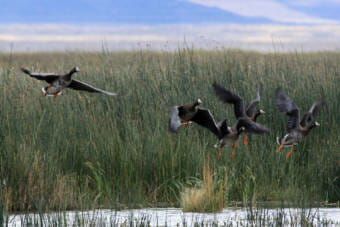
Five Tule geese take off from Summer Lake Wildlife Area, Oregon, the primary stopover site of their four-day fall migration from Cook Inlet, Alaska, to California’s Sacramento Valley. Last year, due to wildfires, the journey for a handful of radio-collared geese took nine days, rather than the typical four. (Photo by Andrea Mott / USGS Western Ecological Research Center)

Four radio-collared Tule geese left their summer breeding grounds near Alaska’s Cook Inlet in the fall of 2020 to head south for the winter. The migration typically takes about four days: The birds fly over the Gulf of Alaska, stay about 100 miles offshore from Canada and skirt Vancouver Island. They stop briefly to float and rest on the Pacific Ocean a handful of times and then gather en masse at Summer Lake in central Oregon before making the final push to California’s Sacramento Valley. Last summer, however, the migrating birds encountered dense wildfire smoke off the coast of British Columbia and over Washington — and that’s when their behavior got weird.

One bird backtracked north almost 80 miles. Two spent nearly four days floating on the ocean before trying to head inland again; they ended up flying directly at the Beachie Creek Fire in Oregon and then climbing almost four times higher than usual to get over the huge plume of smoke. A fourth bird got turned around and headed much farther east than normal, all the way to Idaho. Tule geese typically prefer to overnight at wetlands, but these four stopped in bizarre locations instead, even landing once on the side of Mount Hood.

According to a study released by the U.S. Geological Survey (USGS) in early October, the birds’ 2020 migration took twice as long as the 2019 migration — nine days versus four — and they flew an additional 470 miles, all to avoid wildfire smoke. The paper states that “megafires and thick smoke portend big problems for migratory birds,” as wildfires increasingly coincide with the beginning of fall migration: There were 68 active fires in California, Oregon and Washington when the geese passed through. Lengthier migrations require more energy and take more time to recover from. That could make it harder for the birds to reproduce, and even put them at risk of dying.

Map source: Overton et al., 2021

Cory Overton, a wildlife biologist at the USGS Western Ecological Research Center and the paper’s lead author, was watching the birds’ disjointed flights in real time, via GPS tracking.

“I was glued to my computer for days, trying to figure out what these birds were doing, because it was so clearly, obviously, not normal,” Overton said.

All four birds did, however, eventually make it to their preferred stopover in Oregon.

Overton and his colleagues believe this marks the first time scientists were able to definitively document how wildfire smoke alters bird migration. The birds began to change their behavior when encountering fine particulate matter of 161 micrograms per cubic meter, which is just over the Environmental Protection Agency’s threshold for “very unhealthy” air for humans. Migrating birds across several Western states were found dead and dying the same summer and early fall, and other research found a correlation between the deaths and toxic air.

Tule geese, a subspecies of the greater white-fronted goose, are a “species of special concern” in California due to their low population numbers; there are fewer than 10,000 of them. They’re especially vulnerable to flight obstacles because they follow the same route and stop at the same spots yearly.

Overton and his colleagues were also tracking 12 additional waterfowl species, all of which migrate later in the fall than Tule geese. Smoke was almost gone from the Pacific Northwest by the time the others journeyed through the region. But as fire seasons in the West lengthen, scientists are concerned that smoke may hinder more migrations along the Pacific Flyway. Many shorebirds and songbirds are unable to store the extra energy needed to reroute around fires.

Experts in the bird research community are excited about the study.

“We have a lot to learn about how wildfire smoke affects the health and behavior of animals, and in my opinion this is exactly the kind of research we need,” said Olivia Sanderfoot, a Ph.D. student who studies the impacts of air pollution on birds at the University of Washington. “While the researchers were only able to examine the migratory routes of four geese, which is a small sample size, their findings highlight the urgent need to unravel the mystery of how bird behavior is impacted by smoke.”

Andrew Farnsworth, a researcher who studies migration at the Cornell Lab of Ornithology, also praised the work. He hopes the new knowledge will prompt thinking about what kinds of habitat and resources birds with altered migration routes might need to survive.

“It’s a way of being able to think more broadly and actually prepare to avoid as much ecological drama as we can,” Farnsworth said.

This story was originally published by High Country News and is republished here with permission.

Site notifications
Update notification options
Subscribe to notifications