National Elections

CIA Concludes Russian Interference Aimed To Elect Trump

Brooks Kraft/Corbis via Getty Images

Updated at 1:49 p.m. ET with confirmation from the U.S. official and comments from Sen. Ron Wyden

Updated at 3:20 p.m. ET with comments from Sen. Angus King

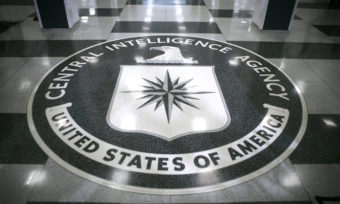
The CIA has concluded that Russia intervened in the 2016 election specifically to help Donald Trump win the presidency, a U.S. official has confirmed to NPR.

“Before, there was confidence about the fact that Russia interfered,” the official says. “But there was low confidence on what the direction and intentionality of the interference was. Now they [the CIA] have come to the conclusion that Russia was trying to tip the election to Trump.”

The official adds: “The reason the assessment changed is that new information became available” since Oct. 7, when the Department of Homeland Security and the Director of National Intelligence released a joint statement accusing Russia of interfering with the American election process.

The Washington Post first reported the CIA’s new assessment on Friday.

In addition to hacking into Democratic organizations, Russians hacked the Republican National Committee’s computer systems, according to a separate report from The New York Times — but they did not release any information that might have been retrieved from Republican networks.

“Intelligence agencies have identified individuals with connections to the Russian government who provided WikiLeaks with thousands of hacked emails from the Democratic National Committee and others, including Hillary Clinton’s campaign chairman, according to U.S. officials,” the Post reports. “Those officials described the individuals as actors known to the intelligence community and part of a wider Russian operation to boost Trump and hurt Clinton’s chances.”

Citing anonymous officials briefed on the issue, the Post says the CIA shared its findings with senators in a closed-door briefing last week, saying it was now “quite clear” that Russia’s goal was to tip the presidency in Trump’s favor:

” ‘It is the assessment of the intelligence community that Russia’s goal here was to favor one candidate over the other, to help Trump get elected,’ said a senior U.S. official briefed on an intelligence presentation made to U.S. senators. ‘That’s the consensus view.’ “

In a previous assessment, CIA officials had thought Russians intervened with the intention of undermining Americans’ electoral system, Adam Entous, one of the Post story’s reporters, tells NPR’s Scott Simon.

On Friday evening, the Trump transition team fired back with a statement dismissing the report of the agency’s conclusion.

“These are the same people that said Saddam Hussein had weapons of mass destruction,” the statement said. “The election ended a long time ago in one of the biggest Electoral College victories in history. It’s now time to move on and ‘Make America Great Again.’ ”

In fact, Trump’s percentage of the electoral vote in the 2016 election ranks 46th among presidential election winners in U.S. history, according to factcheck.org.

Trump’s claim is a reference to the CIA’s flawed intelligence on Iraq, in the run-up to the U.S.-led invasion in 2003. The CIA and other spy agencies judged that Saddam Hussein had weapons of mass destruction — a judgment that proved to be false. While the leadership of the CIA has changed hands several times in the years since then, many intelligence officers and analysts who worked on the Iraq intelligence still serve at CIA and in other parts of the U.S. intelligence community.

But whether or not Trump’s top officials acknowledge the report as a possible threat, the Post‘s Adam Entous points out Trump will soon be in command of the intelligence agencies.

“I’m sure they’re going to declassify some elements of the report and I’m sure there will be leaks,” he adds, but the Obama administration can’t disclose the full details of the case, because it would be “compromising what’s known as ‘sources and methods,’ which would then make it harder for the CIA and the NSA and other spy agencies to get more information in the future.”

Earlier Friday, President Obama ordered the intelligence community to conduct a “full review” of “malicious cyber activity” timed to U.S. elections, as we previously reported:

“In the 2016 election, U.S. intelligence officials charged that Russia had interfered. In early October, they released a strongly worded statement saying they were ‘confident that the Russian Government directed the recent compromises of e-mails from U.S. persons and institutions, including from U.S. political organizations.’ The statement went on to say ‘these thefts and disclosures are intended to interfere with the U.S. election process.’ “

The U.S. official says that “there is a determination to do something” before the Obama administration leaves power. “It’s still being discussed exactly what to do. And as we’ve said before, some of it you may see and some of it you will not.”

Sen. Ron Wyden, a Democrat on the Senate Intelligence Committee, says the response from President-elect Donald Trump is “very misguided.”

“When you have strong evidence that a foreign power has interfered with the American election, with American institutions, then what you do is keep digging. You get all the facts out,” Wyden says. “You respond to the American people with the kind of information that they have a right to know.”

He also advocates releasing more information on the cyberattacks.

“I do believe there is important information that the American people have a right to know. It ought to be declassified promptly.”

“It’s very important that the American public knows what happened, not necessarily to re-litigate this election, but to look forward,” says Sen. Angus King, an independent senator from Maine. “What worries me is the extent to which this is an ongoing pattern — which, by the way, is the Russians’ pattern in other parts of the world.

“And is that going to be the case in our elections? Four years from now, are we going to have the Democrats, the Republicans, the independents and the Russians?” King asks. “I mean, this is very serious stuff.”

Copyright 2016 NPR. To see more, visit http://www.npr.org/.

Jill Stein Campaign Drops Statewide Recount Effort In Pennsylvania

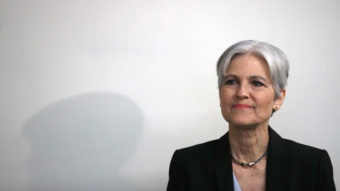
Jill Stein, at a press conference at the National Press Club in Washington, D.C., in August. Win McNamee/Getty Images
Jill Stein, at a press conference at the National Press Club in Washington, D.C., in August.
Win McNamee/Getty Images

Updated at 8:48 ET with Lawrence Otter’s comments

Jill Stein has ended her statewide ballot recount effort in Pennsylvania. Lawrence M. Otter, a lawyer for the former Green Party presidential candidate, withdrew the lawsuit filed with the Commonwealth Court of Pennsylvania early Saturday evening.

“Petitioners are regular citizens of ordinary means,” the filing states. “They cannot afford to post the $1,000,000 bond required by the Court.”

Stein elaborated on Twitter, asking: “How odd is it that we must jump through bureaucratic hoops and raise millions of dollars so we can trust our election results?”

Last month, Stein launched a fundraising campaign to pursue a recount in Pennsylvania, as well as in Michigan and Wisconsin — three states President-elect Donald Trump narrowly won en route to his Electoral College victory. That campaign — which sought to “ensure the integrity of our elections,” according to her website — proved wildly successful, raking in nearly $7 million in donations to fund the former candidate’s efforts.

Stein subsequently filed her request for a statewide recount in Pennsylvania on Monday, just days after she officially requested a recount in Wisconsin. In Michigan, where Trump was certified the winner only last week, the situation proved to be a bit more complicated: Stein requested a recount there — only to have her request tangled by an objection from the Trump campaign. After the state’s Board of State Canvassers deadlocked on the issue Friday, the Detroit Free Press reports a hand recount in Michigan appears set to proceed next week.

Hillary Clinton’s campaign reluctantly said it would participate in the proceedings, “to ensure our campaign is legally represented,” according to campaign lawyer Marc Erik Elias.

In Pennsylvania, though, Stein’s withdrawal brings an abrupt conclusion to a statewide effort that began there less than one week ago.

Still, this doesn’t spell an end to recounts in the state entirely, Stein’s lawyer, Lawrence Otter, tells The Philadelphia Inquirer:

“Stein’s campaign intends to continue its county-by-county recount effort in Pennsylvania, said attorney Larry Otter. That requires efforts in individual precincts — a process that requires three voters to petition their local election boards.

“In the region, a recount in Philadelphia is already underway in 75 of the city’s more than 1,600 divisions. Judges in Bucks and Delaware counties will hear arguments this week on whether to grant recounts, Otter said.”

At this time, there is no indication that Stein’s campaign plans to drop its efforts in Wisconsin — where The Associated Press reports a recount is already underway — or in Michigan.

Stein plans to hold a rally and press conference Monday outside Trump Tower in New York City.

Copyright 2016 NPR. To see more, visit http://www.npr.org/.

Clinton Campaign Says It Will Participate In Recount Efforts

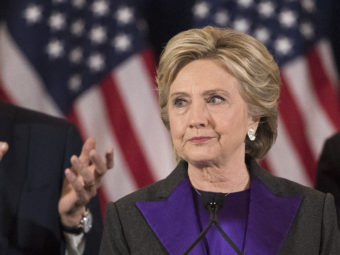
Democratic presidential candidate Hillary Clinton delivers her concession speech in New York on Nov. 9. Her campaign announced Saturday it will back recount efforts in three states. Matt Rourke/AP
Democratic presidential candidate Hillary Clinton delivers her concession speech in New York on Nov. 9. Her campaign announced Saturday it will back recount efforts in three states.
Matt Rourke/AP

Hillary Clinton’s campaign said Saturday it will participate in the recount efforts in Wisconsin spearheaded by Green Party presidential candidate Jill Stein. If Stein also pursues recounts in Pennsylvania and Michigan, as she has pledged, the Clinton campaign will participate in those efforts, as well.

The recount in Wisconsin could begin as early as next week.

In a post on Medium, Clinton campaign lawyer Marc Erik Elias wrote that “regardless of the potential to change the outcome in any of the states, we feel it is important, on principle, to ensure our campaign is legally represented” in any recount proceedings. It was the first time anyone from the Clinton camp had publicly weighed in on the potential recounts.

As the Two-Way reported Friday, Stein and another third-party candidate filed for a recount in Wisconsin, and she plans to do the same in Pennsylvania and Michigan. President-elect Donald Trump’s narrow victories in those states gave him enough electoral votes to cinch the election.

After launching a fundraising campaign Wednesday, Stein — whose website explicitly says the recounts are not aimed at helping Clinton, but in preserving the integrity of the election — has raised nearly $6 million to pay for recounts.

Elias explained in his post that Clinton campaign directors had not pursued a recount themselves because they “had not uncovered any actionable evidence of hacking or outside attempts to alter the voting technology.” But, he said, “now that a recount has been initiated in Wisconsin, we intend to participate in order to ensure the process proceeds in a manner that is fair to all sides.”

He said that the campaign would do the same in Michigan and Pennsylvania if Stein files for recounts there, too.

Elias said the Clinton camp is “fully aware” that the outcome of the election is unlikely to change, noting that “the number of votes separating Donald Trump and Hillary Clinton in the closest of these states — Michigan — well exceeds the largest margin ever overcome in a recount.”

In an interview with NPR’s All Things Considered on Saturday, Stein said her goal in pushing for a recount wasn’t to change the results of the election but to make sure U.S. elections are “fair and reliable.”

“We need a system that empowers voters, and that needs to start with a voting system we can trust,” she said.

Still, Elias wrote, the Clinton campaign believes it has “an obligation” to the 64 million people who voted for Clinton to “participate in ongoing proceedings to ensure that an accurate vote count will be reported.”

Trump issued a statement Saturday calling the recount efforts “ridiculous” and pointing out that Clinton had already conceded. It also said:

“This is a scam by the Green Party for an election that has already been conceded, and the results of this election should be respected instead of being challenged and abused, which is exactly what Jill Stein is doing.”

Trump’s former campaign manager Corey Lewandowski tweeted Saturday about the Clinton campaign’s decision to back the recounts.

Amid the snowballing recount efforts, The Hill reported that President Obama called Clinton on election night and urged her to concede to Trump. Without his urging, she may have waited for the final results, according to anonymous sources from her camp. The Hill‘s Amie Parnes wrote:

“Obama’s call left a sour taste in the mouths of some Clinton allies who believe she should have waited longer, and there’s now a fight playing out between the Obama and Clinton camps over whether to support an effort to force the Rust Belt states to recount their votes.”

This post has been updated with Trump’s statement.

Copyright 2016 NPR. To see more, visit http://www.npr.org/.

Hillary Clinton’s popular vote lead is 1.7 million and growing

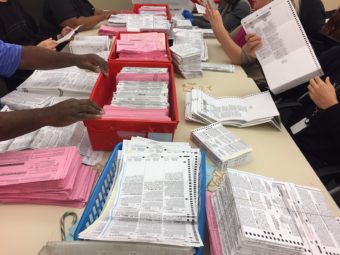
Election workers sort through unprocessed vote-by-mail ballots at the Sacramento County Registrar of Voters office on Monday. (Photo by Ben Adler/Capital Public Radio)

Two weeks after Election Day, Hillary Clinton leads President-elect Donald Trump by 1.75 million votes. Despite Clinton’s popular vote lead, Trump will move into the White House because he won the Electoral College.

Clinton’s margin will grow in the coming weeks — mostly because of California, where there are still more than 2 million unprocessed ballots.

So why does it take California so long to count the votes?

Well, for one thing, blame coffee.

“Coffee stains look just like an oval mark,” says Sacramento County Assistant Registrar of Voters Alice Jarboe. “So we have to remove all those coffee stains.”

Yes, it seems at least some Californians like to fill out their vote-by-mail ballots over breakfast.

And it gets worse: jam and jelly.

“We do find those on the ballot,” Jarboe says. “Those gum up our vote counting machines, so we will remake those ballots.”

Remaking a ballot doesn’t happen quickly. Two election workers pair up to copy the votes from the damaged ballot onto an unmarked duplicate.

“One person will call, the other person will mark,” Jarboe says. “And then they’ll double-check their work to make sure that the calling and the marking compares.”

A nearby election worker calls out “65 yes, 66 yes, 67 no,” as she and a colleague compare a ballot’s votes on three of California’s statewide propositions.

After they check their work, a quality control team will check again. And then, the damaged ballot gets a big blue “VOID” stamp.

Other times, Jarboe says, there’s a slightly quicker fix involving white-out tape: “We will take that white-out tape and white over the problem ovals — the voter crossed out the oval, and said ‘No not this one, this one’ — we’ll cross out the one they didn’t want; we’ll white that out; and then a star stamp next to it. The star stamp is everybody’s indication that we touched that ballot and we corrected it in some way.”

It’s likely that 14 million people will have voted in California once all the ballots are processed — and Clinton won the state by a nearly 2-1 ratio. As voting by mail has surged, so too has the time it takes counties to count ballots.

Plus, there are provisional ballots, which take even longer to process, because it’s often hard to verify a voter’s eligibility. California provisional ballot laws are much more permissive than in other states.

“We would prefer that you show up at your own polling place and that you be registered,” Jarboe says. “But we’re not going to tell you to go away, that you can’t vote. We’ll go ahead and let you vote a ballot and put it in a provisional envelope, and then we true it up here.”

“These expansions [of voting rights] end up slowing down the vote count process,” says Paul Mitchell, one of California’s top voting data analysts. “But to trade off ‘we’re gonna get our votes counted quicker and disenfranchise people on the front end,’ I don’t think is the right trade-off.”

California counties have two more weeks to certify their final ballot counts. Some other large states like Florida and Virginia have already done so.

Mitchell says California’s slow work is skewing Americans’ perceptions of the election results.

“The presidential race was a much larger popular vote win for Hillary Clinton than was seen on Election Day or even the couple days after the election,” he says. “And that’s only going to expand.”

In fact, Mitchell estimates Clinton could end up winning nationally by 2.5 million votes — the largest margin ever for an Electoral College loser.

Copyright 2016 Capital Public Radio. To see more, visit Capital Public Radio.

Moving To Canada, Eh? Or Maybe Ireland?

The view from a peak in County Mayo, Ireland. An island off the coast is inviting any Americans afraid of the election results to move there, and grow their population. David Pace/AP
The view from a peak in County Mayo, Ireland. An island off the coast is inviting any Americans afraid of the election results to move there, and grow their population.
David Pace/AP

It seems every four years, Americans threaten to move to Canada if their preferred presidential candidate isn’t elected. But with two of the most unpopular candidates in history on the ballot, 2016 might be the year some people actually go through with it.

As Mashable reported back in March, Google searches for “how to move to Canada” spiked in the hours after results from the Super Tuesday primaries. By the next day, @GoogleTrends announced on Twitter that searches for “move to Canada” were higher than any time in Google history.

How easy is it to actually jump ship if your candidate of choice isn’t elected Tuesday? Some places are taking advantage of the American election-induced panic. One underpopulated Irish island called Inishturk is inviting U.S. citizens to consider relocating.

The island’s development officer, Mary Heanue, told Irish Central, “I’ve heard there are quite a few people in America looking to move to Ireland and other countries if Donald Trump becomes president. I’d like them to know that we’d love to see them consider moving over here.”

She noted that, given the island’s current population of just 58, immigrants’ children would receive lots of attention in the local public school. “The teacher to pupil ratio is nearly one-on-one,” she said.

Cape Breton, an island off the east coast of Canada, is also offering a warm welcome. A website called Cape Breton If Donald Trump Wins popped up earlier this year and went viral, but residents promise that they don’t really care about your politics: “The truth is, we welcome all, no matter who you support, be it Democrat, Republican, or Donald Trump.”

The site has photos of the island and helpful links to immigration resources, as well as information about local attractions, and the message is an earnest plea: “We always rank high on travel magazine lists of beautiful islands. But we are experiencing a bit of a population problem at the moment. We need people. We need you!” Even Canadian Prime Minister Justin Trudeau joked that “Cape Breton is lovely all times of the year,” in response to a question about the American election.

Now, this one doesn’t seem driven by politics, but the government of New Zealand also offers a website that caters to Americans looking to move abroad. They promise, “We speak the same language and share a lot culturally, which will help make you feel at home.” If you register your interest in moving to New Zealand, the government will email you tips about job openings in your field and how to choose the right visa.

Copyright 2016 NPR. To see more, visit http://www.npr.org/.

FBI Affirms July Decision Not To Charge Clinton, After Review Of Weiner Emails

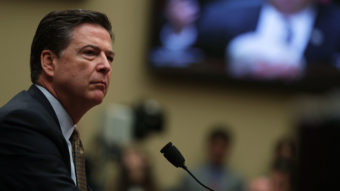
FBI Director James Comey testifies during a hearing before House Oversight and Government Reform Committee July 7, 2016 on Capitol Hill in Washington, D.C. Alex Wong/Getty Images
FBI Director James Comey testifies during a hearing before House Oversight and Government Reform Committee July 7, 2016 on Capitol Hill in Washington, D.C.
Alex Wong/Getty Images

Following up on his letter that set off a firestorm of speculation just two weeks before U.S. voters head to the polls to choose a new president, FBI Director James Comey says the investigative team that analyzed a new trove of emails that were either to or from Hillary Clinton has finished its work — and that the review doesn’t change the findings he put forth in July, when he said no charges will be pursued against Clinton.

“Since my letter, the FBI investigative team has been working around the clock to process and review a large volume of emails from a device obtained in connection with an unrelated criminal investigation,” Comey wrote Sunday, in an official communication with 16 chairmen and ranking members of relevant House and Senate committees.

“Based on our review, we have not changed our conclusions that we expressed in July with respect to Secretary Clinton,” Comey wrote today.

In response, Clinton’s communications director Jennifer Palmieri said the campaign had been confident that the FBI would reach this conclusion, adding, “we’re glad that this matter is resolved.”

The topic of Clinton’s use of a private email server gained new immediacy on Oct. 28, when Comey sent a letter to leading members of several congressional committees, in which he said federal agents had obtained a search warrant, as NPR reported, “to examine the thousands of emails found on a computer belonging to former U.S. Rep. Anthony Weiner that could be pertinent to the investigation” into Clinton.

News of a potential new angle in the email investigation opened the way for Clinton’s Republican rival Donald Trump to attack her — a crucial development that was seen as helping his candidacy rebound from the devastating release of a 2005 audio recording in which Trump bragged about groping women. In the wake of the FBI director’s letter, the race tightened and Clinton was forced to play defense.

Responding to Comey’s letter, House Speaker Paul Ryan, R-Wis., said Sunday afternoon that despite the FBI’s findings, the incident shows “a pattern,” saying of Clinton, “She simply believes she’s above the law and always plays by her own rules.”

Comey’s new letter comes after two weeks in which the FBI has been criticized for inserting the nation’s top law enforcement agency into the closing weeks of a tense political season; Senate Democratic Leader Harry Reid even wondered whether Comey had violated the Hatch Act.

The new letter also comes four months after the legal issues at stake had seemed to be resolved: It was on July 5 that Comey announced that while Clinton and her staff were “extremely careless” in handling classified data via a private email server that Clinton used while she was secretary of state, the FBI was recommending no charges be brought against her.

Copyright 2016 NPR. To see more, visit http://www.npr.org/.
Site notifications
Update notification options
Subscribe to notifications