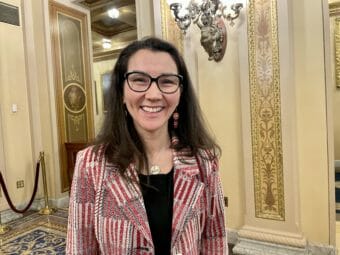
Alaska Congresswoman Mary Peltola in the halls of the Capitol in January. (Liz Ruskin/Alaska Public Media)
Alaska Congresswoman Mary Peltola voted Thursday for a Republican resolution condemning the Biden administration — and specifically Vice President Kamala Harris — for their border security policies.
Peltola was among six Democrats to vote for the non-binding measure. She and other Democrats running for re-election from red districts have repeatedly united with Republicans in statements criticizing the Biden administration for not cracking down on border crossings and not doing more to stop the flow of illegal drugs from Mexico.
Thursday’s resolution takes pointed aim at Harris just days after she became the likely Democratic nominee for president. The resolution calls her the “border czar,” a label USA Today and Politifact, among other fact-checkers, have rated false or mostly false.
Harris is not in charge of border security. President Biden said in 2021 that she would lead diplomatic efforts addressing the root causes of migration from three central American countries.
Peltola said this week that she was not committed to voting for Harris and that she would not endorse any candidate.
Congresswoman Mary Peltola speaks to a joint session of the Alaska Legislature on Feb. 26, 2024. Such speeches are annual events for all three members of Alaska’s delegation to Congress. (Clarise Larson/KTOO)
Democratic Alaska Congresswoman Mary Peltola won’t say who she’s voting for this November after President Joe Biden stepped aside and endorsed his vice president, Kamala Harris.
At a Zoom news conference with Alaska reporters Tuesday morning, Peltola said she’s “keeping an open mind.”
“Looking at this presidential race, my position is whoever the president is, that is the person that I am interested in working with to help Alaska move forward,” Peltola said. “Whether that president is Donald Trump, or if that president happens to be Kamala Harris … there will be a lot of common ground. There will be a lot of things that we collectively agree on.”
Peltola was asked twice, directly, whether she would vote for Harris or Donald Trump. During the news conference, Peltola said her vote for president would depend on the candidates’ stances on energy issues.
“While I really appreciate her stance on women’s reproductive rights, Social Security, voting rights and a host of other things, as the representative for Alaska, my number one job is looking at our economy and our energy situation and which, you know, which of the two candidates will be better in terms of our energy portfolio,” Peltola said. “That is an honest answer. I am not being coy.”
After this article was published, Peltola said on social media she would not vote for Trump.
“I’m not voting for Trump & I’m not endorsing anyone else either. The media won’t allow us to engage in nuanced conversation because it doesn’t sell clicks. I won’t vote for a candidate who’s not pro-choice. I can’t ask Alaskans to vote for a candidate who’s not pro-energy,” she said.
Peltola is facing a tough reelection battle against two Republican challengers: Alaska Lt. Gov. Nancy Dahlstrom, a favorite of establishment Republicans and Donald Trump, and Nick Begich III, endorsed by the campaign arm of the conservative anti-establishment House Freedom Caucus. The National Republican Congressional Committee, the House GOP’s campaign group, launched its first television ad targeting Peltola on Tuesday.
Peltola also suggested Harris’ choice of a running mate could influence her decision in November.
“I would love it if she chose a pro-choice Republican, so we could get away from some of the inflammatory partisanship that we’ve seen,” she said.
Peltola told CNN earlier on Tuesday that “as a human being, I do support her,” referring to Harris, but stopped short of endorsing her.
Republicans have decried actions by the Biden administration aimed at restricting oil and gas development in Alaska. In April, the administration said it would impose new restrictions on oil and gas leasing on 13 million acres of the National Petroleum Reserve—Alaska.
At Tuesday’s news conference, Peltola also walked back her reported endorsement of Biden in 2023, shortly after Biden launched his reelection campaign.
“I have not ever officially endorsed anyone,” she said Tuesday.
She told the Anchorage Daily News at the time that his support for the Willow oil project in the National Petroleum Reserve—Alaska had earned her vote, saying “President Biden has impressed me with his support for Willow and his commitment to civil, constructive discussions.”
“I’ll support him as long as he continues to include Alaskans in those discussions,” Peltola said at the time.
But Peltola said Tuesday that the Biden administration failed to live up to that commitment.
“So many things have transpired in the last year, most notably the 68 different ways that the administration has moved to shut down Alaska’s economy,” referring to a frequent refrain of her Alaska delegation colleague, Republican U.S. Sen. Dan Sullivan.
But Peltola, a Democrat running for reelection in a state Donald Trump carried by 10 percentage points in 2020, downplayed the significance of any endorsement she might make, saying Alaska would not be competitive in the presidential election.
“I just think in a state as small as Alaska, we all tend to know each other, and I don’t think that endorsements carry the same weight that they do in, in a lot of other places,” she said. “And I also just feel really strongly that in a state where there’s over 60% of our voters who are independent, nonpartisan and undeclared, it’s really important to stay away from, really, you know, entrenched partisanship.”
Peltola also said Biden had aged markedly since the last time the two interacted in September 2023, shortly after her husband, Eugene “Buzzy” Peltola Jr., died in a plane crash.
“I think that, just like kids have growth spurts, I think that we have age spurts,” she said Tuesday. “It was very apparent there had been quite a bit of aging that has gone on in recent months.”
Peltola commended Biden’s long career in public office.
“It reminds me a lot of the lifetime commitment that Ted Stevens gave to Alaska, the lifetime commitment that Don Young gave to Alaska, and I really appreciate his commitment to public service,” she said.
Editor’s note: We’ve updated this story and headline after Peltola clarified she won’t vote for Trump in a statement on social media Tuesday afternoon.
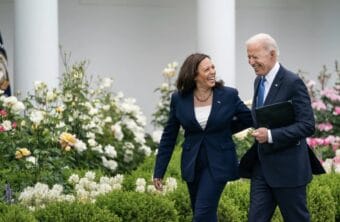
President Biden and Vice President Kamala Harris, in a photo Biden posted Sunday on X. (From Joe Biden X account)
Just hours after President Joe Biden announced he would not seek reelection, Alaska Democratic Party leaders moved quickly to endorse Vice President Kamala Harris as the Democratic nominee for president. They also commended Biden for his endorsement of Harris.
State Sen. Bill Wielechowski, one of the Legislature’s senior Democrats, said Biden had hoped to recover from his poor debate performance — but in the end did what he thought was best for the country.
“This is really unchartered territory, and it takes a lot of courage, quite frankly,” Wielechowski said. “I give Joe Biden a tremendous, tremendous amount of support for what he did. I’m so impressed, because you don’t see it that often. You very rarely see it in politics.”
Wielechowski says he will support Harris’s nomination, because it opens the door to a new generation of leadership. He also believes it sets the stage for women to play a key role in defeating the Republican nominee, former president Donald Trump.
“I think this could be a real watershed moment in our country. We’ve never had a female president before. And I think there’s a very good chance that could happen this time around,” Wielechowski said. “And I’ve heard a lot of people say that there could be a female vice president selected as well.”
President Joe Biden speaks at a 9/11 memorial held at Joint Base Elmendorf-Richardson in Anchorage on Sept. 11, 2023. (Matt Faubion/Alaska Public Media)
State Sen. Elvi Gray-Jackson, D-Anchorage, said she had hoped Biden would stay in the race. But she believes that of all the potential replacements, the vice president is the most prepared.
“I don’t think this is a surprise for her, because as vice president if something happens, you know, if something happens to the president, you’re next in line. Period,” Gray Jackson said. “She didn’t wake up, going, ‘Oh my goodness.’ But she’s going to work hard, and she’s going to have a lot of folks working hard to make this happen.”
As a prominent Black politician, Gray-Jackson she’s tired of hearing about how the country isn’t ready for a woman to be president, let alone a Black woman. But she predicts those arguments are not going to work this time around.
Another Black lawmaker, state Sen. Löki Tobin, D-Anchorage, will be going to Chicago as a delegate and a member of the convention’s standing rules committee.
Tobin said that although it will be an open convention in which other candidates can compete for the nomination, she believes Harris has the momentum.
She calls Biden’s decision to bow out of the race profound.
“His decision to support and endorse Kamala is such a bold and significant step in our nation, and leaves me in awe,” Tobin said. “There is just a beauty in recognizing that it’s time to make space, instead of taking space.”
Gray-Jackson and Wielechowski are also delegates to the national convention in Chicago this August.
The chairman of the Alaska Democratic Party, Mike Wenstrup, said in a statement that he believes Harris is the most capable of carrying on Biden’s legacy.
Wenstrup credited Biden and Harris for large infrastructure investments and policies that have benefited Alaska.
The chairman of the Alaska Republican Party also weighed in. In a statement, Carmela Warfield said Biden’s decision to end his campaign for president only confirms the party’s suspicion that he is unfit for office.
Warfield also said it doesn’t make any difference who becomes the Democratic nominee, because the candidate will advance the same “disastrous” policies championed by Biden.
Former President Donald Trump, who continues to spread lies about fraud in the last election, is set to run again in 2024. (Photo by Sean Rayford/Getty Images)
Donald Trump, who tried to overthrow the results of the 2020 presidential election and inspired a deadly riot at the Capitol in a desperate attempt to keep himself in power, has filed to run for president again in 2024.
Trump is speaking and widely expected to announce he’s running.
“America’s comeback starts right now,” Trump, 76, said flanked by massive American flags, at his Mar-a-Lago club and home in Palm Beach, Fla.
The filing came just a week after the 2022 midterm elections, which saw a lackluster performance from Trump-backed Republican candidates in key Senate races and competitive House elections. As a result, Democrats were able to retain control of the Senate.
Trump running sets up a potential rematch against President Joe Biden, who will turn 80 on Sunday and says he intends to run for reelection in 2024.
Exit polls showed inflation to be the top issue with midterm election voters overall. They said they trusted Republicans more on the issue than Democrats by a wide margin. And the electorate was nearly three-quarters white, reversing a decades-long trend of a decline in white voters as a share of the midterm electorate.
And yet, Republicans underachieved — and fingers are being pointed in Trump’s direction, even from within his own party.
Anger over the Supreme Court’s ruling overturning Roe v. Wade, which made abortion legal in this country, buoyed Democrats in these elections. But voters also sent a message that they didn’t want extremes, rejecting Trump candidates up and down the ballot, who peddled his baseless election lies.
Republicans lost in competitive Senate races in purple states, like Pennsylvania, New Hampshire, Arizona and Nevada. Democrats could further expand their majority with a runoff election three weeks from now in Georgia, with yet another Trump endorsee, who struggled mightily.
For the House, Republicans are on the precipice of control, but by a far smaller majority than they were hoping for, likely hampering their ability to pass legislation next year.
Of the 64 House race contests the Cook Political Report rated as toss ups or leaning toward one party or the other, Trump endorsed in 21. Only seven have won.
It was even worse for Trump candidates in the most competitive races. Of the three dozen toss-up races, Trump backed nine candidates. Only one has won.
And yet, Trump is launching another run for president, despite the evidence that his brand and his style politics have proven radioactive in competitive states and districts for multiple election cycles in a row now.
Trump’s move shows a degree of vulnerability — an effort to freeze out the GOP presidential field and force Republican elected officials to get off the sidelines and endorse him.
He also doesn’t want to give any oxygen to any potential rivals, who may be sensing a chance, especially someone like Florida Republican Gov. Ron DeSantis.
What about “DeFuture”?
Many in the party have begun to openly question whether it’s a good idea to continue to hitch their wagon to the former president, especially with Florida Gov. Ron DeSantis waiting in the wings.
DeSantis easily won reelection as Florida’s governor last week. He’s a staunch conservative and landed in controversy for flying migrants from Texas to Martha’s Vineyard and other liberal cities and enclaves, is widely seen as a more disciplined version of Trump.
The Rupert Murdoch-owned New York Post, which turned on Trump during the Jan. 6 congressional committee hearings’ revelations, dubbed DeSantis “DeFuture” — and Trump “Trumpty Dumpty,” who “couldn’t build a wall” and “had a great fall.”
Some conservative groups also released polling — very soon after the midterm results — showing DeSantis beating Trump in early presidential primary states and places like Texas.
The message was clear — it’s time for someone else.
But Trump’s hold on the GOP base can’t be underestimated. There have been other moments when the “fever” might break, but never has — not with criticizing the late-Republican Sen. John McCain’s status as a war hero, not the Access Hollywood tape in which he bragged about assaulting women, not the two dozen women who accused him of sexual misconduct or assault, not even the Jan. 6 insurrection.
But this latest setback may be threatening the thing Republican officials care about most — winning.
Their resolve will be tested, as the party is in for a reckoning over the next two years.
Digging in
Unsurprisingly, Trump seems uncowed and ready for the fight.
He recently nicknamed DeSantis Ron “DeSanctimonious” and touted polling, prior to Election Day, that he said showed him well ahead in a hypothetical GOP presidential primary.
He has taken to his own social media platform — which he formed when he was booted from mainstream platforms like Twitter and Facebook for spreading misinformation and inciting the insurrection — to blast the naysayers, the media and to spread unfounded election conspiracies.
Expect more of the same from candidate Trump once again.
But it’s hard for his party to escape the reality that Trump’s brand simply hasn’t played well in purple states from the beginning of his time on the national stage, especially now that they’ve suffered because of it.
He may have won the presidential election in 2016, but several swing states were very close, and he wound up losing the popular vote by 3 million votes.
In the 2018 midterms, his party lost 40 House seats and control of the chamber.
After four years of his presidency that saw majorities of voters disapproving of the job he was doing consistently and mishandling the coronavirus pandemic, Trump lost his reelection bid in 2020.
Several swing states were close, but he lost the popular vote by an even wider 7 million votes.
Instead of conceding, and with no other off ramp to explain away his loss, Trump retrenched and cried fraud.
After recounts, audits and dozens of court cases, Biden’s election was upheld, over and over again. Yet Trump continued on with lies and inspired rank-and-file Republicans to turn toward dangerous conspiracies that have eroded their faith in the electoral system.
Courts have proven the 2020 election was fair and that there was very little fraud, certainly not enough to overturn the results anywhere.
Despite that, Trump made his false narrative of a stolen election something of a litmus test for those he would endorse in these midterms. They bought in, were boosted in primaries and many lost in the general election, giving seats to Democrats that might have been won by non-election-denying Republicans.
Broadly unpopular — except with the Republican base
A majority of Americans continue to say they have an unfavorable opinion of the former president. But, at least before the midterm elections, he was by far the most popular and powerful figure within the Republican Party.
He continues to be the favorite for the GOP presidential nomination despite recent losses. It will take a lot to defeat him — time, money and fighting against, yes, the GOP establishment in many ways. The Republican National Committee and many state parties are now filled now with Trump acolytes.
Trump’s grip on the party had seemed to be loosening — at least marginally — this past summer because of the Jan. 6 hearings and just sheer time and distance removed from power. But the FBI’s search of Trump’s Florida home ironically seemed to tighten his grip, as GOP base voters saw Trump as a victim.
And Trump has perpetually used victimhood, especially white victimhood and grievance, as fuel to his political fire.
Plenty of others waiting in the wings
It’s not just DeSantis who could challenge Trump for the nomination. And it’s unclear if DeSantis will. He’s only 44 years old and will likely tread carefully to not upset the base of loyal — and he perhaps hopes formerly loyal — supporters of Trump.
Other Republicans have also been circling, positioning themselves and taking steps for a 2024 presidential run of their own, like Trump’s former vice president, Mike Pence, former Trump United Nations Ambassador Nikki Haley, former Secretary of State Mike Pompeo and South Dakota Gov. Kristi Noem.
Trump’s unorthodox move to officially get in now is an effort to blunt those efforts, clear the field and refocus the attention on him, especially as he faces multiple civil and criminal investigations in multiple states. Trump also faces criminal investigations into his finances, including his tax filings and how the Trump Organization has been run, and he is fighting multiple lawsuits.
Trump vs. Biden rematch?
Trump’s announcement comes as Biden is facing several political challenges. Biden’s popularity has suffered, as inflation has continued to rise, gas prices went up and variants of the coronavirus pandemic have continued to pop up.
The president’s approval ratings took a dive in the summer and fall of 2021 after the withdrawal of U.S. troops from Afghanistan, initiated under the Trump administration, was widely panned for its chaotic execution under Biden.
While Trump faltered against Biden largely because he lost significant backing from the large swath of suburban and independent voters across the country, he retains significant support among Republican voters.
Biden, on the other hand, has struggled to keep his base fired up. In this age of extreme polarization, maintaining popularity with a president’s own party and winning over the narrow slice of remaining swing voters in the country is the pathway to election.
As president, Trump often inflamed cultural grievance
Trump’s victory in 2016 was one of the most stunning results in American history. He became an unpopular president, who made more than 30,000 false or misleading claims while in office, was impeached twice and who Americans saw as mishandling the coronavirus pandemic.
That helped lead to Trump losing his reelection bid to Biden. But now with Biden’s popularity waning and the economy at an uncertain moment, Trump sees an opportunity to rise to power again.
During his time as president, Trump weaponized white cultural grievance, right-wing nationalism and, ironically, considering his status as an Ivy League-educated billionaire, an anti-elitist economic populism.
The foundation of Trump’s 2016 candidacy and ensuing presidency was nativism — he campaigned on building a wall to keep Spanish-speaking immigrants out of the United States; in his early days in office, he banned people from some mostly Muslim countries from coming to the country; he inflamed racial tensions like when he said there were “very fine people” on both sides of a white nationalist protest in Charlottesville, Va., where a counter-protester was killed; and he regularly exaggerated dangers to trigger anger and fear in many Americans.
‘[T]he crime, and the gangs, and the drugs that have stolen too many lives and robbed our country of so much unrealized potential,” Trump said during his 2017 inaugural address, despite the country having seen an overall downward trend in violent crime.
“This American carnage stops right here and stops right now,” Trump said in the enduring line from his first speech as president.
With violent crime up in big cities, Republicans have used the issue in these midterm elections to motivate their voters — and it will undoubtedly be a plank Trump uses again.
Trump pushed policies conservatives favored
Trump removes his mask upon his return to the White House from Walter Reed National Military Medical Center on Oct. 05, 2020. Trump spent three days hospitalized for COVID-19. (Photo by Win McNamee/Getty Images)
Many Republicans would say privately, including on Capitol Hill, that they did not like Trump personally, but were still supporting him — despite the chaos they often saw during his presidency.
This confounded many on the left, but the reason for it was that Trump was pushing many policies conservatives agreed with.
He enacted tax cuts that mostly benefited the wealthy and corporations, installed three conservative-leaning justices on the Supreme Court and oversaw a time of economic growth — until the coronavirus pandemic swept through the world.
The appointment of those justices has borne fruit for conservatives, 50 years in the ripening. The court outright overturned Roe v. Wade, sending abortion policy back to the states and shutting off access to abortion for millions of women in this country. The court has also upheld the rights of gun owners and appears poised to further enshrine conservative social structures in coming terms that would have effects for generations to come.
Continuing lies about losing the election
After losing reelection, Trump refused to concede and did not go along with the American tradition of a peaceful transfer of power, departing Washington hours before Biden’s inauguration. He remained dug in and invented fraud claims, saying the “real insurrection” came on Election Day in an effort to downplay the deadly Jan. 6 attack on the Capitol inspired in part by his own words at a rally hours earlier.
In private, he unsuccessfully pressured state and federal officials to take unprecedented and even illegal actions to overturn his defeat.
It gave him an exit ramp without ever having to admit defeat. Despite audits and reviews in many states, there has been zero evidence of widespread fraud.
Still, Trump continues the lie.
The depth of Trump’s efforts have been detailed in the several Jan. 6 committee hearings, which have featured testimony from multiple witnesses who served in Trump’s White House, worked on his campaign to elect him, and top DOJ and state election officials.
Even considering his role in the Jan. 6 insurrection, most Republican officials, fearing his hold on the GOP base and potential retaliation, declined to stick to criticism of the 45th president. Those who did, like Wyoming Rep. Liz Cheney, faced his wrath from Trump-backed primary challengers. Cheney lost her reelection bid, as did other Republicans, who voted for his impeachment. In fact, just two of the 10 Trump House Republican impeachers remained on the ballot Tuesday.
Jaime Herrera Beutler, who voted for Trump’s impeachment, was ousted in a GOP primary, and, ironically, a Democrat won the seat for the 3rd congressional district in Washington state.
Trump has the money to run again — amassing hundreds of millions of dollars through his political operations.
His formal announcement for president means he will consolidate Republican resources, as the former real-estate developer and reality TV star gets to reprise familiar ground — that of the outsider throwing stones, rather than the insider president responsible for the country’s security and prosperity.
Copyright 2022 NPR. To see more, visit https://www.npr.org.
This is why it’s always important to remember never to assume you know exactly what’s going to happen in an election — and to keep an open mind for potential surprises.

We’ve been saying for months these elections were expected to be close, that many of these elections would take a while to be decided, asked whether things had settled into a typical midterm, where the president’s party would suffer major losses, and said to not believe anyone who told you they knew exactly what would happen.
There’s still a lot we don’t know, but one thing we do know is that Republicans did not have the night they were hoping for.
Based on what we do know in the wee hours, let’s dig in with six takeaways:
1. The Senate is undecided, and is going to go on a while
Control of both the House and Senate are still not yet known, as of 5 a.m. ET. Senate races in the key states of Georgia, Arizona, Nevada and Wisconsin are still not called, though incumbent Republican Ron Johnson in Wisconsin led with 98% of votes in.
Democrat John Fetterman won in Pennsylvania, which was seen as a crucial state for Democrats to be able to retain control. It is likely their one flip of the evening, as Wisconsin looks less likely.
That means Republicans now need a net gain of two pickups to gain control. So far, they have gotten none. They were expecting to win up to 52 seats, and that now appears unlikely. Nevada and Georgia are close, but the Republican was ahead in Nevada and the Democrat was ahead in Georgia. Arizona only had about 58% of votes in, and Democrat Mark Kelly was ahead at that point.
In Georgia, Democrat Raphael Warnock was narrowly ahead, but not quite above the 50% threshold needed for an outright victory. So, let’s say if Democrats hold on in Arizona, but lose in Nevada, then Georgia will decide control of the Senate in a runoff in about a month, Dec. 6. Wow.
2. Republicans underperformed in the House, and there’s going to be a lot of finger-pointing
The House still looks like it’s headed for GOP hands, but not by a huge margin. While votes continue to be tallied, Republicans will make fewer gains than they had hoped for to claim a red wave. Their gains will likely be anywhere from the single digits up to a dozen seats, which is on the low end of forecasters’ projections. It’s also far below the average for a president’s first midterm. And it would mean a very narrow governing majority for Republicans.
Since World War II, the party out of power has picked up a net of 28 seats, and 43 seats when a president’s approval rating was below 50%, as President Biden’s is today. A Republican net gain of nine would be enough for a majority — they only needed five — but it will also make for lots of Republican hand-wringing.
Republican House leader Kevin McCarthy spoke at almost 2 a.m. ET and tried to set the narrative. “It is clear that we are going to take the House back,” McCarthy said. He pointed to diverse GOP candidates across the country and claimed that it was evidence of an expanding GOP tent. “When you wake up tomorrow we will be in the majority — Nancy Pelosi will be in the minority,” McCarthy added.
Democrats would still be in control of the House until January when the next Congress is sworn in, but Republicans will be in charge in the new year and for at least the next two years. They’ll be able to blunt Biden’s agenda and not much will likely happen in Washington legislatively. And it’s true that Republicans this year did put up a lot of diverse candidates relative to previous election cycles. More Republican women ran for the House and Senate this year than 2020, for example.
But there are questions about the strength of McCarthy’s potential bid to be speaker of the House. He lost out once before on being speaker because of messaging problems, and the exit polls showed McCarthy with a 27% favorable, 53% unfavorable rating. Does he get a renewed challenge as leader of the party in the House?
3. There’s also going to be blame directed at Trump
Former President Donald Trump weighed in heavily in these elections, but even in this landscape, with inflation high, Republican House candidates underperformed (except perhaps in New York State, where Republicans might flip four seats, including Democratic Congressional Campaign Committee Chairperson Sean Patrick Maloney’s seat, which was too close to call at this writing).
Overall, Democrats wound up narrowly winning with independents, according to the exit polls.
Why?
“To me it’s Donald Trump,” Scott Jennings, a Republican who worked in the George W. Bush administration, told NPR in live coverage Tuesday night.
We don’t have all the results yet, but the underperformance in the House, and the lackluster performance of Trump-backed candidates in purple states, like celebrity TV doctor Mehmet Oz, who lost to Fetterman in Pennsylvania, and Herschel Walker, who is trailing in Georgia, could have a lot of Republicans, especially GOP professionals, wondering if continuing to be wedded to Trumpism is still what’s best for them in purple states.
That’s especially true considering what happened in Florida. Gov. Ron DeSantis was announced the winner for reelection right when polls closed. Republicans have flirted with an alternative to Trump, and the name who continues to be on the tips of Republicans’ lips is DeSantis. At a recent rally, Trump nicknamed DeSantis “Ron DeSanctimonious” while touting a lead in a hypothetical GOP primary poll.
But Trump clearly sees DeSantis as a threat — and on Trump’s mind. It might be why he is again suggesting he will announce for president soon to put a hold on the nomination as soon as possible.
4. Florida might be the new Ohio …
… in other words, a state that used to be a swing state, but now seems firmly in the Republican hands.
DeSantis won early, and shortly after that, so did Sen. Marco Rubio. Both won by impressive, double-digit margins. It wasn’t even close. Let’s be blunt: No Democrat has won an election to be Florida governor now in almost 30 years (since Lawton Chiles in 1994). And Democrats are shut out of statewide office.
Think about that. This is a state Obama won twice and was decided by hanging chads in 2000 and has been thought of as a swing state for 20-plus years.
But political maps, they are a-changin’. And as the sun has risen for Democrats in other parts of the Sun Belt states, in places like Georgia and Arizona, it may be setting for the party in the Sunshine State. Political maps aren’t static — up until 1992, California had gone Republican in every presidential election dating back to 1968.
There’s going to be a conversation ahead of the 2024 presidential election among Democratic strategists and party officials about abandoning Florida — and its 29 electoral votes. It’s such an expensive state — with multiple TV media markets — there will be questions about whether it’s worth even playing there in a presidential election, when they could spend those millions in emerging states.
5. Democrats appear to slip again with Latino voters
Despite Democrats’ decent night overall, they struggled again to energize Latino voters, who have been a key portion of their base.
Exit polls showed Democrats won about 60% of Latinos overall, down from 65% in 2020, which was already considered a slip. But remember, Latino voters are not a monolith. Latinos of Cuban and Venezuelan descent have grown far more Republican-leaning, which is likely what helped DeSantis and Rubio to their big wins.
Remarkably, they both won Miami-Dade County by double-digits. It’s a place that used to be a Democratic stronghold. In 2016, Hillary Clinton won the county by 29 points. It shifted more Republican in 2020 with Biden only winning it by 7, and that raised eyebrows about how Democrats were doing with this cross section of Latinos.
In a year Biden won the presidential election, in 2020, Biden also struggled with Latinos in South Texas. Multiple counties shifted toward the GOP. In the Texas gubernatorial race, though, Democrat Beto O’Rourke in his loss to incumbent Republican Greg Abbott pulled in similar margins as Biden in two of the largest border counties — Hidalgo and Webb.
In Arizona and Nevada, it was also unclear whether there was any discernible change. The exit polls had the margin for Latinos in Arizona down slightly for Democrat Mark Kelly from 2020, but up slightly for Catherine Cortez Masto in Nevada, but those numbers could change as they are weighted to the final results. The book is still out on this, but it’s safe to say that Republicans are making a genuine play for Latinos, they say, on the economy, crime and progressive policies.
Black voters and younger voters appeared to turn out as similar shares of the electorate and margins as in past midterm elections.
6. The cross currents of this election between abortion rights and inflation were real
For months after the Dobbs decision that overturned Roe, it was clear there were cross currents in this election that could make it different than most midterm elections.
And that appears to have turned out to be the case. Abortion popped as an issue in places like Pennsylvania and was slightly higher overall than had been seen in polling leading into Election Day.
And a more concrete data point: There were four abortion-related measures on ballots in four states — and in all four they are in moving in the direction of support for abortion rights. Vermont, Michigan and California all approved legislation that adds the right to an abortion to their state constitutions. In Kentucky, a measure that would have amended its state constitution to say there was no right to an abortion was losing by 7 points.
Copyright 2022 NPR. To see more, visit https://www.npr.org.
Ukrainian servicemen prepare to fire at Russian positions from a U.S.-supplied M777 howitzer in the Kharkiv region on July 14. (Photo by Evgeniy Maloletka/AP)
KYIV, Ukraine — Sitting on a park bench by a tram stop in Kontraktova Square, Marta Makarova, a 21-year-old budding social media influencer, takes a break from talking with two friends about Instagram to talk instead about the war. Makarova explains how much of their safety depends on U.S. support.
“We have some problems in our country,” she says, “and we need help, very, very, very much.”
Her friend Kyrylo Bessarab, 20, a photographer, nods his head. He holds up his phone.
He says the top issues trending on his social media channels are the upcoming U.S. elections and billionaire Elon Musk’s controversial comments about negotiating an end to the war.
From left: Friends Marta Makarova, Kyrylo Bessarab, 20, and Chistyakova Valeriya, sit in Kontraktova Square in Kyiv on Oct. 11. They are worried about the possible loss of U.S. support for Ukraine if Republicans win the House in next month’s midterm elections. (Photo by Franco Ordoñez /NPR)
“I know in the States there’s going to be elections,” Bessarab says. “Soon there might be some changes and society may be shaken.”
Plugged-in Ukrainians are keeping a close eye on next month’s U.S. midterm elections. The likelihood that Republicans will take control of the House has triggered concerns about long-term support for the war effort.
This week, House Republican Leader Kevin McCarthy warned that his party members will not write “a blank check” to Ukraine if they win control of the lower chamber next year.
“I think people are gonna be sitting in a recession and they’re not going to write a blank check to Ukraine,” he told Punchbowl News in an interview published Tuesday.
Many Ukrainians — elected officials and citizens alike — worry about how long the money will keep flowing.
U.S. House Minority Leader Rep. Kevin McCarthy speaks during a press conference at the U.S. Capitol in Washington on Sept. 29. He warned this week that his party members would not write a “blank check” to support Ukraine if they take control of the House. (Photo by Alex Wong/Getty Images)
“There are concerns that the support will become smaller,” says Mykola Kniazhytskyi, a member of parliament who represents western Ukraine.
Dozens of House Republicans voted against a Ukraine aid bill in May. And last month, all but 10 House Republicans voted against a government funding package that included billions of dollars earmarked for Ukraine.
A line of Ukrainian politicians, activists — even soldiers — have been traveling to Washington in advance of the midterms to keep up relations and lobby for more aid.
Yevheniia Kravchuk is a member of parliament with President Volodymyr Zelenskyy’s Servant of the People party. She’s traveled twice to Washington since the beginning of the war to meet with administration and congressional leaders, making sure to meet with both Democratic and Republican leaders.
“And every time, from both of the parties, we receive confirmation that bipartisan support will continue,” she says.
But Kniazhytskyi worries about the influence of a vocal group of Republicans, many aligned with former President Donald Trump, as well as conservative TV personalities who have been speaking out against the billions of dollars going to Ukraine.
Ukrainian parliament members Yevheniia Kravchuk and Anastasiia Radina, from left, meet with Wisconsin Republican Sen. Ron Johnson and Republican Sen. Lindsey Graham of South Carolina before a meeting at the U.S. Capitol in Washington in June. (Photo by Chip Somodevilla/Getty Images)
“When we see Fox News commentators, from our perspective, promote isolationist positions — that looks like support for Russia,” he says.
A Pew Research Center poll last month found that 32% of Republican and Republican-leaning independents believe the United States is providing too much support for Ukraine in the war. That’s an increase from only 9% in March.
Over roughly the same time, the percentage of Americans who said they were extremely or very concerned about Ukraine’s defeat fell from 55% in May to 38% in September.
The politics surrounding aid to Ukraine is not an easy subject to talk about in Kyiv, where government officials say avoiding partisan politics in the U.S. is a key pillar of Ukrainian foreign policy. That was the lesson learned during the Trump years, says Petro Burkovskiy, a senior fellow at the Democratic Initiatives Foundation who spent years in the Ukrainian government.
A Ukrainian serviceman carries a 155 mm artillery shell before firing at Russian positions from a U.S.-supplied M777 howitzer in the Kharkiv region, on July 14. (Photo by Evgeniy Maloletka/AP)
Speaking at a mall that reopened after being bombed, Burkovskiy says leaders never want to appear to take sides.
“It means that you’re hedging your bets, working with both parties,” he says.
Burkovskiy laments how Ukraine got sucked into Trump’s first impeachment, after Zelenskyy came close to submitting to Trump’s demand to announce an investigation into the family of then-candidate Joe Biden.
Another factor contributing to fears about the U.S. midterms is that many Ukrainians don’t understand U.S. politics, says Volodmyr Dubovyk, the director of international studies at Odesa Mechnikov University.
He’s had to tell several Ukrainian reporters in recent weeks that, no, their country will not lose weapons if Republicans take the House.
“When there is someone, let’s say a member of House, and he or she speaks about ‘why are we spending money and Ukraine is corrupt, is not winning,’ and people in Ukraine hear this — it means, like, ‘Oh my God, that’s a new American position that’s going to prevail,'” he says.
From left: Ivan Sushchyk, Vadym Zahozytsky and Yana Yelizarova discuss U.S. support for the war in Ukraine at a coffee shop in Kyiv on Oct. 11. (Photo by Franco Ordoñez/NPR)
At a downtown coffee shop, Vadym Zahozytsky, 24, who works at a local insurance company, says he’s not worried.
The balance of power in Washington means that a few Republicans can’t change the direction of U.S. support for the war, he believes. And he emphasizes that Ukraine has much bigger problems than U.S. politics.
“I have concerns about the politics of only one country that affects Ukraine and our security,” he says. “Russia.”
Copyright 2022 NPR. To see more, visit https://www.npr.org.
Close
Update notification options
Subscribe to notifications
Subscribe
Get notifications about news related to the topics you care about. You can unsubscribe anytime.