Oceans

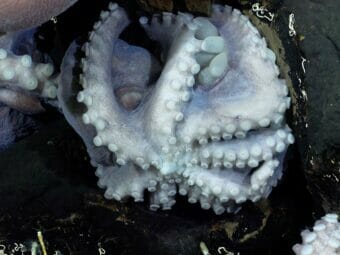
In new book, Alaska researcher dives into the mysterious lives of octopuses

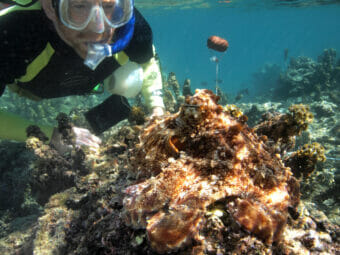
Alaska Pacific University professor of marine biology David Scheel examines an octopus, cyanea, near Mo’orea, French Polynesia. (Sy Montgomery)

Octopuses are mysterious sea creatures to many people, including in Alaska, where more commercially viable and — dare we say — charismatic animals get the most attention.

After all, octopuses do live mostly solitary lives, hiding under rocks, changing color and shape to blend into their surroundings, grabbing prey with their sucker-lined arms and pulling it into their sharp beaks.

But our understanding of their biology and behavior has advanced greatly in the last three decades or so, thanks in part to a professor of marine biology at Alaska Pacific University, Dr. David Scheel. Scheel has a book out called “Many Things Under A Rock: The Mysteries of Octopuses,” which is the culmination of many hours spent investigating octopuses underwater and in tide pools, with help from coastal Alaska’s Indigenous people.

Listen:

The following transcript has been lightly edited for clarity.

David Scheel: Yeah, so the study started as an oil spill-related study. But in the end, we weren’t able to say very much about the impact of the oil spill on the octopuses, because there really wasn’t any pre-oil spill data or studies. And the people who had been most interested in the octopuses in Alaska, pre-oil spill, seem to have been the Alaska Natives, because that’s an important part of their subsistence culture in many of the coastal communities. And so in the early days of my work with octopuses, some of the elders took me out foraging and collecting octopuses. And that was how I learned to find them, initially. And so I designed my early study around the ways that the Alaska Natives harvested the octopuses and, you know, they’re just doing it the same way it’s been done for a long time. And so they’re not using scuba diving gear, right? So that’s how it started. But then, when I was getting funding from my early work, I was asked by the funding agency to add scuba diving.

Casey Grove: It seems like there were a lot of unknowns there. And maybe part of that was, you know, the unknown of your own safety in that situation.

David Scheel: You have to bear in mind, my divers have four limbs, the octopus has eight. So we’re at a disadvantage to begin with. And so it was a question for me to try and solve is, ‘How big do these guys get?’ You know, that’s not a question with a definitive answer, but the Alaska Pacific octopus does routinely get up to about 100 pounds or more, and occasionally much larger. And so that’s a size that’s big enough that we wanted to be careful how we handled them, because we didn’t want to put anyone at risk. But we also weren’t interested in killing or harvesting the octopuses. We wanted to weigh them, measure them, find out whether they’re males and females and put them back.

Casey Grove: And then, is it fair to say, I mean beyond that, that you’ve discovered they have a certain intelligence?

David Scheel: Yeah, a lot has been written about octopus intelligence, and for the most part, that hasn’t been a central subject of my research. But, you know, the stuff that I do, particularly up here in Alaska, is looking at what they’re eating and how they’re choosing their diet, and things like that. And even there, you can see threads of behavior that reveal how their cognition works and what kinds of choices they’re making.

And one of my favorite examples that I talked about in “Many Things Under A Rock” is octopuses prefer larger species of prey. And so they’re eating small crabs, but they’re choosing the bigger species of the crabs in Prince William Sound. And so what does that actually mean the octopus is doing? Well, first of all, they have to be able to judge size, but then they’re also using restraint. We know that they’re passing up small, immediate rewards in order to look for larger rewards in the future. They are very clever animals. But really, I think the building blocks of octopus intelligence are really curiosity, persistence and flexibility. So they’re always exploring things. They’re reluctant to give up. And if one thing doesn’t work, they’ll try something else. And I really think that’s where a lot of intelligence comes from, including in humans.

Casey Grove: That’s interesting, yeah. So there are many ways that that yourself and other researchers have gone into the ocean to look at different animals, and in your case octopuses, and then you sort of famously also have had an octopus living in your house.

David Scheel: Yeah, you’re referring to the PBS documentary “Octopus: Making Contact.” And that was originally envisioned as sort of “a scientist and the octopus he keeps in his home.” But fortunately, my daughter Laurel — who’s the illustrator for the book, by the way, she has done some marvelous drawings to put the book — she kind of bonded with Heidi (the octopus). And so that really changed the whole nature of of that documentary and made it, in some ways, this this charming piece about a girl and her octopus, which I think was much better story than a scientist and his octopus.

Casey Grove: Well, I can imagine that you both had a lot of interactions with Heidi. And so I wondered, I mean, were there things that you felt like by having her in your home that you learned that you would not have otherwise?

David Scheel: Yeah, Heidi was great to have in the home. And one of the things that happened is that she really wanted to interact with us. And I was surprised to find- I had my desk setup, when I would work from home, where I could have a really good view of the aquarium that Heidi was in. And Heidi would get up, she would see me at my desk, and she would get up out of her den and come to the nearest corner of the tank, and then she would go up and down, from the surface of the water to the bottom, from the surface of the water, up and down until I would look up. And then she would, you know, she didn’t wave or anything like that, because that’s not a natural behavior for octopuses, as far as we know, but she would change her behavior a little bit, notice me noticing her, and she wanted me to get up and come and play with her. And if I didn’t, if I tried to get back to work, out of the corner of my eye, I would see her doing that pacing behavior again.

Casey Grove: One interesting thing about octopuses — I mean, other animals as well — but they they dream, right? And how can you tell that they’re dreaming?

David Scheel: Yeah, the question of octopus dreaming is a fascinating one. And I got involved with it through making that PBS documentary,.The cinematographer there, the photographer, was just brilliant. He caught this lovely sequence of Heidi asleep and going through all these bodily changes. And if you look at it, there’s only one thing that you think is happening, you think the octopus is dreaming. You know, what we know about dreaming is anchored in part in having a dream and then talking to people about dreaming so it’s anchored in language. But it’s not entirely anchored in language. There are other things that reveal dreaming. If you can know how the body pattern of an octopus changes in different contexts that are ecologically relevant in their life, like the difference between foraging for prey and escaping a predator, then those body patterns are mimicked in the proper order during sleep, that is very suggestive of dreaming. And studies in humans have shown that our eye movements during REM sleep will actually track what we’re looking at in our dreams. So if you’re dreaming of a tennis match, for example, your eyes during REM sleep are going back and forth following the ball. And so we know that humans do this kind of thing. Their sleep behavior while dreaming reveals content of the dream. So why wouldn’t that be true for octopuses as well?

Casey Grove: It seems like people, you know, with certain animals and how we think about them, for humans, it’s like easier to relate to another primate. And obviously, octopuses are very different from that. And as people sort of begin to understand and begin to acknowledge the intelligence in this creature, are they then, I guess, more obligated to help protect them?

David Scheel: Well, I think it’s very easy for us to identify with octopuses. I mean, they’ve got the same kind of vision we do. And they’re particularly, once you learn to work with them a little bit, they’re very enamored of touch. And we are, too, and so they become very endearing animals. And when you add to that, sort of this notion of octopus awareness — right? — that they have inner lives, that they experience hunger and fear or, you know, that they might be dreaming and having dreams and nightmares, then it becomes very easy to identify with them.

But in terms of what does that mean, how should we behave? That’s a question that’s more about us than it is about octopuses themselves. So maybe, you know, you get to a point where, like me, you think, “Well, I’m just not going to eat any of these animals that I, you know, feel attached to.” I don’t eat octopuses anymore because their behavior. You know, that’s more interesting to me than any culinary experience I could have with an octopus. But that really says something about our culture, particularly. And then if you look at Indigenous cultures was harvest some of these animals, they have a very different relationship, right? Because to them, this is part of their cultural heritage. It’s part of how they relate to the world. It’s part of how Indigenous cultures see people, not as separate from nature, but as part of nature. Octopuses have to eat, right? And they eat clams and crabs. Well, people have to eat as well. And so when you’re looking at these choices, my feeling is that you have to place them in the proper context. The properties of the animal alone do not determine how we should relate to that animal.

EPA has new rules for oil spill dispersants

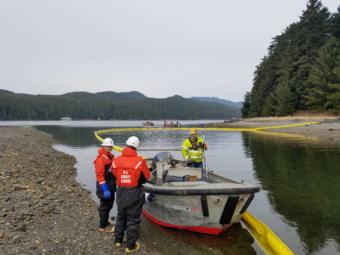
U.S. Coast Guard and Hecla Greens Creek Mine crews deploy a boom April 3, 2019 to contain a fictitious heavy fuel oil spill at Hawk Inlet. (Photo courtesy of Coast Guard Sector Juneau)
U.S. Coast Guard crews deploy a boom during a 2019 oil spill response drill at Hawk Inlet. Typically, only a tiny fraction of the oil spilled in a major event can be contained and removed by skimmers and other equipment. (Coast Guard Sector Juneau)

The EPA has updated its rules on the use of chemicals to disperse oil spills.

The rules for dispersants were last updated in 1994. That was just five years after a dispersant called Corexit was used in response to the Exxon Valdez oil spill in Prince William Sound. It was a highly controversial decision at the time, and the controversy arose again in 2010, when greater volumes of dispersants were deployed on the Deep Water Horizon spill, in the Gulf of Mexico.

Dispersants may break up an oil slick, sparing some birds and wildlife at the surface, but may increase the oil contamination for species that live lower in the water column. The toxicity of dispersants themselves is also a concern for cleanup workers and other wildlife.

A group of Alaskans filed a lawsuit in 2020 to force the EPA to rewrite the rules to take into account research on the long-term effects of dispersants in Prince William Sound and elsewhere.

The new rules revise the testing protocols before a chemical can be added to the list of approved products, require public notification of dispersant use and require more disclosure of the impacts on health and the environment. They go into effect in December.

Revenge of the killer whales? Recent boat attacks might be driven by trauma

Killer whales are pictured during a storm in the fjord of Skjervoy in 2021 off the coast of northern Norway. Researchers say orcas are stepping up “attacks” on yachts along Europe’s Iberian coast. (Olivier Morin/AFP via Getty Images)

Scientists and sailors say orcas, also known as killer whales, are stepping up “attacks” on yachts along Europe’s Iberian coast, with one skipper who’s been pursued by the marine mammals on two separate occasions suggesting that their tactics are becoming more stealthy.

Delivery skipper Dan Kriz, who had to be towed into port after orcas destroyed the rudder on a boat he was on in 2020, had an almost identical experience in April.

“My first reaction was, ‘Please! Not again,'” Kriz told Newsweek.

Unlike last time, the orcas made a stealthier approach without the characteristic squeaks they normally use to communicate, he says. They made quick work of the two rudders on the catamaran Kriz was delivering. “Looks like they knew exactly what they are doing. They didn’t touch anything else,” he said.


View this post on Instagram


A post shared by Catamaran Guru (@catamaranguru)

Most marine scientists have characterized hundreds of encounters between boats and orcas that have sunk at least three vessels and damaged dozens of others over the years as a “fad,” implying that the animals will eventually lose interest and resort to more typical behavior.

But if that’s the case, there are few signs this behavior is going out of style anytime soon. According to a June 2022 study published in the journal Marine Mammal Science, orcas have stepped up the frequency of their interactions with sailing vessels in and around the Strait of Gibraltar, the busy waterway that links the Mediterranean Sea with the Atlantic Ocean.

Some researchers think it’s merely playful behavior

As NPR first reported last August, many scientists who study orca behavior believe these incidents — in which often one or more of the marine mammals knock off large chunks of a sailboat’s rudder — are not meant as attacks, but merely represent playful behavior.

One hypothesis put forward by Renaud de Stephanis, president and coordinator at CIRCE Conservación Information and Research, a research group based in Spain, is that orcas like the feel of a boat’s rudder.

“What we think is that they’re asking to have the propeller in the face,” de Stephanis told NPR last year. “So, when they encounter a sailboat that isn’t running its engine, they get kind of frustrated and that’s why they break the rudder.”

A picture taken on May 31 shows the rudder of a vessel damaged by killer whales (Orcinus orca) while sailing in the Strait of Gibraltar and taken for repairs at the Pecci Shipyards in Barbate, near Cadiz, southern Spain. (Jorge Guerrero/AFP via Getty Images)

In another recent encounter, Werner Schaufelberger told the German publication Yacht that his vessel, Champagne, was approached by “two smaller and one larger orca” off Gibraltar.

“The little ones shook the rudder at the back while the big one repeatedly backed up and rammed the ship with full force from the side,” he said.

The Spanish coast guard rescued Schaufelberger and his crew, towing Champagne to the Spanish port of Barbate, but the vessel sank before reaching safety.

The encounters could be a response to past trauma

Since 2020, there have been more than 500 encounters between yachts and orcas in the area, according to one of the study’s co-authors, Alfredo López Fernandez, a biologist at the University of Aveiro in Portugal and a representative of the Grupo de Trabajo Orca Atlántica, or Atlantic Orca Working Group.

López Fernandez believes that a female known as White Gladis, who leads the group of around 40 animals, may have had a traumatizing encounter with a boat or a fishing net. In an act of revenge, she is teaching her pod-mates how to carry out revenge attacks with her encouragement, researchers believe.

A worker cleans Champagne, a vessel that sank after an attack by orcas in the Strait of Gibraltar and was taken for repairs at the Pecci Shipyards in Barbate, near Cadiz, southern Spain, on May 31. (Jorge Guerrero/AFP via Getty Images)

“The orcas are doing this on purpose, of course, we don’t know the origin or the motivation, but defensive behavior based on trauma, as the origin of all this, gains more strength for us every day,” López Fernandez told Live Science.

It’s an intriguing possibility, says Monika Wieland Shields, director of the Orca Behavior Institute.

“I definitely think orcas are capable of complex emotions like revenge,” she says. “I don’t think we can completely rule it out.”

However, Shields is not ready to sign on to the “revenge” hypothesis just yet. She says that despite humans having “given a lot of opportunities for orcas to respond to us in an aggressive manner,” there are no other examples of them doing so.

Deborah Giles, the science and research director at Wild Orca, a conservation group based in Washington state, is also skeptical of the hypothesis. She points out that killer whale populations in waters off Washington “were highly targeted” in the past as a source for aquariums. She says seal bombs, small charges that fishers throw into the water in an effort to scare sea lions away from their nets, were dropped in their path while helicopters and boats herded them into coves.

“The pod never attacked boats after that,” she says. “It just doesn’t ring true to me.”

Shields says it’s important to remember that whatever the motive is for the behavior of the orcas off the Iberian coast, it isn’t being transmitted to pods in other parts of the world.

“We’ve had folks here in Washington [asking] ‘is it safe to go out in the water here with these orcas?'” she says. “While this is kind of an ongoing situation in that specific place, I don’t think there’s any reason to think it’s going to start spreading to other populations of orcas.”

Copyright 2023 NPR. To see more, visit https://www.npr.org.

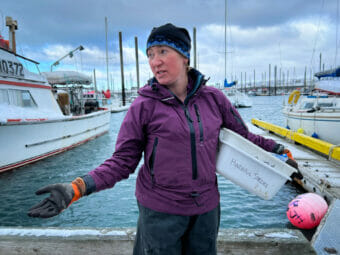
In Metlakatla, people from across Southeast learn how to watch for invasive green crabs

Participants of last month’s green crab workshop on the beach in Metlakatla. (KRBD photo/Raegan Miller)

Invasive green crabs are in Alaska. And they are destructive, outcompeting native species and destroying essential eelgrass. At a workshop in Metlakatla last month, citizen scientists learned from experts how to look out for the invasive crabs in their own communities.

Scientists and concerned Alaskans are at Tamgas Harbor. Gathered near Colby Creek Beach, they’re getting a first hand look at the European green crab. And time is of the essence. The crabs showed up in southern Southeast Alaska last summer, and more than 800 have been found since.

“It’s like we hit the ground running coming out here,” said Taylor Stumpf, with the wildlife department of Metlakatla’s tribe. He’s helping people learn to identify, measure, and document the crabs.

The workshop drew participants from around the region, including Ketchikan, Kake and Prince of Wales Island. Green crabs have already infested waters around Haida Gwaii, California and Washington. But for now, Metlakatla is the only place in Alaska to document live green crabs — which are destroying vital eelgrass and habitat for abalone, clams and Dungeness crabs.

Taylor Stumpf tries to get a crab out of a trap to check if it is a European green crab or a Dungeness crab. (KRBD photo/Raegan Miller)

But that doesn’t mean they won’t spread. That’s why the workshop — which was organized by local,  state, federal and tribal agencies — focused on training people to identify the crabs and alert authorities  before it’s too late to control the spread.

People aren’t allowed to kill the crabs themselves — officials are worried they’ll mix up species and take out a perfectly good Dungie — but they are encouraged to collect information and alert authorities. That’s what the workshop is teaching them to do. The agencies organizing the workshop included Alaska Sea Grant, Washington Sea Grant and the National Oceanic and Atmospheric Association. Other involved agencies included the Central Council of the Tlingit and Haida Indian Tribes of Alaska and representatives from the U.S. Coast Guard. Participants included area mayors, concerned citizens, scientists and more.

Stumpf explained a few key tells for a crab that doesn’t belong. Wildlife officials also handed out laminated guides showing pictures of the green crab to all the participants.

“They have the five spines on either side of the eyes and then the three bumps in the middle,” he said. “So we’ve been teaching people with guides how to identify the crabs.”

Ewa Booth is showing people how to set and bait different kinds of traps. She’s an intern with  Metlakatla’s wildlife department. She said the Tribe has been experimenting with what works best.

“They usually like chum and herring fish,” Booth said. “We haven’t really used cat food like they suggested.”

Booth said she’s noticed a difference on the beach since the first crab was found last year. 

“Eelgrass is important because it’s like habitat for other clams, and like juvenile fish, juvenile salmon,” Booth explained. “So it was kind of a worry for us when they first arrived. And I’ve noticed that they’ve gotten a lot shorter, too, like, the eelgrass.”

Booth noted that the crabs tear up the eelgrass while they’re looking for food.

n invasive green crab found near Tamgas Harbor last month. (KRBD/Raegan Miller)

There’s no sure-fire way to eradicate the crabs once they’ve arrived. Tribal nations in Washington state have been fighting them for years. But Genelle Winter, Metlakatla’s grant and invasive species coordinator, said the key is to just keep finding them. She said Metlakatla has always protected its resources, and that’s what the town will keep doing.

“It just sharpened everybody’s need or awareness to protect those resources, right?” Winter said. “Like those resources were already super precious. It’s wanting to make sure they stay intact.”

Each female crab is capable of laying hundreds of eggs. In Metlakatla, green crab catching is a full day’s work. Just ask Gabriel Nathan.

“We’ve been catching a lot when they were molting, when they’re trying to hatch eggs and everything,” he said. “And we caught like over, probably, 40 green crab with egg shells attached to them. And that slowed down a lot. So it was great.”

The workshop’s message is also one of hope: if everyone learns to spot these crabs maybe there’s a way to protect other communities.

Tre Patterson, with Metlakatla’s wildlife department, said that’s the goal.

“I didn’t think that the state or other places near us were taking it as seriously as we wer,” he said. “So to see something like this happening today here on the island is great, to see that more people are taking this issue seriously.

Patterson said everyone has a stake in stopping the crabs — and that things will get even worse if the crabs keep moving north.

More marine debris cleanup projects coming to Alaska

Marine debris collected on Gore Point. (Aaron Bolton/KBBI)

Plastic, wood, fishing nets and buoys are just some of the waste that washes up on even the most remote parts of Alaska’s coastline. Now, programs aimed at cleaning up that marine debris are getting a funding boost from the National Oceanic and Atmospheric Administration – thanks to an influx of grant money from the Bipartisan Infrastructure Law.

Nearly $14 million in federal funding is earmarked for two separate programs aimed at cleaning up marine debris in the state. The money is distributed through NOAA’s Marine Debris Program and funded by the Bipartisan Infrastructure Law that was passed in 2021.

Peter Murphy is Alaska’s regional debris coordinator with NOAA. He said the new programs go beyond just cleaning up existing debris.

“But also prevention, finding ways to reduce how much is getting into the ocean, because at the end of the day, we’re not going to be able to clean our way out of the problem,” he said.

Of that money, $5.85 million will go to the University of Alaska Fairbanks to establish a Center for Marine Debris based in Kodiak, that will serve as a kind of a regional headquarters for marine debris removal projects across the state. The center will eventually be able to process and recycle debris that is shipped there.

Partner organizations on the project include Alaska Sea Grant, the Aleut Community of St. Paul Island, Douglas Indian Association, Matson, the Native Village of Port Heiden and the Ocean Plastics Recovery Project.

The other project is focused on removing abandoned fishing gear from Chesapeake Bay on the East Coast, and $8 million will go to that project, which is spearheaded by the Virginia Institute of Marine Science. But it will also include a grant program that organizations in Alaska can tap into.

Murphy said abandoned gear is a problem across the country — and it has a big impact on fisheries. For instance, a study in Southeast Alaska showed that abandoned crab pots were still catching crabs and other marine animals years after they were lost.

“Fishing gear is a specifically impactful type of marine debris, because once it gets lost or abandoned in the marine environment, it does what it was intended to do. It continues to catch animals but it does so indiscriminately,” he said.

Money for both programs is included in Bipartisan Infrastructure Law for this year, and both the marine debris and fishing gear cleanup programs are set to start this summer.

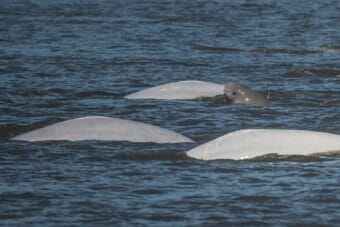
Gray whales find haven in Sitka Sound

A gray whale surfaces while feeding near Shoal’s Point, west of Sitka. (Photo by Blain Anderson)

While reports of gray whale strandings along the Pacific coast have jumped since 2019, there’s at least one place where these whales seem to be thriving. Hundreds of gray whales migrating from Mexico to their Arctic feeding grounds are stopping in Sitka along their route.

Gray whales have often visited Sitka, but over the past few years, boaters and biologists have seen an unusual increase in gray whale activity.

“I was just talking to somebody up in the parking lot who said at one point last year, he estimated over 700 whales – gray whales,” said Blain Anderson, captain of the sailboat Bob.

Seven hundred might be on the high end, but whale biologist Lauren Wild says the number of gray whales in Sitka Sound used to hover around 10 or 20. Since 2019,  it’s been closer to 150.  As Wild put it, “it’s whale soup out here.”

Most of the news about gray whales in recent years has been pretty dismal. In May 2019, the National Oceanic and Atmospheric Administration declared an ongoing  “unusual mortality event” due to elevated strandings of West-coast gray whales. Before that, a 2015-2016 marine heat wave, sometimes referred to as “the blob,” devastated Pacific-coast fauna from whales, to seabirds.

In Sitka, though?

“If people have been seeing them, they’re seeing whales rolling around and playing with each other,” Wild said. “They’re seeing a lot of feeding behavior, a lot of social behavior. Some people are seeing what looks like mating behavior.”

Like humpbacks, which are commonly seen in Sitka Sound, gray whales use baleen to feed. Unlike humpbacks, gray whales feed in the shallows, filtering silt and sand to get to tiny critters, like shrimp. Gray whales are smaller and often covered in parasitic barnacles and long scars from rolling around on the rocks.

Wild usually studies humpbacks and sperm whales, but the gray whale influx has piqued her interest. While it’s not entirely clear what is bringing this barnacle-covered baleen bonanza to the waters of Sitka Sound, Wild has a few ideas.

“We sort of wondered if the marine heatwave maybe disrupted some of the the reliability of food in the Bering Sea and Chukchi seas in the summer,” Wild said. “And if that possibly, sort of prompted these whales to be looking for more opportunistic places to forage along their migration routes, so they weren’t relying so much on those food sources.”

The food source? Likely herring eggs along the outer coast of Kruzof island.

“If you look at a map, the tip of Cape Edgecumbe is right along the outer coast,” Wild said. “If whales are migrating by and they just happen to be there at the right time, they might sort of start seeing more of that herring spawn, and it might pique their attention.”

Pacific herring spawn each spring in the waters around Sitka, and these fish – and their eggs – are an important food source for marine organisms and humans alike. Herring roe in Sitka is already a hotly contested resource, and now these motivated mysticetes may have joined the competition.

Wild said that the timing and location of gray whale sightings correspond to areas of herring spawn. She also pointed to observations from Alaska Department of Fish and Game spawn surveys:

“They’ll be diving and see gray whales around their dive boat and stuff,” Wild said. “So they’re certainly in the same area that those eggs are. And then they’ve seen a few times, you know, kelp beds that look sort of shredded like, and they’re imagining that is probably gray whales coming through and sucking up eggs off the kelp and rolling around in it.”

Wild hopes to confirm exactly these whales are eating – even if the fieldwork gets messy.

“Obviously you don’t know when they’re going to defecate,” Wild said. “So you kind of have to be at the right place at the right time. And we’ll use a little skim, almost like a fish pond net, that’s fine mesh, to just sort of scoop it up. You can also scoop it up with water in a Nalgene or something.”

A gray whale shows flukes as it dives. (Photo by Blain Anderson)

Understanding what these whales eat is one part of the puzzle. Wild is also hoping to start building a catalog to identify and track individual whales to figure out which whales are coming to Sitka, and where else they’re going along their migration route.

In the meantime, both Wild and Anderson urge boaters to be cautious around gray whales, which may be more likely to approach humans than the average Sitka humpback. In Mexico, boaters can legally approach – and interact with – gray whales.

“They get chin scratches,” Anderson said. “And you know, I’ve seen pictures of people kissing them.  And it’s something that perhaps they’ve gotten used to.”

The whales may ignore political borders, but Alaska boaters are still required to follow the Marine Mammal Protection Act – to avoid harassing whales, NOAA encourages boaters to stay 100 yards away and put engines into neutral if a whale approaches.

We don’t know what will happen in the future with these new visitors, or what the implications are for the West-Coast gray whale population as a whole, but for now, it seems that this struggling population has found a haven in Sitka feeding, socializing, and even — as Anderson has observed a few times — mating.

As Anderson noted, “It was all supposed to happen down to Mexico, but it does seem like they’re continuing their frisky ways up in – as we call it – romantic Sitka Sound.”

To report a stranded, injured, entangled, or dead marine mammal, call the NOAA Fisheries Alaska Statewide 24-hour Stranding Hotline: (877) 925-7773.

Site notifications
Update notification options
Subscribe to notifications