Oceans

Conservation groups sue EPA seeking rules for discharges from cruise ships and other vessels

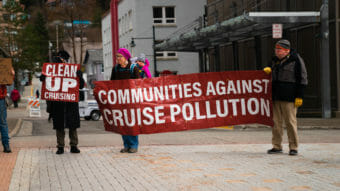
A small group of environmental demonstrators gather near the Capitol in downtown Juneau on April 26, 2022 to protest pollution from large cruise ships. (Photo by Paige Sparks/KTOO)

Two conservation groups are suing the Environmental Protection Agency over its alleged failure to finalize standards to protect U.S. waterways from harmful vessel discharges, including those from cruise ships.

In a complaint filed in February, Friends of the Earth and the Center for Biological Diversity say that the 2018 Vessel Incidental Discharge Act required the EPA to develop standards for discharges from ships.

The lawsuit seeks an injunction that would require the EPA to issue those rules.

Much of the lawsuit focuses on the ballast water that ships take on to provide stability. Friends of the Earth Oceans and Vessels Program Director Marcie Keever says that when ships take on water in one place and discharge it in another, that can help spread invasive species and diseases.

“Unless you have treatment to a level which gets rid of these invasive species, when your ship exchanges ballast water, … it’s an incredible risk just from invasive species alone, let alone the pathogens you might encounter from ships coming from all over the world into our waters,” Keever said.

An EPA spokesperson declined to comment on the pending litigation.

In their lawsuit, the conservation groups say invasive species alone cause more than $9 billion in damage each year to infrastructure for public water supplies, industry and power plants.
But ballast water is only one focus of the lawsuit. Keever says the groups are also concerned about discharges from scrubbers that reduce ships’ air pollution.

“The biggest rise in wastewater pollution that we’ve seen over the last several years is exhaust gas scrubber wastewater, which is, basically, the wastewater generated when you use a wet scrubber to scrub your smokestack to comply with international rules for cleaner fuel,” Keever said.

CoastAlaska investigation published last year uncovered dozens of reports from independent cruise ship monitors alerting state authorities to foamy discharges from ships operated by Carnival Corp. and subsidiaries like Holland America and Princess. Keever says those discharges can harm marine life and those that depend on it for sustenance.

“Essentially, what they’ve done is converted air pollution into water pollution,” Keever said.

Lawyers for the conservation groups and the EPA are due to appear before U.S. District Judge William Orrick in the Northern District of California in mid-May.

The Bering Sea’s smallest organisms are losing fat, putting larger predators at risk

A new study shows zooplankton are getting skinny with lack of sea ice. (NOAA)

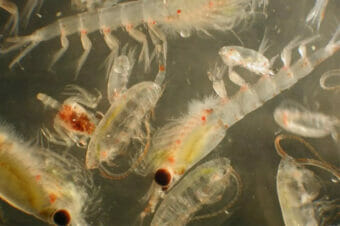
Zooplankton are small organisms — like sea snails, jellyfish, and krill — and they’e crucial to the Bering Sea’s ecosystem. But new data from NOAA Fisheries shows that one of the most common zooplankton isn’t as fatty or abundant as it used to be.

Large, high-fat copepods — distantly related to shrimp and crab — are dwindling with the lack of sea ice from global warming. Meanwhile, smaller zooplankton are increasing in both numbers and range.

David Kimmel is a research oceanographer and leader of the nearly two-decade study. He said Arctic fish, seabirds, and marine mammals are struggling to adjust to global warming while consuming less fatty foods.

“They can get skinny — which doesn’t necessarily lead to mortality, but can make them more susceptible,” said Kimmel. “For example, not surviving in the winter if they don’t have enough energy stores to make it through the winter.”

While less fat in the diet doesn’t necessarily lead to extinction, Kimmel said it could lead to smaller population sizes of common Bering Sea organisms, like king crab and harbor seals. It could also create an ecological shift in the sea.

“Organisms that are normally found to the south are moving northwards,” he said. “So communities that you might expect to exist at more southerly latitudes begin to become more prominent at more northerly latitudes.”

The Bering Sea is one of the most sensitive regions to global warming. Kimmel said knowing how the bottom of the food chain changes with warmer temperatures can help predict how ecosystems around the world will be affected by climate change later on.

“The people that live in Alaska at the frontline of this change are really the ones that are experiencing it,” Kimmel said. “And they’re quite removed from a lot of fellow citizens throughout the country that aren’t experiencing it — you know, right up close and personal. And that makes their stories and their experiences much more important to share and talk about.”

Check out the deepest-swimming fish ever caught on camera

An image shows snailfish swimming around a baited camera more than 27,000 feet below the surface in the Izu-Ogasawara Trench off the coast of Japan.
(University of Western Australia)

Those who’ve wondered what lurks in the dark depths of the ocean have a new answer.

Scientists working off the coast of Japan say they’ve managed to capture images of the deepestswimming fish ever caught on camera.

The unknown snailfish species, of the genus Pseudoliparis, was recorded swimming in the Izu-Ogasawara Trench at a depth of 8,336 meters — or more than 27,000 feet down.

“We have spent over 15 years researching these deep snailfish; there is so much more to them than simply the depth, but the maximum depth they can survive is truly astonishing,” University of Western Australia professor Alan Jamieson said in a press release.

The fish was recorded during an August 2022 mission to several trenches around Japan, which included teams from the Minderoo-UWA Deep Sea Research Centre and Tokyo University of Marine Science and Technology. The trip was part of a decade-long study of the world’s deepest fish populations.

Researchers released video footage from baited cameras that show several of the whitish-blue deep-sea fish swimming by. The particular fish that holds the record for the deepest ever found was a small juvenile.

On the same trip, researchers collected two snailfish from traps in the Japan Trench at a depth of 8,022 meters, which they believe to be the only fish caught deeper than eight kilometers.

“The Japanese trenches were incredible places to explore; they are so rich in life, even all the way at the bottom,” Jamieson added.

According to Guinness World Records, the previous record for the deepest fish was a Mariana snailfish (P. swirei) observed at 26,831 feet in the Mariana Trench in the western Pacific on May 18, 2017.

Copyright 2023 NPR. To see more, visit https://www.npr.org.

Alaska marine debris experts call for tighter regulation and more cleanup funding

Dr. Lauren Divine, Director of Ecosystem Conservation Office, Aleut Community of St. Paul Island Tribal Governement, talks about ocean conservancy and marine debris in rural communities during the Arctic Encounter Symposium event Friday, March 31, 2023. (Alaska Public Media/Mizelle Mayo)

Trawl nets, buoys, even boats and fragments of buildings: these are some types of marine debris that wash up on Alaska’s coasts every day.

“In one cleanup, with a crew of about 10 people on St. Paul Island, in any given year, we can pull about 20,000 or more pounds of debris in a week off of our shorelines,” said Lauren Divine, director of the Ecosystem Conservation Office on the remote Bering Sea island of St. Paul.

Marine debris is a never-ending problem for coastal communities like hers. Divine spoke at a marine debris panel at the Arctic Encounter conference in Anchorage last week.

Another panelist, Fred Jay Ivanoff, senior crew leader for Norton Sound Economic Development Corporation, remembered a cleanup at a camp 50 miles east of Savoonga on St. Lawrence Island several years ago.

“After that week they went home and then a different family went out to their camp over the weekend, and they brought back a table full of [trash] and they asked ‘did you guys even clean the beach?’ That was in a couple of days,” Ivanoff said.

Since 2006, NOAA has funded cleanup of more than 900 metric tons of trash from Alaska’s 66,000 miles of coastline.

The trash piling up on rural beaches isn’t local, Divine and Ivanoff explained. Divine said the majority of debris that washes ashore is fishing-related — often big, heavy pieces of gear.

And coordinating teams to collect and sort the debris, plus a barge to pick it up and take it to a mainland landfill or recycling center is an expensive logistical nightmare.

“All of the time, the burden for these cleanups is put on the communities,” Divine said.

Funding these efforts is also a major challenge. NOAA supplies some grants to fund cleanup efforts, and an Anchorage-based environmental nonprofit called Zender Environmental has helped to coordinate pickups all over Alaska through its Backhaul Alaska program.

“There isn’t enough funding available for what is needed to really address the issue,” said Kristina Tirman, the Sitka-based Alaska marine debris manager for Ocean Conservancy, which gives out small grants up to $10,000 to fund cleanup projects.

There’s also not a clear way to hold anyone responsible for the trash that washes up onshore, the panelists said. NOAA fisheries biologist Erika Ammann said as shipping traffic increases off Alaska’s coasts and the mariculture industry expands, the focus should be on preventing marine debris at its source.

The International Maritime Organization forbids ships from littering all types of garbage while at sea. Ammann said local regulation is necessary too.

“I think now is the time to make sure that we have regulations or permitting requirements in place, so that they don’t contribute to the problem,” she said. “Maybe part of the permit should be that you make sure every float that you have is accounted for at all times, so that if it gets lost, it’s your responsibility.”

Ammann said NOAA is helping start a Marine Debris Action Plan for Alaska to educate rural cleanup coordinators and connect them with resources. She’s also hoping the 2021 bipartisan infrastructure law will help make more money available to fund marine debris cleanup.

Alaska’s annual tsunami warning test failed for some communities

Winter view of the National Tsunami Warning Center in Palmer. (Photo courtesy of NOAA)

Wednesday was the annual test of Alaska’s tsunami warning system. Radio and TV stations along the coast of the Gulf of Alaska were expected to broadcast a test of an emergency alert – similar to what you’d hear during a real tsunami. 

But some communities didn’t hear it at all, including Homer, Kodiak, Unalaska, Sitka, Ketchikan and Kenai.

Dave Snider, with the U.S. Tsunami Warning Center in Palmer, says a combination of technical glitches, along with some confusion, prevented the test from reaching those places. Forecasters in Anchorage failed to pass the message along. 

“I think it was just that they were confused about what kind of tests were running,” Snider said.

An abundance of caution

Wednesday’s tsunami warning test was an annual test. It runs every year in March, with the goal of refining the way tsunami warning alerts are delivered to the public. 

But when forecasters at the NWS Office in Anchorage received the test signal, they failed to enable the regional Emergency Alert System. So the message never reached radio stations like KBBI in Homer, KMXT in Kodiak or KUCB in Unalaska. 

Tsunami warnings in the state follow a complex chain of communication. When forecasters at the Tsunami Warning Center trigger a warning, it goes to NOAA offices like the National Weather Service stations in Anchorage and Juneau. That’s stage one. 

When they’re conducting regular monthly tests, that’s where the chain stops. 

“But this test was designed to go further than the normal monthly communications tests,” Snider said. “And in this case, the problem is we just need to be more clear about what kind of tests we’re running.”

Wednesday’s warning was a rare kind of test, one where the Tsunami Warning Center tries to simulate a real tsunami threat by jumping into stage two: the Emergency Alert System, which notifies the public through radio and TV broadcasts. And that’s the part that didn’t happen for stations that rely on the NWS office in Anchorage. 

When it comes to testing tsunami warnings in Alaska, the team is a bit out of practice, which may have contributed to the breakdown in communication. The annual test has been canceled in recent years when real tsunami threats happened, like the volcanic eruption near Tonga last year and an earthquake in the Gulf of Alaska in January 2018.

Snider also said he believes that past mistakes have caused some hesitation when it comes to sending out test warnings. For instance, in a 2018 incident a routine test activated the Emergency Alert System by accident.

“I think there’s some well placed hesitation during tests,” Snider said. “Out of abundance of caution, and truthfully, you know, previous years of false alarms.” 

Difficulties in decoding

Wednesday’s test also revealed technical failures. Some radio stations received the test message, but their systems were unable to read it.

The Emergency Alert System relies on “live codes,” a form of automated communication where coded messages are deciphered by radio and TV broadcast systems. Some radio stations, including KDLL in Kenai, KCAW in Sitka and KRBD in Ketchikan, received the live codes from NWS in Juneau. But their systems were unable to decode the message, so it wasn’t broadcasted. 

Snider says the root of the problem was the fact that the alert was just a test.

“In a normal situation, zero hesitation, everything would have flown out the door,” he said. “I have no doubt that would have worked.”

The challenge is balancing the need for tests with the need to preserve a sense of urgency when it comes to real alerts. If botched tests and false alarms happen too often, there’s concern that the public will stop taking tsunami alerts seriously. 

But Snider says the errors from Wednesday will be valuable feedback to fortify the warning system. 

“The good thing is that with tests, they’re designed to fix problems before an actual event,” Snider said. 

Communities that had problems with Wednesday’s test are encouraged to submit their feedback at www.ready.alaska.gov.

Annual test of Alaska’s tsunami warning system scheduled for Wednesday

A Tsunami hazard zone warning sign.
A Tsunami hazard zone warning sign. (Photo by Derin/Flickr Creative Commons)

Many Alaskans will get a tsunami warning on Wednesday at 10:15 a.m. It’s a test, but the people sending it out are worried that not everyone will know that.

Dave Snider of the National Tsunami Warning Center says that’s because the system used to send out tsunami alerts is outdated and overly complicated.

“We’re operating on a system that is probably closer to where meteorology and weather science was 20, 30 years ago,” he said.

Real tsunami warnings get broadcast on local radio and TV stations and relayed through warning sirens, in places that have them. They also go out through wireless emergency alerts — the kind that can show up on your cell phone’s lock screen, sometimes with an irritating siren noise. 

For Wednesday’s test, the cell phone alerts won’t be activated. But Snider says it’s possible that some mobile apps might spread the warning anyway. And due to incompatible software, those third party apps could misread the code that communicates the warning and leave out the part that says it’s a test. 

Tsunami push notification sent out through the wireless emergency alert system on Jan. 23 via IPAWS. (Screenshot by Aaron Bolton, KBBI)
Tsunami warnings sent out through the wireless emergency alert system look like this. Those alerts shouldn’t go out on Wednesday, but similar third-party messages could appear on your lock screen (Screenshot by Aaron Bolton, KBBI)

“We do rely on our third party, private industry and enterprise to make sure that they’re keeping up with the changes that we’re making, and making sure that they understand the code that we’re using,” Snider said.

It’s also possible that the warning will reach people outside of the testing zone. That’s because tsunami warnings are issued using weather forecasting boundary zones —  the same ones used to issue alerts for weather hazards like winter storm warnings.

Most of the zones cover large areas, and they’re not designed for tsunami warnings. Snider says feedback from tests — like hearing from people outside tsunami zones — is vital to designing a better warning system. 

“One of the results of this will be to see, are there places that are getting this alert that shouldn’t get the alert? And we may find a couple of those places,” Snider said. “Because we know in the past, there have been some areas that have been over-warned or over-alerted.”

The warning center runs the annual test each March as part of Tsunami Preparedness Week. It falls around the anniversary of the devastating tsunamis of the Great Alaska Earthquake of 1964. 

Those tsunamis are why the center exists in the first place. Decades later, the technology for sending out precise warnings is very much a work in progress. In a report last year, the NOAA science advisory board called for “urgent action” to update the tsunami warning system. 

Snider says perfecting that technology could take decades longer — and in the meantime, he expects some errors.

“​​Twenty years from now, when we’ve redesigned the alert system, it won’t happen,” he said.  “It’s a technology thing, and we’re constantly working to refine that and keep people safe.”

Feedback from this week’s test will help to improve things along the way. People in the southern Alaska tsunami zones are encouraged to submit their comments at www.ready.alaska.gov.

Site notifications
Update notification options
Subscribe to notifications