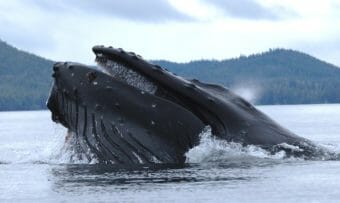
A humpback whale strains krill in the waters of Southeast Alaska. (Photo provided by NOAA)
The 2014 to 2016 Pacific marine heat wave, nicknamed “the Blob,” devastated Alaska’s marine ecosystem.
It turned seastars to goo and caused dead seabirds to wash up on beaches. Researchers also believe it killed almost half the resident humpback whales in Glacier Bay and Icy Strait.
But wildlife biologist Janet Neilson with Glacier Bay National Park says things are looking up for Southeast Alaska’s humpback whales.
“The good news is that whales are very resilient,” Neilson said. “They are really capable of rebounding.”
Glacier Bay and Icy Strait are an essential feeding ground for humpback whales. They fuel up before migrating to winter breeding grounds in Hawaii and Mexico. During the heat wave, cold-water fish and plankton species declined, causing what Neilson calls an “underwater famine.”
In the years since, almost 50% of humpback regulars in Glacier Bay and Icy Strait have gone missing — and they haven’t been located anywhere else. Most are presumed to have died because of the heat wave.
Though temperatures cooled down after 2019, Neilson says that for several years, her team kept seeing devastating survey results.
“We almost call it like the hangover of the heat wave,” Neilson said. “Things actually got worse after the heat wave ended before they started to get better.”
But the 2022 update, which was released last week, shows sure signs of improvement. Whales are fattening up again, and they’re staying longer in Glacier Bay and Icy Strait than they did during the heat wave — which points to a much-needed improvement in feeding conditions.
“We’re seeing less emaciated whales. Less skinny whales,” Neilson said.
Southeast humpbacks are also reproducing more successfully, with fewer sudden calf deaths. But birth rates still have not returned to pre-heat wave levels. Scientists don’t know the exact cause, but Neilson says that may mean female whales have not recovered enough nutrition to support pregnancies.
“A lot of females that we would expect to have calves. They’re just not coming back with calves,” Neilson said. “We’re not sure what’s the problem there.”
And for adult whales, the threat of vessel strikes still looms. 2022’s survey documented at least one death of an adult female whale near Angoon. The survey found only 165 adult humpbacks total in Glacier Bay and Icy Strait, so one death can matter a lot.
As the ratio of whale watching boats to individual whales in Southeast is increasing, researchers fear the risk of disturbances is rising too. Too much boat activity can stress humpbacks, which makes proper feeding even more difficult.
Neilson says that avoiding extra stress and deaths for humpbacks will be especially important as climate change increases the chance of future marine heat waves. But for now, she says Southeast’s humpbacks are on a good track.
“Things definitely are still not back to where they were,” Neilson. “But there are positive signs.”
Sen. Lisa Murkowski and Rep. Mary Peltola addressed attendees virtually for the kickoff forum of ComFish on Thursday, March 16, 2023. (Brian Venua/KMXT)
Alaska’s congressional delegation says species collapse in Alaska’s fisheries is nearing crisis levels. Sen. Lisa Murkowski and Rep. Mary Peltola discussed the monumental challenges faced by Alaska’s fishermen and coastal communities during their legislative update on the opening day Thursday of Kodiak’s annual commercial fishing trade show, ComFish.
Murkowsi and Peltola kicked off ComFish’s federal legislative update with a brief acknowledgement of the Willow project’s recent approval — calling the $8 billion oil development a win for the state of Alaska. Sen. Dan Sullivan was not at Thursday’s forum due to a scheduling issue. He’ll speak on Saturday instead.
But much of their time was spent detailing the uncertainties caused by species collapse in the waters off Alaska’s coast. Murkowski said the declines in salmon, crab and halibut fisheries across the state are at crisis levels.
“I don’t like to use the word ‘crisis’ lightly, but I think crisis is the appropriate word here. I wish that we could tell you the exact causes, I wish there was one single thing to explain everything,” she said.
Population declines that were once “acts of God are becoming trends of nature,” Murkowski said, adding that current fisheries management doesn’t always reflect what’s happening in the water.
“Our management systems are not inherently nimble. And that’s a challenge for us,” Murkowski said.
Alaska’s congressional delegation has been pushing for more funding to study the effects of ocean variability caused by climate change.
Murkowski said that includes money for more bottom trawl surveys, and programs through the Pacific Salmon Treaty. Murkowski said nearly $3 million had been allocated for the research in the Bering Sea through the Bering Sea Fisheries Research Foundation. And money from the Bipartisan Infrastructure Law will also help coastal communities facing reduced revenue streams from crashing fisheries.
Peltola took time to call out bycatch, which is the incidental catch of a non-target species, saying not enough is being done to understand and address the issue.
“I just really want to be clear that I personally feel like we can be doing better. Progress has been made, but we can’t settle for the status quo, we need to make changes at a much faster pace than we are today,” Peltola said.
In a followup forum later that day, members of the state’s Bycatch Review Task Force detailed some of what those changes might be.
The group published a series of recommendations late last year, including the development of a statewide bycatch policy — bycatch is currently regulated federally under several federal policies, including the Magnuson-Stevens Act – and updating the types of gear and how much bycatch is allowed for certain vessels.
But according to the task force, shifting distribution patterns of marine species as ocean temperatures change also presents a hurdle to developing effective solutions.
Murkowski said there needs to be a collaborative approach to address the whole problem.
“We need to be working together to find these solutions because the challenges really are too great for anybody to face alone,” Murkowski said.
That process will take time, although Peltola noted that probably wasn’t satisfying for anyone in the room.
“Even if we do everything right starting today, it still could take 30 years for our fisheries to fully recover, and we really need to be clear about the timeline that we’re looking at. But we can’t let the perfect be the enemy of the good, we can’t hold ourselves back from making every marginal improvement that we can,” she said.
Peltola and Murkowski spoke for about an hour including a question and answer session. Both also addressed the lawsuit against Southeast Alaska’s king salmon fishery brought by a Washington-based environmental group, saying it was an effort to bully the fleet, and they would stand united in fighting it.
The Juneau Douglas ocean science bowl team visited the Alaska Sea Life Center in Seward during the “Tsunami Bowl” in March 2023. (Photo Courtesy of Shannon Easterly & Shelby Surdyk)
After school, empty pizza boxes lay stacked on a lab bench in Shelby Surdyk’s science classroom. The smell lingered as Juneau Douglas High School’s ocean science bowl team waited for coach Shannon Easterly’s next question.
“What is the most endangered cetacean?” she asked.
One student fired off a series of wrong answers.
“Blue whale, sperm whale, bowhead whale.”
Easterly stopped him.
“It’s a teeny, tiny porpoise called the vaquita,” she said. “We don’t know for sure, but there are less than 20 individuals.”
“Oh, I hate it,” said Peyton Edmonds, one of the students, showing her teammates a vaquita on her phone. “That’s not cute.”
The team practices here three times a week, but Tuesday was their first meeting since their win at Alaska’s “Tsunami Bowl” earlier this month. It’s a statewide ocean science competition. This year, in Seward, the school swept the buzzer-style competition — the third year in a row that Juneau has won.
“Rest-A-Shored (left)” and “Free Radicals (right)” competed in the final round of 2023’s “Tsunami Bowl. (Photo Courtesy of Shannon Easterly & Shelby Surdyk)
The freshman team, “Yeah, Buoy,” won first place in their division, while A-team “Free Radicals” and B-team “Rest-A-Shored” faced off in the final round to win first and second place, respectively.
Carson Carrlee, captain of Yeah-Buoy, was surprised. He said competing in Seward felt different from practices.
“Right after school, when you’re very tired and you have the A-team sitting right there, you’re barely buzzing in. So it can feel kind of like you don’t know anything,” he said.
In the heat of the competition, that changed.
“It really shows that you’re actually learning stuff,” he said. “You’re actually starting to become, like, kind of a scientist-ish.”
The Tsunami Bowl, which was hosted by the University of Alaska Fairbanks College of Fisheries and Ocean sciences, is more than a competition. It’s a crash course in all things ocean science, with researchers and professionals from around the state.
The Juneau teams visited a boat simulator at the Alaska Maritime Training Center, tried a tsunami evacuation drill and went behind the scenes at the Alaska Sea Life Center.
The A and B-teams also participated in the research portion of the competition, where teams presented original research papers and oral presentations. This year’s theme was mariculture in Alaska.
Juneau’s students focused on the farming of geoducks, sea cucumbers and oysters. Easterly said the student research efforts are her favorite part of the competition.
“The buzzer is fun,” she said. “But that paper writing and then the opportunity to actually practice public speaking and present your own research — to a crowd of not just your peers, but adults from all over the state — is really valuable.”
The Juneau Douglas “Free Radicals” will go on to compete at the National Ocean Sciences Bowl in 2024. (Photo Courtesy of Shannon Easterly & Shelby Surdyk)
Surdyk joined as a coach last year. She said that the competition attracts students who might not have an interest in ocean science initially. Some join because their friends join. Others join for a small bribe — extra credit in science class.
“Even if they don’t feel motivated by the competition, just to enjoy the process of learning and discover that they love science, I think is a huge reward,” Surdyk said.
Carlee, a first year student, says he’ll definitely be back next year.
“I love all my other clubs,” Carlee said. “But NOSB. You really feel like you’re smart. And you’re learning stuff.”
And the ocean science bowl gets students to stick with STEM education, Easterly says. Tuesday’s practice was proof.
“We didn’t even tell them there would be pizza. And they came anyway,” she said.
Next year, Easterly will take the Free Radicals A-team to the National Ocean Sciences Bowl competition, where they’ll compete against the winning teams from across the country.
A healthy sunflower sea star is seen on the seafloor in 2014. NOAA Fisheries on Wednesday announced it is seeking a threatened listing for the distinctive sea stars, which have been nearly wiped out in some areas by a wasting disease that coincided with warming Pacific waters. (Photo by Ed Gullekson/Washington Department of Fish and WIldlife, provided by NOAA Fisheries)
One of the world’s largest sea stars is on track to receive Endangered Species Act protections.
Federal regulators announced on Wednesday that they are proposing a threatened listing for the sunflower sea star, a creature that has been killed off in much of its Pacific habitat by disease. While the effect of a listing on Alaska and its fisheries is not certain, scientists say they don’t expect significant changes in the state in the near term.
The official proposal for the threatened listing is scheduled to be published Thursday by the National Oceanic and Atmospheric Administration’s Fisheries Service. That will kick off a 60-day public comment period, with a final listing decision due in a year.
The proximate cause of the sunflower sea star decline is sea star wasting syndrome, which wiped out about 90% of the animals across its vast range, according to NOAA Fisheries. The wasting system has hit a variety of sea star species, though sunflower sea stars have suffered especially severe harm, according to scientists. It causes legs to fall off and, ultimately, results in disintegration of the animals’ bodies. Climate change may be behind that disease, as the arrival of Pacific marine heat waves coincided with the disease outbreak, according to federal biologists.
Sunflower sea stars are distinctive and colorful creatures found from Baja California to Alaska’s Aleutian Islands. They can grow up to 24 legs and be as big as 3 feet in diameter. They are considered a keystone species in the marine environment; their top food is sea urchins, and by eating the kelp-feeding urchins, they protect kelp forests that support numerous other species, including those of commercial significance in Alaska.
If it goes through, the listing will be the first for any sea star under the Endangered Species Act.
The proposed listing is unusual in other ways.
While there are some big geographic differences in population trends, with the heaviest impacts in the southern areas and less-severe impacts in Alaska and other northern areas, the listing would cover sunflower sea stars over their entire range. That is because the Endangered Species Act does not allow listings of invertebrates to be broken down into distinct population segments, as is the case in Alaska with endangered western Steller sea lions and Cook Inlet beluga whales.
A sunflower sea star is seen in 2014 with early symptoms of wasting syndrome, including lesions and arms that curl and break off. (Photo by Janna Nichols/ NOAA Fisheries)
Compared to the near-total wipeouts “across the board” in Lower 48 waters, declines in Alaska waters range from 40% to 100%, said Sadie Wright, a Juneau-based protected species biologist with NOAA Fisheries who helped compile the status review that led to the proposed listing.
Beyond listing, ensuing recovery work could consider geographic differences, she said during an online news conference. “Later in the process, when we’re looking at protections, we can tailor those more regionally if that’s a better fit,” she said.
There is also no plan, as of now, for designation of critical habitat, normally a part of the regulatory action to conserve listed species, officials said. That is because critical habitat is considered “indeterminable,” said Dayv Lowry, the NOAA Fisheries biologist who led the status review.
“We know that it occurs around kelp forests. We know that it’s a part of that ecosystem and an integral part of it. But the animal is also found over rock piles, sand, mudflats, eelgrass meadows. It’s found all over the place,” Lowry said in the news conference. “At this point, we’re saying the animal is protected anywhere and everywhere you encounter it.”
There are additional unknowns. Scientists are still trying to figure out the sea stars’ life cycles and lifespans and fundamental biology, Lowry said. The exact pathogen that triggered wasting syndrome is not yet identified. And any contribution of the sunflower sea star deaths to a longer-term decline in kelp forests is still unclear.
“The biggest problem that we ran up in trying to do the status assessment is that there’s a lot of information about the species that is not well known,” he said.
Also yet to be determined are any potential impacts of listing to commercial fishing.
Whatever damage is being done to the sea star population by bycatch, the unintended catch during harvest of targeted fish, it is considered a low-level threat, far overshadowed by the wasting syndrome, Wright said.
“While we want to work with commercial fisheries and the fishery management councils to gather more information and promote safe handling of sea stars that are bycatch in fisheries, we don’t anticipate significant changes to fisheries as an outcome of this proposed rule,” she said.
A sunflower sea star killed by wasting syndrome, its body mangled and partly dissoved, is seen on the sea floor in this undated photo. The disease killed over 90 percent of sunflower sea stars across the entire range, according to NOAA Fisheries. (Photo by Janna Nichols/NOAA Fisheries)
There is an effort to get more details in bycatch reports, Lowry said. For now, those reports often refer to sea star bycatch generically, without identifying species.
While listing will not itself fight off any disease or address climate change, it can heighten awareness and help support various research activities, the NOAA officials said at Wednesday’s news conference. Among the programs they cited was the captive-breeding research underway at the University of Washington’s Friday Harbor Laboratories.
The proposed listing results from a petition submitted in 2021 by the Center for Biological Diversity.
In a statement, the center hailed Wednesday’s listing news.
“Protection under the Endangered Species Act will be so important for reviving these incredible sea stars,” Miyoko Sakashita, the center’s oceans program director, said in the statement. “Disease fueled by climate change has devastated this gorgeous species, and these safeguards will help tackle threats to their survival and promote the health of the kelp forests they live in.”
Officials with Alaska Department of Fish and Game and Alaska fishing organizations have previously expressed concerns about the wide geographic span that listing would affect.
Currently, Nome’s port can only handle ships of a certain size, but an infusion of cash through the Biden Administrations 2021 Infrastructure Investment and Jobs Act means an expansion of the existing port could make the region more inviting for larger vessels. (Photo by Emily Schwing / KNBA)
By 2050, ships traveling through the Arctic’s Northwest Passage may not need an icebreaker to escort them for the journey. In Nome, residents are wondering whether a new port will help or hinder efforts to address a myriad of chronic social problems. Some are also concerned that an onslaught of industrial marine traffic may impact Indigenous people, who have thrived along the coastline here for generations.
One warm summer day, Austin Ahmasuk stood on Nome’s sand spit. A light breeze blew against his face as he looked over the thin slice of land that lies at the mouth of the Snake River and stretches out in front of the city’s port.
“When you look up ‘sand spit, Nome’ and you look up historical photographs, you’re going to see Alaska Native people living here, celebrating here, harvesting here,” he said.
Ahmasuk grew up in Nome. He has a lot of memories of this place, both good and bad.
“My uncle was working in the tugboat industry and he drowned right over here,” he said. “But I also have really fond memories growing up here, before all these rocks were here.”
He pointed across the spit.
“Cigar fish used to come here and spawn and so myself and a childhood friend — one of us had a box of matches and we cooked cigar fish on a rock and we spent most of the day here,” he said.
A gold discovery here in the late 1890s brought 10,000 stampeders, all looking to get rich. Now, the melting ice caps have triggered another kind of stampede. Large industrial ships can travel through here faster — shaving days off transit times that would otherwise take them through the Panama Canal.
But, Ahmasuk said his memories and the legacy of the Iñupiat who have lived here for thousands of years, shouldn’t have to compete with the modern-day monetary gain some people hope to capitalize on as the Arctic becomes increasingly ice free.
“It’s like a highway going right past us now,” said Nome’s Harbormaster, Lucas Stotts.
Stotts sees Nome as the last pit stop before ships head through the Bering Strait and north into the Arctic.
As the climate warms and sea ice along the northernmost coast of North America dwindles, all kinds of marine traffic — from cruise ships, to hobby sail boats to large-scale industrial ships — is picking up in the icy waters of the Arctic Ocean. According to the Arctic Council, marine traffic increased by 44% through the Northwest Passage between 2013 and 2019.
“There is a lot of traffic that currently isn’t coming into Nome,” Stotts said. “That’s only because they’re too deep draft to come in.”
Anything that rides deeper than 20 feet under the surface of the water can’t dock. He said that’s why Nome needs to expand its port. A $250 million dollar infusion of cash from the Biden Administration’s 2021 Infrastructure Investment and Jobs Act means the basin could be nearly twice that deep in coming years.
“We feel we’re already behind the times in terms of what is needed for the region and by the time this thing is built, I think we’ll be behind as we’re already at that point,” he said.
Nine cruise ships passed through Nome last summer, fewer than Stotts expected due to ongoing concerns about the coronavirus pandemic and conflict between Russia and Ukraine.
“We were going to have 24,” he said. “That is massive growth by itself and that industry isn’t basing that growth on our facility. That was happening well before any expansion was ever slated.”
Erica Pryzmont runs the Pingo Bakery and Seafood House in Nome. She said she’s more concerned with hiring and keeping good staff on hand than she is with whether a port expansion in Nome will raise her bottom line in coming years. (Photo by Emily Schwing / KNBA)
Roughly half a mile from the harbor, at Pingo Bakery and Seafood House, things are pretty quiet after lunch service ends. The restaurant is tiny, with seating for 12, run by Erica Pryzmont. She’s not sure an influx of shipping traffic will influence her business.
“It’s interesting because sometimes the cruise ship visitors just sort of come to the threshold and peer in like you’re some sort of a curiosity or almost like you’re on exhibit,” she said.
Right now, she’s more concerned with trying to find and keep reliable staff to serve the clientele she already has.
A bright red Help Wanted sign hangs on her front door. While she’s looking for employees, others are looking for work. At 4.5%, the unemployment rate in Nome is higher than both the national and state averages.
The Bering Straits region is also facing a serious housing shortage. The local emergency shelter is often full, especially in the winter. Chronic substance abuse is another social ill the community is fighting to manage. And, while there is federal funding for the port expansion, a local funding match is required. So, some residents believe the city should address the issues the community already faces, before assuming millions of dollars in debt the federal government requires in matching funds for the port expansion.
Nome’s Mayor John Handeland doesn’t see it that way.
“You know, if we build all these other resources first because we think we need it, it’s all on speculation,” he said. “And, I haven’t been successful going to my bank and, you know, getting a loan for something that’s purely speculative.”
Nome’s Mayor John Handeland believes a port expansion will decrease the town’s cost of living while also boosting long-term investment in the community and bringing badly-needed jobs to town. (Photo by Emily Schwing / KNBA)
Handeland said a port expansion will decrease the cost of living while simultaneously boosting long-term investment and available jobs in Nome.
Others in favor say it’s essential for national security. They say it will be crucial for environmental protection and emergency response as more ships traverse the Arctic Ocean in the future. But Austin Ahmasuk calls these “the three big lies.” He grew up in Nome and for years worked as a marine advocate and lobbied for improved food security for Alaska Natives through his Alaska Native Corporation Kawerak.
“It certainly makes sense to shippers that cutting a thousand or so miles or a couple of thousand miles off is cheaper. Right. But it doesn’t mean that it’s less risky. You’re still going to the Arctic. It’s still going to be cold,” he said.
Declining sea ice allows more ships to pass through the Arctic. They are coming in larger numbers through the Bering Strait. With them, they bring more greenhouse gas emissions. At least 10% of ships utilizing Arctic waters today are burning heavy fuel oil, which if spilled, can solidify or remain floating for weeks in cold water.
“The weather is so changeable up here, and it’s shallow,” said Vernon Adkison. A lifelong mariner, he says the Bering Sea is not to be underestimated. “So when the wind really picks up, the seas build quicker than out in the middle of the deep blue sea.”
Adkison stars in the Discovery Channel’s reality show Bering Sea Gold. He’s depicted as a gruff and wry business man, with old-school beliefs and a no-nonsense approach to making money off Norton Sound’s rich ocean floor sediments. But he also has some misgivings.
When ships pull into port at Nome, many use much smaller boats to deliver cargo and people to shore. The process is known as lightering. It’s necessary, because the current port can’t accommodate ships over a certain size. Even with a port expansion, lightering would still need to happen. For Adkison, that means more accidents waiting to happen.
“I know what can go wrong in conditions with no eyeballs on the scene,” he said. “They’re out there littering and doing various things. I used to be a lightering master in the Gulf of Mexico, and I saw what some of those guys will do if there’s nobody watching. And then not everybody is ethical. There are bilges, there are spills, there are all kinds of things that can happen if there’s nobody really keeping eyes on the situation.”
The largest Coast Guard base in Alaska is located hundreds of miles south in Kodiak. It could take days to respond to a shipping related accident or spill in the Bering Strait.
“If it was up to me, I’d like to leave it the same as it is right now. I don’t know if I want to have to deal with all the bigger boats and the bigger industry-type scenario just right there where we start our hunting journeys,” said Ben Payenna.
He fishes commercially for crab, salmon and halibut and when he’s not catching fish as his sole source of income, he’s out on his boat, hunting for his family’s main sources of food: seal and fish, many different bird species and walrus.
“I was able to harvest my first one when I was seven,” he said. “I wasn’t really quite big enough to hold a rifle to my shoulder yet. And so my dad actually sat me in his lap and he held the rifle on his shoulder.”
Payenna said that the whole crew of men he used to hunt walrus with is now gone. And he wonders what else he might lose as declining sea ice makes way for more shipping traffic.
This ongoing series is made possible through a grant from the Climate Justice Resilience Fund.
A new study finds that orca mothers still feed their adult sons. It’s a bond that may come with costs, researchers say. (David K. Ellifrit/Center for Whale Research / NMFS research permit #21238)
Twenty years ago, in the waters off the coast of Washington State and British Columbia, an adult female killer whale (dubbed K16 by those who know her well) gave birth to a son, K35.
“These two have an extremely close social relationship,” says Michael Weiss, the research director at the Center for Whale Research in Friday Harbor, Washington.
It’s hard for Weiss to think of a time when he didn’t catch the pair hanging out in the same group, and often immediately next to each other.
“[They’re] just this pair of whales that are basically each other’s best friend,” he said.
Weiss has observed the mom and son pair spending a lot of time close together, touching and floating at the surface — and sharing salmon.
Male orcas are massive, and so are their appetites. They’re also less maneuverable, which may make it harder for them to catch prey. All this means that a male like K35 needs help getting enough food.
So his mom will often dive down, says Weiss, “catch a salmon, and bring it up to the surface and actually bite half of the fish off and leave that half for her son. So she’s sharing a huge amount of food.”
And here’s the striking thing — since K35 was born two decades ago, his mom has never had another calf. Contrast that with other females in the population.
“Some whales started reproducing at the same age around the same time,” says Weiss, “and they had daughters. And they’ve produced three or four offspring.”
It’s not just K16. In a paper out this week in the journal Current Biology, Weiss and his colleagues looked back across four decades of life history records of Southern Resident killer whales in the Pacific Northwest. The trend was clear:
“Killer whale mothers pay a really huge cost to take care of their sons,” says Weiss. That cost is that they have fewer offspring. “And they do this throughout their son’s life and never really stop paying that cost to keep their sons alive.”
In fact, when a mom dies, her son usually perishes within a year or two. “We think that is largely because they’re seeing a huge reduction in the amount of food they get,” explains Weiss.
Weiss can’t think of another animal that makes this never-ending investment when it has the option of reproducing multiple times. So why would these orca moms sacrifice so much for their sons? Weiss argues the potential payoff is huge.
“K35 is now one of our biggest males in the population,” says Weiss. “He’s grown big and healthy and looks good.”
That means he’s ready to become a father.
“Honestly, I wouldn’t be surprised if some of the next few calves that get popped out in the population are his,” says Weiss.
The result is that his mom would become a grandmother multiple times over. Her genes would end up in a bunch of calves. And because they’ll be born into other pods, she wouldn’t have to spend any effort raising them.
“It’s an amazing piece of work,” says Eve Jourdain, the director of the Norwegian Orca Survey. Jourdain, who wasn’t involved in the study, is hoping to conduct a similar research project in Norway.
“There could be direct comparisons possible across populations,” says Jourdain. “And only then can we start getting a better understanding of how important it is for the conservation of those different populations.”
It’s worth mentioning that this strategy of moms investing so much in their sons has a dark side. Southern Resident killer whales like K16 and K35 are in trouble. In recent years, the population has cratered to just 73 animals. And what these orcas really need right now is more reproductive females.
“That’s how you keep a population of slow-breeding animals going,” says Weiss. “So investing in sons for a population like ours that is so stressed is really not ideal.”
Weiss worries that this maternal strategy, which served this population so well in the past, could raise their risk of extinction — that the kind of lifelong bonds he’s seen between K16 and her son may tether these creatures to an uncertain fate.
Copyright 2023 NPR. To see more, visit https://www.npr.org.
Close
Update notification options
Subscribe to notifications
Subscribe
Get notifications about news related to the topics you care about. You can unsubscribe anytime.