Oceans

Alaska crab fishery collapse seen as warning about Bering Sea transformation

""
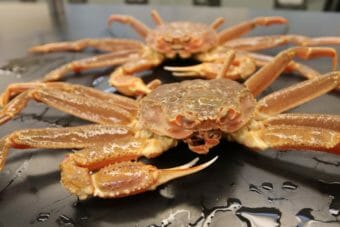
Bering Sea snow crab support an iconic Alaska seafood harvest, but a crash in population since 2018 has triggered the first-ever closure of the fishery. (Photo provided by National Oceanic and Atmospheric Administration)

Less than five years ago, prospects appeared bright for Bering Sea crab fishers. Stocks were abundant and healthy, federal biologists said, and prices were near all-time highs.

Now two dominant crab harvests have been canceled for lack of fish. For the first time, the Alaska Department of Fish and Game in October canceled the 2022-2023 harvest of Bering Sea snow crab, and it also announced the second consecutive year of closure for another important harvest, that of Bristol Bay red king crab.

What has happened between then and now? A sustained marine heat wave that prevented ice formation in the Bering Sea for two winters, thus vastly altering ocean conditions and fish health.

“We lost billions of snow crab in a matter of months,” said Bob Foy, director of the National Oceanic and Atmospheric Administration’s Alaska Fisheries Science Center, at a public forum held Dec. 12 at the Anchorage Museum of History and Art. “We don’t have a smoking gun, if you will. We don’t have one particular event that impacted the snow crab — except the heat wave.”

That heat wave is now over, but its effects linger. A NOAA survey showed an 80% decline in Bering Sea snow crab, from 11.7 billion in 2018 to 1.9 billion this year. It could take six to 10 years to recover, experts told members of the North Pacific Fishery Management Council, which wrapped up a 10-day meeting in Anchorage on Wednesday.

Snow crab may be the “poster child” of climate change, council member Bill Tweit said during deliberations on a rebuilding program that was ultimately approved at the meeting, but much more will be affected by the long-term changes in the ocean.

“It’s going to be more and more a problematic question for us among a broader range of species than just snow crab,” Tweit said.

In the short term, loss of the snow and red king crab harvests is devastating. Direct losses from harvest cancellations this year amount to $287.7 million, according to state estimates. Local governments are suffering, too, like the Aleut community of St. Paul, which relies on the crab harvests for more than 90% of its tax revenue.

""
Close-up view of an Alaska king crab is seen in 2019. (Photo by Julia Brownlee/National Oceanic and Atmospheric Administration)

There are limits to what the North Pacific Fishery Management Council can do to manage crab stocks. Crab harvests are managed by the state, even for stocks existing in federal waters, though the council and federal agencies provide support and scientific information to assist and cooperate in that management. However, the council and associated federal agencies do have the power to regulate other fisheries that might affect the crab – and that is what crab fishermen and crab-dependent communities asked them to do.

Alaska Bering Sea Crabbers, a nonprofit trade organization, petitioned the council to use its emergency powers to ban all fishing for six months in areas designated as protected zones for red king crab. In those areas, crabs mate and molt, spending much of their time in a vulnerable soft-shell stage. That puts the crabs at high risk for being crushed and killed by trawl nets that hit or scrape the seafloor, the organization argued.

Warm temperatures may have wiped out much of the crab population, but that is not something that can be corrected immediately, said Jamie Goen, Alaska Bering Sea Crabbers’ executive director.

“Our concern as crab fishermen is we need to focus on the things we do have control over, and that’s really fishing impacts and habitat protections,” she said at the museum forum, which was organized by the Anchorage Daily News and the Seattle Times.

The council ultimately declined to take such emergency action, which critics said might not be effective and would have unintended consequences. They include pushing the trawl fleet into different territory, where there might be higher incidental catch of salmon or other problems. Instead, the council opted for a plan to study alternatives that include possible fishery closures in the key red king crab mating and molting areas. And the snow crab rebuilding plan it approved leaves open the possibility of a small harvest conducted as the stock recovers, which is important to industry representatives who voiced concerns about losing their position in the wider seafood markets.

“Once you lose that space at the buffet table and they fill it with shrimp or lobster, it’s really hard to get that back,” said John Iani, president of the North Pacific Crab Association, a Seattle-based organization of processing companies.

There is plenty of competition for the market slice held by Alaska snow crab and red king crab.

Stockpiles of Russian king crab are still being sold – even recently at an Anchorage Costco – though the U.S. government has banned further imports of Russian fish due to Russia’s invasion of Ukraine. Snow crab is harvested in eastern Canada, where stocks remain healthy, and in the Barents Sea off Scandinavia, where it is a relatively new species.

There is other Alaska crab on the market, too, though not as celebrated. Harvests of golden king crab, a species smaller than red king crab, are proceeding, and a relatively small harvest of red king crab in Norton Sound, in the Nome area, that is expected to open in 2023, though in two recent years it was shut down because of low stocks. Dungeness crab harvests continue in Alaska, as in other West Coast states. The Alaska Department of Fish and Game last week announced that a tanner crab season will open in 2023 in the Aleutians area.

A stack of boxes of king crab
Russian king crab is displayed at a Costco in Anchorage on Nov. 14. The crab, from the Barents Sea, was distributed by Arctic Seafoods of San Francisco, and was part of inventory stockpiled before the U.S. government banned fish important from Russia. (Photo by Yereth Rosen/Alaska Beacon)

There are other positive signs in the Alaska marine environment, according to the ecosystem reports presented to the council.

After successive years of low ice and high temperatures, a normal freeze returned to the Bering Sea last winter, scientists told the council. That resulted in the return this summer of an average-sized “cold pool” – the section of ultra-chilled water that serves as a thermal barrier separating habitats in the northern and southern Bering Sea. Seabird populations, many of them substantially reduced in recent years, are now showing reproductive successes, the scientists said. Some fish populations, including pollock and Bristol Bay-bound sockeye salmon, have actually thrived in the warmer conditions, the scientists said.

But there are also persistent signs of trouble. Ocean temperatures in certain areas, like the Aleutians, remain high. Steller sea lions, an endangered population in western Alaska, continue to decline in the western Aleutians. Northern fur seals, which congregate in the Pribilof Islands, are in a long-term decline.

The future of the Bering Sea appears to depend on whether humans take action to reduce greenhouse gas emissions that are warming the planet, NOAA fisheries biologist Elizabeth Siddon told the council on Dec. 11.

A “high-mitigation” scenario, with big reductions in greenhouse gas emissions, will result by the end of the century in “a Bering Sea that’s only slightly warmer but pretty similar to current conditions,” Siddon said. But under a business-as-usual scenario, with very little progress to reduce greenhouse gas emissions, the Bering Sea will be “much warmer than we would have observed to date,” she said.

Foy, speaking at the museum event, said the peak Bering Sea temperatures seen during the heat wave are unlikely to become normal anytime soon. But marine heat waves are expected to become more frequent, overlaying an ongoing and gradual rise in ocean temperatures, he said.

“It’s the impact on an ecosystem of those heat waves that worry scientists the most,” he said. “Because the data shows that the animals can’t adapt. If they can’t move, if they can’t grow, if you don’t get enough year classes in a row to sustain a fishery, then that’s when we have difficulty of fishery and communities and large-scale economic issues.”

Cook Inlet beluga birth rates lower than expected, study finds

A woman on a snowy shore looks out on the water with binoculars
Trained beluga monitor Kelly Hild, of Kasilof, watches for belugas on the bluff in Kenai in March 2022. (Sabine Poux/KDLL)

Low birth rates are likely contributing to the decline in the population of beluga whales in Cook Inlet, according to a study published this week.

Gina Himes Boor is a research professor in the ecology department at Montana State University and the lead author on the study. She said this is the first time researchers have been able to estimate birth rates for the species, and she said those lower-than-expected rates are likely a big factor in the population’s overall downfall.

“Getting that demographic piece in place and understanding that helps us to get closer to identifying what might be the external factors that are limiting their recovery,” she said.

The study is the latest piece in a puzzle scientists are trying to solve about why the endangered population of Cook Inlet belugas is not rebounding.

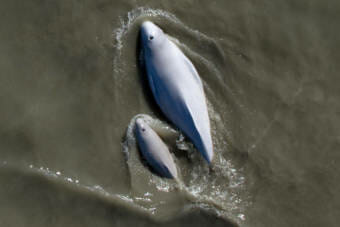
A beluga whale and calf, seen from above
A Cook Inlet beluga whale mother and calf (Photo by Hollis Europe and Jacob Barbaro/NOAA Fisheries)

Himes Boor and her team used photos of individual belugas to chart trends in the population as a whole. They found that whales weren’t giving birth at rates they would expect from healthier populations. She said while belugas in healthy populations gave birth every two to three years, Cook Inlet belugas were reproducing every four.

Rebecca Taylor, from the Alaska Science Center, was another author on the study. She said researchers also used the photo data to measure survival rates in the population, which they also found were lower than expected.

“It is really important to understand birth and death rates for endangered populations like the Cook Inlet belugas,” Taylor said.

Himes Boor said the next step in research will be pinning down the specific factors contributing to low beluga birth rates and higher death rates. “Because this population is declining and its prospects aren’t looking great,” she said.

In the next year, she said researchers will look at data that extends through 2022.

Himes Boor and her team used photos from the Cook Inlet Beluga Whale Photo-ID Project, led by Tamara McGuire, to study the population. That project also takes photos from citizen scientists. You can submit photos to the project at cookinletbelugas.com.

The bottom of the Bering and Chukchi seas could become too warm for some important species

A tan basket star illuminated on the seafloor
A basket star is seen on the Alaska seafloor. If ocean warming continues on its current trajectory, marine life at the bottom of the Bering Sea and Chukchi Sea will look a lot different in the coming decades, according to a new study. The seafloor environment will be too warm for the snails, worms, clams and mussels that make up the diets of walruses and some seabirds and fish species. But basket stars like this one and related brittle stars — species that do not currently play much of a role in the food web — are expected to thrive in the warmer temperatures. (Photo provided by NOAA Alaska Fisheries Science Center)

There is danger lurking on the floor of the Bering and Chukchi seas for mussels, snails, clams, worms and other cold-water invertebrates, according to a new study led by National Oceanic and Atmospheric Administration scientists.

If climate change continues its current trajectory, the Bering and Chukchi seafloor areas will be too warm for those creatures by the end of the century.

In turn, that means trouble for walruses and other marine species. Snails and mussels are particularly important to commercially harvested fish like halibut and yellowfin sole, along with being prey for the Pacific walruses that gather in the summer in the northern Bering and southern Chukchi seas. The Bering Sea is part of the North Pacific Ocean south of the Bering Strait that separates Alaska from Russia, while the Chukchi Sea is part of the Arctic Ocean just north of the strait.

The results warn that those seafloor-dwelling populations of invertebrates that support populations of Bering Sea and Chukchi Sea marine mammals “may be seriously impacted by future ocean warming,” the study said. That also affects coastal residents who depend on traditional harvests of walruses and seabirds for food and cultural connections, the study said.

Under the current climate trajectory, key cold-water bottom-dwelling prey species are on track to lose half of their suitable habitat by mid-century, the study said. By the end of the century, almost the entire Bering and Chukchi sea region would be too warm for them to live on the seafloor there, the study found.

The resulting seafloor habitat would be taken over by a few species that can tolerate a wide range of temperatures – creatures like brittle stars and basket stars, relatives of sea stars. But those marine species are very minor players in the food web.

The study is a cooperative effort of scientists from NOAA’s Alaska Fisheries Science Center, NOAA’s Pacific Marine Environmental Laboratory, the University of Washington and the Institute of Marine Research in Norway.

A walrus in close-up, with open water and ice in the background.
A young bull walrus rests on a piece of sea ice in Alaska waters on April 13, 2004. Walruses eat clams, mussels, snails and worms that live on the seafloor. Projected ocean warming threatens those food supplies and may force walrus populations farther north. (Photo by Joel Garlich-Miller/U.S. Fish and Wildlife Service)

It uses a decade’s worth of data to calculate the preferred temperatures for a variety of species that dwell on the bottom of the sea in areas of the Bering and Chukchi that normally have seasonal ice coverage.

In the past, that data has been used to understand fish and crab populations that are important to the commercial seafood industry. The new study, however, used the data to examine the prospects for sometimes overshadowed bottom-dwelling species. That makes it the first examination of climate-change impacts on the entire suite of invertebrates living on the seafloor environment there, said lead author Libby Logerwell of NOAA’s Alaska Fisheries Science Center.

The prospects appear grim for most of them – and for the species that need them for food.

“The climate models under this ‘business-as-usual’ climate change scenario project that the thermal habitat for all but the few most heat-tolerant arctic invertebrates will shrink dramatically northward by the end of the century,” Logerwell said by email.

The species that would benefit account for only about 8% of the animal groups currently in the environment, the study said.

Because the study projects into the future, its findings do not explain the recent crash in Bering Sea crab stocks, Logerwell said. The “thermal habitat” for crab still exists through much of the Bering, she said. However, long-term prospects appear to be poor if climate change continues on its current trajectory. Habitat with suitable temperatures for crab species is likely to move farther north, she said.

The study was published in the journal Deep Sea Research Part II: Topical Studies in Oceanography.

This story originally appeared in the Alaska Beacon and is republished here with permission.

Dead bowheads in Beaufort and Chukchi point to increased killer whale presence in Arctic

Two killer whales breaching
Killer whales are seen swimming in Alaska waters in 2005. As sea ice diminishes, killer whales are increasing their presence in farther north waters. Studies confirm they are preying on bowheads in the eastern Chukchi Sea and western Beaufort Sea. (Photo by David Ellifrit/National Oceanic and Atmospheric Administration)

There are new signs that killer whales, which are swimming farther north and staying for longer periods of the year in Arctic waters, are increasingly preying on Alaska’s bowhead whales.

A newly published study found that 2019, an especially warm year in the region, also seems to have been an especially dangerous year for bowheads targeted by killer whales.

That year, 11 dead bowheads were found in the eastern Chukchi and western Beaufort seas, with seven of them identified as killer whale victims and the others with causes undetermined. That compares to the 33 dead bowheads found floating or beached in the region in the previous decade, from 2009 to 2018. Eighteen of them were identified as killer whale victims, according to a previous study by the same authors.

Along with the sheer numbers, the new study had another interesting finding about 2019, a year known for its warm Arctic Alaska waters and associated effects like seabird die-offs: a “drastic shift” from the eastern Chukchi to the western Beaufort as a place where bowhead carcasses were found, said lead author Amy Willoughby of the University of Washington and the National Oceanic and Atmospheric Administration’s Marine Mammal Laboratory in Seattle.

The new study detailing 2019 numbers and the previous 2020 study detailing 2009-2018 numbers comprise the first project to systematically examine causes of death for Alaska bowheads killed outside of the traditional Inupiat subsistence hunts. The project uses information gathered in the Aerial Surveys of Arctic Marine Mammals program that is funded by multiple federal agencies.

The authors, along with Willoughby, are other University of Washington and NOAA scientists, as well as colleagues from the North Slope Borough and University of Alaska Fairbanks.

A dead bowhead whale floating on its side
A dead bowhead calf, spotted floating in the Chukchi Sea in 2015, was found upon close analysis to have the tell-tale signs of killer whale predation. This calf was among several dead bowheads in the Chukchi and Beaufort seas that were determined to have been killed by killer whales. (Photo by Lisa Barry/National Oceanic and Atmospheric Administration)

Willoughby and her colleagues were also the first to assemble direct proof of killer whale predation on Alaska bowheads – a dead bowhead calf photographed in 2015 with bite marks on its flipper, mouth and jaw.

On its own, the new study holds too little information to show a trend. “Unfortunately, we do not have comparable data before 2009 in this portion of bowhead whale range, so we cannot determine what is normal or establish patterns without future data,” Willoughby said by email. Also unknown, she said, is how many dead bowheads went undetected – and how many of those were killer whale victims.

Still, the findings fit into a larger pattern, emerging in Alaska and elsewhere, of killer whales spending more time in Arctic waters and preying on marine mammals there. “This is likely because summer sea ice is moving farther north, sea water temperatures are rising, and sea ice is breaking up earlier in the spring and forming later in the fall,” Willoughby said.

Numerous studies and Indigenous whalers’ reports are documenting more killer whales spending more time and making more predation attempts in far-north waters.

2017 study led by Craig George, a longtime North Slope Borough biologist, found an increased frequency over time of killer whale-inflicted scars on subsistence-harvested bowheads. That study examined the body conditions of 514 bowheads harvested from 1990 to 2012.

A study published in 2018 tracked an increasing frequency of killer whale calls in the Chukchi in the fall months. The acoustic monitoring showed that they have substantially increased their post-summer presence, said the study, by Kate Stafford of the University of Washington.

On the Atlantic side of the Arctic, killer whales have been increasingly seen preying on narwhals. One recent study estimated that killer whales could kill more than 1,000 narwhals a year.

This story originally appeared in the Alaska Beacon and is republished here with permission.

Study looks at the return of tourism’s impact on whale stress levels

Suzie Teerlink holding a whale blubber sampling dart. Sept. 16, 2022. (Photo by Yvonne Krumrey/KTOO).

The pandemic offered a unique chance for scientists to sample stress levels in whales while there was minimal tourism activity in Juneau’s waters. Federal biologists took advantage and took samples in 2020 and 2021.

In 2022, tourism was almost back to pre-pandemic levels, so samples taken this year will show the difference in the whale’s stress levels when there are and aren’t boats in the water all summer. 

Suzie Teerlink studies whales and coordinates whale watching practices with NOAA’s Whale SENSE program in Juneau. 

For the study this year, researchers collected samples of the stress hormone cortisol from whales in Juneau waters. Teerlink said they take those samples from blubber, which stores the hormone longer than blood does. 

“In blubber, it takes weeks and months to accumulate,” she said. “And so we’re getting more of a cumulative average of what their physiological stress environment has been in the weeks and months prior.” 

That also makes sure that the sample doesn’t reflect the whale getting temporarily stressed out by the dart that takes the sample. Teerlink said the whales often show that they feel it a little bit, sort of like a bee sting.

“Generally speaking, after we take a biopsy sample, we do monitor whales for some period of time,” she said. “And by and large, they go back to what they were doing before, so we think that it’s a pretty small impact.”

A 2019 study used instruments posted on land that observed the whales without influencing their behavior. The instruments record respiratory rates, dive patterns and speeds of whales. This tracked the more immediate behavior differences, minute by minute.

“And what they found is that, especially as the number of boats increased, they did see faster swimming speeds, faster rates of respiration, longer downtimes, and changes in direction,” she said.  

That study was led by Heidi Pearson with the University of Alaska Southeast. Pearson is also the lead investigator for this year’s stress study. 

Pearson said they biopsied 24 whales in total and will use photographic data to track which whales are coming and going. 

“We’re also trying to determine if there’s a change in residency, or how long whales are here each year,” Pearson said. “And also how many whales are here each year, because we predict that there might be changes in how many whales are here, or how long they stay, depending on the vessel traffic.”

Teerlink, Pearson and their research group are expecting results from this latest round of data next spring, which will be just in time to help better inform whale watching practices in Juneau for next season. 

Seal hunting regulations on St. Paul Island show a new path for federal marine mammal protection

Seal pups on St. Paul Island. (Photo courtesy of Justine Kibbe)

This October marks the 50th anniversary of the Marine Mammal Protection Act, the conservation law that prohibits the killing of marine mammals. It does have an exception for Alaska Native people, and the federal government now works with Tribes to co-manage animals for subsistence use.

On St. Paul Island there’s a model for how this kind of partnership might guide Alaska’s marine mammals – and the people who depend on them – through dramatic climate shifts.

The Aleut Community of St. Paul Island Tribal Government has a partnership with federal scientists at NOAA Fisheries to manage Steller sea lion and fur seal populations.

“It’s actually just gotten better as the years go,” said Aaron Lestenkof, a local hunter who works for the Tribe. “And we have weekly meetings with them. And, you know, try to keep up to date on things happening here.”

Lestenkof is an Island Sentinel—a Tribal member who monitors hunting and stranded marine mammals on the island, among other duties. Federal biologists work only seasonally on the island, but Sentinels are there year round.

Lestenkoff says the changing climate has made fur seals more available over the last decade. They used to leave St. Paul in winter, but he says now some of them stay on the island over winter due to climate change. The Tribe worked with the federal government to update local regulations so hunters could take advantage of the longer seal season. That’s important because the changing climate means a decrease or even a crash in other subsistence foods, like halibut and crabs, respectively.

Lauren Divine is the director of the ecosystem office for the Tribal government on St. Paul. She says the federal regulation change was a milestone. Now the Tribe runs a research project on northern fur seals.

“We’re leading as a Tribal government, rather than kind of supplementing something that NOAA is doing,” she said. “This is something that addresses our Tribal member concerns, and is led and funded by our Tribal government.”

She says federal management needs to do more to keep up with climate change, but recent co-management decisions have given her hope for the future.

Site notifications
Update notification options
Subscribe to notifications