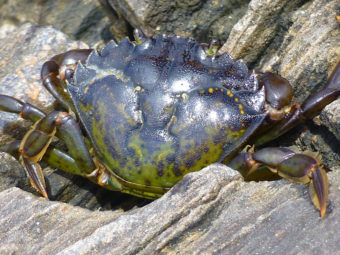
An invasive green crab that was collected in Metlakatla. Officials with Metlakatla’s Division of Fish and Wildlife are keeping the crabs alive in a refrigerator while more information is gathered. (Photo courtesy of Albert Smith).
Wildlife monitors in Metlakatla say they’ve found 13 invasive European green crabs in the waters around Annette Island — the first time they’ve been documented alive in Alaska.
Staff from the community’s Division of Fish and Wildlife have been combing the beaches and waters around Metlakatla for the five-spined crabs, which federal officials have called one of the most invasive marine species around.
On Wednesday, Metlakatla Indian Community announced they had found 10 live crabs — four late last week and six on Tuesday. Then Albert Smith, Metlakatla’s mayor, said three more crabs were caught on Thursday for a total of 13.
Spencer Guthrie, with Metlakatla Indian Community’s Division of Fish and Wildlife, works on an oyster bucket. The container will be used to catch invasive green crabs. (Photo courtesy of Albert Smith).
The crabs are largely falling into salmon traps around Tamgas Harbor.
“There’s a salmon trap that has been there for hundreds of years,” Smith explained. “And that’s kind of where they’re kind of congregating a little bit. Because it’s like a tide pool. So that’s where they’ve been catching them.”
Shrimp pots are also being set to catch the crabs, which is how staff from the Division of Fish and Wildlife caught one crab on Thursday. Another was found in an area with lots of eelgrass.
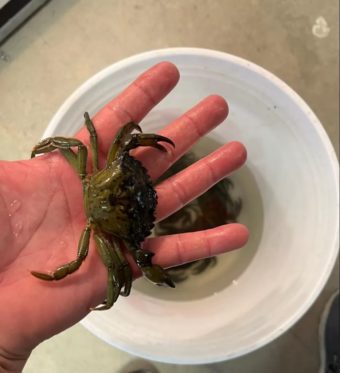
Of the 13 trapped live crabs, three are female and 10 are male. Smith said the Tribe’s scientists are preserving them alive for now for research.
“The people that are catching them are our Fish and Wildlife staff,” Smith said. “So they’re bringing them right to the office. And then we put them in a bucket of water, and then put them in the refrigerator until they can get all the data they need from them.”
In a statement, the Tribe announced that officials are working with federal and state partners to conduct genetic analysis and outreach efforts.
“It is essential that we address this matter urgently as GC (green crab) target juvenile Dungeness crab, juvenile salmon, shellfish and mollusks,” the statement read. “This species poses a real and present threat to our most critical subsistence and commercial resources.”
Smith said he’s concerned about what it means for the community’s traditional food sources.
“They go after salmon habitat and salmon fry,” he said. “Also, they go after most of all of our subsistence lifestyle.”
But at the same time, the discoveries haven’t been a total surprise.
“We’ve been watching them work their way up the coast, in the Haida Gwaii,” Smith said. “And then also over by Prince Rupert last year, which isn’t far from here.”
Invasive green crabs in a bucket of sea water. To keep the crabs alive while more information is collected, Metlakatla’s Division of Fish and Wildlife are keeping them in a bucket of cool in a refrigerator. (Photo courtesy of Albert Smith).
Smith said he’d like to avoid a situation like Washington’s experience dealing with the invasive crabs. The appearance of the species prompted Gov. Jay Inslee to issue an emergency proclamation.
For now, Metlakatla’s scientists are keeping an eye on the area and trapping the crabs. The goal of that work is to learn more about just how many might be in the area.
As for what to do with the crabs, NOAA strongly advises against releasing the invasive crabs back into the water. Smith said the community is still discussing options, but he noted that adding the crabs to the community’s garden compost pile might be a good idea.
Sightings of European green crabs can be reported to the Alaska Invasive Species Hotline at 1-877-INVASIV.
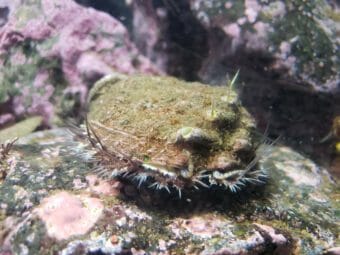
A pinto abalone rests on the rocky seafloor of Southeast Alaska. Of all abalone species found along North America’s west coast, the pinto abalone is the only one in Alaska waters. A multiagency project is examining ways to boost the depleted population. (Photo by Ashley Bolwerk/Alaska Sea Grant)
There is only one species of abalone native to Alaska waters, and a new project is underway to try to find ways to boost its depleted numbers.
An Alaska Abalone Recovery Working Group is brainstorming ideas for strengthening the state’s vulnerable population of pinto abalones, also known as Northern abalones or, to the Indigenous peoples of the region, Gunxaa and Gúlaa. The working group includes representatives from state and federal agencies, tribal governments and others, including support from Alaska Sea Grant, a program based at the University of Alaska Fairbanks that provides marine education, research and technology.
That has started with surveys of people in Southeast Alaska where pinto abalones are part of Indigenous tradition.
The reception so far has been enthusiastic, said Ashely Bolwerk, the Alaska Sea Grant fellow leading the community engagement aspect of the project.
“Everybody I talk to is really excited about abalone, so it makes it a really fun topic to focus on,” said Bolwerk, who lives in Sitka and is working on a fellowship with the National Oceanic and Atmospheric Administration.
Pinto abalones are found as far south as Baja California and as far north as Southeast Alaska, but throughout the range, numbers have been sparse and uneven, according to NOAA Fisheries. That inconsistency extends to the Alaska populations. For example, the Sitka Sound population seems to be increasing, while abalones around Prince of Wales Island are hard to find, Bolwerk said.
In Lingít, Haida and Tsimshian traditions, pinto abalones are valued for their meat — and more. They were traditionally used for trade, and their shells are material integrated in artwork.
But scarcities have left some gaps in traditional practices and knowledge, Bolwerk said.
A pinto abalone displays its oval shell. The multicolored shells, with patterns that vary, protect the abalones from predators. Pinto abalone populations have declined throughout the species range, which extends from Baja California to Southeast Alaska. (Photo provided by NOAA Fisheries)
She was introduced to the subject as an offshoot of her research work as a graduate student working on a big project studying sea otter reintroduction off British Columbia. That led to work at Prince of Wales Island and a relationship with the tribal government in Hydaburg, where community members told her about the severe declines in their cherished resource.
“There are folks in Hydaburg who don’t harvest abalone anymore because they don’t see enough at their sites and are sort of self-managing,” she said. Some say they haven’t harvested in so long that they’re forgotten how to process the meat, she said. Additionally, “There’s a whole generation of kids who can recognize abalone shells in regalia and things like that but have no idea where the animal lives or what it looks like when it’s alive.”
Pinto abalones live for 15 to 20 years and reproduce slowly and in irregular patterns, making them inherently at risk for depletion, according to NOAA. The species is classified as endangered in British Columbia and Washington state, though NOAA Fisheries in 2014 rejected petitions to grant range-wide Endangered Species Act protections.
Overharvesting by people has gotten much of the blame for the recent declines across the range. Commercial harvests have been closed in various areas, including in Alaska in 1996, though some very small-scale subsistence and personal-use harvests continue in parts of Southeast.
People are not the only abalone eaters. Sea otters have also gotten some of the blame for abalone declines. However, sea otters have an important place in the ecosystem, too, in eating creatures like sea urchins that could otherwise mow down kelp forests.
For the Alaska Abalone Recovery Working Group, the plan is for the survey element of the project to be completed in August, Bolwerk said. Results are expected to be presented to communities over the winter, she said. From there, the working group will consider potential rebuilding actions.
Possible responses include mariculture — either farming pinto abalones all the way to adulthood or a more limited project that would help restore wild populations, Bolwerk said.
Also possible are habitat improvements or changes to management of species that interact with pinto abalones. In British Columbia, for example, there is an effort to increase harvesting of sea urchins, which compete with abalones for kelp and seaweed, Bolwerk said.
Another idea is an educational campaign to raise the public profile of the multi-colored sea snails that crawl along the rocky seafloor. “Maybe some added emphasis on how important it is to local cultures and communities might help bring in more funding and create more awareness of the work that needs to be done,” Bolwerk said.
Carapaces, or shells, from invasive European green crabs found on the beaches of Annette Island this week. (Courtesy of Dustin Winter/Metlakatla Indian Community)
An invasive species that could wreak havoc on commercial and subsistence fisheries has been found in Alaska for the first time. Biologists with Metlakatla Indian Community say they found the first evidence of European green crabs on Annette Island, near the southern tip of Southeast Alaska, in mid-July.
NOAA Fisheries biologist Linda Shaw says they’re a particular threat to fellow shellfish.
“They compete with juvenile Dungeness crab. They are shellfish predators, so things like clams, they would directly eat,” she said. “And then there’s also anecdotal information from British Columbia that they predate on juvenile salmon.”
Scientists have been looking for the crabs in Alaska for years. And to their relief, they had come up empty so far. Then came a troubling find on the beaches of Annette Island: three shells.
“Well, everybody was pretty much shocked, I guess, is the best word,” Dustin Winter, the director of Metlakatla Indian Community’s Fish and Wildlife department, said in a phone interview Friday.
Winter says the find, credited to Sealaska Heritage Institute intern Natalie Bennett, is the first evidence of the invasive species’ presence in Alaska.
“On Tuesday, July 19, 2022, the MIC DFW confirmed that three shed carapaces (crab shells) from Invasive Green Crab were found on Annette Island Reserve, AK. This is the first confirmed observation of Invasive Green Crab carapaces in the State of Alaska. On July 21, 2022, five more carapaces and two fully intact juvenile carcasses were identified,” Metlakatla Indian Community said in a statement.
Metlakatla biologists started setting traps in 2020 after a shell fragment was found in Haida Gwaii, an island chain off the coast of northern British Columbia.
“It started out kind of small, but it’s turned into quite the project now,” Winter said. “We have three, sometimes four, people working every other week, setting pots and pulling pots and recording what kind of crabs they’re catching.”
Winter says that as of July 22, they still haven’t located a live specimen.
Shaw, the NOAA biologist, says the discovery means it’s time to take action.
“I think that it definitely is a reason for concern, but not any kind of panic. I think that it’s a wake up call that they are moving our way,” she said. “They are detected here now, so we need to take it seriously, but we are not in the situation — yet — that Washington state is,” Shaw said by phone on Friday.
Shaw says the crabs tend to spread with El Niño, the weather pattern characterized by higher-than-normal sea surface temperatures in the central and eastern Pacific. She says warming ocean temperatures associated with climate change also play a role.
“Warmer temperatures would allow for greater survival and reproductive timeframe,” Shaw said. “So if it’s warmer, they have more chances to reproduce, they have better growth and they have a longer season to survive in.”
So what can be done to prevent them from spreading further north? Shaw says trapping the crabs is, for now, thought to be the most effective approach.
“Enclosed bays and areas are places where we might be able to do intensive trapping to, if not eradicate, at least control them, especially in areas where you have resources at risk that are important,” Shaw said.
It’s also important to know where the crabs are, so scientists are asking the public to keep an eye out for them. Though they’re called green crabs, they’re found in a variety of colors. Shaw says they’re most identifiable by the spines on either side of their eyes.
“We like to say, ‘find the five spines,’” Shaw said. “Green crab have five spines on either side, right and left, of their eyes, and then three bumps in the middle. And those are the only crabs in Alaska right now with those characteristics.”
Officials are asking people who find green crabs in Metlakatla to bring them to the Department of Fish and Wildlife office. Sightings can also be reported in Metlaktla and elsewhere to the Alaska Invasive Species Hotline at 1-877-INVASIV.
A sea star at Bishop’s Beach. (Photo by Hope McKenney/KBBI)
Soon-to-be seven-year-old Isa Santiago splashed through a tide pool at Bishop’s Beach Friday morning. She shrieked excitedly when she spotted a dark pink sea star glued to the rocks, surrounded by dark gray and green stars.
Isa and her family made the four-and-a-half-hour drive from their home in Eagle River to tidepool during one of the lowest tides of the year in Homer. Her mom, Kyra Santiago, said she started planning the trip nine months ago.
“I looked at tide charts months in advance to be able to book Airbnb [and] make sure we got here on the lowest tide possible of the season,” she said.
Friday’s tide was especially low, at –5.3 feet, only topped by a low of -5.6 in June. Homer only sees tides this low a few times a year.
Dozens of tourists and locals headed to the tide pools on Bishop’s Beach.
Biologists like Katey Shedden say it’s a great time to see critters who live at the bottom of the ocean, where they might normally be hidden under 25 feet of water.
Shedden is an environmental educator at the Alaska Maritime National Wildlife Refuge, which put on last week’s tidepooling events.
On Friday, she led a group of bundled up kids and adults along the long, sandy beach to the intertidal zone — where the sand meets the sea — to look for critters.
The first lesson: Be aware of where you’re going and respect the fragile ecosystem.
“Our main thing we want to pay attention to is where our feet are,” Shedden told the group. “There are lots of critters like anemones and even nudibranchs and sea cucumbers that have really soft bodies that would not be able to survive if you step on them. So it’s really important to pay attention to where your feet are going.”
The colorful starfish and anemones were the biggest hits Friday. One member of the group said they even spotted an octopus.
Katey Shedden shows a crab to tidepoolers on Friday. (Photo by Hope McKenney/KBBI)
Chad and Pam Landes were visiting from Topeka, Kansas. Friday was their first time tidepooling.
“There’s no tide in Kansas,” Chad said, chuckling.
The couple was sloshing through the tide pools in tennis shoes — feet wet, but faces sporting big grins.
Chad said he liked the starfish, but didn’t want to touch any of them.
“I didn’t mess with it. I’m not as curious as my wife,” he said.
Pam, on the other hand, snapped photos of starfish and picked one up, using what Shedden called the “three-finger technique.” With her thumb, pointer and middle finger, Pam gently grabbed a star and tried to lift it from the sand.
The star resisted, she left it alone. But its neighbor was less resistant, gently releasing from the seafloor when Pam bent to pick it up.
“I’ve only seen them in aquariums,” Pam said. “To actually be walking out here and seeing it firsthand and exploring this whole area is just amazing. It’s so much fun.”
Payton Tobin talks to the Santiago Family about various sea critters. (Photo by Hope McKenney/KBBI)
Payton Tobin, a Youth Conservation Corps member, is interning with the Wildlife Refuge for the summer. He tagged along with the visitors, pointing out various sea critters and listing off facts about them.
“I’ve just been helping look around, see if I can find anything interesting to show the people, answering any questions they may have and giving some fun information about the critters,” he said.
Tobin’s studying computers at the University of Alaska Fairbanks. But he has tidepooling in his blood: his mom, Debbie Boege-Tobin, is the marine biology professor at the college in Homer.
His favorite, like many of the other adults at the event, was the somewhat rare six-rayed sea star. He said sea stars are fascinating because they can regenerate their arms and grow back from almost nothing after being attacked by a predator.
But Shedden, the environmental educator leading the outing, said while sea stars are cool, don’t overlook the barnacles.
“They’re so hardcore,” she said. “They are the toughest of the critters and they’re everywhere. “
For the first part of their lifecycles, she said, barnacles float through the water, looking for spots to anchor down. When they do, they hunker down in their little shells and send their feet out to collect food.
Barnacles are usually hidden beneath the sea in the intertidal zone or found covering rocks, pilings and buoys. Shedden said when the tide pulls back, tidepooling is a great chance to explore and see them up close.
“They’re so cool. I’m stoked on barnacles,” she said.
Isa Santiago holds a sea star while tidepooling at Bishop’s Beach in Homer on Friday. (Photo by Hope McKenney/KUCB)
For Isa Santiago and her 13-year-old brother Lucas, Friday was all about another critter altogether. Isa said she liked the pink starfish – pink is her favorite color – but it was the anemones that felt like “gooey soap” that caught her attention.
Lucas concurred.
“They’re like a big blob – or they could be small – with tentacles coming out of the top,” he said. “Sometimes, when you poke the base of it, the tentacles go back inside. But if you touch the tentacles part, you may feel a little suction, because it sticks on to you.”
Lucas said he thinks it’s “pretty cool” that when a little fish or other creature swims through the water next to an anemone, the anemone will shock it, pull it in and eat it. He said he definitely wants to go tidepooling again.
And that’s exactly what Kyra Santiago, Lucas’ mom, hoped her kids would say.
“This is great to be able to just see living creatures in their own habitat and learn the etiquette of how to treat the sea and [about] conservation efforts,” she said. “These are all the kinds of things I want our kids to be able to grow up with and see.”
Sockeye in a creek in the Wood River watershed. July 28, 2021. (Photo by Stephanie Maltarich/KDLG)
Bristol Bay’s 2022 sockeye run is now the biggest on record: 69.7 million fish have returned this summer. That surpasses the previous record of 67.7 million fish, which was set last year.
More than 3 million sockeye have swum up the Wood River to spawn in the tributaries around Lake Aleknagik, about 20 miles from Dillingham, according to the state’s counting tower on the river.
Sherol Mershon lives along the lake near the head of the river. She owns a bed and breakfast there and has hung commercial fishing nets for 45 years. She said this year’s runs are remarkable.
“They just pour by. Sometimes there’s 500 in the air, breaking the water. When it’s dead calm you can see really well,” she said. “I lay in my bed at night with the window open and I can hear them jumping, and it’s just amazing. It’s absolutely beautiful.”
The east side of Bristol Bay has seen robust sockeye returns as well. Shaelene Holstrom grew up in Naknek and returns each summer to subsistence fish.
“I have been enjoying hearing how everybody is catching and how it’s just been crazy processing and running all over the place, trying to figure out what to do with fish,” she said. “I think that’s a great feeling, cause then we know we’re getting our numbers up at the river, and that warms my heart.”
Huge commercial harvests
Bristol Bay’s commercial fleet hauled in the most fish on record this year. Fishermen in the Nushagak, one of the bay’s five commercial districts, harvested more than 2 million sockeye in one day this season.
William P. Johnson just finished his sixty-second year as a boat captain. He grew up set net fishing near Igushik in the 1940s with his family. After more than six decades of fishing, he wasn’t phased by the large returns this season.
“Our goal was to get at least 100,000 [pounds]. We exceeded that, and so we came home after our last delivery on [July] 12th,” he said.
For thousands of years, Yup’ik, Alutiiq and Dena’ina peoples have presided over Bristol Bay. The commercial fishery began in 1884, as outsiders came to the region and built canneries. The federal government managed the fishery until the state took over in 1960.
Johnson believes that change was an improvement.
“I think the local control by our local Fish and Game department has a lot to do with the improvement of the resource that we participate in,” he said.
Johnson, who also fishes for subsistence, said the large sockeye runs haven’t changed how much food he and his family put away for winter.
“There has never been any problem for us in getting our fish,” he said. “But one thing that has been impacted is that king salmon seem to have declined.”
As sockeye abound, chinook and chum runs decline
While sockeye have returned in droves, chinook and chum salmon runs have dropped. Scientists don’t know why that is, either.
Dan Schindler is a professor of aquatic and fisheries sciences at the University of Washington. He’s studied sockeye on the west side of Bristol Bay for decades and says the exact reasons for why the bay’s sockeye runs are so huge will probably always remain a mystery.
“In terms of what the mechanism is, it’s really hard to really pinpoint that,” he said. “What we have is correlations. And the correlations are that when we’ve had really warm — to hot, even — eastern Bering Sea sea surface temperatures, Bristol Bay sockeye have done really well. And other species in the region haven’t,” he said.
There are slight differences in how these fish behave.
“We know they eat slightly different things in the ocean. They migrate to the ocean at slightly different times during the season. They probably have slightly different behaviors in the ocean,” Schindler said. “All of those things are making chinook and chums vulnerable to something that sockeye aren’t – at least sockeye that are returning to Bristol Bay.”
Of course, this isn’t the case for sockeye returning to rivers in other parts of the state. Runs to tributaries along the Gulf of Alaska have performed poorly over the past decade.
“I suspect it’s something to do with ocean temperatures causing some change in the food web — that smolts leaving the west side of Bristol Bay are hitting really excellent conditions for survival, whereas smolts leaving places like Chignik and the Copper River are hitting ocean conditions that have been really poor for smolt survival,” he said.
Warming oceans and lakes coincide with big Bristol Bay returns
River systems on the west side of Bristol Bay have seen an especially large sockeye boom over the past few years.
“All the way up along the western north side of Bristol Bay all the way to the Kuskokwim. So something anomalous has happened here. And it has coincided with some of the warmest ocean temperatures ever observed in the eastern Bering Sea and in the Gulf of Alaska,” Schindler said.
Warming waters at the spawning grounds likely also affect their growth, Schindler said.
“As the lakes have warmed up, we see more plankton in the lakes, and of course the plankton are the food for juvenile sockeye,” he said. “So over the last 60 years, we actually see that juvenile sockeye are growing much faster now than they were 30 or 40 years ago, which means they’re leaving for the ocean as bigger smolts. And presumably, that has something to do with their higher survival rates in the ocean.”
The sockeye runs now returning to Bristol Bay may be the largest of the past several hundreds of years. Schindler and other scientists have attempted to reconstruct how big the bay’s runs were hundreds of years ago.
“Salmon coming back from the ocean bring back a distinctive marine nitrogen signature, which we’ve used to reconstruct how many sockeye were spawning in places like the Word River and the Kvichak and throughout the Togiak refuge over the last thousand years or so,” he said.
This is called paleolimnology, where researchers take the mud out of the bottom of lakes and scan that sediment for an isotope, Nitrogen-15. Schindler said even with commercial exploitation of the sockeye populations, the recent runs have returned at historically high rates.
“If you add up the catch and escapement that we’ve observed in the last 25 or 30 years, the sum of those two numbers appears to be higher than the number of fish that ever returned to these lakes in the last 500 to 1,000 years,” he said. “And while that might seem surprising, it really does support what we’ve seen with our real time data over the last 50 or 60 years that climate warming has actually made these lakes more productive than they were 100, 200, and 300 and longer — 400 years in the past.”
The total run is now 69.7 million sockeye, but the season isn’t over yet. Fish and Game forecast a run of 75 million fish, but it could go as high as 90 million this summer.
Mackenzie Mancuso conducted an interview with Shaelene Holstrom which was used in this story.
Jon Moore (left), professor at Simon Fraser University, and Mark Connor (right), Fisheries Coordinator for the Taku River Tlingit First Nation, stand on the banks of the Tulsequah River, which flows past the Tulsequah Chief and New Polaris Mines. (Photo courtesy of Chris Sergeant)
A new study shows that mines can have impacts on watersheds hundreds of miles downstream and years into the future. The paper’s authors say their analysis points to a need for more comprehensive risk consideration for mines to protect salmon watersheds throughout the Northwest.
There are thousands of coal and metal mines — both active and inactive — scattered throughout northwestern North America. A study published earlier this month in the journal Science Advances found a consistent pattern of harm to salmon habitat and watersheds from some of those mines.
“It is basically a smoking gun,” said Guy Archibald, the executive director of the Southeast Alaska Indigenous Transboundary Commission, a coalition of 15 tribal governments advocating for protections for watersheds shared by Alaska and British Columbia in Canada as well as tribal representation in the decision-making process for B.C. mines. He says the study is groundbreaking.
“We have observed for decades that mines in watersheds occur, and then salmon populations are harmed,” Archibald said. “But there’s never been a direct connection made between the mining activities and the harm to the salmon. This paper goes a long way to showing that.”
“I think that’s one of the things that’s really unique about this paper,” said study co-author Jonathan Moore, a salmon ecosystems scientist and professor at Simon Fraser University in Vancouver, British Columbia. “It brings together the state-of-the-art science about how these really complicated and changing river systems work with state-of-the-art mining understanding and how it’s regulated.”
Moore says the paper isn’t arguing against mining.
“What it is,” he said, “is arguing for the incorporation of best available science to guide mining, so it can be more sustainable.”
The study’s lead author, Chris Sergeant, is a research scientist with the University of Montana’s Flathead Lake Biological Station. He says the interplay of mining effects on salmon watersheds is compelling in part because it’s so complex.
“You need engineers, biologists, hydrologists, governance and policy people,” Sergeant said. “They all play a role in the mining world and how mines could potentially impact salmon — and in such an important place, like northwest North America, including Southeast Alaska, it’s one of the last best places for fish in the world.”
Sergeant says there’s no one-stop-shop for mining data, so they had to pull from a variety of sources — U.S. Geological Survey databases, data from mining industry resources, government agencies and academic literature. Study authors found numerous examples of mines having negative impacts on watersheds, even long after they were closed.
“We point out a river in the Coeur d’Alene watershed in Idaho, where even seventy years after mining had ended, the pollution that maintained because of that work continues to depress the populations of fish and aquatic insects in that stretch of river,” Sergeant said.
It can be a similar story hundreds of miles away from mines and across international borders.
“In the Elk Valley watershed in southern B.C. that flows in the Kootenay River, through Montana and Idaho back into B.C., there’s selenium pollution from coal mines that’s 250 kilometers downstream,” Sergeant said. “And that wasn’t really envisioned before those mines were built.”
Whether or not mines and watersheds straddle borders, Sergeant also notes that mines are being proposed and built in more extreme environments — on mountains, across glaciers — as easy-to-reach areas are already tapped.
“You’ve got these feats of engineering to build mines in places where there are no roads or many humans at all,” Sergeant says, “And then on top of that, you’ve got climate change coming down the pike, where we’re getting more intense rain events, more landslides, more flooding, more drought.”
That puts additional, hard-to-predict pressures on the mine infrastructure. And extreme climate events are happening more and more frequently, says another co-author Nikki Skuce. She’s the director of the Northern Confluence Initiative and serves as co-chair of B.C. Mining Law Reform Network, a consortium of academics and community organizers pushing for changes to mining law in the province.
“We were hit with a heat dome, atmospheric rivers, catastrophic flooding, all within a six-month timeframe last year,” Skuce said. “There really needs to be a step up in the environmental assessment process for projects as well as for existing infrastructure like tailings dams to look at these climate risks.”
Tailings dams are earthen structures used to contain solid or liquid mining waste.
Sergeant says a prime example of unanticipated climate impact is the Red Dog Mine in Western Alaska, which was built in 1989.
“Because of unforeseen permafrost thaw, their water treatment facilities and their open pits are getting overwhelmed with more water than was ever envisioned,” Sergeant explains, “And that’s within a few decades of the project starting. Those are the kind of concerns — if we’re building these bigger and bigger mine projects, [taking into account the changing climate,] can we even do the engineering correctly?”
He points out that mines are critical for the transition to a low-carbon future. Copper and other minerals are essential parts of batteries for electric cars and other low-carbon alternatives.
“But this decision to build a large mine is going to impact the land for decades to centuries. And that needs to be thought about really carefully,” he said.
Moore says that the two-year process of putting together the study also exposed what he calls some “really massive black holes” in our understanding of the extent and impact of mining.
“Mining companies and other industries, at least in Canada, don’t necessarily need to share their data. It’s proprietary,” Moore said. “So the information that underpins their environmental assessments, underpins their monitoring, not all of it sees the light of day. I think that’s a real key challenge in terms of trying to assess the true risks of these projects.”
For study authors, the data point to a need for better transparency, more consideration of the cumulative effects of mines, and of the complex environmental stressors that could impact mines and watersheds due to the changing climate.
“I think we hope that this paper can be a resource that helps people make decisions in these landscapes,” Moore says, “To help people understand what might be at stake and what can be done about it, where policies might need to be improved, where science can be done better, where we need to think about who’s part of these conversations.”
From her side of the border, Skuce says she and B.C. Mining Law Reform are pushing to improve Canadian tailings dam safety standards and water management, in part by closing loopholes in the environmental assessment process that allows mining permits to be amended.
“If they don’t talk to the downstream communities, if they don’t learn how these communities utilize the resource (salmon) and depend on the resource, then basically they’re making a decision without any information,” Archibald said. “That’s no way to manage a mine and a habitat.”
Mining Association of B.C., a mining industry group, did not respond to a request for comment.
Close
Update notification options
Subscribe to notifications
Subscribe
Get notifications about news related to the topics you care about. You can unsubscribe anytime.