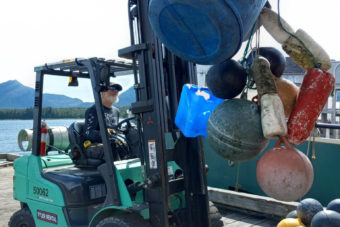
John Boyd of the state Department of Fish and Game works a forklift to move collected buoys into an AML shipping container on Wednesday. (Photo by Raegan Miller/KRBD).
Nearly six tons of marine debris collected from a remote island were offloaded in Ketchikan last week. The debris is bound for recycling in Seattle, but researchers hope it could also shed light on the kinds of garbage that find their way into the ocean.
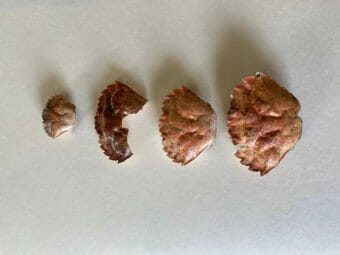
Crews hauled enormous cloth bags full of garbage off of the F/V Polar Lady on Wednesday — 11,500 pounds in all. It all came from Forrester Island.
That’s an uninhabited islet 40 or so miles southwest of Prince of Wales Island, known as Gaskuu in the Haida language.
Kit Cunningham is a technician with the state department of Fish and Game’s marine mammal program and a graduate student at the University of Alaska Fairbanks. She’s studying the garbage as part of a research project for her thesis.
“I want to know where the debris is coming from and how long it’s been in the water,” Cunningham said. “And one way we’re kind of looking into that is if there’s any growth on the marine debris.”
That growth is known as biofouling. Things like algae, barnacles and the like can offer clues about the origin of the marine debris that washes ashore.
“There’s always been quite a bit of trash and marine debris out there, so it was kind of the perfect candidate,” she said.
Working in shifts, Cunningham and two crews spent just over a month picking up trash on the island. The work was funded by a National Oceanic and Atmospheric Administration grant program.
But why does so much debris pile up on this particular island in the North Pacific? Cunningham said the location may have something to do with it.
“It’s something that I’m still learning about right now, but I would guess that since it’s along the continental shelf, a lot of currents go through there — there’s actually some really cool photos of storms rolling in,” she explained. “And Forrester, Gaskuu, it’s actually the first thing they hit. So, I think just a lot of currents and storms, it’s just a perfect catching spot.”
Alaska General Seafoods provided two tenders and a skiff for the removal work. Alaska Marine Lines provided two, forty-foot-long shipping containers to transfer the garbage to Seattle.
Among the debris were a few glass buoys and bottles — one even had a note inside.
“It was pretty wild,” she said. “It was actually someone writing to a loved one who had passed, and just expressing a lot of love and appreciation for that person.”
But perhaps more interesting to Cunningham are the plastics: mostly old buoys, bottles and plastic foam.
She said her research into the debris could last into next summer, and she’ll try to determine what kinds of plastics were most common on the island.
But she’s not just studying the trash. While she was on the island, Cunningham collected the vomit samples from sea birds and fecal samples from Steller sea lions. She’ll be sending those to a professor to see if there are any microplastics in the animal’s diets.
If there are, she wants to learn if it’s the same kind of plastic found on the island. She’s expecting results later this year.
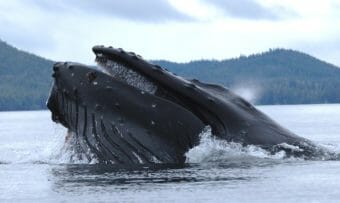
A humpback whale strains krill in the waters of Southeast Alaska. Most of the documented cases of large whales entangled in fishing gear in 2020 and 2019 — in Alaska and in the nation — involved humpback whales, according to the National Marine Fisheries Service. Most Alaska cases occurred in Southeast, according to NMFS. (Photo provided by NOAA)
Alaska was the only U.S. coastal region to have an increase in the confirmed cases of large whales entangled in fishing gear in 2020, a contrast to a national trend of declining cases over the past six to eight years, according to a report issued Tuesday by the National Oceanic and Atmospheric Administration.
Of the 53 cases of large whales entangled in fishing gear nationally in 2020, 11 occurred in Alaska, according to the report, from NOAA’s National Marine Fisheries Service. The previous year, there were 75 confirmed cases of whale entanglements nationwide, with nine of them occurring in Alaska, according to a separate report for 2019 also released Tuesday by the fisheries service.
The vast majority of confirmed Alaska whale entanglements — and the vast majority of entanglements nationally — involved humpback whales. In 2020, 10 of the Alaska cases involved live whales, and eight of those involved humpback whales. All but one of the confirmed Alaska entanglements of live large whales in 2020 occurred in waters of Southeast Alaska, according to the report.
An entangled humpback whale swims near Tenakee in Southeast Alaska, on Nov. 25, 2020. An assessment was conducted that day and a response launched the following day, which was Thanksgiving, disentangled the whale. This humpback is a known whale that swims near Tenakee annually. It was seen the following year, free from fishing gear but still bearing scars. (Photo by Gordon Chew/Steve Lewis, provided by NOAA Fisheries)
Humpback whales are relatively plentiful among the large whale species, the report for 2020 notes. “Humpback whales are found in all the world’s oceans and several populations have rebounded in recent years, so the frequency of entanglements seen in this species could be due to many factors, such as the increasing number of whales, a high degree of overlap in distribution of whales, growing coastal communities, and fishing effort, or a combination of these or additional factors,” it said.
The Central North Pacific stock of humpback whales, which accounts for most of the humpback whales found in Alaska waters, now numbers over 21,000, rebounding from a low of 1,400 in 1966, according to the Alaska Department of Fish and Game.
The 2020 entanglement statistics might be skewed by the COVID-19 pandemic, the report cautioned. There were fewer fishing vessels operating that year, but there were also fewer people on the water to observe and report entanglements, the report said.
]In general, the reported statistics are likely an understatement of the risks that large whales face from encounters with fishing gear, which can kill the animals or cause serious injuries such as amputations, the report for 2020 said. “Importantly, confirmed entanglements underestimate the true number of entangled whales, as many entangled whales go undetected,” it said.
One environmental group said the report showed the need for better protections.
“These reports show far too many endangered whales are caught in fishing gear, particularly because reported entanglements are just the tip of the iceberg,” Kristen Monsell of the Center for Biological Diversity said in a statement. “We need a swift transition to ropeless or pop-up fishing gear starting in our national marine sanctuaries, which fail woefully to protect these majestic animals. The Fisheries Service should push hard and help the fishing industry adopt whale-friendly gear.”
The 98-foot Pacific Sounder hailed a MAYDAY call at 10:43 Friday morning, but the crew waited three hours before they were rescued. Eventually, the Good Samaritan boat, the Polar Sea, arrived and found the crew unharmed. (U.S. Coast Guard photo)
A 98-foot fishing boat ran aground in the Eastern Aleutians on June 17 will be scuttled.
Four people were on board the F/V Pacific Sounder when it got stuck along the western shore of Unimak Island, between Unalaska and the Alaska Peninsula.
The Pacific Sounder hailed a mayday call at 10:43 Friday morning, but the crew waited three hours before they were rescued. Eventually a good Samaritan boat, the Polar Sea, arrived and found the crew unharmed.
“They were still on the boat when they ran aground,” said Nate Littlejohn, a spokesperson for the U.S. Coast Guard. “By the time the Polar Sea arrived on scene, they were wearing their survival suits.”
Littlejohn says the boat owner has hired Resolve Marine, a salvage and wreck removal company out of Dutch Harbor, to recover the boat. The first thing they will do is make sure the diesel on board doesn’t spill into the ocean. And there’s a lot of it: 21,000 gallons, to be exact.
“We sent out a Coast Guard helicopter crew Saturday who did not observe any pollution,” Littlejohn said. “That’s not to say there hasn’t been any diesel that has escaped, but we don’t know of any at this time.”
Resolve said the Pacific Sounder is too stuck for them to be able to tow it. Instead, they’ll have to scuttle it. In other words, they’ll sink it, and Littlejohn said he doesn’t know how long that will take.
“It cannot be understated how complex this operation is,” Littlejohn said, “and to make a prediction about how long it’s going to take is just not a good idea. It’s just very unpredictable how long it’ll take based on the weather.”
No reason has been given for what caused the boat to run aground. The Coast Guard is investigating.
A bowhead whale and calf are seen swimming in an open-water lead the Arctic Ocean in this undated photo. A new study appears to be the first to document the presence of PFAS compounds, known as “forever chemicals,” in body tissues of bowhead whales. (Photo provided by the National Oceanic and Atmospheric Administration)
Chemicals from fire retardants and other materials have accumulated in the bodies of seals, whales and other animals of the northern Bering Sea, showing that pollutants emitted thousands of miles away continue to contaminate animals on which Indigenous people depend for food, according to a newly published study.
The study, published in the journal Environmental Science and Pollution Research, focuses on marine mammals and reindeer harvested by the Yup’ik residents of St. Lawrence Island, at the southern end of the Bering Strait.
Through samples donated by hunters, researchers – who included island residents themselves – found varying levels of polybrominated diphenyl ethers (PBDEs) and per- and polyfuoroalkyl substances (PFAS) in marine mammals and reindeer on or around the island.
PBDEs are a class of compounds used as flame retardants. PFAS compounds are also used for that purpose but are found in a wide variety of consumer products such as cosmetics, clothing and cookware; they are known as “forever chemicals” because they do not break down in the environment. PBDEs have been phased out in the United States since 2004, but there is no national PFAS ban.
The study of subsistence foods at St. Lawrence Island shows how contaminants carried to the far north by atmospheric and ocean currents persist for years and sometimes decades, burdening the region’s Indigenous people.
Pam Miller, executive director of Alaska Community Action on Toxics, and Vi Waghiyi, the organization’s environmental health and justice program director, hold up a photo of the late Annie Alowi, a health aide from the St. Lawrence Island community of Savoonga who spurred studies of contaminants from local and long-range pollutants. Miller and Waghiyi are co-authors of a study that examined contaminants found in marine mammals and reindeer that the Yup’ik people of St. Lawrence Island hunt for traditional foods. Waghiyi is also from Savoonga. (Photo by Yereth Rosen/Alaska Beacon)
“We are being contaminated against our will,” said study co-author Vi Waghiyi, who is from Savoonga, one of the two villages on the island.
Still, the findings should not deter people from conducting their harvests of negepik, or traditional foods, said Waghiyi, the environmental health and justice program director at Alaska Community Action on Toxics, a nonprofit environmental health organization based in Anchorage.
“Our people still feel the benefits outweigh the risks. It is our identity,” she said. “We’re intricately tied to our lands and waters and wildlife that have sustained our people since time immemorial.”
The St. Lawrence Island findings are, in some ways, similar to those of other studies of contaminants in animals around the Arctic.
There were some new discoveries, however. The study appears to be the first to document PFAS compounds in bowhead whales, with traces showing up in mangtak – the name for skin-attached blubber – and blubber alone and muscle.
It also found that of all tested species, seals generally had the highest levels of PBDEs. That shows how persistent those chemicals are in the environment, said Pam Miller, ACAT’s executive director.
“Even though they’ve been subject to some global regulation and regulation in the U.S., they’re still very ubiquitous in the Arctic and still prevalent in people and wildlife that people depend on for traditional foods,” said Miller, another co-author.
The study, which used tissue samples provided by local hunters, is the latest in a series in a research program conducted by ACAT and its partners. The program traces back to the advocacy of Annie Alowa, a former health aide in Savoonga, who pushed for cleanup of military pollution on the island after watching so many villagers get cancer and other health problems. Much of the inspiration for ACAT’s founding and its continued work; she died of cancer herself in 1999.
Walrus meat dries on a rack in Gambell, one of the two communities on St. Lawrence Island, in 2005. Walruses were among the animals tested in a study that traced persistent pollutants in the Bering Sea environment. (Photo provided by the Alaska Division of Community and Regional Affairs)
The research program is notable for its community focus and reliance on local leadership and knowledge, said Waghiyi, who was named last year to a White House advisory council on environmental justice. “It’s one of the few where we’re not just research subjects,” she said.
While this newly published study focuses on pollutants that are carried long distances in the air and in the ocean, other work in the program is continuing to examine the effects of pollution from Northeast Cape, a military site closed in the 1970s, and other on-island sites.
St. Lawrence Island gets pollution from both faraway and local sources, and it is possible to distinguish between the two, said study lead author Sam Byrne, an assistant professor of biological and global health at Middlebury College.
Proximity to military sites and places like landfills is one distinguishing factor, he said. The types of chemicals discovered is another factor, as lighter compounds are more volatile and can be more easily carried by the winds, while heavier compounds such as some of the PCBs found near Northeast Cape, tend to not travel far.
A Bering Sea bearded seal displays its distinctive whiskers. A study of animals hunted by St. Lawrence Island’s Indigenous people found that the highest levels of flame-retardant chemicals were generally in seals. (Photo provided by NOAA)
The problems go beyond emissions of dangerous chemicals, Waghiyi and Miller said. Melt of sea ice and glacier ice, thaw of permafrost and the proliferation of microplastics in the ocean is also spreading contamination, some of what had previously been sequestered in frozen states, they said.
“The convergence of climate, chemicals and plastics has not been fully appreciated by the scientific community or climate-justice activists,” Miller said.
The eight-nation Arctic Council is one organization that has made the connection between climate change and persistent organic pollutants, known as POPs.
A report issued at a meeting last year of high-level officials from council nations showed how climate change has eroded some of the progress made since the mid-1990s by international bans and phaseouts of dangerous chemicals. In some places of the Arctic, the report said, POPs are even increasing in concentration after earlier declines.
Corals seen at the bottom of the ocean near Kodiak Island. (Photo courtesy of Oceana)
A group of researchers is hoping that data collected from the Gulf of Alaska’s sea floor will shed new light on the effects of bottom trawling.
Scientists from the conservation group Oceana, which is based in Juneau, spent eight days aboard a research vessel circumnavigating the Kodiak archipelago late May. Jon Warrenchuck is a senior scientist and fisheries campaign manager with Oceana.
“The Gulf of Alaska is a very special place and a very productive ecosystem,” Warrenchuck said. “Our timing of our survey here in the spring means we saw just an abundance of life, from the phytoplankton to the fish to the birds feeding at the surface.”
The focus of the trip, though, was to document life at the very bottom of the sea to better understand the impacts of commercial trawling, Warrenchuck said.
The group surveyed 23 locations during the trip. Warrenchuck said they sent cameras and remotely operated vehicles down to depths more than a thousand feet deep at some sites, and photographed areas of the seafloor that had never been seen before.
“We chose sites to explore that were both open and closed to bottom trawling and we did see differences between those types of sites,” Warrenchuck said.
Researchers documented coral gardens and groves of sea whips, but the group also saw evidence of heavy damage to the ocean floor, including areas of crushed coral where commercial trawling is permitted. Warrenchuck said they don’t know what those areas of the sea floor looked like before trawlers arrived. But Oceana scientists plan to submit their observations to the North Pacific Fisheries Management Council and the National Marine Fisheries Service — they’re in the midst of an essential fish habitat management review process that’s completed every five years for the area.
Warrenchuck hopes the photos and videos from the waters off Kodiak will help make the case to keep trawlers out of some areas of the ocean.
“So much of the ocean has remained unexplored that any information we gather on seafloor habitat characterization, locations of sensitive habitat that will only help us make better fishery management decisions going forward,” he said.
The essential fish habitat summary report is slated to come out in October, according to the North Pacific Fishery Management Council’s website.
“Old Timer” may be the oldest known humpback, first sighted Lynn Canal, Southeast Alaska 1972. Also sighted as PWF-NP1117 and HIHWNMS-2017-2-25WWG01A01 (Photo by Jim Nahmens, courtesy of Happy Whale)
It’s a special moment, watching a gigantic humpback going for a deep dive. The whale’s back arches and the tail swings up, disappearing below the surface like the pointed toes of an Olympic diver.
The black-and-white patterns on the underside of a whale’s tail fins, or flukes, are unique. Now a citizen science program called Happy Whale uses artificial intelligence to quickly identify humpbacks from those patterns.
Through photographs shared by whale watchers, Happy Whale has recorded thousands of whales that travel to and from Alaska.
“Like facial recognition, we can tell who it is,” said Ted Cheeseman, an expedition scientist who has studied whales all over the world, including in Antarctica. He co-founded Happy Whale as a way to track humpbacks, a species that’s known to travel thousands of miles.
It’s helping to answer a lot of questions about their individual behavior.
“Who does the whale hang out with? Does the whale have a calf?” Cheeseman said. “What is the larger story here such that we can build family relationships and so on, tell more of the story of the individual. To me, that’s a huge part of this.”
The difference between this photo ID program and others in the past is the manpower needed. Happy Whale uses an automated computer program to ID the photos instead of people doing it by hand. Just one full-time and two part-time employees run the database and confirm the results.
The program started in 2015 but took years to test and fine tune. Now, whale watchers can share their fluke photos and locations to the online database, which has identified 68,000 humpbacks worldwide.
The program started with 18,000 whale photos that had been previously identified by hand. Cheeseman says Happy Whale is more efficient.
“Somebody gives me a dataset of a thousand photos, it used to be that that would be an hour per photo,” Cheeseman said. “The actual matching time is now insignificant. If someone gives me a thousand photos I can tell them the next day that, ‘Oh, 700 of them are these known whales and these 300, those are probably new.'”
The program has documented about 30,000 humpbacks in the North Pacific, which Cheeseman expects is about 70% of the population.
Participants are rewarded for their work. They usually get an initial response within a few days to a week and get notices when their whale is spotted again.
Dennis Rogers, a long-time whale watching guide in Petersburg, has uploaded over 5,500 photos to the program.
“It’s very interesting just to see the migrations,” Rogers said. “Some of these whales go to Hawaii for the winter, and they’re re-sighted there, which we get a notification when that re-sighting happens. Some of our whales go to Mexico. It’s real interesting, some of our whales go to Mexico one year and to Hawaii the next year.”
Rogers encourages his clients to send in their photos as well. He says other tracking systems, including satellite tags, can fall off whales within days.
“This is purely un-invasive and gives a great amount of information over time. Some of our whales, we’ve been tracking close to 40 years,” Rogers said.
The program has found some unusual migrations in Alaska’s individual whales, said Scott Roberge, a board member for Petersburg’s Marine Mammal Center.
“They’ve followed one from Alaska to Hawaii to Japan back to Alaska,” Roberge said. “Made the loop of the North Pacific.”
Roberge also contributes photographs and enjoys getting the feedback.
“It’s incredible to get that information and to get the email that says, ‘Oh, the whale that you took a picture of last summer was just found in Hawaii, and it just had a baby,” he said.
Cheeseman believes that over 95% of humpbacks in Southeast Alaska are in the database already. But the program is expanding. Cheeseman hopes to automate dorsal fin recognition within the year, which would allow them to identify and track orcas and other species a lot faster.
Cheeseman gave a presentation in Petersburg on May 18 at the Wright Auditorium.
Close
Update notification options
Subscribe to notifications
Subscribe
Get notifications about news related to the topics you care about. You can unsubscribe anytime.