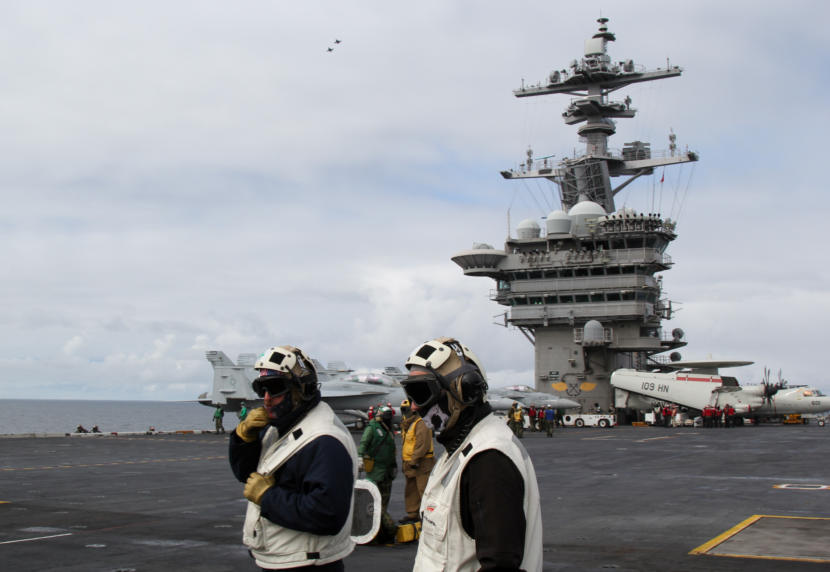
Crew members handling fighter jets as they take off and land onboard the USS Theodore Roosevelt during exercises in the Gulf of Alaska during Northern Edge 2019 (Photo by Zachariah Hughes/Alaska Public Media)
Public comment ends Monday for a U.S. Navy proposal to greatly expand the area its ships are allowed to use for a war games exercise next summer in the Gulf of Alaska.
Northern Edge is a biennial, large-scale training exercise that involves the Air Force, Army and Marine Corps, as well as the Navy, which says it needs more room.
In the past, the Navy has worked within a 55,000 square mile zone east of Kodiak and south of Prince William Sound. But for 2023, it wants to add 246,000 square miles, stretching west to a point south of Dutch Harbor.
Critics of Northern Edge include coastal Alaska city councils, commercial fishers and environmental and Alaska Native groups. They say such a massive exercise — often conducted in May, with live munitions and active sonar — disrupts fish and marine mammals during a critical time, as they’re migrating and breeding in the Gulf of Alaska.
The Navy disputes that its activities harm fish and marine mammals, saying it takes steps to mitigate negative impacts. Unlike its existing zone, the Navy would not conduct live-fire training or use active sonar in the new area.
A supplemental environmental impact statement is available for review and public comment. The comment period is open until 11:59 p.m. Monday, May 2.
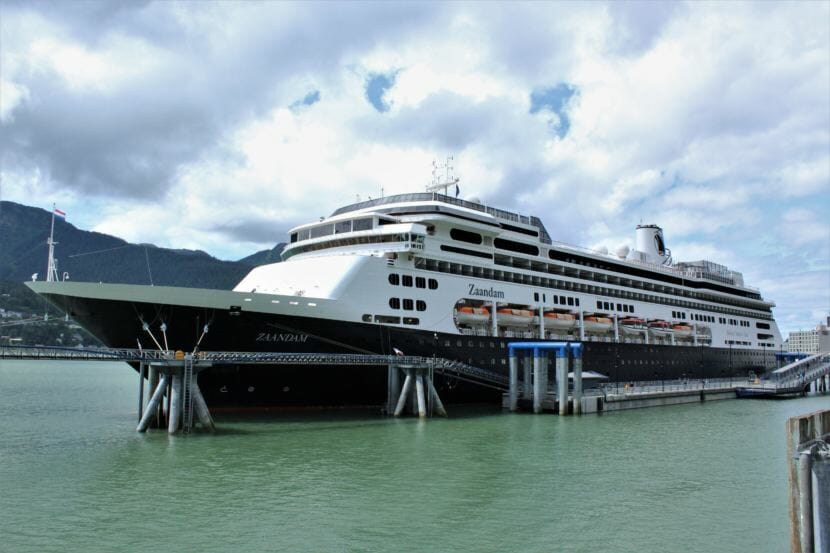
The Holland America cruise ship Zaandam docked in Juneau on June 22, 2018. (Photo by Adelyn Baxter/KTOO)
Cruise ships are now returning to Alaska for the first full-length season since the pandemic. It’s a relief for coastal port economies whose visitor sector has struggled.
For the past several years there’s been a debate among regulators over what to do about a controversial anti-air pollution device called scrubbers. Scrubbers dissolve chemicals from ships’ exhaust into seawater, allowing them to burn cheaper, dirtier fuels.
A two-year CoastAlaska investigation uncovered dozens of reports from independent cruise ship monitors alerting state authorities to foamy discharges from the kind of scrubber systems used by ships owned by Carnival Corp. and its subsidiaries, which make up a large portion of the Alaska cruise ship fleet.
State and federal authorities didn’t take steps to curb the emissions. State environmental regulators in Alaska say they don’t regulate scrubber discharges. Meanwhile, a federal law meant to protect the owners of small fishing boats from massive fines has, in practice, prevented state officials on much of the West Coast from clamping down on water pollution from scrubbers aboard cruise ships.
Critics say it’s a weakness in environmental regulations that for years has allowed the cruise industry to pollute Alaska’s waters.
‘Air pollution to water pollution’
The devices — which are formally called exhaust gas cleaning systems — are commonly known as scrubbers because they use seawater to “scrub” sulfur from an engine’s exhaust. They’re required by the International Maritime Organization, which has mandated lower sulfur emissions in the atmosphere. Regulators say sulfur emissions are harmful to human health and a major driver of acid rain.
For the cruise industry, scrubbers are a way to save money by allowing ships to burn cheaper, dirtier fuels. But the toxic chemicals removed from smokestack exhaust don’t just disappear.
A video shot from the deck of the Holland America Line cruise ship Amsterdam in the summer of 2019 captured a churning and bubbling of water spewing from the ship’s starboard side. By 7 a.m. — about 1 minute 22 seconds into the video — what appears to be a sea lion swims through the oily water.
Former Ocean Ranger Robert Layko was on a different ship that day. But he says he saw these kinds of oily discharges all the time.
“If they were running their open-loop scrubbers in port, you could see a sheen — black, like soot — on the side of the ship where their discharge was coming out,” Layko said.
The Ocean Rangers were an independent monitoring program unique to Alaska. And for years they tracked all manner of pollution and reported them to the ship’s deck officers and state regulators.
The Ocean Ranger that summer morning in Hoonah logged a report with state regulators. It sat in a file until it was turned over in a records request to CoastAlaska that included the June 22, 2019 video, which said the sheen was likely generated by the Amsterdam’s scrubbers.
“We’re supposed to report any pollution incident we see,” Layko said, who spent eight seasons as an Ocean Ranger. “When I was on the ships, I would tell them that I’m going to report those because it’s my job and it’s pollution to me, and they say their scrubbers are all in compliance.”
Some scrubbers run a closed-loop system. The washwater gets heavily filtered, leaving a thick sludge that’s sent to landfills in the Lower 48.
But in the open-loop systems used by Carnival, Holland America and Princess ships, there’s no sludge to be hauled away at the end of a voyage. The seawater used to dissolve sulfur, arsenic and other potentially harmful contaminants goes right back overboard.
Shipping industry critics say scrubbers have allowed the shipping industry to skirt regulations by exchanging one form of pollution for another.
“What would normally be emitted as air pollution and dispersed in the atmosphere is now being concentrated and dumped directly overboard,” said Bryan Comer, a maritime expert with the International Council on Clean Transportation in Washington D.C. who has written about open loop scrubbers.
Congress preempts states from scrubber regulation
Layko reported the oily sheens he saw to the Alaska Department of Environmental Conservation. But there’s little states can do to control discharges from exhaust scrubbers.
That’s because states like Alaska lost much of their authority to regulate scrubber discharge through an act of Congress. Alaska’s delegation were champions of legislation called the Vessel Incidental Discharge Act.
Sen. Lisa Murkowski (R-Alaska) says it was over concerns for the commercial and charter fishing fleet.
“What we really set out to do with VIDA was to address the incidental discharge off of fishing vessels,” Murkowksi told CoastAlaska in 2019.
She says her office got involved to protect the skippers of fishing boats from fines under the Clean Water Act. When deckhands spray down their boats, sometimes the water that washes overboard includes some oily residue.
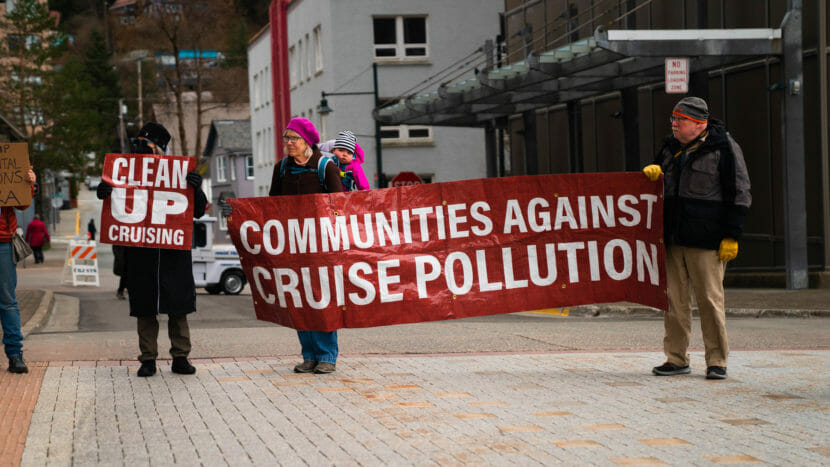
A small group of environmental demonstrators gather near the Capitol in downtown Juneau on April 26, 2022 to protest pollution from large cruise ships. (Photo by Paige Sparks/KTOO)
But some state regulators say the 2018 law’s definition of “incidental” goes far beyond small fishing boats and cripples the ability of state water quality monitors to regulate ships the size of office buildings that discharge hundreds of thousands of gallons of scrubber water every hour.
Washington State Department of Ecology’s Amy Jankowiak, a supervisor in its water quality section, told CoastAlaska there’s specific language in the law “that preempts states from regulating quite a few of the different types of discharge types coming off of vessels.”
But the law’s passage was just the first step in a complex process. The EPA now has to write the regulations that say exactly how and when scrubbers can discharge in U.S. waters, which fall to the U.S. Coast Guard to enforce. But today, four years after the law was passed, it has yet to do so as the regulations remain to be finalized.
Jankowiak says Washington’s Ecology Department has done its own research into scrubber discharges. Not only were they acidic — which can harm sea life — state scientists also found a host of contaminants.
“Polycyclic aromatic hydrocarbons, or PAHs, were significantly high,” she said, “and toxics including some metals, arsenic, cadmium, copper, nickels, selenium, zinc — all were higher than our water quality criteria.”
“We believe that there are enough concerns for the water for water quality, not just in our waters, but in other states’ waters,” Jankowiak said.
Alaska state regulators mum on scrubbers
Alaska state regulators have attended listening sessions on the debate over scrubbers in U.S. waters, EPA records show. But DEC officials have declined to wade into the debate themselves. The state of Alaska’s cruise ship program has a public-facing website that explains the technical aspects and notes that it’s up to the EPA to regulate scrubbers.
“The department has not taken any regulatory action regarding scrubbers,” DEC spokeswoman Laura Achee wrote in an email.
SPAR officials say they logged 24 scrubber discharge reports in 2017, 38 reports in 2018 and 18 reports in 2019. No further action was taken, staffers at the agency confirmed.
DEC is supposed to forward reports of scrubber water pollution to the U.S. Coast Guard.
A records request by CoastAlaska found that of the 18 documented observations by Ocean Rangers in 2019, only one was forwarded to the Coast Guard for potential action. But again, there’s no record of enforcement by either agency.
The Dunleavy administration has been hostile to the program, saying no other industry has that kind of 24/7 scrutiny.
“Most of these Ocean Rangers were not even Alaskans,” DEC Commissioner Jason Brune said during an appearance on a state-sponsored podcast last November. “They were retired marine engineers from the Lower 48 that were getting a free vacation on these cruise ships.”
The shipping industry insists scrubbers are both safe and effective. Donald Gregory heads the Exhaust Gas Cleaning Systems Association in the U.K., which represents global manufacturers. He predicts one day that all large ships will be outfitted with the technology.
“But it won’t be fitted to remove the sulfur dioxide, necessarily,” Gregory said. “It’ll be fitted to take out black carbon, and to take out some of these other compounds. And that’s where the real benefits will be.”
That would also allow the shipping industry to delay switching to cleaner, more expensive alternatives to fossil fuels.
Gregory also dismisses concerns about water pollution.
“What’s going overboard is going overboard anyway — through the funnel — if it’s not being scrubbed,” he said in an interview from Greater London.
But without the scrubbers, ships wouldn’t be allowed to burn the dirtier fuels in the first place.
Cruise industry says scrubbers are ‘interim solution’
CoastAlaska repeatedly requested interviews from Cruise Lines International Association. The industry group declined.
But the topic does come up when cruise execs attend public forums. During an appearance last summer on Wrangell public radio station KSTK’s Talk on the Rock, CLIA executive Brian Salerno said scrubbers perform well.
“They do meet all the international standards,” he told KSTK interviewer Sage Smiley. “They meet the EPA standards for the U.S., there have been quite a few tests on them, particularly with the washwater.”
“I realize not everybody is prepared to look at them in the same way,” Salerno said. “But as an interim solution for now, they’re doing the job. I think long term, though, you know, we need new solutions.”
Scrubbers save Carnival ships in Alaska $150,000 a week
In court filings, Carnival Corporation says its brands have spent at least $500 million on installing scrubbers on its fleet. So why the huge investment? It says it’s to cut costs.
“The exemption gives us the flexibility to use whatever fuel source we determine. And that’s significant for us because it gives an economic value,” Carnival spokesman Roger Frizzell told CoastAlaska in 2013 when the scrubbers were first being installed ahead of more stringent sulfur limits in marine fuel.
Carnival reported to the EPA that switching its vessels in Alaska to cleaner-burning marine gas oil would be too expensive.
At 2019 prices, it says burning lower-sulfur fuels would increase a ship’s fuel bill by an extra $150,000 a week.
Jim Gamble, the Arctic program director for conservation group Pacific Environment, is pushing for a ban on heavy fuel oil in Alaska waters and, by extension, scrubbers that allow bunker oil on board ships in U.S. waters.
His organization is part of the Clean Up Carnival campaign — a coalition of environmental groups urging the Miami-based cruise giant to stop burning heavy fuel oil on its ships.
“A company like Carnival can easily afford to come into Alaskan waters and follow every regulation,” Gamble said.
He says the environmental cost is higher than the money Carnival saves by running scrubbers to burn cheaper fuels.
EPA allows Carnival ships in Alaska to discharge scrubber water that’s two, three times as acidic
Carnival has received special permission for its open loop scrubbers to exceed water pollution rules while in Alaska waters. That’s according to waivers obtained through a Freedom of Information request filed by CoastAlaska. The EPA has green-lit discharging scrubber washwater with a pH more acidic than what’s allowed under its 2013 permits.
“The pH scale is logarithmic,” explained Bryan Comer of the ICCT Marine Program, in an email. “That means that allowing Carnival to emit washwater with a pH of 5.7 instead of 6.0 is really allowing them to emit water that is twice as acidic. And on the occasions where they emit contaminated washwater with a pH of 5.5, that’s 3.2-times more acidic than if it had a pH of 6.0.”
Scrubber discharges aren’t always obvious but critics say the volumes are significant. Some estimates by Washington state say they churn out around 475,000 gallons every hour.
Cruise ships may avoid extra scrutiny by not running them in port where the sheens are more visible. And since last year, there have been no Ocean Rangers on board to watch and record them.
Robert Layko, the retired Ocean Ranger, says he’s worried scrubber water pollution will now go unreported.
“If we’re not watching them, it’s up to the public to watch them and the public — they’re not engineers,” Layko said. “It seems to me like the state kind of dropped the ball a little bit.”
DEC confirmed that in 2021 it received three public complaints about cruise ships, two for air quality and one for water. The agency says none of the complaints resulted in action.
A Carnival spokesperson confirmed that its fleet would continue to operate under its waivers for the 2022 cruise season. The EPA declined to comment on progress of its exhaust gas cleaning system regulations which are expected to be finalized at the end of the year.
In Alaska, the public can report suspected cruise ship pollution to the state Department of Environmental Conservation’s cruise ship program by emailing: DEC.WQ.Cruise@alaska.gov
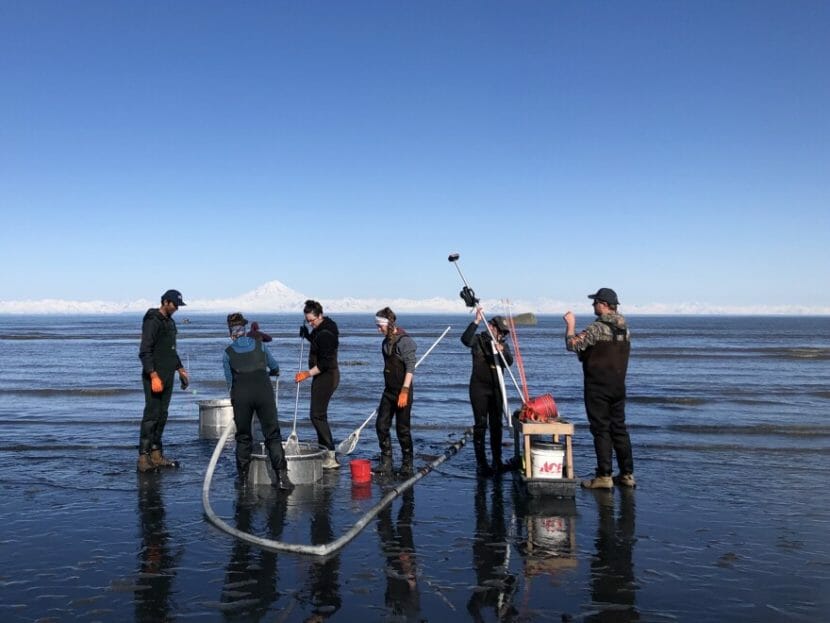
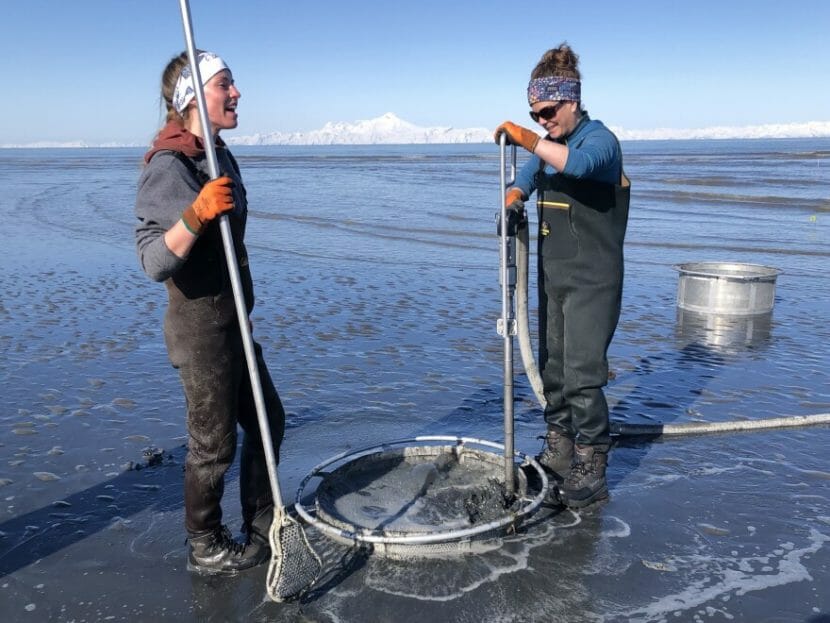
The Department of Fish and Game is hopeful it will be able to open at least some beaches on the east side of Cook Inlet to clamming this year. (Photo by Sabine Poux/KDLL)
The Alaska Department of Fish and Game might reopen the razor clam fisheries in Ninilchik and Clam Gulch for the first time since 2014.
But before that can happen, biologists are hitting the beaches to count clams.
Technicians surveying the Ninilchik beach Wednesday used some unlikely tools to stir up the clams hiding underneath the sand.
Some held lacrosse sticks. Assistant Area Manager Holly Dickson used a high-pressure water pump connected to a fire hose to liquify the sand within a small circle of beach.
“Once the sand is liquified inside the plot, razor clams will just sort of float to the surface,” she said. “Then people come in with these scoops and just filter through the water and sand.”
When they were certain there were no clams in a given plot, they picked up and ran to the next spot, chasing the tide as it quickly pushed out.
Dickson said the circular plot they probed is just one of hundreds they’ll survey this week.
“So we’ll start to get more into the best clam habitat once we get more like 300 to 500 feet out,” she said. “The middle of the beach has the most clams, is what we typically see.”
Fish and Game will use the clam counts to decide if there are enough to reopen sport and personal-use clamming in Ninilchik and Clam Gulch.
Holly Dickson (right), assistant area management biologist for Lower Cook Inlet sportfishing, used a high-pressure water pump to emulsify sand in small pockets on the beach. (Photo by Sabine Poux/KDLL)
The closures have been a response to low razor clam counts on the east side of Cook Inlet. The clam population crashed about a decade ago and has been slow to bounce back. In the meantime, clammers and sportfish charters have been taking their shovels over to the west side of the inlet, where the population is healthier.
Fish and Game Area Manager Mike Booz said his department has been watching the clams closely.
“Really at the closure of the fishery — ‘16, ‘17, ‘18 — we saw really high numbers of juvenile clams,” he said. “And so that’s really the first step for numbers to rebuild. You get new clams showing up on the beach. So that was kind of the bright spot. The downside was during those years we had really poor growth rates.”
Today, he believes there might finally be enough clams to justify reopening some beaches. The Alaska Board of Fisheries just approved a management plan that sets a threshold for restarting a limited fishery with a bag limit of 30 clams per day.
“This fishery is loved by so many Alaskans, so we definitely like to hear from people and want everyone to understand, really, what’s going on with these Cook Inlet razor clams,” he said.
Before the closure, the beaches on the east side were a mecca for clammers.
Brent Johnson started clamming with his family when they homesteaded on the Kenai Peninsula in the 1950s.
They’d dig near their set-net site on the beach in Clam Gulch — named for its abundance of clams.
“I would describe it as great clamming,” Johnson said. “I mean, a person who went out in that area, we would get a bucket of clams, the limit was 60. We could get that on any minus-one or two tides, something like that.”
For several years in the 1980s and 1990s, the sport fish harvest of clams was over 1 million.
Clamming was popular long before it became a regulated fishery. Johnson, who’s also a historian, knows the first, Alaska Native settlers of the land clammed, too. He’s found shells buried on his parents’ homestead.
And he’s seen surveys from the early 1900s that list “Clam Gulch” as a town name.
“And so ‘Clam Gulch’ must stretch back at least to 1920,” Johnson said. “So it was known for clamming at least back as far as 1920, I would say.”
Johnson and his family clammed up until the closure, in 2015.
He’d cook the clams the same way his mom did when he was a kid.
“We either fry ‘em, or we have clam chowder,” he said.
He’s not sure he’ll go clamming himself this summer if the fishery does reopen. He’s vegan now.
But Booz knows there are lots of people waiting, shovel ready, to dig into the east side beaches again.
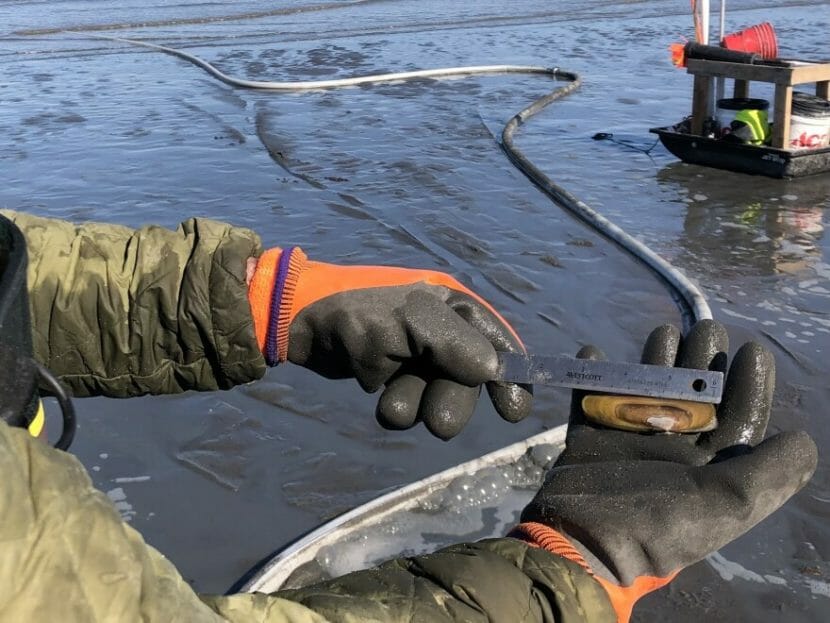
Aging a clam by the stripes on its shell is a bit like aging a tree by its rings. (Photo by Sabine Poux/KDLL)
Technicians in Ninilchik were several plots into their survey Wednesday when, at last, a small yellow clam bubbled to the surface.
Booz took out a ruler and pointed to the distinctly colored stripes on its shell, like the rings of an aging oak.
“So this is a three year old clam that didn’t quite grow enough to make it to the adult size this year,” he said.
On the whole, Booz said it’s not looking too good for Ninilchik. But he’s more optimistic for the beaches Clam Gulch, where he thinks there will be enough mature clams to have a fishery.
He said his department will make a decision by the middle of next month. The fishery, if open at either beach, would run May through October.
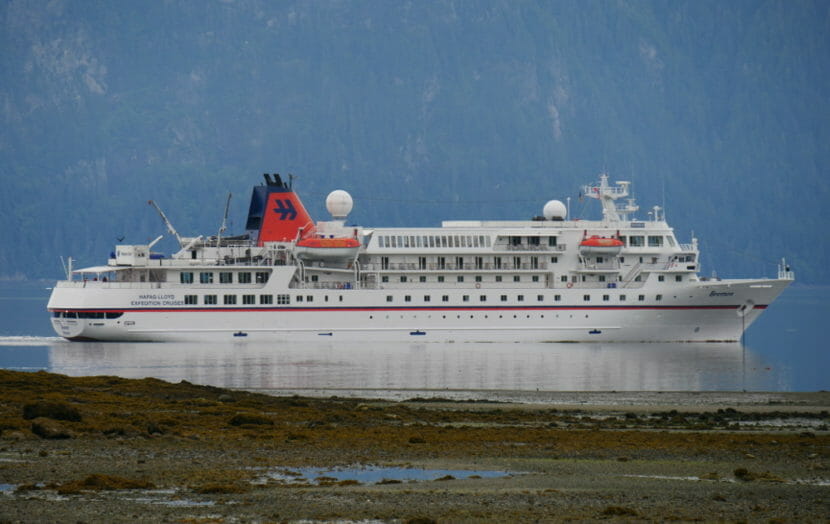
The cruise ship Bremen anchored near Petersburg’s Sandy Beach in July of 2017. (Photo by Joe Viechnicki/KFSK)
Gov. Mike Dunleavy’s proposal to overhaul environmental regulation of cruise ships has passed a key Senate committee. But the bill would also permanently repeal the Ocean Ranger program passed by voters in 2006.
That would eliminate the independent observer program on cruise ships. It would be replaced with direct oversight by the Alaska Department of Environmental Conservation and rely on self-reporting of wastewater discharges permitted by the state.
Sen. Jesse Kiehl, D-Juneau, proposed a compromise, a scaled back program with Ocean Rangers on one of every five ships.
“I think there were some strong arguments made by the administration that just as we don’t have a police officer on every single corner in town, they have built out capacity so that they don’t strictly need an Ocean Ranger on every single cruise voyage in Alaska,” Kiehl said. “But deleting them entirely I think we’ve heard from strong public comment is not what Alaskans are looking for in this self-funded program.”
A fee charged to cruise companies paid for the program for licensed marine engineers onboard the majority of voyages by the larger ships. However, Gov. Dunleavy has vetoed money for it and it last operated during the 2019 season.
Written public testimony has been overwhelmingly in support of keeping or even expanding independent oversight by the marine engineers. The Petersburg borough passed a resolution asking to reinstate funding. Dozens of Alaskan fishermen and processors have signed on to a letter highlighting their importance.
Senate president Peter Micciche, R-Soldotna, supported the state’s plan to end the Ocean Rangers and opposed Kiehl’s amendment during a Wednesday, April 20 hearing of the Senate Resources Committee.
“The Ocean Ranger program was a great program,” Micciche said. “I think what it did was demonstrated that we have a compliance program that works. I think they were engaged and I know that it’s popular, but frankly I think that what’s in this bill has the potential to deliver much greater performance than the previous program.”
State regulators made a pitch for the governor’s plan. DEC Water Division Director Randy Bates told lawmakers his state agency is expanding and hiring staff to review discharge records and take samples when vessels are in Alaska waters.
“We’re going to be on vessels 100 percent of the time, 100 percent of all vessels early in the season, those first three or four weeks,” Bates said. “We’re going to follow up with scheduled and unscheduled inspections as necessary and we’re going to do, for those vessels, large vessels, discharging in state waters, we will do a ride along.”
The state agency projects 41 large cruise ships and 18 small cruise ships to operate in Alaska this year, bringing an estimated 1.6 million passengers to the state.
Kiehl’s amendment to keep Ocean Rangers deadlocked at 3-3 and failed before the bill ultimately advanced.
At first the committee didn’t have the votes to move the bill out of committee, but a late arrival helped it pass. The vote was 4-3, with Micciche, Natasha Von Imhof of Anchorage, committee chair Josh Revak of Anchorage and Click Bishop of Fairbanks, who showed up late, voting yes. No votes were Scott Kawasaki of Fairbanks, Jesse Kiehl of Juneau and Gary Stevens of Kodiak.
The legislation would also establish a new fund to pay for sewage treatment plant upgrades for Alaska communities and eliminate citizens’ right to sue companies for pollution.
Next stop for the bill is the Senate Finance Committee. But its ultimate trajectory is less clear in the House. That’s because the companion bill has not advanced, with time running short for this legislative session.
With no Ocean Rangers for a second year running, the DEC says it plans to inspect cruise ships during the season in port and while underway — both large and small ships. The Ocean Rangers program only focused on ships that carry more than 250 people.
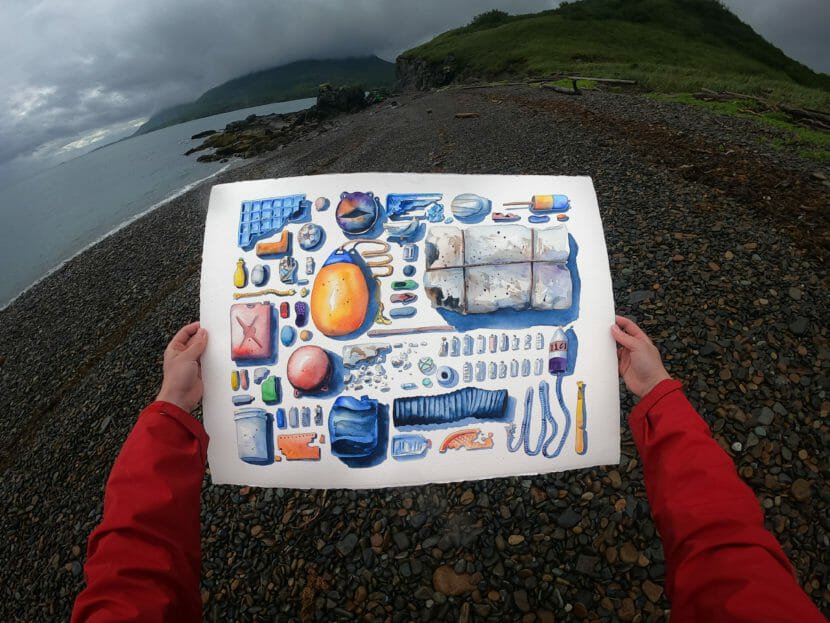
Painter and filmmaker Max Romey holds up a watercolor he made showing ocean debris he and other volunteers collected from an Alaska beach. (Photo by Max Romey)
An Alaskan painter and videographer has released a short film about the dangers of ocean plastic.
It’s called “If You Give a Beach a Bottle,” it’s by Max Romey and it incorporates scenes of volunteers cleaning up Alaska shorelines littered with marine debris, coupled with images from Romey’s watercolor sketchbooks.
Romey says the title is a reference to the children’s book, “If You Give a Mouse a Cookie,” because the issue of plastic in the ocean seemed like a similar, circular, never-ending story.
That’s after Romey started going on trips to Alaska beaches remove tons of washed up debris.
Listen here:
The following transcript has been lightly edited for clarity.
Max Romey: Alaska has these islands, which kind of stick out and scoop this stuff all up. And so it was this completely overwhelming experience. For the last seven years, it’s just been kind of sitting in the back of my head. And this is one of the first times where I went back out, this time with a sketchbook, and kind of just tried to tell a story of this huge, huge thing. And this is one of the first times I’ve been able to share the film publicly. This is very much just the first step in what is probably going to be a journey that I might not see the end of until you know, I’m 90 or 100.
Casey Grove: You’re in deep now.
Max Romey: I am indeed now, yes. We’ll see where this goes.
Casey Grove: Am I understanding this correctly, that it started with a sketchbook and watercolor, right?
Max Romey: Yeah, well I guess my whole journey with this started with a sketchbook and watercolor. I’m really dyslexic. So I struggle with reading and writing. My handwriting is close to illegible, but the spelling makes it even worse. And that’s where sketchbooks came in. My grandmother is an amazing painter, and my whole family really encouraged me to get into art, because you can’t really misspell a painting. People see it, they understand it, doesn’t matter if they speak English, or like, speak nothing at all, people understand sketches. And so from age six to now I’ve been kind of sketching this whole time, but rarely have actually used it in films. And all the sudden, these giant complex issues that words had no real way to capture, I’m finding that sketches could get a grasp of of these things that that words really couldn’t.
Casey Grove: (If You) Give a Beach a Bottle, it’s about five minutes or so right? And you’re showing your progress on the art that you’re making while the beach cleanup is going on, and some of the negative aspects of that and animals that are affected by it and whatnot, affected by marine debris. And then also just these beautiful landscapes. It seems like the things that you decided to sketch were sort of crystallized, bigger ideas that then had maybe more impact, just in those those moments in the film like that. I mean, having seen it for yourself and spent so much time looking at this problem. How big is it?
Max Romey: Marine debris is like a slow motion tsunami that’s hitting Alaska. And it’s nets, it’s lines, but it’s also bottles, it’s buoys, it’s barrels, it’s coolers, it’s Styrofoam. Everything is made out of plastic, nowadays, all over the world. Stuff gets thrown away, a lot of this is coming from rivers, so it goes into a landfill, landfill is not very good, landfill ends up in the river, river ends up in the ocean. Or it just gets dumped directly into the ocean. That happens, too. But then plastic will never break down, it will only ever break up. And so as it ends up in the ocean, the ocean currents kind of spin around, and then Alaska is just stuck out right in the middle, like putting your hand into a washing machine full of clothes. And it just kind of captures all of this. These winter storms just blow it all up on shore.
We’re kind of this cheese grater that all of these ocean plastics are ending on, and we just shred them into all these tiny pieces. And then these tiny pieces are, once they get small enough, they bioaccumulate, they pick up a lot of toxins and they end up back into the environments that these cycles of nutrients make possible. The salmon go up the stream, they die, all that nitrogen from the ocean goes up, the bears eat ’em, the eagles eat ’em. Most of the trees have these salmon nutrients in them. But we’re basically injecting plastic into this whole situation. So once these things are broken down into trillions of little pieces, you lose them.
Right now, you could go to the beach, you could go to Cordova, you could go to Kodiak, Katmai, and you can find big, big piles of bottles and buoys, and you can pick them up. But the scary part is what you don’t find, all of those things that have been broken up into thousands of pieces. And then that will build up in a lot of these systems. And by the time it builds up, when we actually see it in the nature, it’s too late. It’s this funny little time where you can actually do something about it now, but it’s super complex, it’s really hard to see and it’s slow moving. So it’s not like, you know, an oil spill. It’s like asbestos. This stuff is gonna affect Alaska for a very long time, and we have a chance to kind of do something about it now. But the longer we wait, the harder it’s going to be.
Casey Grove: And a lot of people don’t see that every day. I mean, it sounds like it kind of changed how you thought about it to see it up close and personal and be out there on the beach like that.
Max Romey: Yeah. You see buoys, you see things that you don’t see every day, but you also see laundry baskets, you see dish detergent bottles, you see lunch containers, and you see pieces of all this as well. The big pieces are just what you could pick up, that’s not too late. The little pieces, it’s gone. But you see all this stuff and you realize this came from somebody’s car, this was in somebody’s trash can, somebody ate off of this plate and now it’s in Alaska for some reason. So it’s this major global problem, and we could have people picking up these beaches 24/7, all day every day for years, and we wouldn’t get it all.
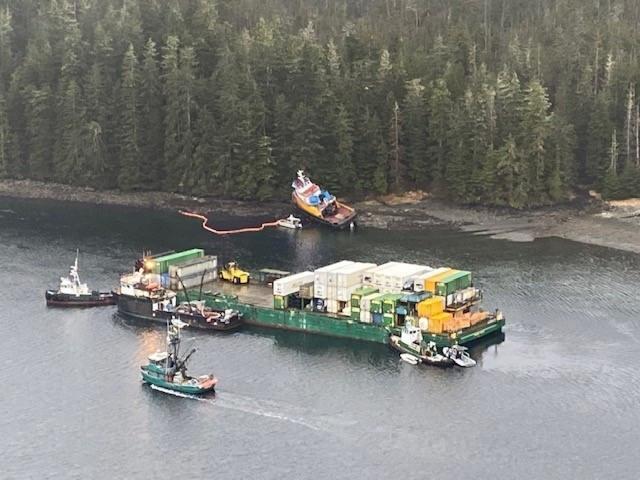
Western Mariner, an 83-foot tug, ran aground in Neva Strait March, 21, 2022, while towing Chichagof Provider, a 286-foot containerized barge. No injuries were reported. (USCG Photo)
The company that owns a tugboat that crashed around 18 miles north of Sitka last month now estimates that 5,307 gallons of diesel fuel were spilled into the ocean as a result of the accident.
The Western Mariner was towing an Alaska Marine Lines barge in Neva Strait early on the morning of March 21 when a steering failure caused the two vessels to collide, pushing the tugboat onto the shore. The wreck caused a diesel spill, leading to a coordinated response from multiple state and federal agencies. The cleanup effort is ongoing.
The Western Mariner can hold around 50,000 gallons of diesel, but the Western Towboat Company estimates that the boat was only holding about 43,000 gallons of fuel when it crashed.
A situation report published by the Alaska Department of Environmental Conservation on April 5 reported that salvage crews had recovered around 33,000 gallons of fuel directly from the boat. A mix of oil and water recovered by skimmers yielded an additional 4,000 gallons of fuel.
The boat was towed back to Sitka on March 29 and remains moored at the Samson Tug and Barge dock.
Efforts to assess the nearby environmental impacts are ongoing, with crews still flushing nearby beaches with water last week. The DEC reports that shoreline monitoring will continue in the coming weeks.
Close
Update notification options
Subscribe to notifications
Subscribe
Get notifications about news related to the topics you care about. You can unsubscribe anytime.