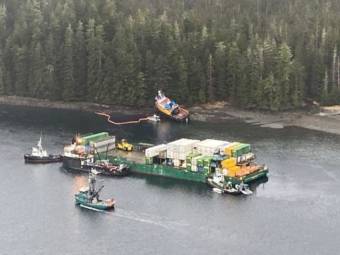
The towboat Western Mariner (center) was towing an AML barge on the morning of March 21, when it ran aground in Neva Strait. It returned to Sitka on Tuesday (Photo courtesy of Rowan Chevalier)
A tugboat that ran aground in Neva Strait last week has been towed back to Sitka.
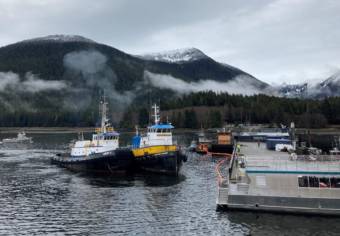
The Western Mariner was refloated shortly after noon on Tuesday and arrived back in Sitka around 5 p.m. It’s currently moored at the Samson Tug and Barge utility dock.
According to a situation report from the Alaska Department of Environmental Conservation, a light diesel sheen remained in the area where the boat was grounded. They’re still monitoring the containment boom left in the area to capture any remaining diesel sheen.
The state is trying to determine how much diesel is on shore in Neva Strait and nearby areas. On Monday, a shoreline cleanup team identified three beaches in Neva Strait that were “lightly oiled” and recommended flushing the areas out with low-pressure sea water. A crew began those beach cleanup efforts on Tuesday.
The Western Mariner was towing an Alaska Marine Lines freight barge on the morning of March 21, when a steering failure led the boats to collide, pushing the Western Mariner onto the beach. One of its fuel tanks ruptured in the accident, and diesel began spilling into the ocean.
It took salvage crews around three days to slow and finally to stop the spill. The Western Mariner can hold 50,000 gallons of fuel. Crews recovered around 32,000 gallons of fuel and around 11,000 gallons of mixed oil and water. The DEC reports that the exact amount of diesel spilled remains unknown.
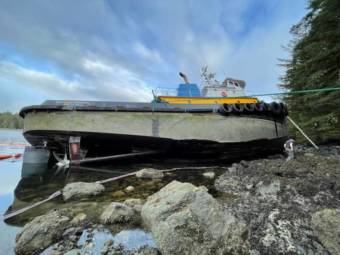
View of the Western Mariner and primary boom configuration as of March 25. (ADEC Photo)
Herring seiners and subsistence harvesters are grappling with a large diesel spill near Sitka that happened last Monday.
On Thursday, state managers shifted the focus of the commercial fishery away from the areas where an oily sheen has been reported and were conducting test fishing instead on eastern shore of Kruzof Island.
KCAW spoke with commercial fisherman Matt Kinney on Friday, who said the weather forecast was one sign that fishing could happen soon — which it did, with an opening this weekend.
“I think this nice stretch of weather that we have coming into the weekend is going to cause the picture to change quite a bit, and you’ll see a lot of fish separate out,” Kinney said. “And we’re actually seeing a tremendous amount of biomass out there.”
Kinney has been on the Kruzof shoreline and north into Promisla Bay. No sign of the diesel sheen had been reported in those areas. Over the week, diesel sheen was reported from as far north as St. John Baptist Bay and, as of Thursday, as far south as Krestof Sound, near the Magoun Islands.
Kinney says wind had pushed the sheen north, and the schools of herring commercial fishermen are tracking hadn’t moved into Krestof Sound yet.
“There really hasn’t been any fish mixed with the diesel that I’ve seen, but you know, I know there’s a lot of concern about that,” Kinney said. “And so we’re trying to be really careful. You know, they won’t let us fish anywhere where there’s even a hint of sheen. And that’s really responsible by the department.”
Subsistence harvesters begin to assess fuel spill impact on fishing grounds
While commercial fishermen were preparing for a fishery, subsistence harvesters were trying to figure out how the diesel spill could affect their harvest season, which typically happens a little later in the spring. Krestof Sound — one of the areas where diesel sheen was spotted on Thursday — is an important spawning area for herring.
Andrew Roberts has been harvesting herring eggs since the early 1980s. He was heading out Friday afternoon to scout locations for setting branches.
“I am very concerned. Very concerned,” Roberts said. “And it’s almost like it’s kind of a worst-case scenario of the catastrophic spill like this … during a time when the precious herring are expected to spawn.”
He says in all the years he’s harvested, he’s never seen a fuel spill this big or this close to spawning grounds. He typically sets branches in the Hayward Strait area but said he would be documenting any diesel sheen he spots along the way and looking for safer locations to harvest eggs.
Roberts’ partner, Paulette Moreno, who has been harvesting eggs for the last decade, says the stakes are high for the herring right now, and called on Sitkans to respond.
“I believe this is an emergency. We need more resources sent to the Sound as soon as possible,” Moreno said. “We went through an area close to [the spill site] just a couple of days ago. And it was such an eerie silence. I didn’t see any wildlife or marine life in sight. And it was a strong feeling of mourning. So I would humbly call on all of us as a community, and supporters of our community, to gather and use their voices, that absolutely every tool and every resource is brought here to Sitka and is put on this area.”
Observed sheening from Whitestone Narrows north through Salisbury Sound as seen around 8:00 a.m. on March 23rd. (ADF&G Photo)
Crews have been working for four days to contain a fuel spill in Neva Strait after a tugboat ran aground early Monday morning. The Western Mariner was towing an Alaska Marine Lines freight barge when the two vessels collided after a steering failure, and the tug was pushed onto the beach. The barge, the Chichagof Provider, was brought back to Sitka earlier this week, but the tugboat remains grounded.
On Thursday evening, the Alaska Department of Environmental Conservation reported that salvagers had sealed off the remaining sources of the leaking fuel, and no more fuel was escaping.
Petty Officer 3rd Class Christopher Daniel, an aviation maintenance technician at Air Station Sitka, observes an oil sheen surrounding the Western Mariner, an 83-foot inspected tug, in Neva Strait March, 21, 2022. (USCG Photo)
The amount of spilled diesel is still unknown, but the Western Mariner was carrying an estimated 45,000 gallons of fuel when the accident occurred.
According to a press release from the DEC, through Wednesday night salvagers had not controlled the source of the spill, and fuel was still entering the boat’s engine room. Response crews deployed containment boom in the area and began skimming the water on Monday. Over the last four days, they skimmed at least 1,200 gallons of oily water along with nearly 5000 gallons of diesel and water from the tug’s engine room.
Observed sheening ribbons on the north end of Krestof Sound extending south around 8:30 a.m. on March 24th. (ADF&G Photo)
Skimming efforts were put on hold early Tuesday due to poor weather conditions. Conditions were so bad that a small, private vessel responding to the incident capsized on its way back to Sitka on Tuesday. All four aboard the boat were rescued.
Local concern over the situation is growing, as the Western Mariner is aground about five miles north of Krestof Sound, an area where Pacific herring are known to spawn in the spring. On Thursday evening, the Alaska Department of Fish and Game reported observing sheen from Salisbury Sound through Neva Strait. For the first time, sheen was reported in Krestof Sound to Double Island and in Olga Strait. They did not observe any sheen in Hayward Strait, where numerous schools of herring were seen Thursday, moving into Promisla and Eastern Bay.
Nevertheless, the commercial sac roe herring fishery remains on two-hour notice. The Alaska Department of Fish and Game conducted five test sets Thursday, averaging between 9 and 11 percent mature roe and weighing on average between 117 and 134 grams.
According to the DEC, environmental shoreline assessments will be conducted over the weekend.
Western Mariner, an 83-foot tug, ran aground in Neva Strait March, 21, 2022, while towing Chichagof Provider, a 286-foot container barge. No injuries were reported. (USCG Photo)
State biologists are looking into how a recent diesel spill around 15 miles northwest of Sitka will affect the sac roe herring fishery, which went on two-hour notice Tuesday morning.
The Alaska Department of Fish and Game’s annual pre-season herring meeting on Monday night was punctuated by news of the spill, which occurred early that morning when a tugboat towing an Alaska Marine Lines barge ran aground in Neva Strait.
In the collision, one of the tugboat’s fuel tanks ruptured. The size of the spill remains unknown, but the boat has an overall fuel capacity of around 45,000 gallons, and the ruptured forward tank can hold up to 13,000 gallons.
Sarah Moore is a spokesperson for the Alaska Department of Environmental Conservation. She said response teams were still working to remove fuel from the damaged fuel tank and had successfully patched all of the holes in the tugboat’s hull as of Monday evening.
“One of the big ‘to do’ items for the next couple of days is to remove the tow line from the barge so that the barge can continue on to Sitka,” Moore said. “And then they will continue to focus on recovering the tugboat that is grounded.”
Sitka area management biologist Aaron Dupuis said Fish & Game would begin assessing potential impact on the fishery and subsistence harvest.
“Nets will not go in the water until we have a good handle on where the diesel spill is,” Dupuis said. “Nobody wants to get oil nets, or oil fish or any of that. So yeah, in our aerial survey, and with vessel surveys, we’ll be able to know exactly where the sheen is. And the commercial fishery will not operate in areas that are impacted by this.”
Fisheries biologist Troy Tydingo added that the state has a zero tolerance policy for oil contamination and seafood, and they would not open an area for fishing if there was a risk of contamination.
Dupuis said that as of Monday, the visible sheen had not extended into Olga Strait or into Krestof Sound, where herring openers have occurred in the past. As long as the sheen remained limited to Neva Strait, Dupuis didn’t anticipate it would impact the timing of the fishery.
Petty Officer 3rd Class Christopher Daniel, an aviation maintenance technician at Air Station Sitka, observes an oil sheen surrounding the Western Mariner, an 83-foot inspected tug, in Neva Strait March, 21, 2022. (USCG Photo)
Salvagers are attempting to contain a diesel fuel spill after an 83-foot tugboat ran aground in Neva Strait early Monday morning while towing an Alaska Marine Lines barge.
Four crew members were aboard the Western Mariner when it ran aground shortly before 3 a.m. Monday, about 15 miles northwest of Sitka. All were safely taken aboard a Good Samaritan vessel.
The Western Mariner was towing the Chichagof Provider, a 286-foot container barge. According to a situation report from the Alaska Department of Environmental Conservation, the Western Mariner was heading southbound when a steering failure caused the barge to collide with the tug, pushing it onto the beach.
The grounding ruptured one of the tug’s fuel tanks, which can hold around 13,000 gallons of diesel fuel. The DEC says that a sheen was observed on the water covering an area of around 4 nautical miles, north to Salisbury Sound.
Efforts to offload the fuel and stop the spill are underway, and containment boom has been placed to reduce the spread. The Coast Guard and Alaska Department of Environmental Conservation have set up a unified command, and the tug’s owner, Western Towboat, has retained Sitka-based salvagers Hanson Maritime.
The oil spill response vessel Neka Bay has been mobilized from Juneau, and the Southeast Alaska Petroleum Response Organization has been activated.
The barge has been anchored in Neva Strait outside of the main navigation channel.
The DEC says that the cause of the accident remains under investigation. The DEC is coordinating its response with the state Department of Fish & Game, which could potentially hold a seine opening for herring on March 22 in Hayward Strait, eight miles to the south of the grounded tug.
The Russian R/V Tinro at sea. (Photo courtesy North Pacific Anadromous Fish Commission)
Tensions continue to simmer between Moscow and Washington in the wake of Russia’s invasion of Ukraine.
Oil companies are canceling partnerships with Russian firms. State legislators are calling for the state’s sovereign wealth fund to dump Russian investments. President Joe Biden announced Tuesday the U.S. would close its airspace to Russian aircraft.
But the United States and Russia are still working together on at least one issue: salmon.
There’s a map scattered with orange, green, blue and red dots spanning most of the North Pacific above 46 degrees latitude.
On the map are three flags of Arctic nations: the U.S., Canada and the Russian Federation.
“This interaction between the countries in this is really something that has never happened to this scale before,” said Mark Saunders, the executive director of the five-country North Pacific Anadromous Fish Commission.
He’s talking about the 2022 Pan-Pacific Winter High Seas Expedition.
Vessels from both sides of the Pacific are braving gale-force winds and 13-foot seas as they crisscross the ocean from the edge of the Aleutian Chain to the Strait of Juan de Fuca.
A map showing the current expedition along with past surveys conducted in the western Pacific and Gulf of Alaska. (North Pacific Anadromous Fish Commission)
All in the name of research into the challenges to wild salmon runs that are important to people on all sides of the north Pacific Rim.
A historic shortfall
Last year, the chum salmon run on the Yukon River collapsed.
“This past summer, the Yukon River did not fish for food. Zero,” said Mike Williams Sr. He’s the chair of the Kuskokwim Inter-Tribal Fish Commission, an organization that manages and researches fisheries using a combination of traditional knowledge and Western scientific methods.
Williams says in recent years, he’s watched runs on the Kuskokwim dwindle, too. In the past, he says fishing was relatively unrestricted. Residents would return to their fish camps shortly after the ice on the river broke up in the spring.
But in recent years, he says residents have had to wait until June — long after breakup — to start stockpiling fish.
“We depend on the salmon to sustain us through the winter, and we’re very concerned about the returns of our salmon in all of the rivers in Western Alaska” Williams said in a phone interview Wednesday.
It’s not clear what was behind the collapse. The Inter-Tribal Commission — and the Alaska Department of Fish and Game, for that matter — spend most of their effort studying what happens in freshwater. But that’s just a small part of a salmon’s life.
‘Something happens in the ocean’
“The salmon spawn in our headwaters, they go down to the ocean, and something happens in the ocean,” Williams said.
And it’s not just Western Alaska that’s struggled with salmon runs in recent years — in Southeast, chinook runs from Haines to Ketchikan are listed as stocks of concern. Salmon fishing on the Unuk River has been banned outright for years.
Some, including Williams, say too many salmon in the Bering Sea and the North Pacific are pulled out of the ocean as bycatch from trawlers that scrape the seabed for sole and flounder. Others say fish from hatcheries all over the north Pacific Rim are outcompeting native fish. Some say climate change is affecting the food web — or that it’s a combination of all these factors.
But one thing is clear: something is happening to chum and chinook salmon in the open ocean.
“We know that a lot of the poor survival for chum and other salmon is related to the marine environment,” Saunders, of the North Pacific Anadromous Fish Commission, said Tuesday from his home office on Vancouver Island.
There’s quite a bit known about how the ocean is changing, “but you need to know where the fish are and have actually had your hands on them, and understand how they’re interacting with the environment,” Saunders said.
“I think a lot of that is a large black box — in particular, this winter period we know very little about,” he added.
He says the goal of the survey, the largest ever conducted, is to shine some light in that black box.
Scientists are hoping to map out the distribution of salmon across the North Pacific using new DNA techniques developed over the past decade or so to understand where salmon interact with predators, prey and each other — not to mention a generally warmer, more acidic ocean.
“And the big question is, how is the changing North Pacific Ocean affecting our salmon? And improving our ability to understand how that change is going to impact people and fish and fisheries into the future,” he said.
That brings us back to the map.
A screenshot of a live map tracking vessels from the U.S., Canada and Russia during the 2022 Pan-Pacific Winter High Seas Expedition on March 2, 2022. (YearOfTheSalmon.org)
A long-planned voyage meets geopolitical realities
Earlier this winter, ships from the U.S., Canada and Russia set sail for the North Pacific. Each is assigned its own area to sample: The U.S. and Canada are tackling areas in the Gulf of Alaska and west of British Columbia, and a vessel from Russia is surveying an immense swath of ocean spanning areas south of the Alaska Peninsula all the way out the Aleutian Chain southwest of Adak.
Alaska’s chief salmon scientist, Bill Templin, says a few thoughts crossed his mind as he watched the invasion unfold.
“My first concerns were for the people of Ukraine,” Templin said by phone Wednesday. “But then when I walked into my office and I sat down, I was thinking, Oh, OK, so what does this mean?”
He says it’s not the first time international tensions have come up in his work with the five-country commission. He recalls Russian scientists including islands disputed with Japan on maps of salmon stocks — all in good fun, as he recalls it.
“The first two years, they got it past me, and the Japanese had to come over and correct me very politely,” he said.
But this is more tension than usual.
Saunders, the head of the anadromous fish commission, says an American scientist was scheduled to board the Russian vessel to allow it to survey within the 230-mile U.S exclusive economic zone.
That didn’t happen. And that means the Russian research vessel can’t work close to the Aleutian Chain, where some salmon are thought to spend the winter. Templin says that means salmon activity within that zone will remain a blank spot for now.
“It doesn’t ruin the results. It’s not a failure — but it is going to limit what we get,” he said. “And it’s taken years to get this winter coordinated, so it’s a little disappointing.”
But Templin says scientists from Japan, Canada, South Korea, Russia and the United States have always put their work first, and their political leaders’ policies second. And he says that’ll continue.
“The salmon all go to the same place. So they’re all grazing in the same field, so to speak. For all of us to work together to understand what’s happening out there, and the way it affects our nations, is — I think it’s a pretty huge deal,” he said. “And I’d hate to see it go away.”
Close
Update notification options
Subscribe to notifications
Subscribe
Get notifications about news related to the topics you care about. You can unsubscribe anytime.