Oceans

Groups prod federal government to act on plan to save Cook Inlet beluga whales

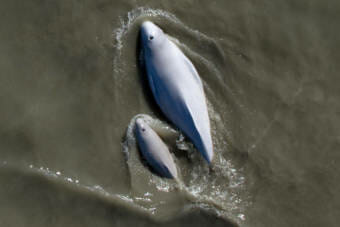
A beluga whale and calf, seen from above
A Cook Inlet beluga whale mother and calf (Photo by Hollis Europe and Jacob Barbaro/NOAA Fisheries)

As Cook Inlet beluga whales continue to slide closer to extinction, a coalition of conservation groups petitioned the federal government this week to do more to save them.

The National Marine Fisheries Service has not made much progress in carrying out the recovery plan it created in 2016 to reverse the decline, the groups say.

“It’s been a little bit over five years now. And the population is is not recovering. In fact, it’s worse,” said CT Harry, with the Environmental Investigation Agency, a group behind the petition.

EIA has produced a report on the government’s efforts to help the whales. It’s titled “Five Years of Failure.”

Harry noted that the National Oceanic and Atmospheric Administration continues to grant permits for activities in the inlet that emit noise or otherwise disturb the whales.

“The goal in our petition is to basically tell NOAA to follow their own advice by reevaluating how these harassment authorizations are permitted,” Harry said. “And to not look at each one on an individual basis, but to look at them on a cumulative basis to determine the cumulative stress impact of a multitude of threats.”

Cook Inlet belugas — the relatively small white whales that are sometimes seen from the Seward Highway and the Coastal Trail in downtown Anchorage — have been listed as endangered since 2008. They’ve declined about 80% since the late 1970s. The last subsistence harvest was in 2005, and still the slide continues. NOAA estimates that 279 individuals remain.
A statement from NOAA Fisheries says only that it’s aware of the petition and will review it carefully. But in previous interviews and on its website, the agency describes the whales’ decline as dire and confounding, despite lots of research. A video on NOAA’s website describes the challenges the whales face, living so close to Alaska’s largest city.

The threats “may include diminishing food, habitat loss or destruction, pollution, toxins and human caused noise which hampers their ability to feed and communicate,” says a video on NOAA Fisheries’ website. “Researchers are trying to understand which of these threats may be impacting them most.”

Of the thousands of beluga-harassment incidents the government has allowed in recent years, the vast majority are for research — some just to count or photograph the whales, but also for biopsies.

Liz Mering is at Cook Inletkeeper, another one of the groups behind the petition. She said the goal isn’t necessarily to block permits for the oil industry or port construction or research, but to get the government to figure out what it needs to do to prevent an extinction.

“I just can’t imagine living any other place where you can drive down the highway and see beluga whales out your window of your car,” she said. “It’s just such an incredible place and to lose them would be devastating, I think, for all of us who live in the Cook Inlet area.”

Cook Inlet belugas are a distinct genetic population that live in this one spot. The conservation groups and the scientists at NOAA Fisheries agree that if they disappear, others aren’t likely to take their place.

How climate researchers and Juneau composers are turning data into song

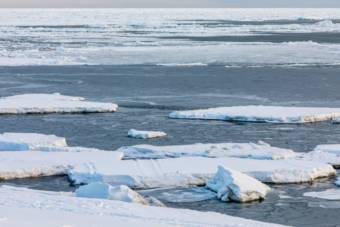
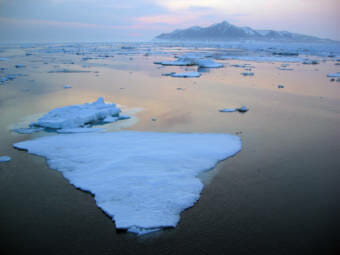
Sea ice floats in the Bering Strait off Cape Prince of Wales. Juneau composers are working with climate researchers in Fairbanks to translate climate data sets into music.  (Photo by Gay Sheffield/University of Alaska Fairbanks)

Fairbanks climate researchers teamed up with Juneau composers to turn data into music. It’s a bid to bring climate research to a new audience.

When Juneau composer and middle school music teacher Michael Bucy first saw the climate data he had to turn it into a song, he said he couldn’t make sense of the symbols.

“I didn’t get out of my algebra II class in high school,” he said with a laugh.

That’s a pretty normal reaction to the codes used in climate modeling. Bucy was looking at data sets showing warming temperatures in the Bering Sea. And his initial response is part of why he and fellow composers attempted to translate the ideas behind the numbers into the more approachable medium of music.

“To be honest, climate change has actually been just too overwhelming for me to address. It’s one of those things that … I think we all somewhat put our heads in the sand just for survival sake … because it’s just too, too overwhelming to think about too much,” he said.

Bucy wrote “Babel 2.0,” which was performed in Juneau last month, with additional help from a writer friend who took care of the lyrics. The name is a biblical reference—prideful men attempt to build a tower to heaven, so their god gives them all different languages so they can no longer work together.

The science to music project is the brainchild of Kaja Brix, who directs the National Oceanic and Atmospheric Administration Fisheries Arctic Program in Alaska. She also works at the University of Fairbanks International Arctic Research Center. She said most climate talks reach the same audience over and over.

“I was reflecting on how we really need to think of other ways to bring information about changes in our state to the public in a way that people will be exposed to that science,” Brix said.

Bucy says his composition is an effort to aid what he considers some of the most important work in the world — he called it “music with a purpose.” But to get from science to music, he had to call professor Vladimir Alexeev at the International Arctic Research Center for a layman’s description of what was going on.

Alexeev has studied climate for 30 years, and he’s modeled recent warm temperatures in the Bering Sea and their effect on the rest of the world. He broke it down simply: “The warm water in Bering Sea makes air move differently.”

His model shows that unusually warm water in the Bering Sea pushed a column of warm air into the jet stream. That sent warm air up north into places like Fairbanks, and that sent cold air south where it doesn’t belong.

“It’s like a rock in the middle of the river. It sends ripples up and downstream,” he said.

Alexeev called it a “disaster.”

He says he suggested dissonant sounds and musical cycles that represent the seasons. He says the project made him think about his research in a new way.

Michael Bucy’s song is the first in what will be a series of about six pieces of music. The Bering Sea is just one theme. Other composers will interpret glacier outburst floods, high latitude mirages and arctic sea ice changes.

The goal is to hold concerts in Juneau and Fairbanks, but pandemic concerns have delayed the project.

Coming soon: Everything you wanted to know about Juneau’s most popular humpbacks

Flame, whose tail is pictured above, is one of Juneau's most frequently spotted humpback whales in recent years. (Photo courtesy of Brianna Pettie)
Flame, whose tail is pictured above, is one of Juneau’s most frequently spotted humpback whales in recent years. (Photo courtesy of Brianna Pettie)

There’s about to be a new resource to educate locals, tour guides and visitors about the humpback whales of Southeast Alaska.

A larger list of all the individual humpback whales that have been spotted swimming around Juneau already exists, and just about every local whale watching outfit has a copy on board. But a group of marine mammal enthusiasts is working on a simplified version.

Shannon Easterly is a local whale watching guide in the summer, and she’s been working with marine mammals all over the country for about 10 years. For the past few months, she and three others (Gabrille Lopez, Brianna Pettie and Jayleen Bydlon) have been working on making a new, condensed catalog of humpbacks.

“The goal of the project is basically to make a mini catalog,” Easterly said. “[We want] to take that well over 100 whales and shrink it down to about the 20 most commonly sighted whales in Juneau.”

The new catalog will have fewer individuals in it, but will have a lot more information about each whale. Easterly said they hope to provide tour guides with more detailed profiles of Juneau’s most frequently spotted flukes — also known as whale tails.

“So a great example would be one of our whales, Flame,” Easterly said. “She is probably the most commonly sighted whale in Juneau waters in recent years. The photo of her in the catalog is great. There’s a little bit of information about her. [It] says that she’s a known female, things like that. But what we really want to do is build something that doesn’t just include that, but also includes information like ‘Is that whale a whale the breeds in Hawaii or in Mexico?’”

Gabrille Lopez photographs a humpback whale in Auke Bay.
Gabrille Lopez photographs a humpback whale in Auke Bay. Lopez is  one of four people working on creating a new catalog of Juneau’s most-sighted humpback whales. (Photo courtesy of Shannon Easterly)

For instance, Flame is a whale that breeds in Hawaii, and she’s been sighted in Maui.

“And we also know that she has had calves in at least 2013, 2016, 2019, 2020 and 2021,” Easterly said. “[Flame] is a prolific lady.”

The new catalog will also include facts like where the whale was first recorded, where it’s most commonly seen feeding and which other animals it hangs around with.

“Are they typically seen alone? Like, Flame prefers to be alone,” Easterly said. “It’s also fun to talk about the fact that she doesn’t really like killer whales and will actively avoid them or be aggressive toward them. Those little personality quirks that set one whale apart from another are some of the things that we want to include.”

All of the photos in the catalog were taken by one of the four guides and researchers working on the project. A lot of the data comes from a citizen science website, managed by Duke University, where anyone in the world can contribute information about their own whale sightings.

Easterly said she hopes knowing more about Juneau’s whales will help both tour guides and tourists make more meaningful, personal connections with the animals.

“It’s on everybody’s bucket list to see a whale, and we want you to take that home — not just with a pretty picture, but with a story about that animal and to know who they are, so that it’s an important part of your trip and [so it will] maybe inform your decisions conservation-wise moving forward,” Easterly said.

So far, the mini catalog is 42 pages long, with each animal having two pages dedicated to it. When it’s finished, the catalog will likely be distributed in Facebook groups for local whale watch guides and other social media sites.

Skagway’s blue mussels were nearly wiped out last year

A close-up of blue mussels with their shells partly open
Blue mussels before the mortality event. (photo courtesy of Reuben Cash)

Reuben Cash says blue mussels are best served steamed with melted butter. But this year, he doubts you could find enough for a meal.

Cash is the environmental coordinator at the Skagway Traditional Council. He says that last summer, 70-90% of the population died in what he calls a massive mortality event.

“You can see all the shells from what happened this summer. And for a while, I mean, it was thick,” he said. “Where the high tide comes in was just probably four inches deep, and empty mussel shells and dying mussels with meat still on it — it was widespread.”

The Skagway Traditional Council samples local mussels to test for paralytic shellfish poisoning because they work well as an indicator species for the toxin. In late June, they realized something was wrong.

“We noticed that there was kind of a funky smell about a week earlier,” Cash said. “They kind of had a sweet, slightly putrid smell. And in the weeks leading up to that, temperatures were in the 60s, maybe the 70s.”

He says there was a heatwave in the Pacific Northwest further south that caused many blue mussels to die, but the upper Lynn Canal stayed relatively cool.

“I kind of discounted the temperature theory right off the bat because it just didn’t get hot enough,” Cash said. “Blue mussels are pretty tolerant of high temperatures — they can tolerate up to about 85 degrees.”

Cash also considered that it could have been some sort of pathogen, like a virus or bacteria affecting the shellfish, but blue mussels are highly resistant to them.

He says it was probably a combination of things that caused the mussels to die.

A stretch of rocky beach covered with blue mussel shells
Dead blue mussels line the beach at Nahku Bay. (photo courtesy of Reuben Cash)

One thing is the salt. Typically sea water levels are 35 parts per 1,000.

“Starting in June, in 2021, it was down below one part per 1,000 — like, as fresh as river water,” Cash said.

And Cash says when the salt levels drop, blue mussels aren’t as tolerant of temperature shifts.

Another issue is sediment.

“Not only does the freshwater dilute the amount of salt that’s in the water, it also introduces a lot of sediment,” Cash said. “Sediment covers up the muscles. Now, they’re filter feeders, they’re not going to be able to function as well as they would if the water was clear.”

Last winter there was record snowfall in the mountains above Skagway and Dyea. Then the area went through a cool spring, which kept the snowpack in place later than usual. As temperatures warmed up, the snow melted and brought fresh water and heavy amounts of silt into areas like Nahku Bay.

Then around the summer solstice, an extreme low tide occurred.

“So they were exposed at the low tide for longer and with a little bit higher temperatures, probably being smothered by sediment with low salinity,” Cash said.

Normally, the mussels can handle any one of these things — but all of them combined? It may have been too much.

Cash says the blue mussels that are left will be the strongest of the population and the most resilient. But he’s asking harvesters to avoid collecting mussels until the population rebounds.

“If you want blue mussels next year, hold off this year,” advised Cash.

Blue mussels tend to spawn mid-summer, so it may be late summer before the area sees an increase in their numbers.

Past heat waves and low sea ice continued to impact Alaska’s waters in 2021

A man in an orange raincoat watches Pacific cod slide out of a black cage onto the boat.
NOAA Fisheries scientists collect Pacific cod samples in the Aleutian Islands. The North Pacific Fishery Management Council, closed the Pacific Cod fishery in 2020 after the blob decimated cod stocks in the Gulf of Alaska. (Public domain photo by
NOAA Fisheries)

The so-called blob that brought warm surface water temperatures to the Gulf of Alaska between 2014 and 2016 has passed.

But the effects of that blob, and a subsequent heat wave in 2019, are not all in the rearview mirror. And researchers are bracing for more as climate change brings with it more ocean warming.

“For an area like the Gulf of Alaska, definitely this is a topic we need to understand better,” said Bridget Ferriss, a research fish biologist with NOAA Fisheries. She edited this year’s Ecosystems Status Report for the Gulf of Alaska, used by federal managers to inform fisheries policy in Alaska.

Last year, researchers continued to track the impacts of recent heat waves on Alaska’s marine species.

Ferriss said a heat wave happens when the sea surface temperature on a given day is warmer than 90% of the temperatures on record for that same day, for five days in a row.

The gulf wasn’t dominated by heat waves in 2020 and 2021 like it was in the years before. But some populations are still responding — for better or worse.

Forage fish, some seabirds and humpback whales in Prince William Sound all seemed to see declines in the gulf related to warm temperatures, with mixed rates of recovery.

Herring, on the other hand, have done great since the heat wave. They thrive in warmer water.

Salmon were likely impacted by the blob as well. Ferriss said decreases in salmon runs in 2020 track with low juvenile salmon survival in the years immediately following.

“I think definite signs are that they were affected by the heat wave,” Ferriss said. “We don’t have a nice concise story yet to really what caused each one.”

NOAA Fisheries Research Biologist Elizabeth Siddon was the editor of the Bering Sea ecosystem report. She’s also taking the long view at how conditions over the years have impacted salmon runs.

“Many of the stories or the things we saw in 2021 were a result of conditions that these organisms — fish or crabs, salmon — have experienced since 2014 when this new warm phase started,” she said.

Siddon has been thinking about three coincident crashes in the Bering Sea — snow crab, salmon and sea-birds.

She said having the historical perspective is important. Understanding the salmon crashes in the Arctic-Yukon-Kuskokwim region, for example, requires following the run through the last several years.

“What we’re seeing this year could be the results of what happened this year,” she said. “Could be the results of what happened two years ago or three years ago.”

Scientists who are monitoring the Bering Sea are looking at another important factor: sea ice.

“When the ice melts, we get this cold, dense water that sinks to the bottom of the Bering Sea,” Siddon said. “And that cold water then changes the distribution of the fish in the Bering Sea.”

She said when sea ice was low and there were no cold pools in the years after the wave, so species were freer to move into the northern Bering Sea. Now, she said NOAA is seeing different combinations of species living there than it has seen in the past.

Reports like NOAA’s are used to inform policy decisions by the council that manages fishing in Alaska’s federal waters. That group, the North Pacific Fishery Management Council, closed the Pacific Cod fishery in 2020 after the blob decimated cod stocks in the gulf.

Ferriss said it’s too early to tell if that species is recovering, years after the fact.

“It’s still at a low level since the marine heat wave period,” she said. “And we’re monitoring it and trying to make sure we’re managing that fishery correctly so it can recover.”

She said it’s important for researchers and fisheries managers to stay up to speed on how changes like these impact species in the gulf because the area is changing so rapidly.

That’s true now, just a few years after the blob subsided. But as heat waves continue to increase in the North Pacific, as they are predicted to do, it could be more critical than ever.

Alaska SeaLife Center scientists learn from two baby belugas with diverging paths

Endangered Cook Inlet belugas in the wild. (NOAA photo)

Tyonek became the first beluga calf to be successfully nursed back to health when the Alaska SeaLife Center rescued him in 2017. The baby beluga was just 6 months old when he was found stranded on a mudflat in Trading Bay, on the other side of Cook Inlet.

The scientific success story came just a few years after the SeaLife Center took in another stranded beluga calf from the beluga population in Bristol Bay. But that calf, named Naknek, died from infections.

Those two cases give biologists invaluable insight into the species, said Carrie Goertz, director of animal health at the SeaLife Center. She and her team published a paper on the two whale tales, and their findings, late last year.

“As we’re caring for animals, we wind up getting a lot of information about them, specifically, but also about the populations they come from and even the species,” Goertz said.

Opportunities to study beluga whale calves up close aren’t so common.

That’s what made Naknek and Tyonek so interesting for the team. Goertz said researchers gathered important data on the beluga populations while they were in the SeaLife Center’s care, from hearing tests to disease screenings.

Naknek, the Bristol Bay beluga, was found stranded after a storm in 2012. He was born prematurely. Goertz said he had a weak immune system as a result, which is partly why he died.

“In retrospect, there are things we could’ve tried with Naknek,” Goertz said. “We could’ve been more aggressive with various therapies.”

But she said the experience was informative. Cut to Tyonek, several years later.

“We were able to learn not only how to provide care, but potentially giving us the comfort to go ahead and pursue more aggressive treatment,” she said. “And I think that really helped in the end.”

Unlike Naknek, Tyonek had experience with his mother, as well, which Goertz said was important to how he adapted.

After a month at the center, Goertz and her team weaned Tyonek off his medications and moved him to a pool outdoors. But they determined he couldn’t live on his own in the wild.

In 2018, Tyonek was moved to SeaWorld in San Antonio, Texas.

Goertz said it was a bit of an adjustment from all the time around human caretakers. But eventually,  it clicked.

“And when he started exhibiting play behaviors with other belugas, it was just a really magical moment, to be honest,” she said.

Tyonek still lives in San Antonio today.

Goertz said rehabilitating cetaceans, in general, is difficult. Even though Naknek didn’t survive, his story and Tyonek’s show promise that, while caring for beluga calves in captivity does require an extreme amount of care and dedication, it can be done.

Site notifications
Update notification options
Subscribe to notifications