Oceans

Bering Sea survey finds Yukon River chinook populations are low and staying closer to shore

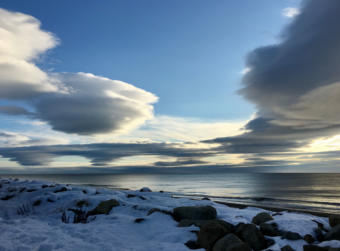
Bering Sea coastline near Nome, October 2017.
The Bering Sea coastline near Nome in October 2017. (Zoe Grueskin/KNOM)

Salmon abundance is down and population distributions have changed, according to NOAA’s 2021 surface trawl survey. Besides focusing on salmon, the survey also examined aspects of Bering Sea life such as zooplankton, sediment, sharks, marine birds, pacific herring, capelin and saffron cod.

Like the bottom trawl presentation on Zoom earlier in November, the top trawl presentation examined decreasing fish populations occurring in several Bering Strait species.

According to the survey’s preliminary estimates, young Yukon River chinook salmon populations continue to be low.

“Juvenile abundance was below average in 2021 and has been below average since 2017,” research biologist Jim Murphy said.

Besides lower populations, Murphy also noted the distribution of chinook salmon observed this year was unusual. While one typically finds chinook salmon distributed throughout the Bering Sea area, the area which NOAA typically surveys, most chinook salmon were found near Alaska’s shores.

Graphs on juvenile chinook salmon. (Courtesy of NOAA)

Like chinook salmon, Murphy’s team observed chum salmon almost exclusively near Alaska’s shores.
“And this is even more atypical for chum salmon as they tend to be much more broadly distributed than chinook salmon,” Murphy said.

Juvenile chum salmon populations have actually been above average since 2018, according to Murphy. 2021’s population is estimated to be one of the largest juvenile populations seen since then. A large juvenile fish population usually correlates with a large returning adult population.

But past observations, the correlation between adult and juvenile chum salmon tends to be more variable than the relationship between juvenile and adults in other fish species, Murphy said.

To illustrate, he pointed out that there was a large population of juvenile chum salmon in 2016 but a significantly low adult population. Murphy and his team postulated that this is because chum salmon are dying at greater rates later in their lifecycle. That would explain the great decline of chum salmon in the Yukon River, despite the high juvenile populations observed in the survey, Murphy said.

Pink salmon saw the same kind of low numbers and near-shore distribution during 2021. Murphy noted that his team combined pink salmon from Norton Sound and the Yukon River into the same graph because of their genetic similarity.

“With this model we are expecting to see low numbers of pink salmon returning to the region in 2022,” Murphy said.

In contrast, NOAA’s preliminary biomass index of coho salmon was close to the highest in the history of the survey. Hopefully, this means a strong run of coho in North Bering Sea salmon next year, Murphy said.

Besides salmon, multiple fish populations surveyed were found to be lower than average. These species include capelin, saffron cod, young pollock and cod and pacific herring.

In general, forage fish populations are low.

NOAA conducts both its bottom and surface trawl surveys annually to study the status of marine life in the Bering Sea.

Wrecked trawler breaks up and spills thousands of gallons of diesel off Sitkalidak Island

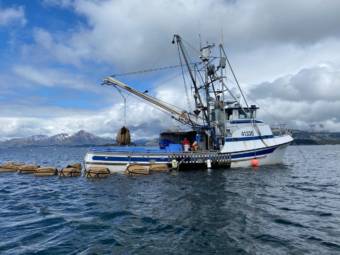
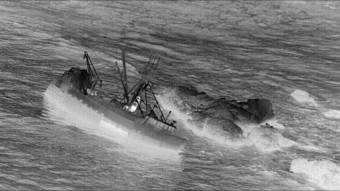
A Coast Guard C-130 Hercules aircraft forward-looking infrared camera captures fishing vessel Laura aground near Black Rock in Kodiak, Alaska, Nov. 1, 2021. The vessel had run aground and the crew abandoned the ship in life rafts. (U.S. Coast Guard photo by Air Station Kodiak)

A 93-foot fishing trawler has reportedly broken into pieces and spilled thousands of gallons of diesel, days after ending up on the rocks off Sitkalidak Island near Black Point. That’s according to a Tuesday update from the Alaska Department of Environmental Conservation’s spill response team that’s been monitoring the situation.

No one was hurt when the fishing vessel Laura ran aground the morning of Nov. 1. All four crew members were picked up by the U.S. Coast Guard, and an 8-month old puppy named Grace was rescued 36 hours later.

It’s not known exactly when the Kodiak-based vessel broke up, but nearby residents in Old Harbor traveled to the beach nearest to Black Point to clean up and salvage debris. They also recovered several five-gallon buckets of oil, the DEC said.

State environmental officials say the 3,000 gallons of diesel and several hundred gallons of lubricants won’t have a significant environmental impact. Salvage efforts to recover fishing gear and debris are being coordinated by state responders.

The trawler is owned by Kodiak commercial fisherman Michael O’Callaghan, who is listed as the potential responsible party.

After more than 30 years at sea, a message in a bottle washes up in Dyea

Pam Joy and her message in a bottle on the Dyea Flats. (Mike Swasey/KHNS)

A Skagway resident has found a message in a bottle washed up on a beach with no indication of who sent it — or from where. Now she’s looking for help to find its sender.

The beach at the Dyea Flats sits at the northernmost tip of the Inside Passage. Once a Gold Rush boomtown, Dyea is now home to a few dozen residents and a recreational area managed by the Skagway Borough.

On the beach, among a pile of washed-up logs, branches and general flotsam, Dyea resident Pam Joy stumbled across one of those special finds that beachcombers always hope to discover. A message in a bottle.

The message Pam Joy found in a bottle washed up on the Dyea flats. (courtesy of Pam Joy)

“I was walking along the flats, like I always do. Picking up trash, like I always do. And I saw this bottle peeking out, and I picked it up and was just about ready to chuck it in my bag. And I saw there was a piece of paper in it,” Joy said. “It said Happy New Year 1987!”

The tides had been over 20 feet a couple of days before, with winds gusting 40 mph. Joy thinks it was the combination of the two that may have dislodged the bottle from wherever it had been resting.

“I’m amazed that it had been in the water this long and not been broken,” Joy said. “Maybe it really hasn’t traveled very far. Or maybe it came from Australia. Who knows? Who knows?”

The bottle is clear glass with a beige plastic screw-on top. The safety seal is still attached.

“The only other clue I have is that there’s a Rite in the Rain logo at the bottom of the piece of paper. And it’s in a liquor bottle. So, you know, New Year’s Eve, I’m sure there was alcohol involved in this event,” Joy said.

Rite in the Rain paper has been around for over a century. This piece has been ripped out of a small spiral notebook with the spiral at the top of the page. The message was written in black ink.

It definitely looks like an adult. It’s kind of like cursive writing,” Joy said.

But the sender of this message in a bottle didn’t include any other information.

I really wish that I had some way to identify who it was or how far it’s come and where it came from. I would like to be able to let the person know who wrote this that I found it where I found it,” Joy said.

She posted a photo of the bottle on social media and asked friends to share, but she hasn’t had any luck tracking down the sender.

I grew up in Maine and spent lots of time on the beach. And I even worked on a fishing boat in Maine, hauling traps and hauling up things out of the bottom of the ocean,” Joy said. “Many, many years on the beach. And this is the first message in the bottle I’ve ever found, so I’m very excited.”

Joy says that unless she miraculously figures out who sent the message, she’ll add it to her collection in her home in Dyea.

If you have information about this message in a bottle, please email news@khns.org.

A beluga from the Beaufort Sea has traveled unusually far south, to Washington State

A beluga whale from the Beaufort Sea photographed in Puget Sound earlier in October, 2021. (Photo from NOAA Fisheries, World Vets under MMHSRP 18786-05)

A beluga whale found unusually far south in Puget Sound earlier this month is believed to have come from a pod in the Beaufort Sea. NOAA Fisheries made the announcement this week based on genetic material they were able to analyze from the beluga.

In the first week of October, the Seattle Times reported a single beluga whale had been sighted in multiple places across Puget Sound — something that hasn’t been seen in the area since the 1940s.

NOAA Fisheries says the whale appears to have swum thousands of miles south from Arctic waters in the Beaufort Sea. Scientists do not believe the beluga came from the smaller Cook Inlet population.

NOAA Fisheries did not say what might have caused the beluga to wander so far south on its own. However, beluga whales are known to sometimes roam beyond their normal area in Arctic waters.

Dr. Kim Parsons, a research scientist with NOAA Fisheries, said they used genetic analysis of DNA taken from a water sample in the Puget Sound near where the beluga was located. This material is referred to as environmental DNA.

“The information that we can obtain from eDNA is more limited than what we can generate from a tissue sample, but can provide insight about where the whale is likely from,” Parsons said.

Scientists determined that the DNA sequence from the beluga matches other beluga whales found in the Beaufort Sea and Arctic waters. This population usually migrates between Alaska, Canada and Russia.

The far-flung beluga was last sighted on Oct. 20 near Tacoma, Washington, according to NOAA Fisheries. The West Coast Marine Mammal Stranding Network will respond if this whale is identified as stranded.

Scientists have documented an increase in harmful algal blooms in northern waters

A bloom of algae discolors a swath of Gastineau Channel just north of the Douglas Bridge on Monday, July 30, 2018.
A bloom of algae discolors a swath of Gastineau Channel just north of the Douglas Bridge in Juneau on Monday, July 30, 2018. Scientists have documented an increase in harmful algal blooms in the northern Bering and Chukchi Seas. (Jeremy Hsieh/KTOO)

Scientists have documented an increase in harmful algal blooms in the northern Bering and Chukchi Seas. The blooms carry toxins, but scientists aren’t sure what effect they will have on marine mammals.

“We don’t know yet if toxin levels in Arctic food webs are reaching high enough concentrations to cause health impacts in marine mammals in that (the Arctic) region,” Don Anderson said.

Anderson, a senior scientist with Woods Hole Oceanographic Institute, or WHOI, has been studying algal cysts in the Bering and Chukchi Seas for several years. He presented his data and the work of other researchers in the region during a Strait Science virtual event hosted by the University of Alaska Fairbanks Northwest Campus on Oct. 14.

Map of harmful algal blooms in the Northern Bering and Chukchi Seas. (courtesy of Don Anderson/WHOI)

Not all types of algal blooms are harmful, Anderson pointed out. In fact, there are thousands of them spread across the world’s oceans. But in the Northern Bering and Chukchi Seas, there is a growing presence of Alexandrium cysts, an algal bloom that creates harmful saxitoxin.

The previously accepted explanation for how they got this far north is called the “trail of death” hypothesis, Anderson said.

“That (says) it’s being carried from the south in these relatively warm surface waters, and that it would form cysts in the Chukchi region that fall to bottom sediments where the temperatures would be too cold to support significant germination,” Anderson said. “I call that cyst seed bed a sleeping giant.”

Since bottom water temperatures have been warming drastically across the Northern Bering and Chukchi Seas over the last few years, cysts are now growing locally in Arctic waters. In other words, the sleeping giant has awoken.

“So what you’ve got then is a dramatic increase in the potential for what we would say is local initiation of blooms. In other words, not just transport, but blooms that are starting, inoculated from that region, from those two Ledyard Bay and Barrow cysts’ seed beds,” Anderson stated.

Ocean currents shown on a map in the Northern Bering and Chukchi Seas. (courtesy of Don Anderson/WHOI)

Recently, the United States Geological Survey concluded that the recurring seabird die-offs seen in the Bering Strait region are not related to harmful algal blooms. USGS scientists did however find low levels of toxins in many species of birds they sampled.

Since 2016, low levels of biotoxins have been documented in all different types of marine mammals, seabirds and various fish species in the Bering Sea, Anderson pointed out.

Even so, Anderson said eating various forage fish or salmon in the region still poses low risk to human health.

“Based on current understanding of these toxins in many other parts of the world, we think that muscle and blubber are not likely to accumulate saxitoxin in levels that pose a human health hazard. These tissues haven’t been fully tested, but there are reasons to believe they’re not going to accumulate toxin,” Anderson said.

This baseline is based on the only metric that exists from the FDA regarding safe food consumption of shellfish. It determines the level at which clams or other shellfish become too toxic to eat and then could cause paralytic shellfish poisoning. However it is not the best way to gauge how high algal toxins can be in marine mammals before causing harm to humans who eat them, Anderson said.

Alaska Marine mammals map showing toxin levels found in various species, from Kathi Lefebvre’s 2016 report on algal toxins in Alaskan waters, used with permission. (courtesy of Kathi Lefebvre)

While Anderson believes the health risk for Bering Strait subsistence users is quite low, he still emphasized using caution and safe practices as usual when eating shellfish or marine mammals. He also highlighted the fact that other parts of the world are living with the same conditions.

“Many regions of the world face similar risks and yet are able to maintain healthy communities and ecosystems. But it’s done through good management, good communication, and through understanding what the threats are,” Anderson said.

Overall, as cysts spread and cause more harmful algal blooms, there is an increasing potential for them to impact human health and ecosystem health in Northern Alaskan waters.

One observation from Edgar Ningeulook cited in 2013 pointed to an algal bloom near a historical place called Ipnauraq.

“This was the location of a red tide that at one time caused many deaths. And it doesn’t say how, what were they eating? I note that this is a place where there is a lot of fishing going on, especially for herring, one of those forage fish that I was talking about. So was it herring that was eaten, was it clams, who knows. But notice its location, it’s in that pathway of the transported blooms from the south. So long ago there was that threat and it got to the point where many people died,” Anderson said.

Research in the Chukchi Sea is ongoing. Anderson’s team will be partnering with scientists on the Russian side of the Strait in 2022 to get the full scope of what other changes are happening in the Bering Sea ecosystem.

Scientists are still following whales that swam through the Exxon Valdez oil spill

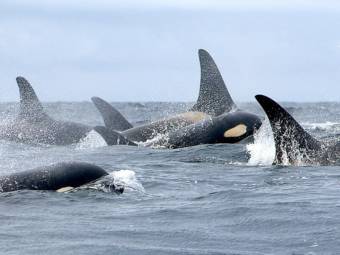
The Chugach Transients have not had a calf since the Exxon Valdez Oil Spill in 1989. And scientists aren’t exactly sure why. (courtesy of Dan Olsen/North Gulf Oceanic Society)

Scientists in Homer and Seward have spent the last several decades tracking a population of mammal-eating killer whales called the Chugach Transients in the Gulf of Alaska.

There used to be 22 whales in the pod. But the year after they swam through the Exxon Valdez oil spill in 1989, nine members died. Others went missing.

“And now there are seven of them remaining,” said Dan Olsen, a field biologist with the Homer-based North Gulf Oceanic Society.

Olsen and his team have been keeping track of all seven members of the Chugach Transient pod as they age. Late this summer, researchers were still waiting for a glimpse of the seventh transient — a 46-year-old lone male named Egagutak.

“It wasn’t until late in the season that one of the local tour companies here in Seward sent us a photograph, and we were able to confirm that this male was still alive,” Olsen said. “He’s 46 years old now, so we may not have him much longer. Males often live to be 45 to 50 years old. So every year that goes by, we’re crossing our fingers that he’s still alive.”

The North Gulf Oceanic Society identifies the transients photographically. It also tracks them acoustically because pods have distinct calls.

Olsen recorded that lone male’s call in 2019:

He said the distinct call is one call he’s hearing less and less as the population of whales dwindles.

The Chugach Transients have not had a calf since the oil spill, over 30 years ago. Olsen said scientists are not exactly sure why.

Other populations of killer whales are doing well. But two pods that swam through the spill are not.

“It’s difficult to know why, if the oil spill reduced their prey abundance such that they weren’t able to have enough nutrition to continue to have offspring, or if the contaminants directly impacted their reproductive systems,” he said. “But regardless, we’re seeing a population that is going extinct.”

Olsen said it’s important to keep tracking the whales because it helps researchers track the entire ecosystem.

“Killer whales are an apex predator and often are indicators of the health of the entire ecosystem,” he said. “And changes in their population, changes in their body condition, their body health, can help alert us to issues that we’re seeing in the ecosystems.”

The North Gulf Oceanic Society has been around since the 1980s and is based in Homer.

Historically, it has relied on funding from the Exxon Valdez Oil Spill Trustee Council, the group tasked with spending the $900 million civil settlement from the Exxon Valdez oil spill. This year, Olsen said, the council decided it will not continue funding the group’s research going forward.

Site notifications
Update notification options
Subscribe to notifications