Oceans

Marine debris is washing up again on Bering Strait shores

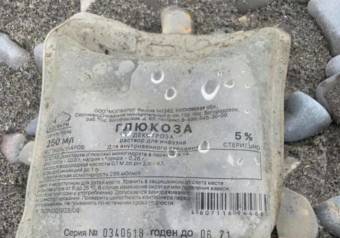
An IV bag with Russian labelling lying on a beach
A Russian IV drip bag found washed up on the beach in Shishmaref in September, 2021. (Courtesy of Tim Nayokpuk)

For the second year in a row, Bering Strait residents are finding foreign debris on their shores — and they’re still looking for the source.

The first reported piece of trash, one of numerous plastics with Russian and Korean writing, appeared in mid-August.

Last year, community members found well over 300 pieces of trash. This year, only 17 have been reported so far. Even this seemingly small amount is a serious cause for concern, according to Austin Ahmasuk, Kawerak’s marine advocate.

“Well, this year, again, it’s just the tip of the iceberg. So we don’t know, again, none of us are being funded to do this. So we don’t know how extensive this year’s debris event is,” Ahmasuk said.

Ahmasuk and Gay Sheffield with UAF and Alaska Sea Grant received the foreign debris reports. Sheffield said that the condition of the debris is a cause for concern.

“It’s very pristine, it’s not weathered. The 17 or so items that have come in look like they just came right off the shelf … The little flimsy plastic thing is still there. The pictures are still on, clear as can be, not even faded, not even scratched. They’re just pristine containers for the most part,” Sheffield said.

That “off-the-shelf” look implies that these pieces of trash were dumped recently and close to the shore.
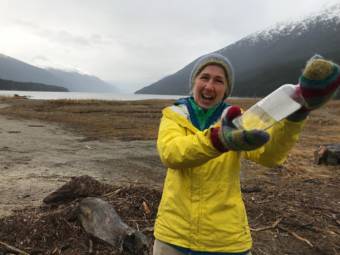
Among the food and fishing debris, Sheffield said someone found the first instance of medical waste.

“And then the most unusual, which we have not seen before, was a pristine IV drip bag,” Sheffield said. “And it had Russian writing that it had a 5% glucose solution. That’s medical waste. That’s a whole other category. And that’s a whole other concern.”

Under the MARPOL Convention, it is illegal for vessels to dump garbage in the sea. Because the trash is being dumped from foreign vessels, it can be difficult to pinpoint exactly where and from whom the trash is coming. Getting in touch with foreign entities requires help from federal agencies.

a shampoo bottle with Russian labeling lying on a piece of driftwood
An empty body wash container found on the beach in Shishmaref in September, 2021. (courtesy of Tim Nayokpuk)

Peter Murphy, an affiliate with NOAA’s Marine Debris Program, said that NOAA has made contact with international entities, and an official report on the debris event will come out this fall.

However, Ahmasuk felt that NOAA’s response was not enough.

“NOAA handled the situation now really hands off. They received reports from us. They undertook an internal review of the information that we supplied,” Ahmasuk said. “But in terms of collaboration, we will call it true collaboration or partnership, there was much to be desired.”

Murphy explained that NOAA recognizes the disappointment and the effort locals have made in responding to the event.

“We certainly understand that people are frustrated,” Murphy said. “Most funding vehicles for marine debris work through grants that have long lead times. And there aren’t dedicated resources like funding or assets, you know, people equipment, boats, that sort of thing to deploy when there’s an influx of debris. And this event really illustrated a lot of those challenges.”

Ahmasuk echoed those challenges, emphasizing that without federal funding and resources, foreign debris could very well continue to collect in western Alaska.

“What we really needed was action from the federal agencies to get funding or resources to reimburse us for time or, in the case of this year, funding should have been in place so that we can pay our people to clean up our beaches. Because no one else is going to clean our beaches except us,” Ahmasuk said.

Ahmasuk praised residents who collected garbage all across the region and reported it to him and Sheffield.

“The better question is, ‘Who responded to this event?’ And that was us, we did it on our own. And again, I’m tremendously thankful for all the people who were just merely going to camp, living our subsistence lifestyle. And coincidentally, we reported our findings, findings that were terrible, illegally dumped trash, which impacted our environment, impacted our lifestyle and of course, impacted our habitat,” Ahmasuk said.

Climate change is causing problems for puffins

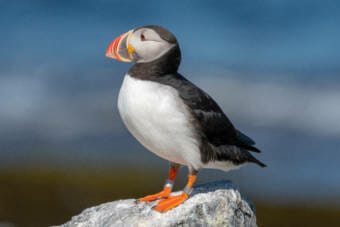
A puffin on Eastern Egg Rock. (Brian Bechard/Maine Public)

Maine’s population of rare Atlantic puffins took a hit this year, as the number of chicks to survive a tough summer plummeted.

The state’s coastal bays and the Gulf of Maine is among the fastest-warming large water bodies on the planet, making the puffins’ fate a test-case for how climate change could disrupt marine ecosystems worldwide.

The little clown-colored birds are abundant in Canada, but in the U.S. they were hunted to near extirpation by the early 1900s. Scientists and volunteers later helped them to re-establish several island colonies off Maine, where they now number around 3,000.

Over the last decade, though, a series of “marine heatwaves” and intense storms upended their living conditions. This year was one of the worst yet, and the number of puffin chicks to live through the season plunged.

“In some cases it was significantly worse than we’ve seen in the past,” said Linda Welch, a biologist with the U.S. Fish and Wildlife Service.

On one offshore island she watched closely, Petit Manan, Welch said 90% of the nesting puffins failed to raise a chick.

“Many of the chicks that we classified as fledging, reaching the age where they leave their burrow and go to sea, the birds were kind of 40% to 50% smaller than we normally see,” she said. “We were calling them ‘micro-puffins.’ ”

A camouflaged puffin egg in a nest. (Brian Bechard/Maine Public)

The birds faced a complex of challenges; nests were flooded by some of the heaviest rains in a hundred years, exposing chicks to cold and predators. That was especially hard on another rare bird that nests in the open, Arctic tern. But it was tough for young puffins, too, who were being reared in burrows within the jumbled boulders that line the island’s shores.

And their parents had a hard time finding herring and other North Atlantic prey they usually dive for, which scientists think may have retreated to cooler waters too deep or far-off for the birds.

The adult puffins ranged farther than usual in a foraging commute that scientists say limited their time to keep chicks warm in their nests.

They did find and bring to the nests a lot of butterfish, a more southerly species that’s been showing up in force in the Gulf of Maine in heatwave years. The thing is, butterfish are too big for young puffins to swallow.

On Petit Manan, Welch saw some heartbreaking things that repeated similarly tragic outcomes several years ago.

“There was a puffin chick that had reached the age where it should have been able to leave its burrow,” she said. “It was fully feathered. It was dead in the burrow and there were probably ten or 12 carcasses of butterfish surrounding it.”

Other ecosystem dislocations are emerging in the Gulf of Maine. New research suggests, for instance, that a big incursion of voracious squid during an extended heatwave was decisive in the collapse of a prized shrimp fishery.

Endangered North Atlantic right whales are ranging far from their traditional haunts in search of their favorite food, a tiny crustacean whose abundance in the Gulf is varying in response to changing temperatures and currents.

Formerly itinerant black sea-bass are starting to stick around all year, and spawning; they fetch a good price at market, and could present a new opportunity for Maine fishermen. And juvenile sea bass might even become a new food source for other species, such as, puffin chicks.

The director of the National Audubon Society’s Seabird Institute, Don Lyons, says puffins provide a unique window on global-warming, on how even small shifts in the range or timing of any one species’ occurrence can influence the fate of many others.

Puffins on Eastern Egg Rock. (Brian Bechard/Maine Public)

“Working with puffins in Maine, we’re seeing the harbingers of climate change every day,” he said. “I tend to think of puffins as a bunch of researchers. They’re going out and sampling our marine ecosystem all summer, many times a day. And the way we learn from them is watching what fish they bring back and how well they are able to raise chicks. … They’re really telling us to be concerned, you know, to pay attention.”

Lyons says that with good management of herring and other fisheries that the puffins depend on, the birds should be able to hang on.

Puffins can live up to 30 years, he notes, providing some resilience against a bad year. He adds, though, that their future in Maine may depend on just how often those bad years keep rolling in.

Copyright 2021 Maine Public. To see more, visit Maine Public.

A massive oil spill in the Pacific Ocean has reached the Southern California coast

Oil is seen on the beach in Huntington Beach, California on October 3, 2021, after a pipeline breach connected to an oil rig off shore started leaking oil, according to an Orange County Supervisor. (Patrick T. Fallon/AFP via Getty Images)

More than 120,000 gallons of oil that spilled into the Pacific Ocean has reached the Southern California coastline, closing parts of the beach as officials warn residents to stay away from the slick.

Federal, state and local agencies are racing to determine the cause of the spill, which is at least 13 square miles in size, and mitigate its impacts.

“The ramifications will extend further than the visible oil and odor that our residents are dealing with at the moment. The impact to the environment is irreversible,” Orange County Supervisor Katrina Foley said in a statement on Saturday.

“We must identify the cause of today’s spill, and for the greater good of our cities, beaches, and coastal ecological habitat we need to understand how to prevent these incidences moving forward,” she added.

The cause of the spill remains under investigation, the U.S. Coast Guard said on Saturday. It announced that it was working with the California Department of Fish and Wildlife’s Office of Spill Prevention and Response, local agencies and Beta Offshore, an oil production company, on the response.

Foley said the spill came from the oil rig Platform Elly, which Beta operates about 8.6 miles from land. Amplify Energy, Beta’s parent company, did not immediately respond to a request for comment.

Coastal communities respond to the spill

The city of Huntington Beach reported “substantial ecological impacts” on its beach and wetlands from the spill, and urged residents to steer clear of the area “due to the toxicity of the spill.” Local officials closed part of the ocean and cancelled the third and final day of the Pacific Airshow to facilitate clean-up efforts and to protect the health of attendees.

The nearby city of Newport Beach said on Saturday that it was it bracing for oil to come ashore as well.

Boats helping clean up an oil spill are seen from the shore in Huntington Beach, California on October 3, 2021, after a pipeline breach connected to an oil rig off shore started leaking oil, according to an Orange County Supervisor. (Patrick T. Fallon/AFP via Getty Images)

According to the Coast Guard, trained spill response contractors were working to clean up the slick and public volunteers were not needed.

Ecological damage has been reported

The damage caused by the spill could be substantial, public officials and environmental advocates said.

“The hundred-thousand of gallons of oil that spilled into the ocean near Huntington Beach provide a stark and dark reminder that oil is dirty, dangerous, and can make our air and water too toxic for life,” Laura Deehan, state director of Environment California, said in a statement.

“The oil from the spill has already washed up onto Huntington Beach and the Talbert Marsh wetlands, an area that’s home to vibrant birdlife, including great blue herons, pelicans and endangered California least terns, which migrate up the Pacific Coast. The coast is also the habitat for myriad non-avian marine life, from fish that we eat, such as tuna and sea bass, to sea turtles, dolphins and whales,” Deehan added. “This spill threatens all of them.”

Foley tweeted early Sunday morning officials had already started to find dead birds and fish in the wake of the oil slick.

She added that she had spoken with Newport Beach Mayor Brad Avery, who told her that while he was returning on his boat he saw dolphins swimming through the oil.

“It sounds worse than the information slowly trickling in,” Foley said.

California officials encouraged residents not to approach “oiled wildlife” but rather to report any animals impacted by the spill to the Oiled Wildlife Care Network by calling 1-877-823-6926.

Copyright 2021 NPR. To see more, visit https://www.npr.org.

Navy training and testing in Southeast Alaska will stay at similar levels for the next 7 years

Fast attack submarine USS Los Angeles (SSN 688) is moored at the Southeast Alaska Acoustic Measurement Facility Static Site in Ketchikan, Alaska, as part of Escape Exercise 2006. “First and Finest,” Los Angeles was the first nuclear-powered U.S. submarine to conduct an open ocean escape. U.S. Navy photo by Mass Communication Specialist 1st Class Cynthia Clark
Fast attack submarine USS Los Angeles (SSN 688) moored at the Southeast Alaska Acoustic Measurement Facility Static Site in Ketchikan. (U.S. Navy photo by Mass Communication Specialist 1st Class Cynthia Clark)

The U.S. Navy says its operations in Southeast Alaska won’t increase over the next seven years. It announced on Oct. 1 that it will continue training and equipment testing in the Northwest Testing and Training Area — which includes Southeast Alaska — under what it calls its “preferred alternative.”

In Southeast Alaska, that mostly consists of measuring the sound signature of submarines at the Southeast Alaska Acoustic Measurement Facility (SEAFAC) in the Behm Canal near Ketchikan.

The Navy says it won’t be testing any weapons in Southeast Alaska waters and only proposes one or two sonar tests per year at SEAFAC.

NOAA Fisheries granted a final permit for the Navy to conduct its training activities last November. The permit authorizes the possible impact the Navy might have on marine life over the next seven years of training and testing.

In Alaska, the permit includes permission to behaviorally harass marine mammals more than 16,000 times throughout the next seven years.

Under the Marine Mammal Protection Act, the Navy must submit an environmental impact statement for its Northwest Training and Testing Area. The statement includes projected impacts to marine life and some mitigation efforts. The Navy released the final supplement to its EIS last September.

The federal agencies tasked with protecting marine mammals then evaluate the EIS and approve a permit for harm. The Navy is not allowed to physically harm or kill any marine mammals in Southeast Alaska over the next seven years, but it is permitted thousands of what it calls behavioral disturbances. That can include disruption to feeding, interactions or travel from place to place.

The Navy’s calculation of its disturbance to marine mammals and other ocean-dwellers is theoretical. It does not keep track of actual harm done to animals during training exercises, instead using the number of training and testing activities as a tool to estimate marine impacts.

Environmental groups have expressed concern that the Navy does not do enough to mitigate its impact on marine life — from larger marine mammals like whales and porpoises down to fish populations and zooplankton.

Marine geology expedition takes research ship Sikuliaq farther north than it’s ever been

(Photo courtesy Mark Teckenbrock/University of Alaska)
The R/V Sikuliaq, owned by the National Science Foundation and operated by the University of Alaska Fairbanks. (courtesy of Mark Teckenbrock/University of Alaska)

The research ship Sikuliaq is wrapping up a marine geology expedition this week. The nearly 2-month long journey took the ice capable ship — which is owned by the National Science Foundation and operated bu the University of Alaska Fairbanks — over 500 miles north of Utqiagvik.

That’s the farthest north the Sikuliaq ever been.

“Where we were up in the northern Chukchi, we were breaking new ground,” said UAF Geophysical Institute professor Bernard Coakley, speaking from the Sikuliaq by satellite phone.

Coakley and colleagues have used an array of technology to survey the ocean floor of the Canada Basin and adjacent Chukchi Borderlands. Coakley says the features they observed included channels in the sea bottom.

“Where the gouges are parallel, we call them mega-scale glacial lineations,” he said. “They’re evidence that a continental glacier once scraped across the top.”

Coakley says other features, like random plow marks made by icebergs and piles of sediment created by now inactive faults, can help us better understand the ocean area’s formation. 

“I like to say we’ve been working backwards in the Arctic, where we stand on the edges and make our observations, and then we say ‘well, therefore, the ocean is this,’” Coakley said. “But I think the real answer to the question of how the ocean formed is to be found by looking at the features.”

Coakley says surveying the seafloor has practical implications for things like mineral exploration and defining the extent of U.S. territory in the Arctic, but there’s also the pure intellectual pursuit.

“We want to know, we want to understand. That’s what drives me,” he said.

Coakley and fellow UAF researchers are scheduled to disembark from the Sikuliaq in Nome and be back in Fairbanks this week.

Pollock fishery may be cause of decline in Bering Sea fur seals, study says

The number of northern fur seals in the Bering Sea has dropped by around 70% since the 1970s.

Fur seals are an essential subsistence food for the Unangax̂ communities in the Bering Sea’s Pribilof Islands. But for years, scientists have been unable to explain why the seals’ populations have been falling.

Now, a new study points its finger at an industry that’s long been suspected, but never definitively linked with the population declines: Alaska’s huge commercial pollock fishery, which harvests the same species that nursing female seals rely on to feed their pups.

Jeffrey Short is the lead author of a study published in the Journal of Marine Science and Engineering on Sept. 9, which he says presents for the first time clear evidence linking the pollock fishery with fur seal reductions.

Some scientists have suspected the pollock fishery, but evidence-based research linking the two has been scarce. According to Short, that’s because much of the existing literature has focused on the overall abundance of pollock, which is quite high.

By contrast, this new study focuses on the pollock catch — that is, the amount of fish being pulled out of the water.

“I was just astonished at how well it worked,” Short said. “Just that single number of pollock catch can explain nearly all of the [fur seal] population trajectory since about the mid-1970s.”

The team found evidence to suggest that the pollock industry, by breaking up the dense schools of fish the mothers rely on while fattening their pups, has made it harder for lactating fur seals to feed their young.

“What a female lactating fur seal wants to do is find a dense aggregation of food right next to where her pups are,” Short said. “So she can spend the minimum amount of energy to go find it, sit on top of it and eat to her heart’s content, and then swim right back and nurse her pups and repeat that all summer long.”

But commercial fishing boats also seek dense schools of fish. By fishing those schools, the fleets break them up, and the fish disperse. Which means the mother seal can’t fatten up her pups as quickly as she once could.

That’s a problem because the pups swim south in the fall. If they haven’t built up enough reserves, those seal pups likely won’t survive their first year.

And that, according to this study, is why fur seal populations are declining so steeply.

The number of northern fur seals in the Bering Sea has dropped by around 70% since the 1970s.

“I think it’s possible for the fur seal herd to eventually go extinct or become extirpated off the Pribilof Islands,” Short said.

The fur seal rookeries in the Bering Sea hold special importance to the Unangax̂ communities in the Pribilof and Aleutian Islands which rely on fur seals for subsistence.

Martin Stepetin grew up on St. Paul Island — the most populated of the Pribilof Islands — but now lives in Juneau where he advocates for Alaska Native rights.

“We eat those seals, so it gets scary,” Stepetin said. “If you’re trying to support your family, and you’re trying to put food in the refrigerator, you worry about the future. What about your kids? How much food is there going to be whenever your kids come of age? Are they going to be able to support their families?”

The study suggests that to make any real changes, the fishery — which is one of the most lucrative in the United States — would likely need to limit pollock catch to around a million tons in the areas surrounding the Pribilof Islands. That’s nearly a quarter of the total 1.375 million tons currently allowed.

One pollock industry booster, Stephanie Madsen, said she’s worried about a one-size-fits-all solution.

“It would be devastating to just have a blunt tool. And that’s what I think this is. It’s a blunt tool,” said Madsen, executive director of an industry group that represents large factory trawlers, the At-sea Processors Association.

Madsen said she welcomes the paper into the growing body of research on the subject, but she said there needs to be more precise measures than simply limiting the total allowable catch. She also expressed skepticism that limiting catch would improve the seals’ fate.

“When you’re talking about drawing circles around rookeries, and preventing fishing from occurring in there, you’re making quite a few assumptions about the pollock staying inside that circle, that the fur seals aren’t going to go outside the circle,” Madsen said.

The pollock industry employs around 30,000 people nationwide. In the eastern Bering Sea and Gulf of Alaska, the fishery brought in around $420 million in 2020, according to the National Oceanic and Atmospheric Administration.

“Thousands of jobs and tens of thousands of families depend on that income,” Madsen said. “I think depending on the size of those circles, for the most part, it could be quite damaging to the pollock fishery’s ability to harvest our quota.”

Madsen said that while she is moderately concerned about the authors’ findings, she doesn’t anticipate they will lead to immediate changes in the industry.

The North Pacific Fishery Management Council, which manages fisheries in the region, receives updates on marine mammals at the beginning of each year.

“We have great science, we have rational thinking heads,” Madsen said. “And I think the North Pacific council will take this information [when] they get their annual marine mammal updates at their February council meeting.”

Site notifications
Update notification options
Subscribe to notifications